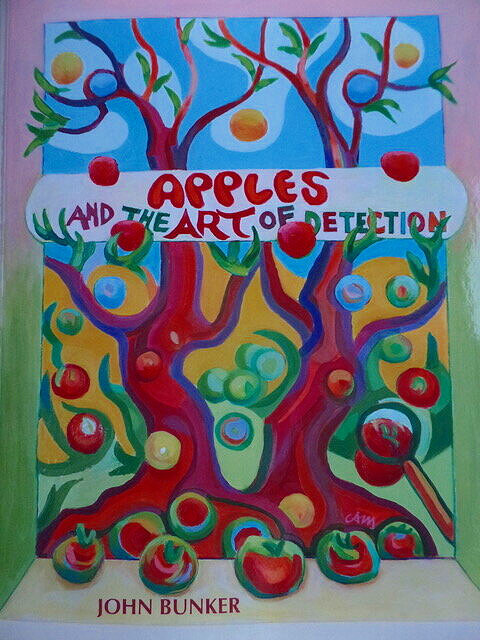
by John Bunker
Magnificent, ancient apple trees can still be found scattered throughout much of Maine. Look for them behind old barns, next to abandoned cellar holes, along roadsides nestled in thickets, sometimes even beside a gas station or a convenience store parking lot. The ancient apple trees of Maine were spreading their branches and producing bountiful crops even before Maine joined the Union two hundred years ago. They are the survivors, the ones who lived through the summer of 1816 when there was no summer; they are the ones who lived through half a dozen famously cold test winters, including the brutal 1933-34; they lived through the hurricane of 1938, the drought of 1947, not to mention waves of gypsy moth, browntail moth, scab, fireblight, decades of acid rain, polluted water and everything else. As we struggle to make sense of the COVID-19 pandemic, we might consider taking a look at these old apple trees. There’s a chance that everything we need to know about survival, these trees have known for millennia.
Here are a few tips gleaned from the trees themselves.
1. Don’t move. You don’t need to convince an old apple tree about the value of “shelter in place.” They’ve been perfectly content to stand in one spot for two hundred years. They’re well aware that everything you need in life is right here at home. They know that everything you need to learn you can learn wherever you are. If you’re willing to stay put, as the old jazz standard says, “you’ll see your castles in Spain, through your windowpane, back in your own backyard.” As Ram Dass liked to say, “Be here now.” Or as Gary Snyder put it, “Don’t move.”
2. Build community. The old apple trees are masters at creating community right where they are. They understand the value of deep roots. They are the ultimate collaborators. They know well the folly of competition. They share everything. They hoard nothing. Often I’ll come across one of these old trees with “perfect” looking fruit. It looks like it came from the grocery store cooler. Never sprayed, never pruned, never fertilized, living in a tangle of grasses, goldenrod, yarrow, milkweed, elderberries, alders, even white pine. How do they do it? At first glance it looks like they’re living in chaos. But they’re not. They’ve created a community above and below ground with an organization so elegant and so complex that we humans may never understand it. It’s a balanced ecosystem. There they are living in harmony, sharing their fruit and everything else, feeding and healing one another, all the while communicating through their own solar-powered subterranean original version of the World Wide Web.
3. Waste not want not. You don’t need to tell an old apple tree about being conservative. They don’t need a pandemic to get that. Apple trees are the true conservatives. They conserve everything. They put the so-called human conservatives to shame. Give them a dot of land, a scratch of soil, a few drops of water, a breath of air and they will thrive. In times of drought, they simply slow down their growth; in times of plenty, they put on new wood and produce great crops of fruit. They’ve been living that way for hundreds of thousands of years. Not only that, surprisingly enough they don’t wreck the air and the water they use. They improve it and pass it along even cleaner than it was.
4. Eat local. To the old apple, the local food system is the secure food system. They have no desire to obtain food from away. They prefer the fresh produce they can get right here at home. It’s always available, it’s good for you, and it has no carbon footprint. They are the ultimate local food geeks. They also compost everything: leaves, twigs, branches, bark, even old logs, uneaten fruit and the occasional squirrel or deer carcass. Nothing gets flushed down the drain or dumped into the river. It all gets grown right here and eaten right here. They are the ultimate organic gardeners participating in the perfect secure food system.
5. Grace and flexibility. The old apple trees are the epitome of grace and flexibility. Give them a heavy, wet, spring snow storm or a massive crop of fruit and they just bend. There’s an old medieval saying, “The mo appelen the tree bereth the more she boweth to the folk.” We should all be practicing bowing these days. Bowing is far more graceful than shaking hands anyway. When the weight is too great, here and there the occasional branch gives way rather than taking down the whole tree. That’s just nature’s pruning. When a hungry bear or porcupine creates a mess up high, the tree sees it as a growth opportunity. The fallen branches and debris become compost and by next year you’ll find all this fresh young growth up in the tree where it recently looked like destruction. A few years later that young growth will translate into strong young branches and lots of fruit. When the weight is too great, the old trees simply lay down. Next summer one of the younger branches will rise to become a fresh new vertical trunk. The old stump eventually rots away but the tree lives on.
To the ancient apple tree, there’s nothing adverse about adversity. It’s just life. Would that we all could enjoy traveling less, enjoying our yards and our neighbors more, tending our gardens, eating local and expressing grace in everything we do. If you look closely, you might see the old apple trees smile as they watch us bicker endlessly about who’s right, who’s wrong and who’s to blame. To the old apple tree, all facts are neutral. Bickering only distracts us from healing life’s inevitable wounds with new wood. As we rebuild civilization after the pandemic tide goes out, perhaps we could all take a few hints from the old apple tree.
(To be published in Malus, Issue #9. For more information on Malus, visit WWW.MALUSZINE.COM)