September 21, 2025

Today in the orchard
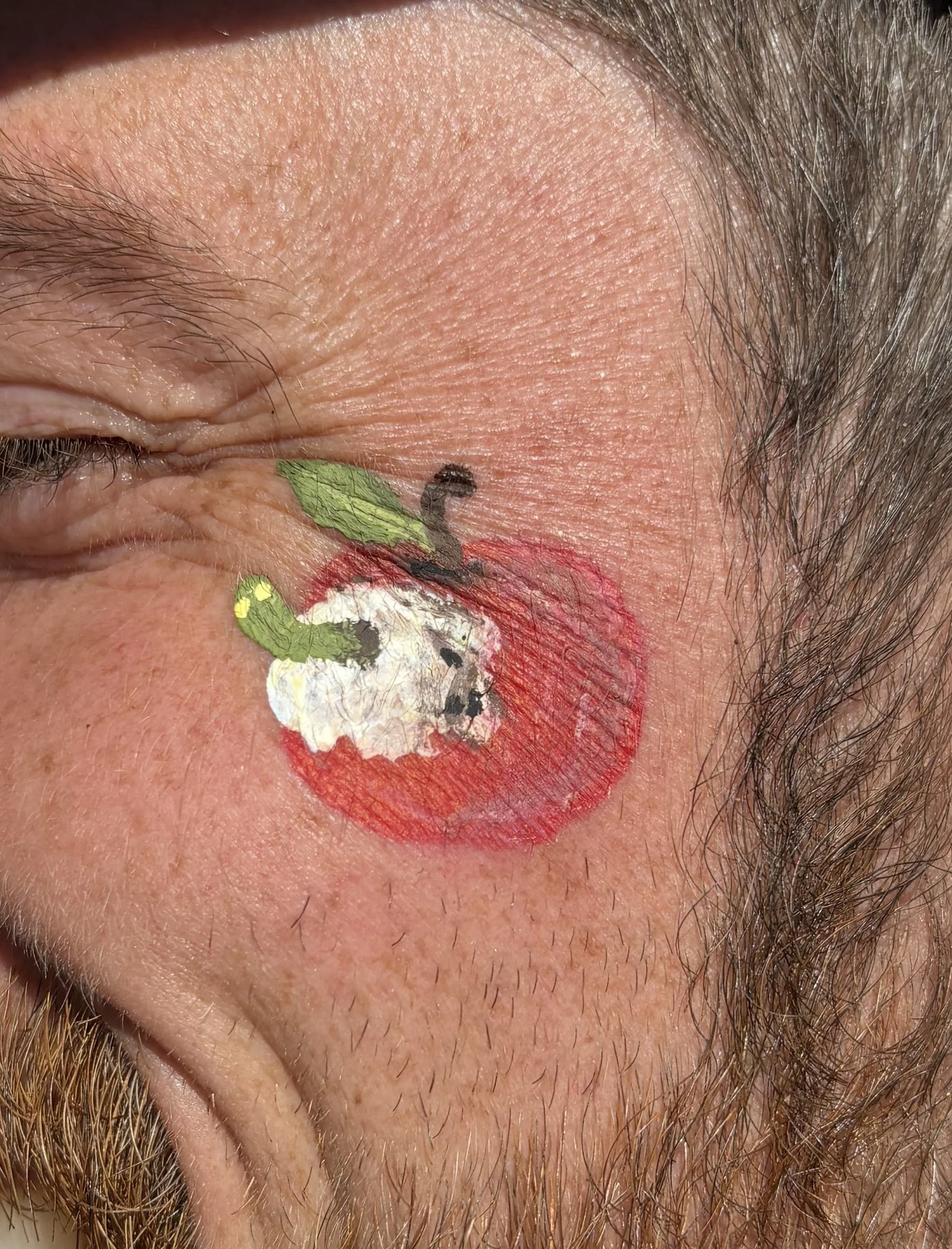
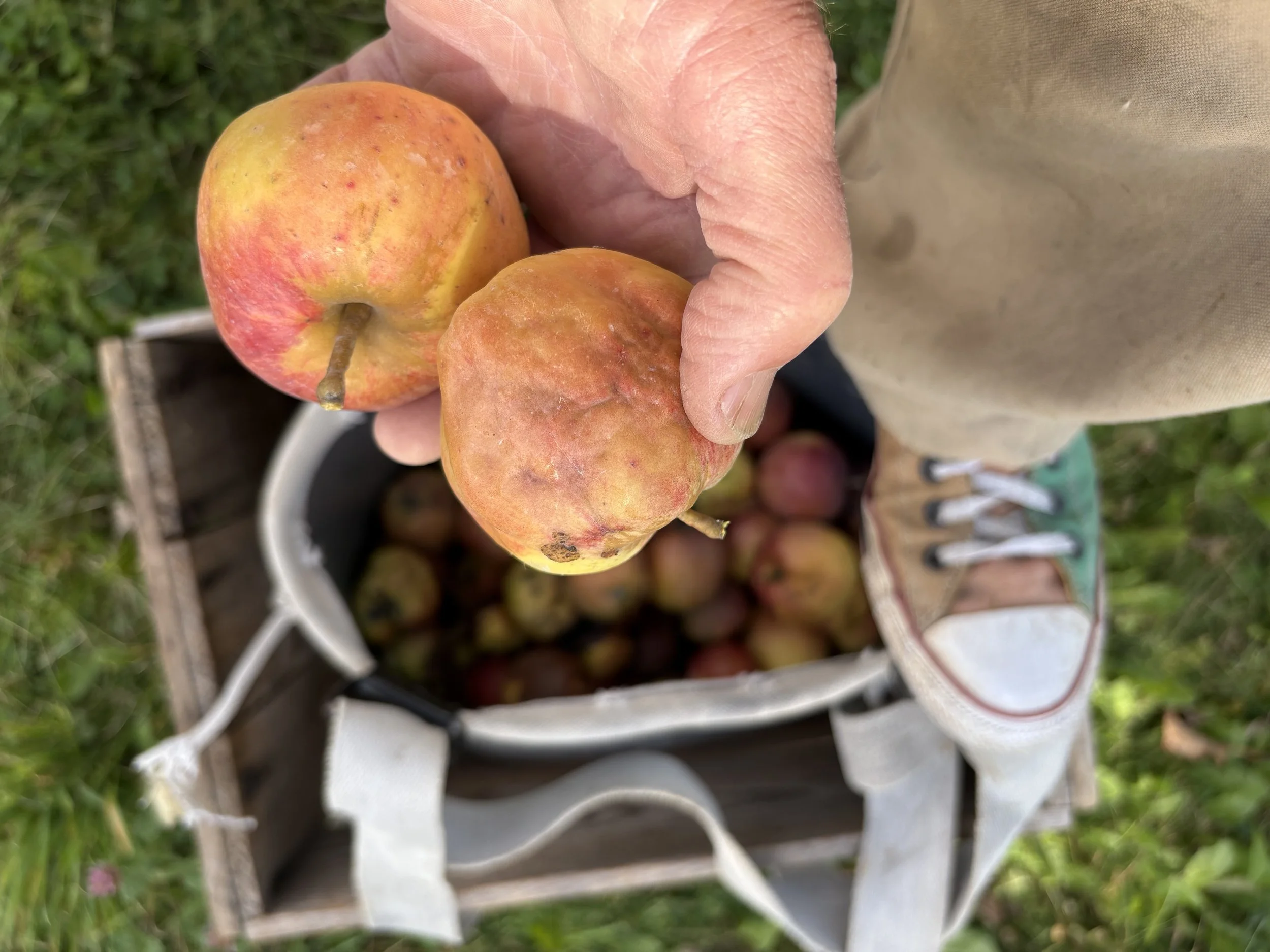
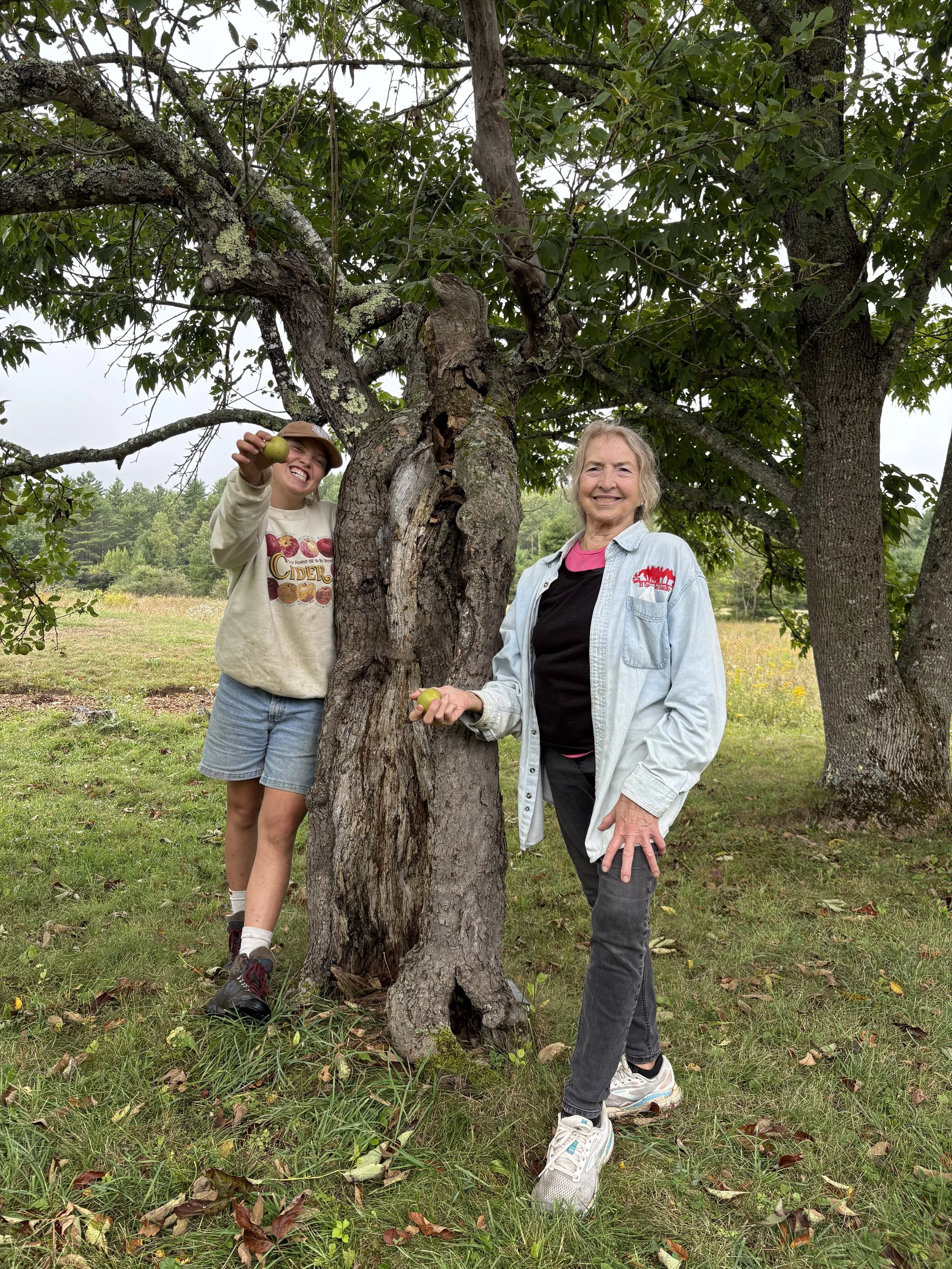
Worm or serpent?

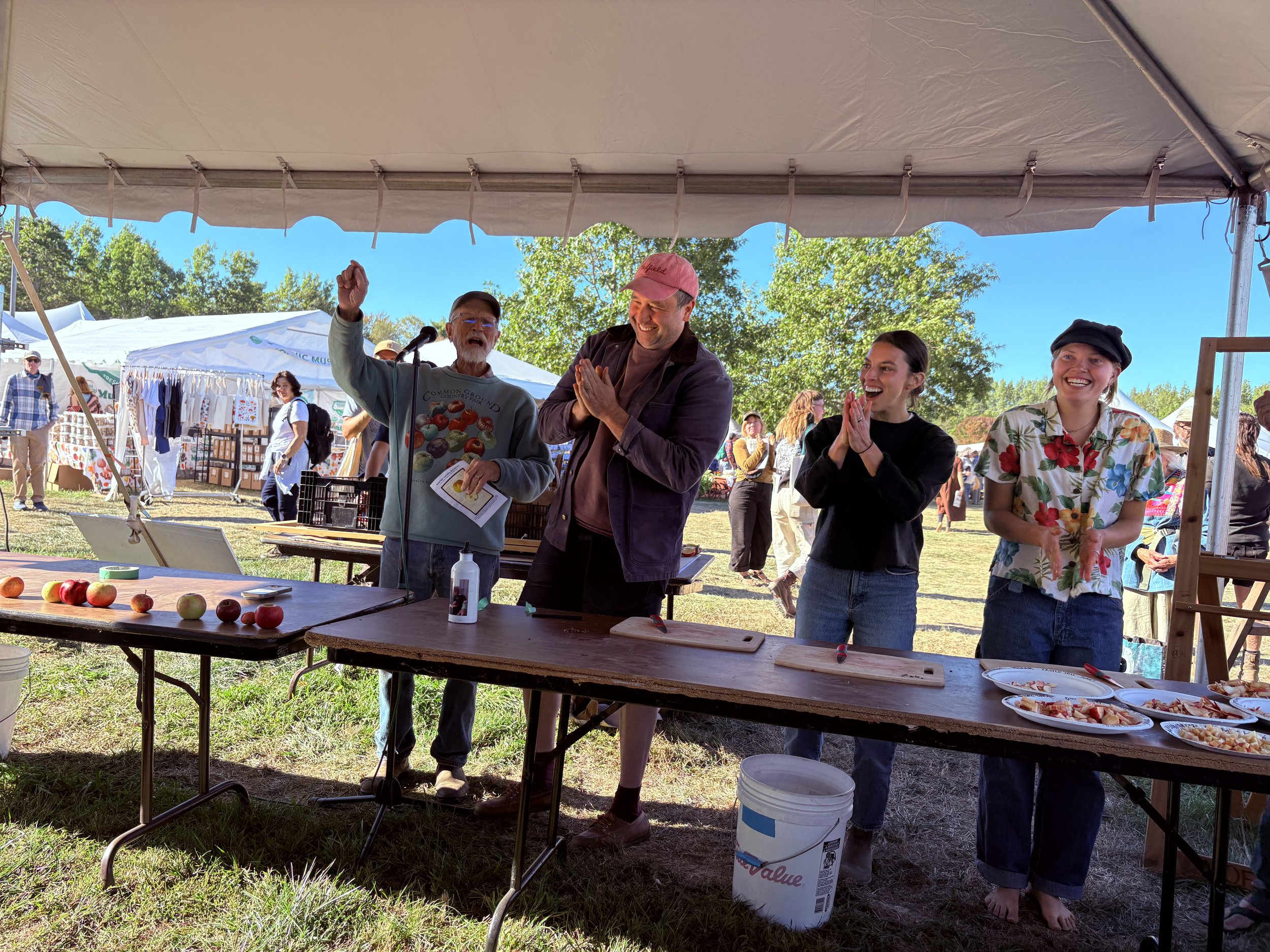
Last day at the Fair. It was another big crowd. There wasn’t an apple tasting, but Dave Fulton led the second of two smaller cider-apples tastings.  Dave is a UK-er living in Blue Hill who grows dozens of UK cider apple cultivars.  He’s a wealth of cider knowledge blended with a wonderful sense of humor. 

There were many highlights throughout the day. According to Lauren Cormier who works in the Maine Heritage Orchard and was selling fruit at the Fair, “a young kid came up holding the little crab from the display called Worth Every Penny and asked how much a whole bag would cost.”  “Worth Every Penny” is one of the seedlings we grow at SCF. It was discovered by Angus Dieghan and is a little bigger than a large highbush blueberry…about the size of a one cent piece. The flesh is rather nasty. We pressed several dollars worth two weeks ago and wound up with about a half pint of cider. We don’t know how much a bag-full would cost but we definitely know it would be worth it.

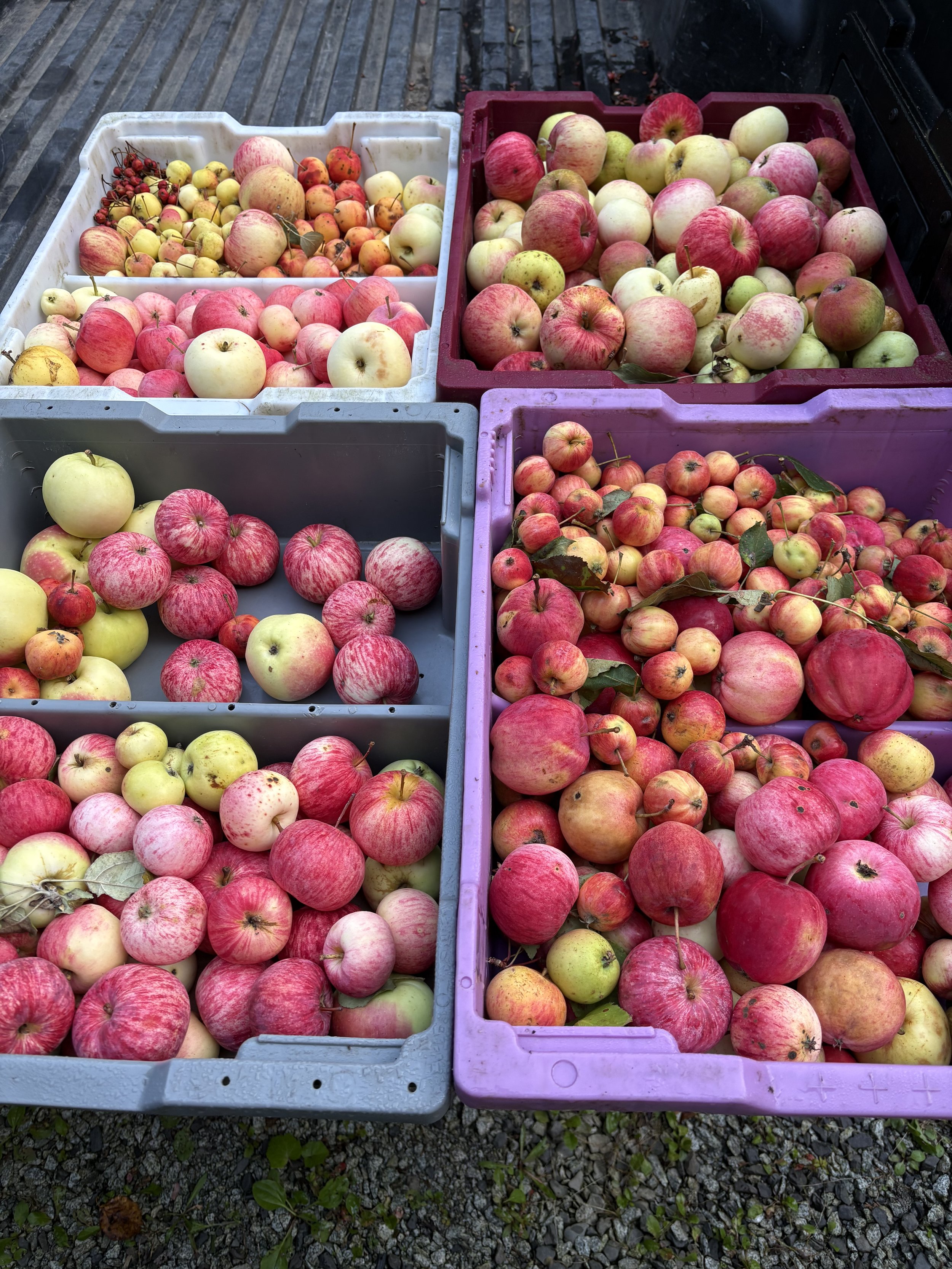
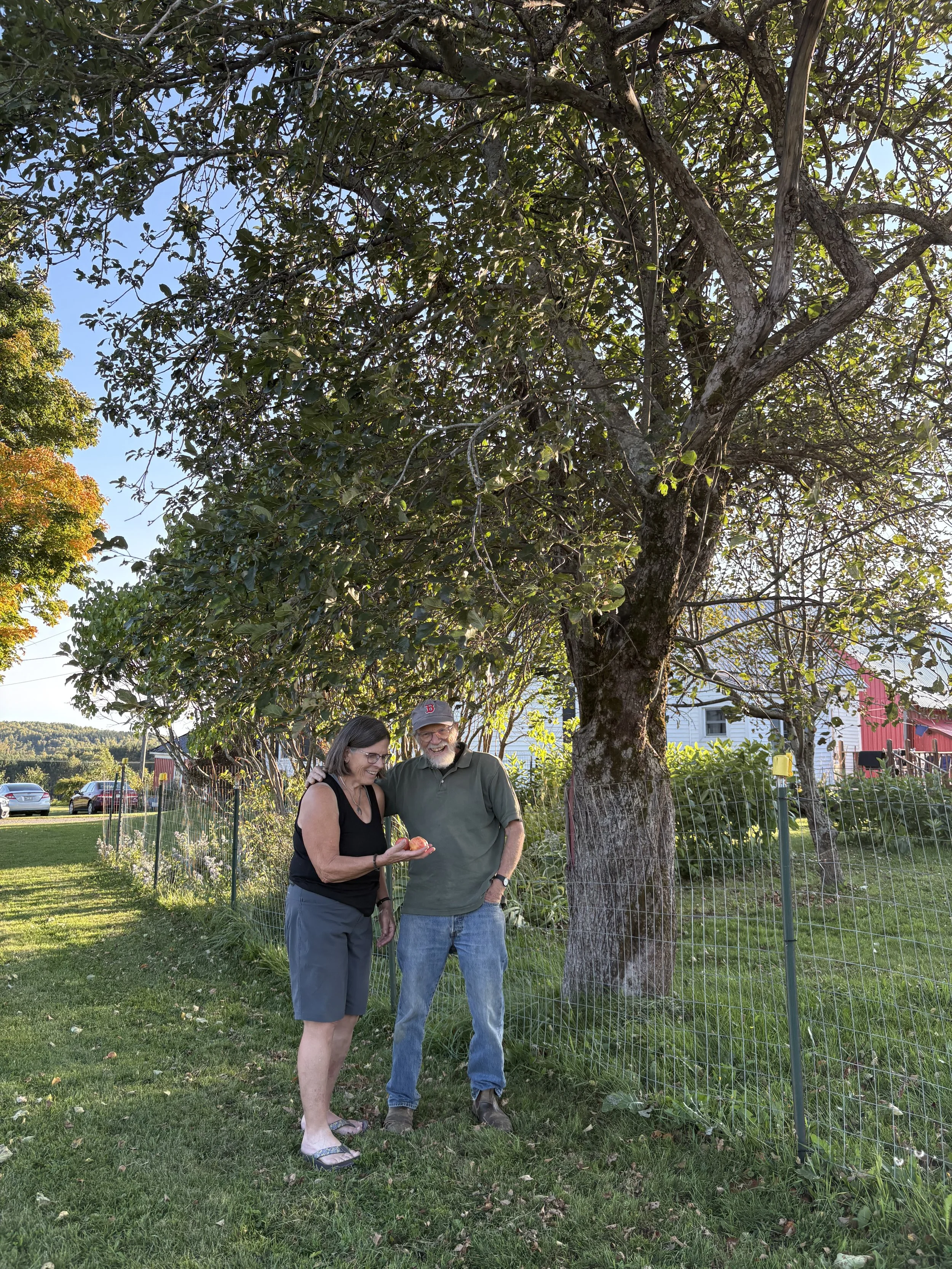
A few minutes before we closed up shop for another year, we were treated to what may turn out to be the most important find of the year. Several apples appeared from a possible second Drap d’or de Bretagne tree. The fruit is—at first glance—phenotypically exactly like the Verona tree. Apparently the tree is extremely old. We’ll check out fruit and tree this coming week. Thanks to everyone who came to visit us over the weekend. It was a great fair!  
September 20, 2025

Today in the orchard

And the winner is…

Second day of the Fair. There was a huge crowd, and the Hayloft “Apple Tent” was a busy place all day. Many fairgoers brought apples for us to identify. It’s amazing how many varieties there are out there that we just don’t know. Darn! Today was the second tasting of (mostly) Maine apples led by myself and Sean Turley.  The tasting attracted a large, enthusiastic crowd. As expected, Canadian Strawberry was a big favorite again today although the surprise winner was the largely unknown, bright-red-fleshed Winekist. 

Winekist was introduced in the 1949 Carl A. Hansen Nursery Co. catalog from Brookings, SD. Here is the description from page 20 of the catalog, reprinted in full:

 “A Carl A. Hansen Introduction First Time Offered. Clear red flesh from skin to core. Beautiful to look at and most delightful to eat. It has a sprightly sweet, most distinctive flavor. Makes the most beautiful looking and delicious tasting sauce, jam and jelly, the color of Port Wine. It is hardy far north into Canada. It produces big crops on very young trees. The fruit gets up to 3 inches in diameter, with an outside coloring of clear, dark red, sometimes overstriped with darker red.

VERY ORNAMENTAL

Because of the large red, fragrant flowers in spring, this new apple makes an outstanding ornamental tree for planting on your lawn or in your garden. In an orchard its striking red flowers are a sight to behold as they stand out amongst all the other trees. The tree is of a semi-dwarf type, and does not require as much space as most apples. The branches are strong forked and will bear well the large heavy crops of fruit.

The demand for trees of red fleshed apples is going to be tremendous and once they are sufficiently planted for the fruit to be sold on the market, it’s hard to say how enormous the demand will be. You can be sure that for many years the fruit will command premium prices. Those who get started with these new fruits now will reap rewards for years to come.”

September 19, 2025

Today in the orchard

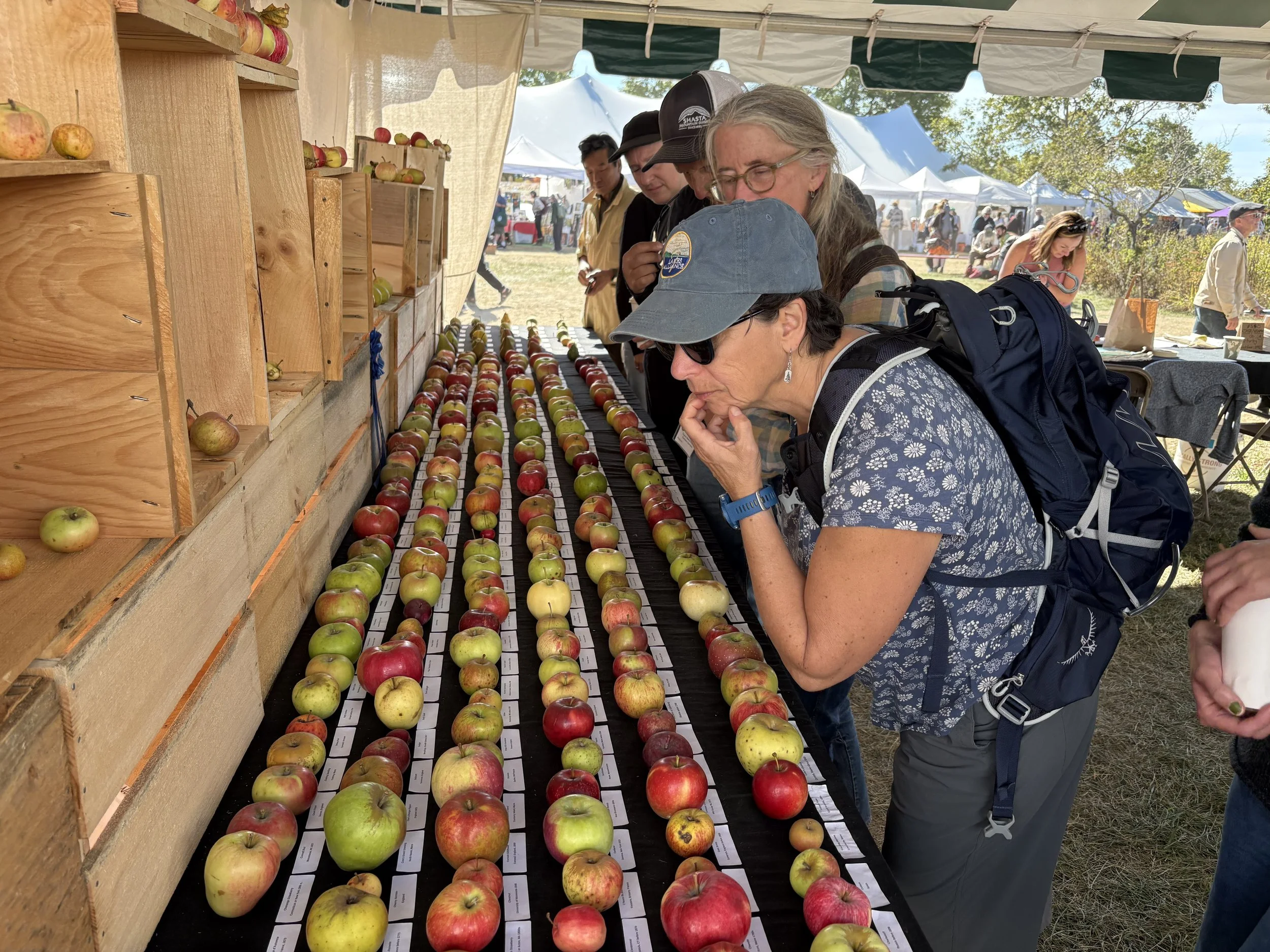
The 2025 Common Ground apple display

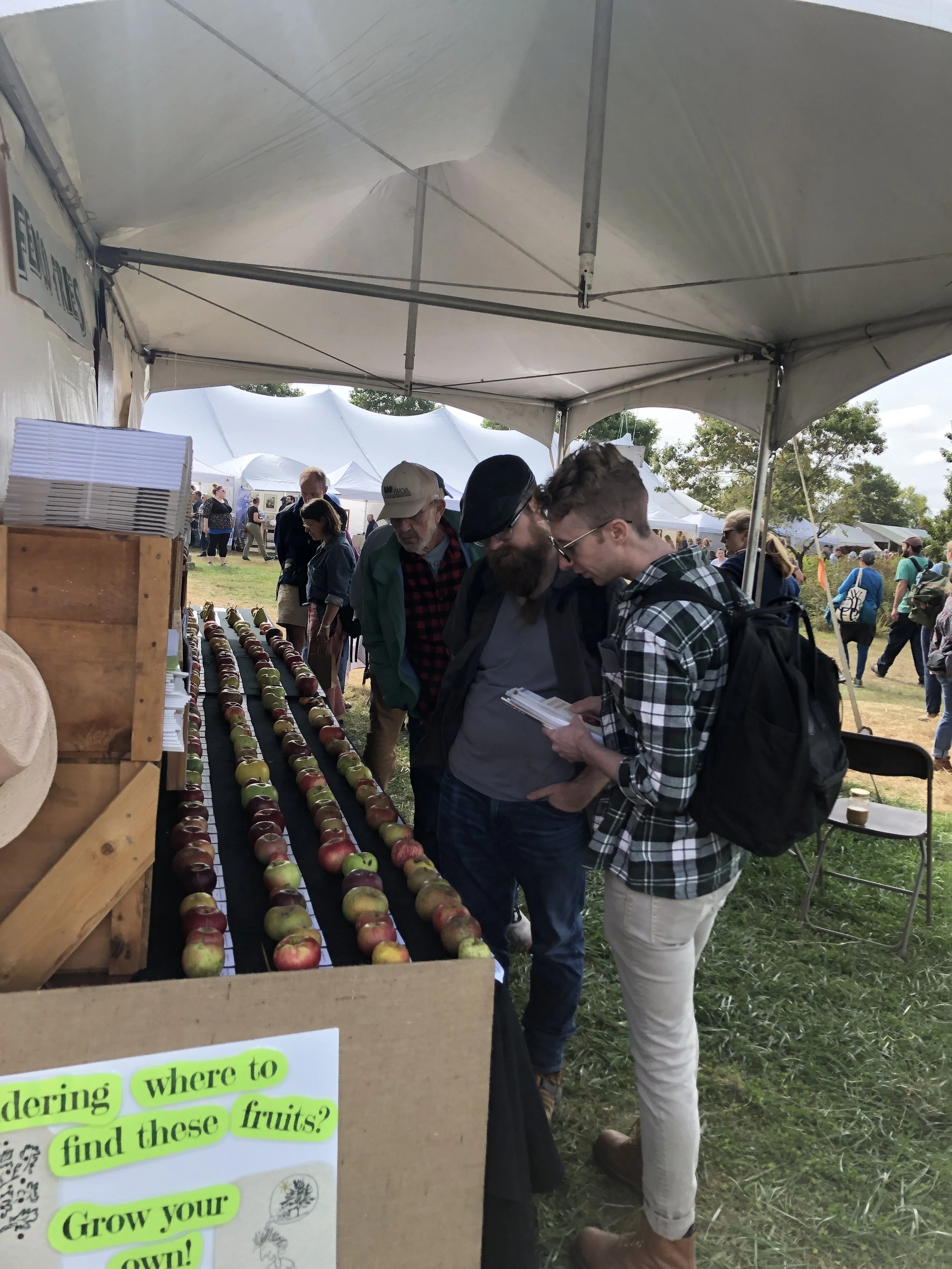
Today was the first day of MOFGA’s annual Common Ground Country Fair (aka THE Fair). It’s three days of agricultural displays, workshops, talks, demonstrations, speakers, crafts, organic food and, of course, apples. A bunch of us gather at the “Hayloft Tent” where we display a couple hundred apples and pears grown in Maine and talk to fairgoers about their apples. We attempt to identify their mysteries and geek out over the amazing diversity of fruit growing throughout the state. This year, we also sold fruit grown in the Maine Heritage Orchard. That was a first and a big hit.  

Among the highlights of the Fair (at least for apple lovers) are the apple tastings on Friday and Saturday afternoon. We cut up twelve varieties and pass them out to the crowd. Then everyone votes for their favorites. Although it’s entirely dependent on what’s ripe at the moment, it does give everyone a glimpse into some of the best dessert apples growing in Maine. It’s also a wild and fun event. Today we had a tie for first place: Canadian Strawberry and Garden Royal. In second was the modern European cultivar, Ingrid Marie. Rounding it off in third was St. Edmond’s Russet.     

September 18, 2025

Today in the orchard

Spent time puttering in the orchard we call the BRC. It’s the orchard where we allow all the various companion species to grow more or less unchecked.  It’s the location of some of our most coveted cultivars (varieties). The orchard is relatively close to the house and surrounded by a good fence. The chicken house and the duck house are both in the BRC. That means we go into the orchard at least twice a day to let the birds out in the morning and in at night. It’s a great motivator to get us out observing what’s happening in the orchard every day.

Trouble in the Henhouse

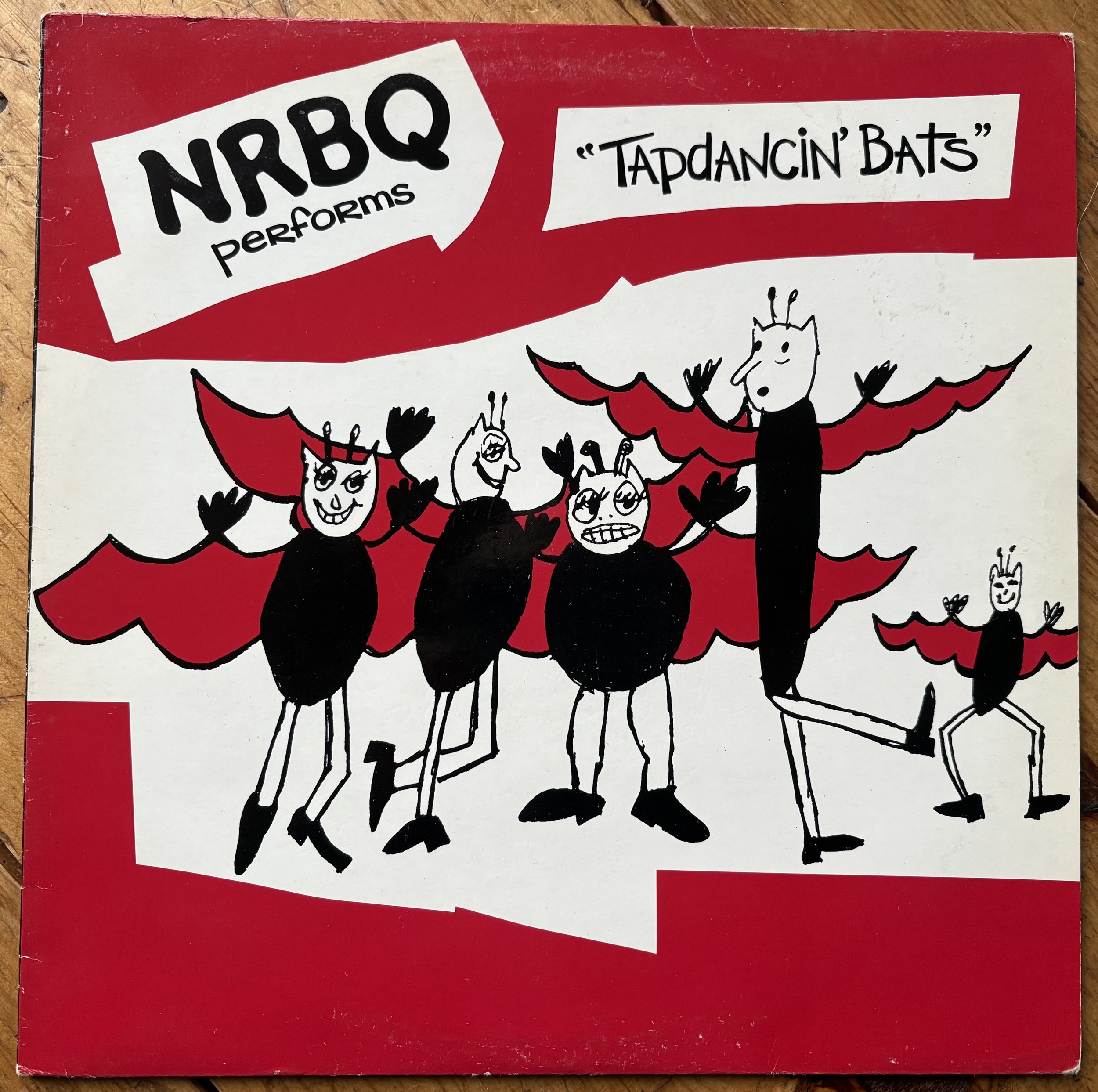
Occasionally, however, one of us gets distracted and doesn’t get out to close the birds in til well after dark. That can be a bummer, or almost a bummer, like tonight. I was heading to the coop a little after dark when I heard unmistakable trouble in the hen house. I stepped it up and bolted down the path past the Ribston Pippin (no crop this year), Black Oxford (lots of fruit), 447 (good crop), Rolfe (4 apples), Yellow Bellflower (excellent keeper), and Cherryfield (aka Benton Red aka Collins aka Salome) and got to the gate just in time to see a sizable and rather rotund raccoon racing off into the darkness. There were a lot of detached tail feathers lying around but no further damage. Looks like I arrived just in time!  Thankful, I clucked it all the way back to the house under the emerging stars humming NRBQ’s tune “Trouble in the Henhouse. (Check it out on Tapdancing Bats.)  Tomorrow I'll be on time.

September 17, 2025

Today in the orchard

I returned home from fruit exploring in Aroostook County and jumped back into picking. This afternoon I picked Screen Shot, Milwaukee, Payson Estate, and Snow (aka Fameuse). 

Milwaukee is a large oblate cooking apple that may have been historically grown in Maine. I’m trying to sort that out. Payson Estate is an odd-looking apple—probably a seedling—large size fruit with nearly no basin. We thought it could be a good cooking apple so we whipped up a galette with some leftover dough and a bag of Payson Estate drops. The apples in the opening at the top stayed chewy and even a bit crispy while those down deep in the galette got soft and almost sauce-like. Pretty perfect. Could have used a bit more sweetner. The original source tree is in Falmouth, ME and is huge. Fameuse is one of the most famous northern hardy dessert and sauce apples. 

Screen Shot, Sept 17, 2025

Screen Shot is one of my favorite seedling discoveries. It’s oddly-shaped and strangely-flavored. Just my type of apple. We could try to sell them, but I don’t think anyone would want them after a nibble or two (maybe one). The flesh is dense, spongy and juicy all at the same time, low in acid with some astringency and bitterness. It makes a very thick, tasty sauce. We need more apples like Screen Shot!  

September 16, 2025

Today in the orchard

Back on the home front Cammy picked Royal Jersey, Ivan and Blenheim Orange. The Royal Jerseys were mostly on the ground and should be pressed soon. Ivan is a small but exceptionally delicious fresh-eating fruit. It’s one of Niels Hansen’s best introductions. Blenheim is a large, famous, historic English dessert and cooking variety. 

Aroostook apple diversity, Sept 16, 2025

Meanwhile I spent the day fruit exploring with Laura and Sean west of Presque Isle. Our goal was to taste as many seedlings as we could in a single ten-hour period. I think we won the Guinness Book of World Record by a few hundred. My guess is we may have tasted 1,000 between the three of us. We found multiple forests of hundreds upon hundreds of seedling trees of every imaginable size, shape, color and flavor. It was incredible, fantastic and exhausting. Apples ranging from the size of Blueberries to the size of softballs. By about 3 PM my poor mouth was so overwhelmed, I could barely tell what it was I was eating. The colors of the fruit were absolutely electric against the blue September sky. Everywhere we looked there were more apple trees. Tree after tree after tree. Utterly amazing.  Among the hundreds we found several that we should name and graft. We had flagging tape that we discreetly tied onto the backsides of the trunks. We’ll come back this winter to collect scionwood. It was a truly fantastic day.

September 15, 2025

Today in the orchard

I headed to Maine’s northern Aroostook County to go fruit exploring with Laura Sieger and Sean Turley. Although it’s tough to leave the farm during September, I was pretty sure it would be worth the effort. The historic apples in “The County” are different from those down here in central Maine. Many are Duchess-related. The rugged, hardy Duchess (of Oldenburg) was planted throughout the area, and the descendants of those early plantings can still be found as selected cultivars and as massive seedling populations. It is a magical place for fruit-exploring.  

Pam Sweetser and the possible Hayford Sweet tree, Sept 15, 2025

We were immediately rewarded late this afternoon with two great visits. First we went east of Presque Isle to the farm of Wayne and Pam Sweetser. Their old door-yard tree may be the real Hayford Sweet. It is a true low-acid “sweet.” We then went to see an ancient grafted tree a few miles west of Presque Isle on the Parsons Road that must have had ten bushels on the ground. Fortunately many were still in decent enough shape for us to taste. That tree is an old variety—yet to be identified—that deserves to be added to the Maine Heritage Orchard. We took fruit to phenotype and leaves for a DNA profile. 

It was a productive and fun afternoon. Tomorrow we will visit the seedling forests. Thanks to the bears, there are tens of  thousands of seedlings spread over practically every available hillside field no longer in agricultural use.   

September 14, 2025

Today in the orchard

The Fair apple and pear display of 2024

Skylar and I spent the day going through all the orchards at the farm collecting specimens for the Common Ground Fair apple display this coming weekend. Our contributions will include some of the key “Maine” heirlooms that aren’t available elsewhere, as well as dozens of the rare varieties we have on trial. The display itself is one of the most popular features of the Fair. It’s a magnet that lures in hundreds of people all three days. It’s hard to resist. I and several of my fruit exploring comrades will be on hand at the “Hayloft Tent,” geeking out over the display, answering your apple questions and attempting to identify your apples. See you at the Fair!   

September 13, 2025

Today in the orchard

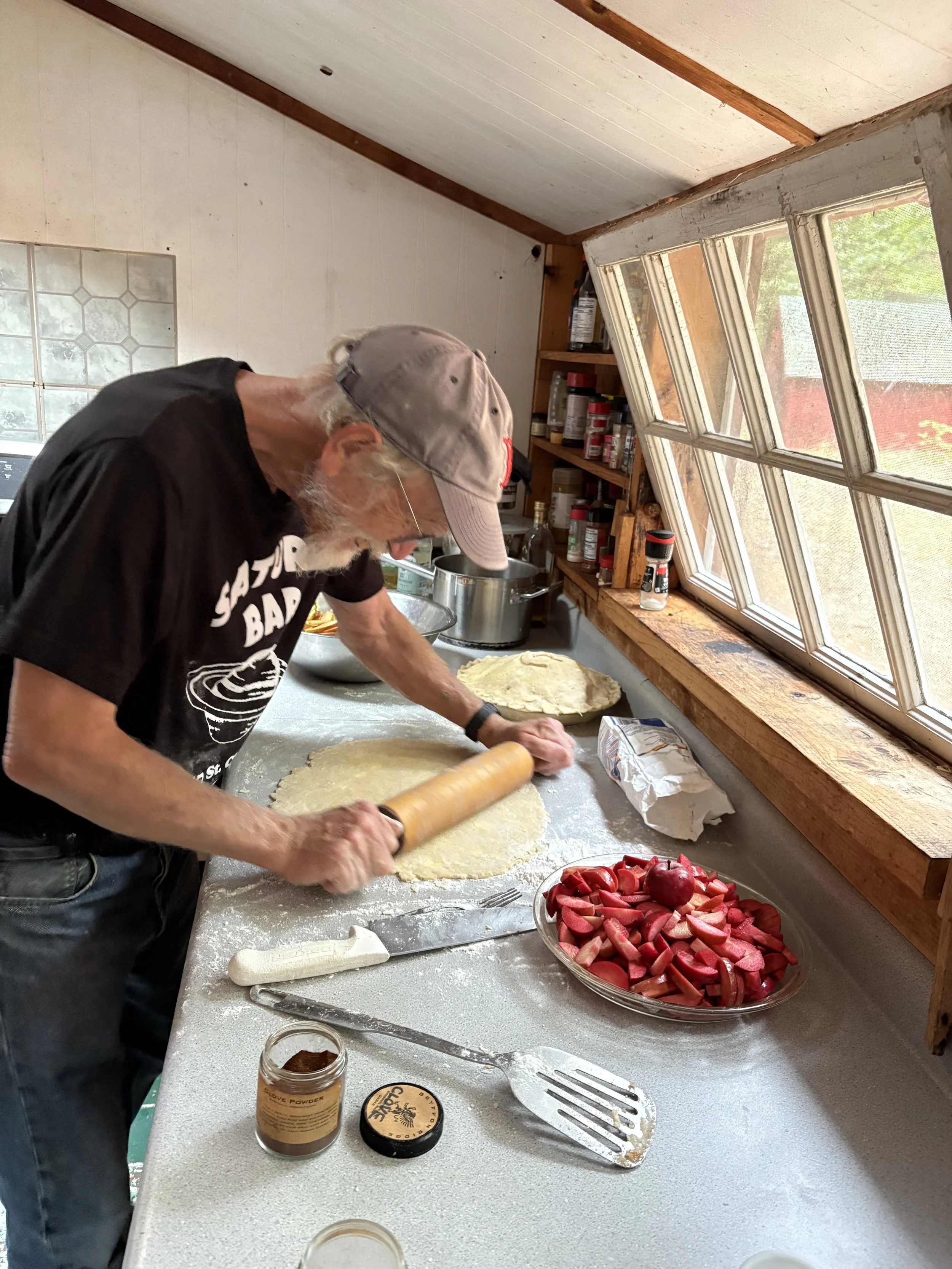
Today I woke up on the shores of Great Pond in Belgrade, ME. It’s the place I call the center of the Universe. (Move over, Sun.) It’s also the location of the Annual Belgrade Pie Taste-off, an event where we serve three specially curated, single-variety apple pies to a large group of friends who sample the entries and then vote on their favorites. It’s a wild and fun evening. You eat a thin slice of one pie and you think it’s an apple pie. You eat two and you notice, “Hey, these are different.” You eat three and a favorite inevitably emerges. All apples have different flavors and textures. Some won’t cook in an hour, the time it takes to bake the perfect crust. Others turn into soup (think Macs). Some have intense flavors while others lose their flavors. Some are great pie apples while others should never see an oven. Every variety is—of course—unique. 

Roll out the dough, Sept 13, 2025

I start early in the day making the three crusts right after breakfast. I leave them to chill for a few hours and then assemble the pies later in the afternoon. This year's three apples were Red China, Charlamoff and Somerset of Maine. Charlamoff and Somerset are both beautiful fruit on the table. The brightly-colored red-fleshed “Red China” was the most tart of the three apples before baking. It retained that tartness, but its flavors loved the oven. When the votes were tabulated, it was the resounding winner. Perhaps it was the intense red-color, or maybe it was the tart flavor. Whatever it was, the Belgrade taste-off crowd loved it. 

Red China is also becoming popular with sauce-makers. Look for it in your supermarket apple display sometime soon?

September 11, 2025

Today’s highlight was taking a trip over to the Maine Heritage Orchard at MOFGA in Unity to meet with an old friend and supporter who had not yet been able to see what we’ve accomplished in the past 12 years. The Maine Heritage Orchard is the location of our preservation orchard, now numbering close to 350 apple and pear trees all grown historically in Maine. These are cultivars (aka varieties) that we’ve rediscovered over the past forty years and deemed worth saving for present and future generations. 

New Sharon, Maine, September 2025

“MHO” as we call it has been the ultimate in collective cooperation and group effort. It’s a great example of the fun adage, “Teamwork makes the dream work.” It’s taken hundreds of people around Maine and beyond to make it happen. We have our two-person team of orchard managers—the ones who keep the trees and hundreds of companion plants alive. (Without them, none of this would happen.) We have the other MOFGA staff who wear many hats but who support the orchard whenever they can. We have the volunteer historians, explorers and data-base freaks who follow leads for new MHO candidates, attempt to identify rare discoveries, document the huge amount of information we gather and connect with other collectors, academics and scientists across the USA and over seas who are all collaborating in this amazing effort to sort out the history of apple around the world and make this treasure available to future generations. Lastly (but not at all least) we have dozens upon dozens of individuals who have led us to old trees and supported the project with their time and donations. It’s fantastic.  

Want to be involved? Keep a look-out for old apple trees everywhere you go. You’ll never know when the next lead just might appear.

September 7, 2025

Today in the orchard

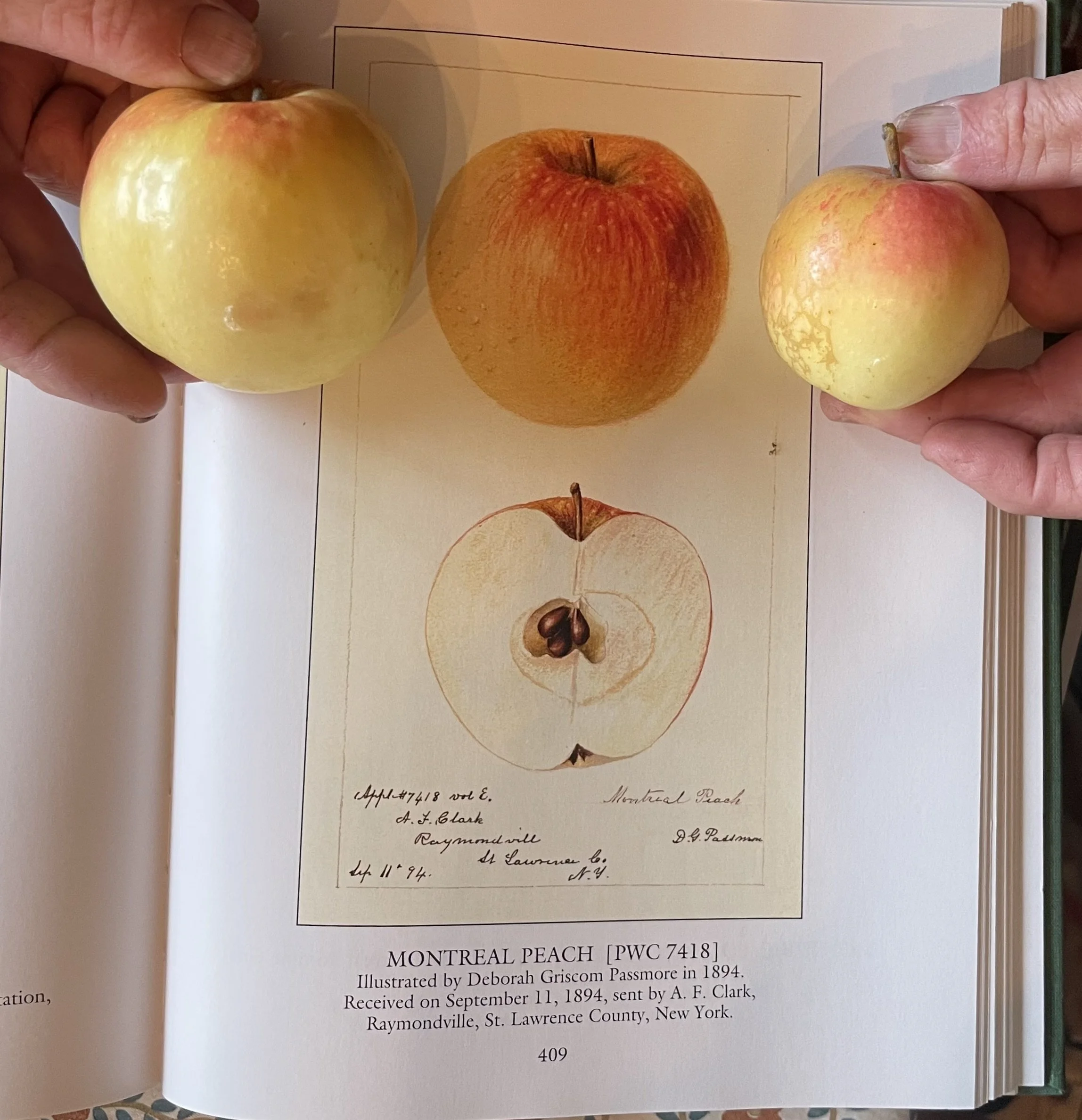
Our Peach of Montreal and the 1894 USDA watercolor, Sept 7, 2025

Last night we were blessed with about an inch and a half of rain.  At times it was coming down quite powerfully, especially early in the evening. Today the much-needed rain continued off and on. We spent most of the day indoors attempting to solve apple-identification mysteries. Skylar took on the apple we’ve been calling Peach of Montreal (aka Montreal Peach). It was given to me as scionwood about fifteen years ago by Josh Karp of Cate Hill Orchard in Greensboro, VT having been identified for Josh by old-timers in the area. A recent DNA profile threw that ID into question, suggesting it was Iowa Beauty, not Peach of Montreal. After several hours of slicing up and examining fruit and reading Bussey’s History of North American Apples, we are certain that we do have the correct POM after all. 

There are any number of things that could have led to what is an apparent mix-up somewhere along the way. I will now resubmit leaves that might have been mixed up in the DNA testing. I will also look at the apple that became the original DNA submission for the reference panel to which our leaves were eventually compared. That tree is in Iowa, and hopefully I can get apples from it this fall.

The solving of apple ID mysteries is incredibly time-consuming and, some might say, tedious, but for the right geek it is fun and rewarding when you sort out something like we were able to do today.  Meanwhile, the rain came to an end, and the world began to dry out. Tomorrow we’ll be back outside in the orchards.

September 5, 2025

Today in the orchard

Carol Gillette and the Tozette Russet, Sept 5, 2025

In the morning we hosted a small apple sauce tasting party with our visiting friends. We tried five different single-variety sauces. No clear winner although Red China did produce an electric-rose-pink sauce that could be described as a visual grand slam. We then packed apples to sell at “Apples Jubilee!” tomorrow in Cushing at the Langlais Art Preserve in Cushing where I will give a talk. Later we visited two ancient, nearby trees—the Parmenter Russet and the Tozette Russet—where we collected fruit for Cushing. Both trees have been DNA profiled. Parmenter is GR1, the famous Golden Russet of Western New York. Tozette remains unidentified. For now we call it GR2 and have been working on an ID. For now it remains a top-priority mystery.

We have found other ancient GR2 trees in several midcoast Maine locations. GR2 is also in the parentage of the possible Bourassa and the possible Union Pippin, both ancient trees themselves. We have not found GR2 outside the state, suggesting it may be a locally selected seedling. After reviewing Z.A. Gilbert’s 1896 article, “The Russets of Maine”, I think there is a possibility that GR2 is a “Faux-English Russet” that was being grown in Waldo County (the general location of all the GR2’s). Gilbert writes, “An apple has been grown under the name of English Russet to a considerable extent in western Penobscot county and was also frequently found a few years ago in Waldo county… It is emphatically distinct from the English Russet of the books…”  Gilbert includes a brief phenotypic description of the apple which generally fits GR2. We will do a deeper dive into the apple later this fall when the fruit is ripe and report our findings.

September 4, 2025

Today in the orchard

Somerset of Maine, Sept 4, 2025

We were back in the orchards picking today - Somerset of Maine, Red St. Lawrence and Hung Hai Tung. Somerset of Maine is a large, rusty red, pie apple that originated in Somerset County. The fruit is beautiful.. SOM is sometimes confused with the apple, Thompson, also from Somerset County. (You can read more about that saga in Chapter 9 of Apples and the Art of Detection). 

Red St. Lawrence is a red sport of the famous, historic, Canadian all-purpose cultivar that was discovered in Newburgh, ME. The contrast of the bright red stripes and the dull red ground color is more than amazing. Both the sport and the original St. Lawrence are cooking apples of outstanding quality. 

Lastly, Hung Hai Tung is a selection of Malus asiatica discovered in the 1920’s by fruit explorer P.H. Dorsett in Jilin province, China at the Buddhist temple of Fa Hua Ssu. Although introduced as an exceptionally beautiful, white-flowering ornamental, the small, tart, red, juicy, slightly bitter fruit may also have potential for cider.

Later in the afternoon friends came to visit, and we put them to work preparing to cover-crop this year’s garlic bed. Weeding is always a excellent way to put friends to work ,and have lots of time to chat and catch up in the process. And the bed looks great. 

September 2, 2025

Today in the orchard

The fruit is ripening at an increasingly rapid pace. It’s an ongoing challenge to keep up. One thing I’ve learned (sometimes the hard way) is you have to be out there checking on the trees daily.  Sometimes, you have to check hourly. Today we picked the last of the Gracious plums as well as all the Kahinta plums. You don’t actually “pick” the plums. Rather you gently touch the fruit ,and it drops into your hand. It’s unbelievable. 

Gracious is an interesting plum. It an absolutely delicious fruit with a great texture, although what we call Gracious may be incorrect. I received the scionwood for “Gracious” about forty-five years ago from Robert Kurle at NAFEX. Bob sent me a pile of plum scionwood in the early 1980’s, and I grafted it all.  At that time I was just learning about plums. Some of the cultivars he sent were the European types which all eventually got black knot (Apiosporina morbosa). In the end I cut them down and quit growing them. The hybrid types that he sent grew well, and I continue to grow them. They do not get black knot, are hardy and the quality is excellent. 

One drawback with the hybrids is that they are clingstone, with one exception: Gracious. Supposedly Gracious is a hybrid type that is freestone. I’ve grown what I presumed to be Gracious for nearly a half century. The quality is excellent, but the fruit is definitely not freestone. This could mean that Bob or I (or someone else) mixed up the scionwood along the way. It could also mean that Gracious never was freestone. As far as I know there is no plum DNA profiling being done. If any reader out there knows of anyone growing true freestone Gracious plums, please point them in my direction. Meanwhile, we continue to grow (and love) our “Gracious”. It’s a very good plum, clingstone and all.   

September 1, 2025

Today in the orchard

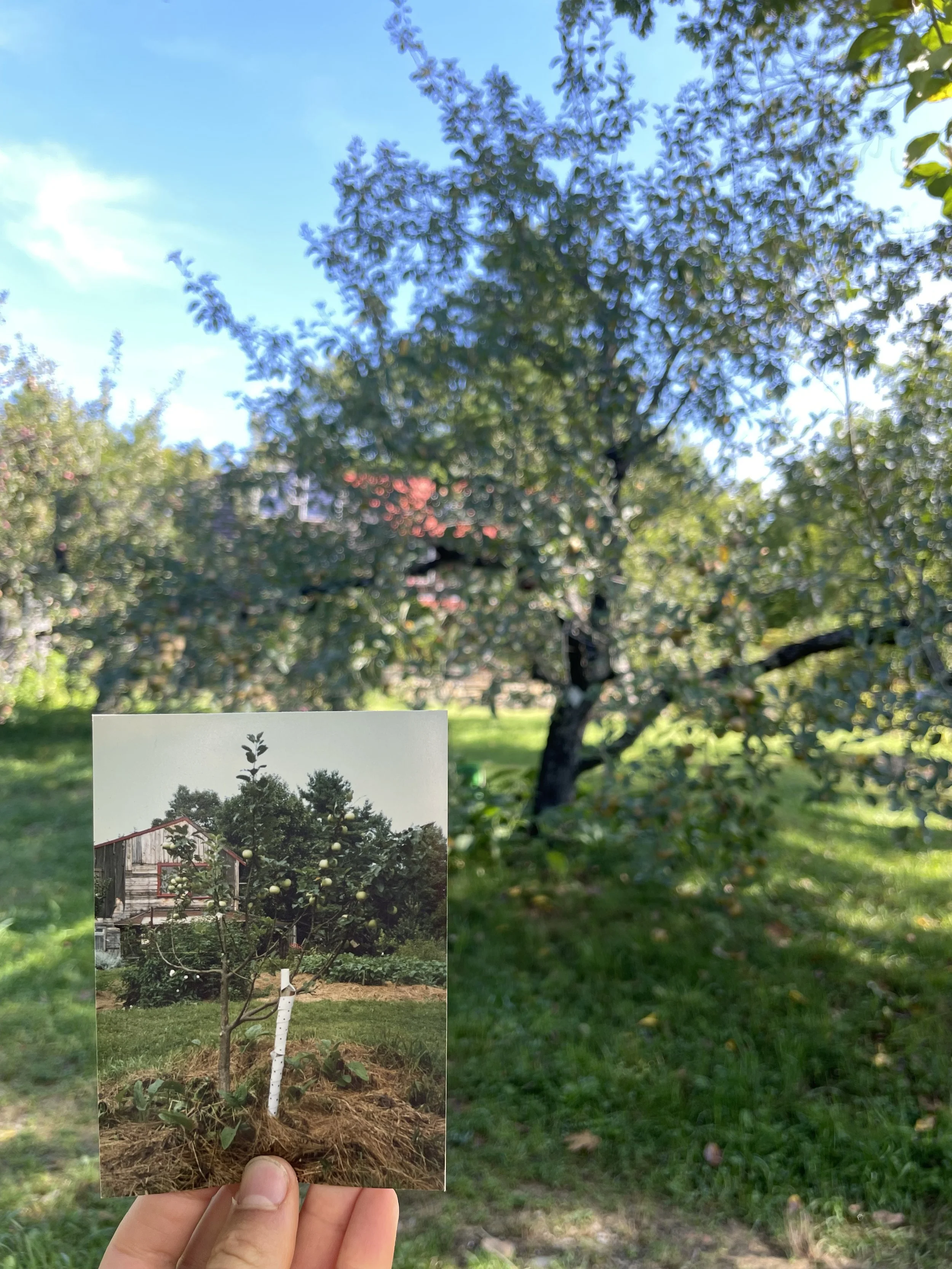
The Garden Royal tree, then and now, photo taken September 8, 2025, original photo from 1985

(Report by Skylar.) August has ended and just like that, September has begun. I spent a chunk of the morning harvesting the Garden Royals. While the whole top of this tree is Garden Royal, it’s also grafted with Red St. Lawrence, Tolman Sweet, and Pomme Gris. Despite all sharing a root system, it’s clear that Garden Royal has a different agenda than the rest in terms of how to grow. The Garden Royal part of the tree is tall and upright, while the other varieties spread low and wide, leaving the tree looking slightly confused. Once upon a time this tree was all Yellow Transparent, slowly to be crowded out by the current four cultivars. It was one of the first trees Bunk planted on the farm some fifty years ago. How wonderful it is that I get to climb in its branches today. 

Also on the docket was harvesting the Foxhill and September Ruby apples, as well as the Gracious plums. The Garden Royals were in beautiful shape: we hardly had any to cull. The Sidrunkollane Taliouns weren’t in quite as nice of shape, but we were still left with bushels of ‘seconds’ and ‘utility’ fruit.

In the evening I made two more sauces, one with Red China apples and the other with Sidrunkollane Talioun. Making single variety sauces has been a fun practice for me, and a great way to get a sense of a particular cultivar. The Red China sauce came out a vibrant pink and is sharp with perhaps something of a savory note in there. The Sidrunkollane sauce is a warm, pale yellow, acidic but more balanced with sweetness than the Red China, and to me has a soapy or perfumy fragrance to it. Either would be great additions to a mix, or something interesting to cook on their own in a pie, crisp, sauce, and so on

August 30, 2025

Today in the orchard

(Report by Skylar.) When ‘late summer’ actually begins I do not know, but I think maybe it’s here. The Monarda are now past; the Goldenrod are fading too. From afar the Finley Lane Orchard is once again mostly draped in green. Chlorophyll dominates. The fruit is flowing, the cooler is getting fuller. To me, the apples are already abundant, but I’m told it’s only the beginning.

Today I spent some time cataloging and setting aside good-looking apples for display at the Common Ground Country Fair. At the same time, I collected duplicates for the Super Chilly Farm collection. Tucked away in the root cellar are apple boxes labeled from A to Z that will eventually be full of apples of every SCF cultivar that fruits this year. They are used to compare other apples to as an identification aid, for photographing, and for other documentation purposes. They in essence act as models for their entire cultivar: a lot of weight rests on their shoulders. 

I also harvested Peach of Montreal—an apple, not a peach— and Wealthy. I picked a few Captain Zero before realizing that it was a different cultivar grafted to the same tree as Wealthy. In my defense, they do look particularly similar. I paused, then continued on, now exceptionally careful that the only apples I was picking were, in fact, from the Wealthy branches of the tree.

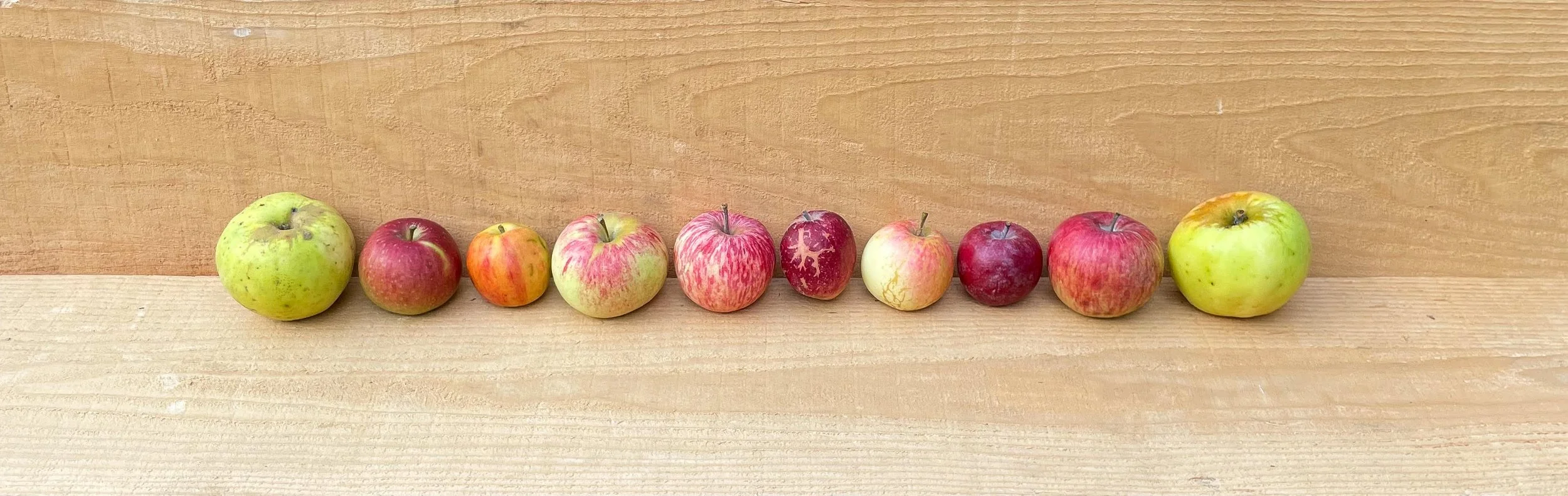
The apple varieties harvested in this last week of August, from left to right: Cole’s Quince, Garden Royal, Yellow Jay, Foxhill, September Ruby, Peach of Montreal, Red China, Wealthy, and Sidrunkollane 

August 29, 2025

Today in the orchard

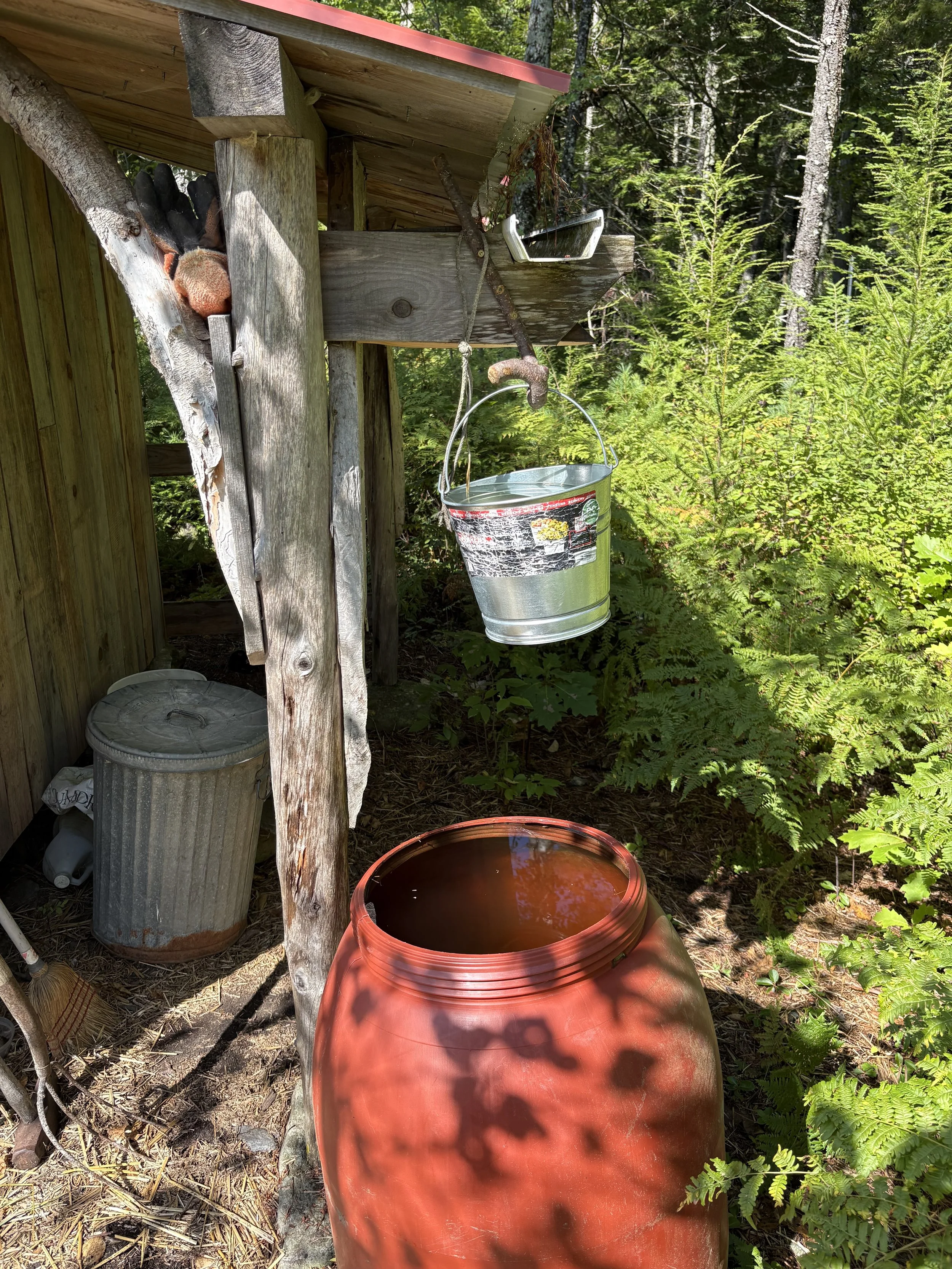
The rain barrels are full again, August 30, 2025

Tonight we finally got rain. The last decent rain was four weeks ago on July 30.  (By that time it was already getting quite dry. We hope tonight’s storm wasn’t too little too late. It was definitely not too little.)  The weatherman said rain all afternoon and we did get some—maybe a quarter of an inch. But at about 10 PM the storm arrived. It was accompanied by impressive thunder and lightning. The rain came straight down, and it came down hard. In the end we got slightly more than 2”—about a month’s-worth in a couple of hours.  Not exactly the way we want it (we prefer a half inch a week, thank you) but, hey, we’ll take it! 

Tomorrow I’ll survey the farm. I bet the rain barrels are all overflowing. Hopefully the downpour didn’t knock too much fruit off the trees. Fortunately most of the early apples, plums and peaches are picked. Amazingly enough, the trees have fared remarkably well despite the lack of moisture. Although many things are ripening early and some fruit is dropping prematurely, overall the fruit quality is very good.  

August 27, 2025

Today in the orchard

Today Lauren Cormier and CJ Walke of the Maine Heritage Orchard came over to meet with Skylar, Todd Little-Siebold and me. We discussed plans for the upcoming Common Ground Fair. We will have a large display of apples from throughout the state as well as tastings and talks. It should be a great three days. 

We also discussed some of the apple identification mysteries that we hope to sort out this fall. There will be opportunities to focus on some big ones. This fall we have a good apple crop in Maine which means access to lots of fruit. A few of the cases we’d like to crack include what we’ve been calling “Cherryfield,” “Sorrento,” and “Zachary.” We’d also like to find Walbridge, a prized apple that has been eluding apple explorers from multiple states across the US. And there will be others.

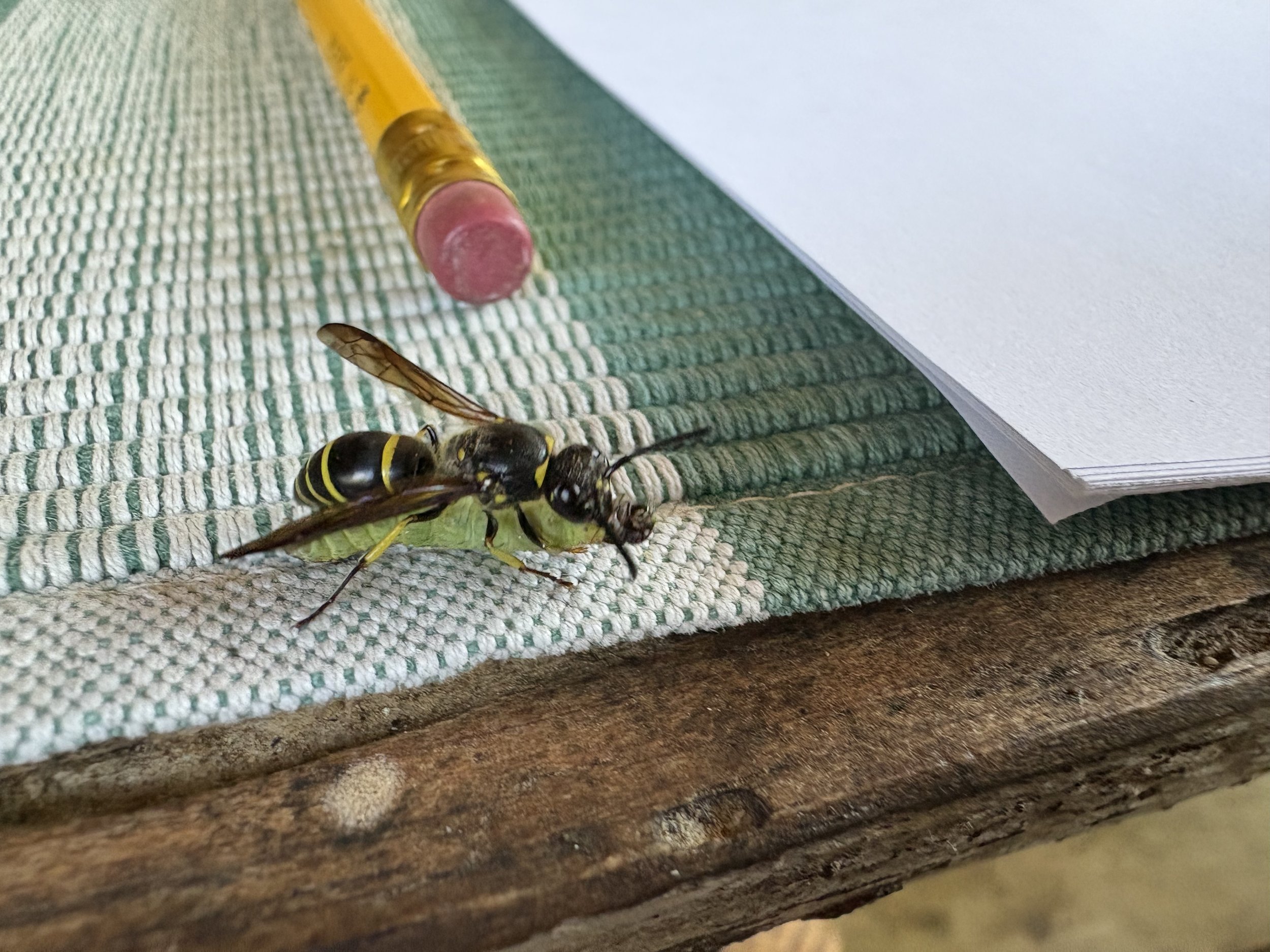
In the middle of the meeting a wasp flew in and landed by my pencil. In her grip was a small green worm. It was amazing.

A wasp, a worm and a Ticonderoga #2

Later in the day, I took apples and plums to John’s Ice Cream. Keep a lookout for their new plum ice cream. It should be delicious. Skylar and I worked on identifying an old tree from the North Palermo Road, incorrectly thought to be American Summer Pearmain. As it was getting dark, we picked the Estonian apple Sidrunkollane Talioun. The tree was loaded with large beautiful yellow fruit that were starting to drop.   

APPLE JUBILEE - SATURDAY, SEPTEMBER 6, 10 AM - 6 PM

Come join us at the Apple Jubilee on September 6, 2025, 10 AM-6 PM

Free and Open to All

Langlais Art Preserve 
576 River Road
Cushing, Maine 04563

Featuring: "apple magic", apple art, cider pressing, cider tasting and a talk by John at about 1:30: "Historic Apples of Midcoast Maine"

John will begin his program in the apple orchard, discussing the trees, fruits, and other aspects of the orchard and local ecology. Following the discussion, John will lead participants to the barn to deliver his lecture

August 26, 2025

Today in the orchard

Today Skylar built her first compost pile from scratch. This is a major achievement, a rite of passage and no easy feat. Her pile looks good so far, and I’m a real stickler when it comes to compost piles. (For more information on compost piles see the Orchard Reports on 6-16-24, 8-9-24 and 6-16-25.) We did more nursery weeding and watering as the drought trudges on. Meanwhile, the apples miraculously continue to ripen ,and we’re picking new varieties daily. Today it was Red China. 

The original Red China tree that was cut down to make a driveway.

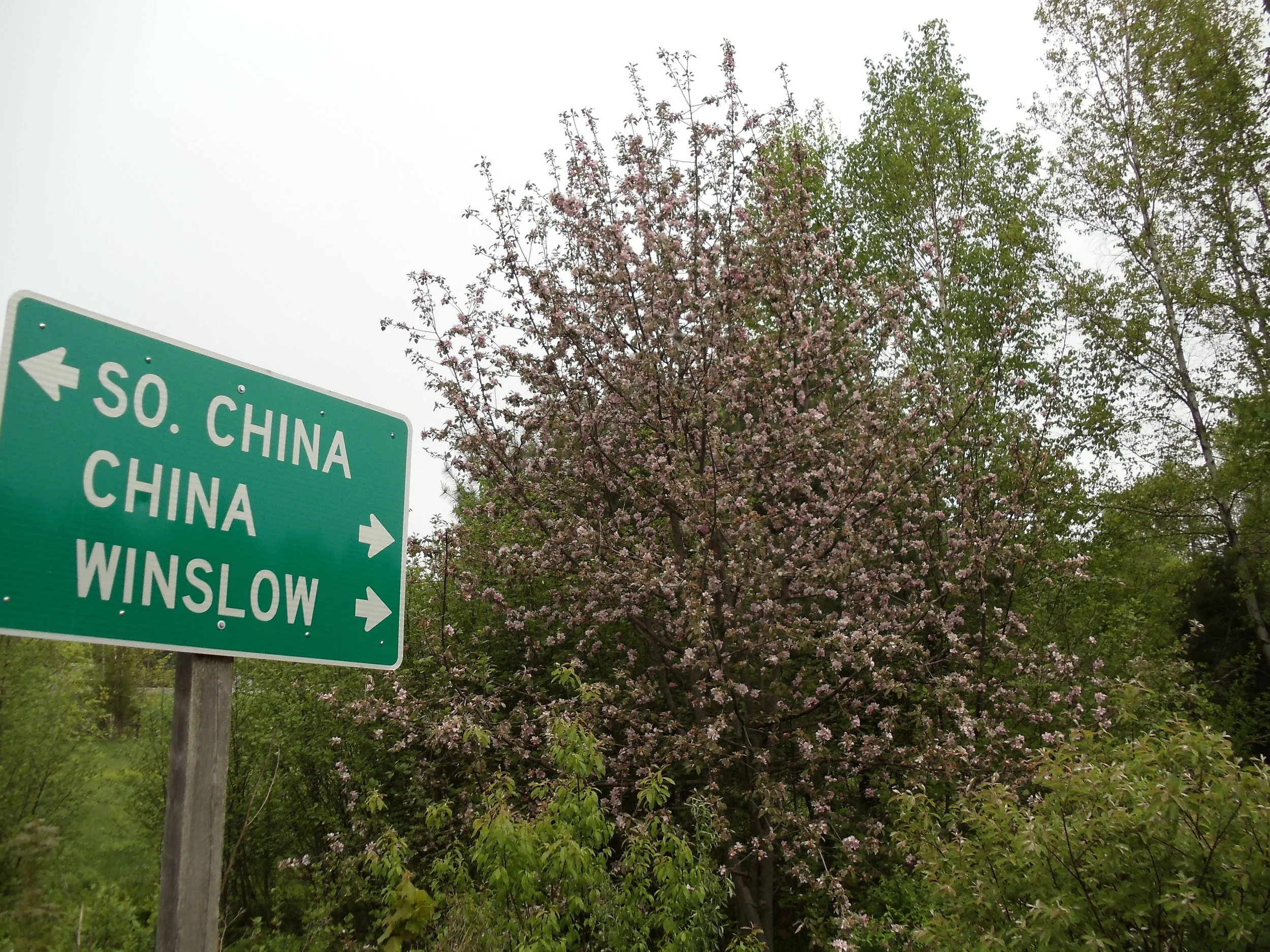
I have always thought Red China was a seedling tree. I discovered it one spring growing by the side of Alder Park Road about ten miles from here in China, ME. I first noticed it’s spectacular dark pink flowers. As I suspected the flesh is red too (get it?). The skin is a beautiful orangey-red-pink. It’s not a dessert (fresh eating) apple although some people may like it that way. It does cook-up well into an outrageous, raspberry-colored sauce. We had Red China DNA profiled, and the results came back as the same as another named red-fleshed cultivar. (I’m skeptical.) I don’t think that they’re the same, but the original “Red China” is now gone so we’ll likely never know if it was a seedling or a grafted tree. Fortunately we have two trees grafted here on the farm. If you’re into red-fleshed apples, scour your roadsides during bloom, looking for red/pink-flowering apples. You will have found a red-fleshed seedling.