March 26, 2026

Three-year old loops, March 26, 2026

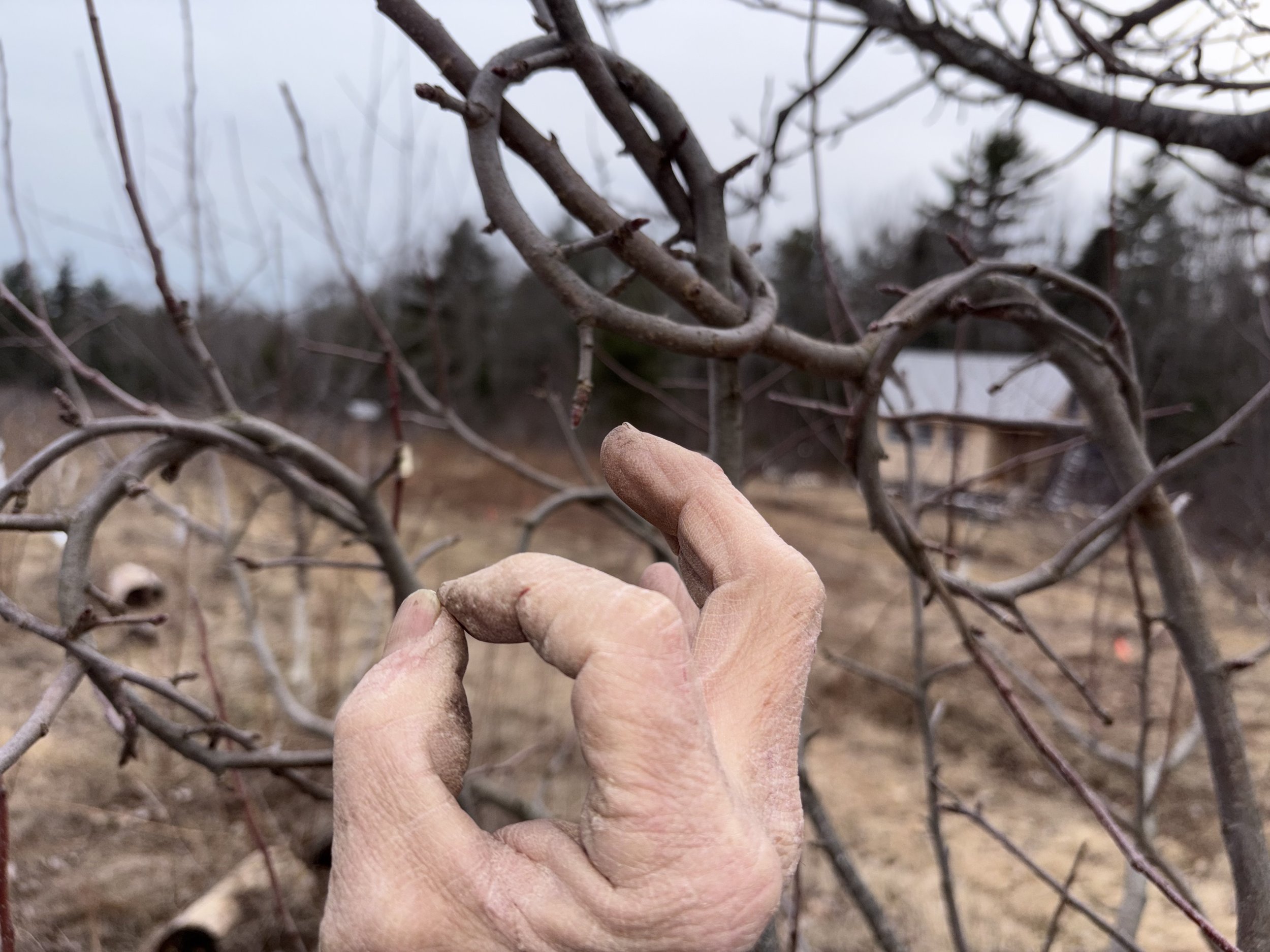
Today started out clear, but by mid-day it was gray. Still it was mild and quite pleasant out in the orchards. Perfect working weather in the 40’s. Both Cammy and I continued pruning. I spent my time up at Finley, mostly on rows 6 and 7. The snow is gone, and the pruning was easy. I brought along a roll of masking tape and made several dozen loops as I went along. I bend the “watersprouts” and other longer, one-year-old growth into circles and then wrap a bit of masking tape around the loop to keep it from slipping apart. Supposedly the loop triggers some sort of hormonal shift in the wood. It slows vigor while increasing fruit bud formation. It’s an alternate strategy to cutting off watersprouts and then having them all come back again next year. I’ve been doing it for the past three years. 

Typically I take a few seconds to massage the twig I want loop. That softens it up so I can make the loop without snapping the twig. The young growth on some cultivars is super flexible, and loops can be made with practically no effort at all. Golden Russet of Western New York (aka GR1) is one of those. On others the growth is nearly impossible to loop without snapping the twig. Too brittle. So I give up and move onto the next tree. It’s easy, fun and is definitely a conversation starter. But does it work?  

In a few locations in the orchard, there are two adjacent trees of the same cultivar. I loop one tree and leave the other one un-looped. Although the sample-size is small, I can at least get a vague sense if the loops appear to be making a difference. It seems to be: many of the loops are a mass of fruit buds. 

The bees were out in force mid-day. The hives at Finley were all a’humm. Today was the Opening Day for the Red Sox. The Green Monster is back. Some claim the Green Monster can save the world. I tend to agree. The Sox won. They are now undefeated.  
March 25, 2026

Today was another clear blue March day—second in a row. Although it wasn’t much above freezing, all day, Finley Lane is mostly snow-free. There’s still a lot of snow in the shade and in the woods, but another week or two like this, and that will all disappear.

I wanted to be pruning but decided to drive north to Wilton to collect scionwood from what may be the last “Sarah” apple tree on the planet. I made several stops along the way including a favorite old tree in an abandoned field next to a body shop in Norridgewock which I think might be an old, local cultivar called ‘Muskmelon Sweet.’ The tree is beginning to do battle with some prickly multi-flora rose (Rosa multiflora) so I took a bit of time to snip off twenty or thirty beefy rose stems coming out of the snow. (Spring haircut!) I also stopped at Murph’s (Lane Road Orchard) in New Sharon to collect some Hidden Rose (aka Arlie’s Redflesh) scionwood. It was fun to see the Murphs who look as though they’ve both survived the winter well. Murph has been out in the orchard pruning, and the alleys were a jumble of branches awaiting the chipper. 

Denis and David and the “maybe” Sarah tree, March 25, 2026 

I continued on deep into Franklin County where I met up with Denis Brown in East Wilton. Denis grew up in Wilton and spent much of his youth working at one or another of the eight big wholesale orchards that once lined the ridge along Orchard Drive. You can see the remnants of those orchards in the woods and in the backyards of the new homes that now pepper the area since the orchard industry abruptly collapsed decades ago. We got in his truck and drove a few miles to the home of David Fournier. The Fourniers have an old tree in their front yard that could be the Sarah apple I’ve been looking for since Clinton was president. David met us in the driveway as I was cutting sticks with my pole pruner. “There might be two different apples on the tree.” Oh. Well, better to know that now than later. Years ago an old-timer had told David that there were two cultivars grafted onto the tree. David thought that one side was solid-red; the other side, striped. Unfortunately he wasn’t sure which of the four large limbs was which. So I made a hopeful guess and cut from two of the four: Roadside and Houseside. Ill graft and DNA profile both. The search for Sarah continues.      

March 24, 2026

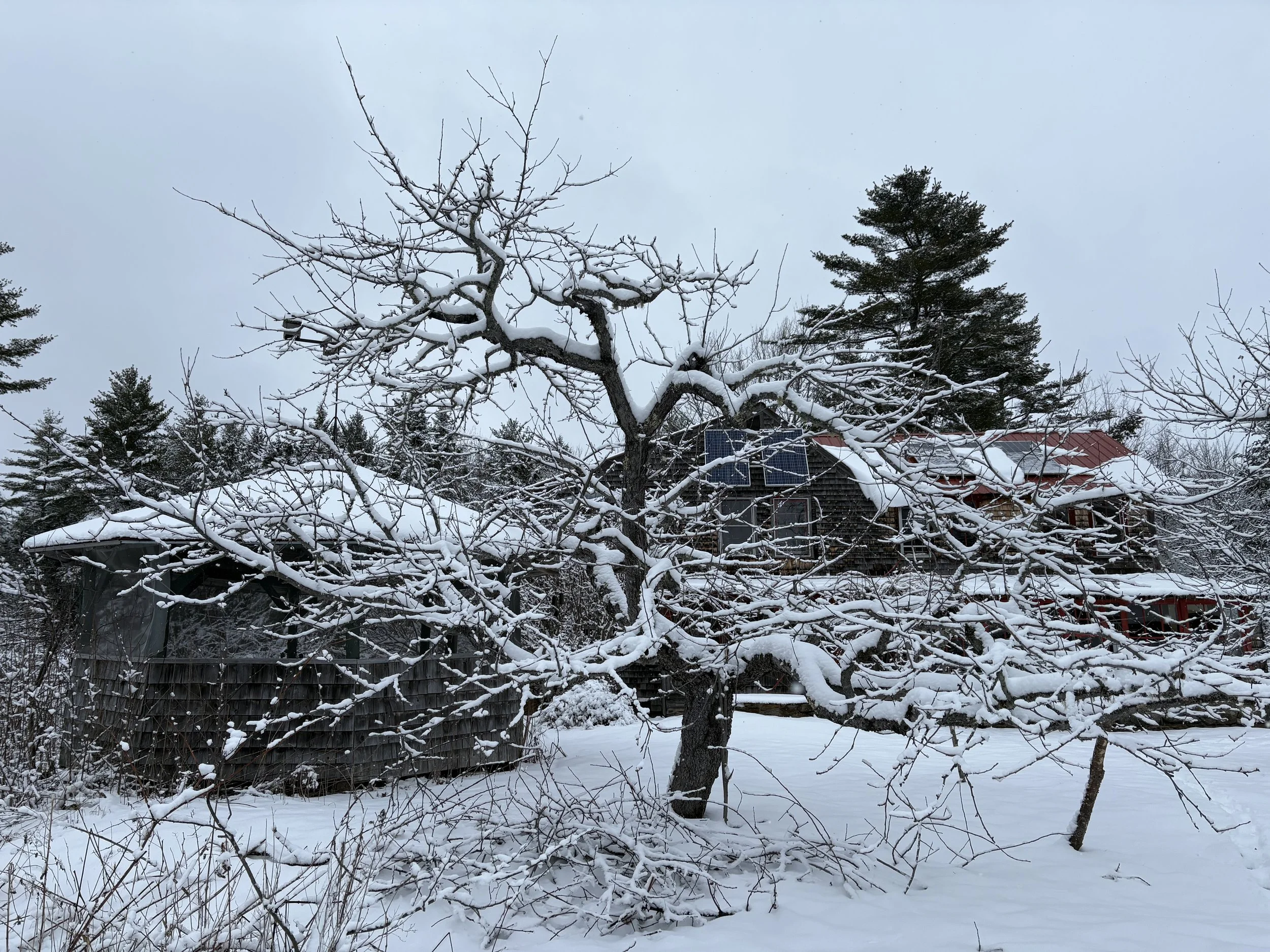
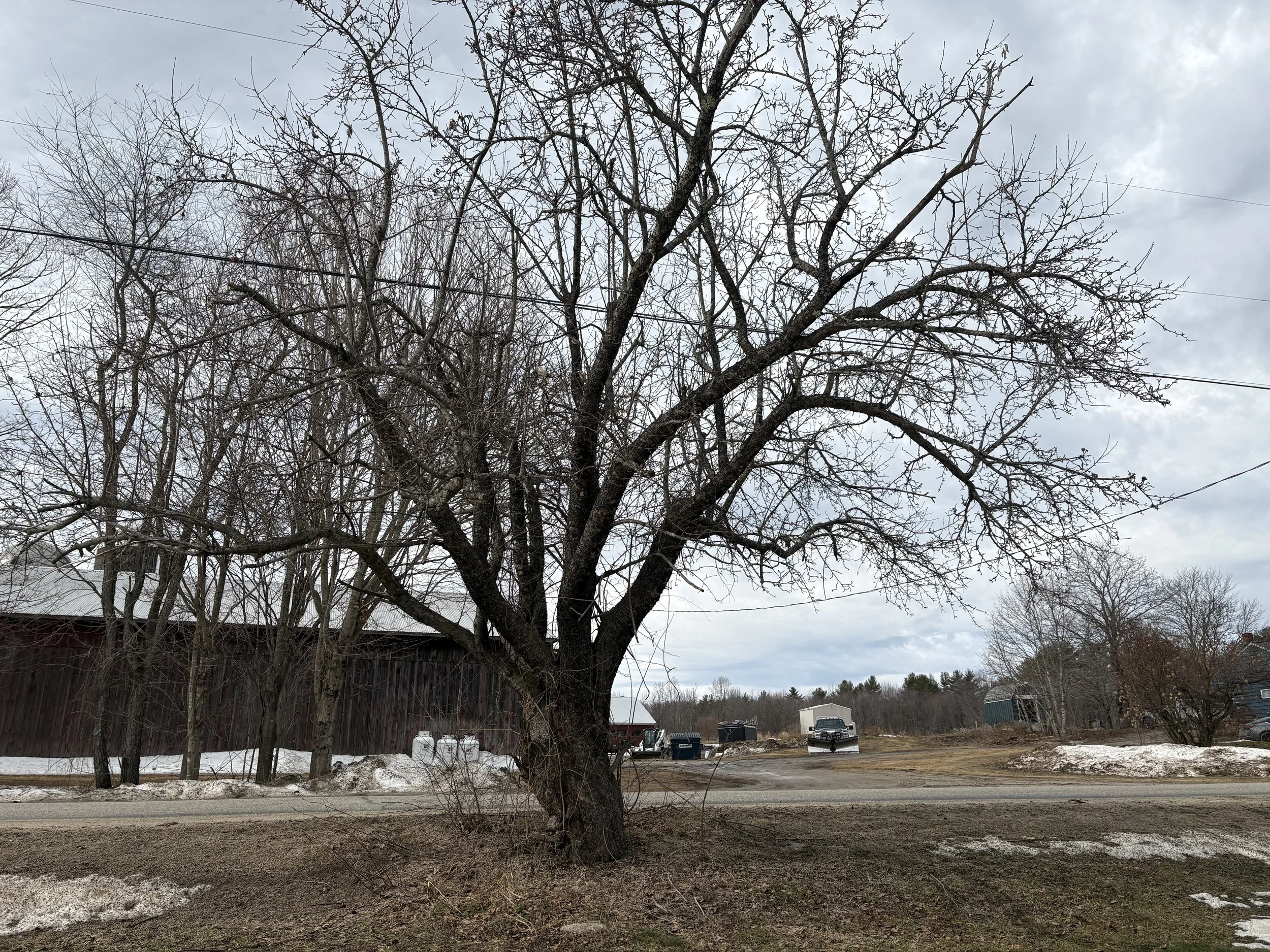
Black Oxford showing off its wide-spreading, rounded form after the March 23, 2026 storm

The snow ended late last night. It was time for it to move on. This morning the brilliant March sun returned. It was the type of sun that can sneak up on you this time of year, reflecting off the snow and beaming down from outer space to give you a sunburn to end all sunburns, like the ones Jen Reis and I both got cutting scionwood one March day in Monmouth at Highmoor Farm many years ago. We didn’t even know it was happening. We were having a gay ol’ time cutting away much of the day, totally oblivious until we looked at each other as we hiked back to the truck. Ouch. We were both the color two tomatoes in late August.

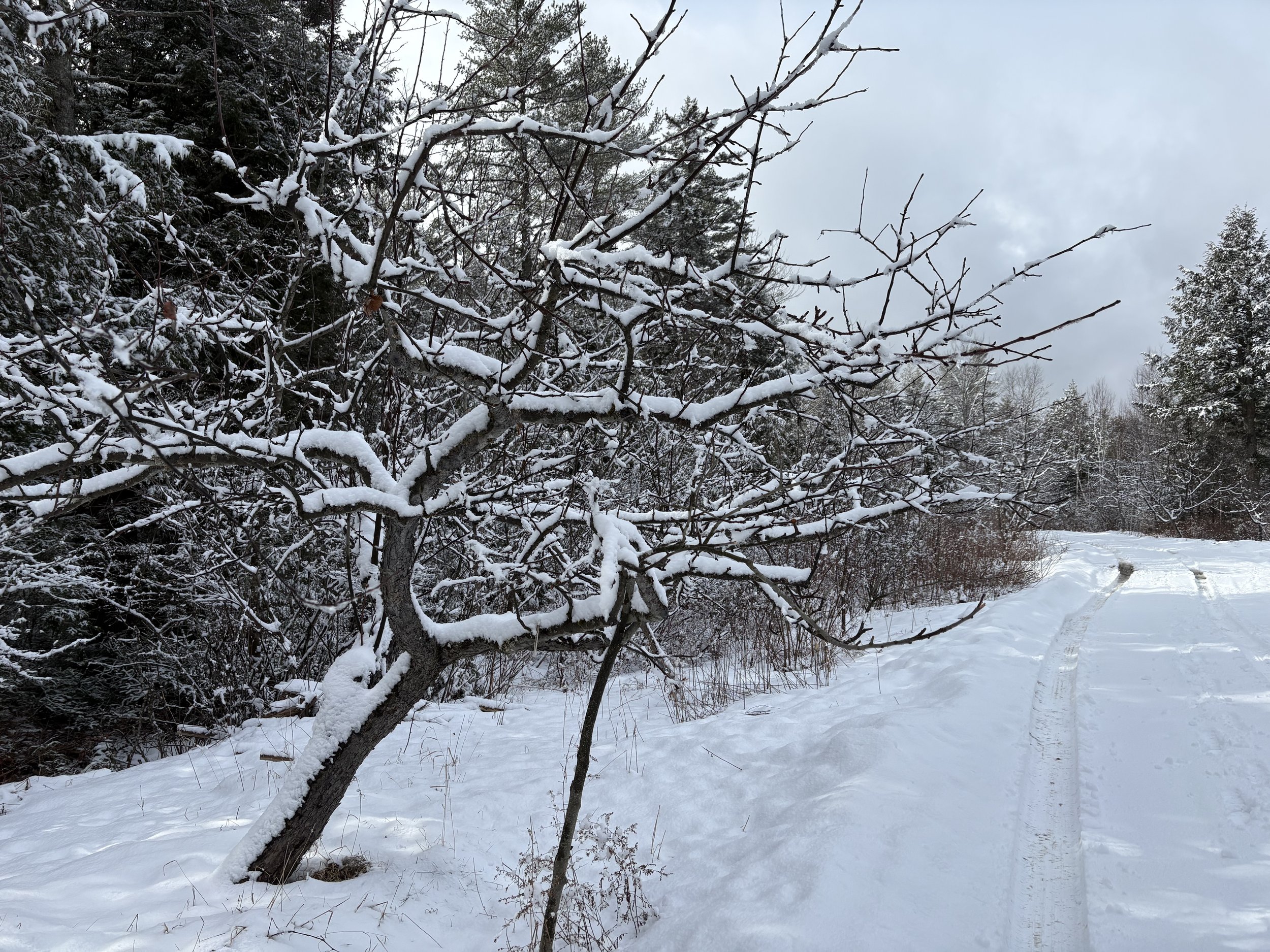
I spent today pruning up at Finley Lane. It was delightful. The snow was settling, and I didn’t get fried. I love being with the trees in all their nakedness. I’m endlessly entertained by the differences in tree-forms. Every tree has its own. One of the reasons why I lean towards having only one cultivar per tree is just that: I love to see the tree form of each cultivar. They are so different. Or as I like to say, really, really, very, very unique!     

March 23, 2026

Pulling scion orders: “Come in,” she said, “I’ll give you shelter from the storm.”  March 23, 2026

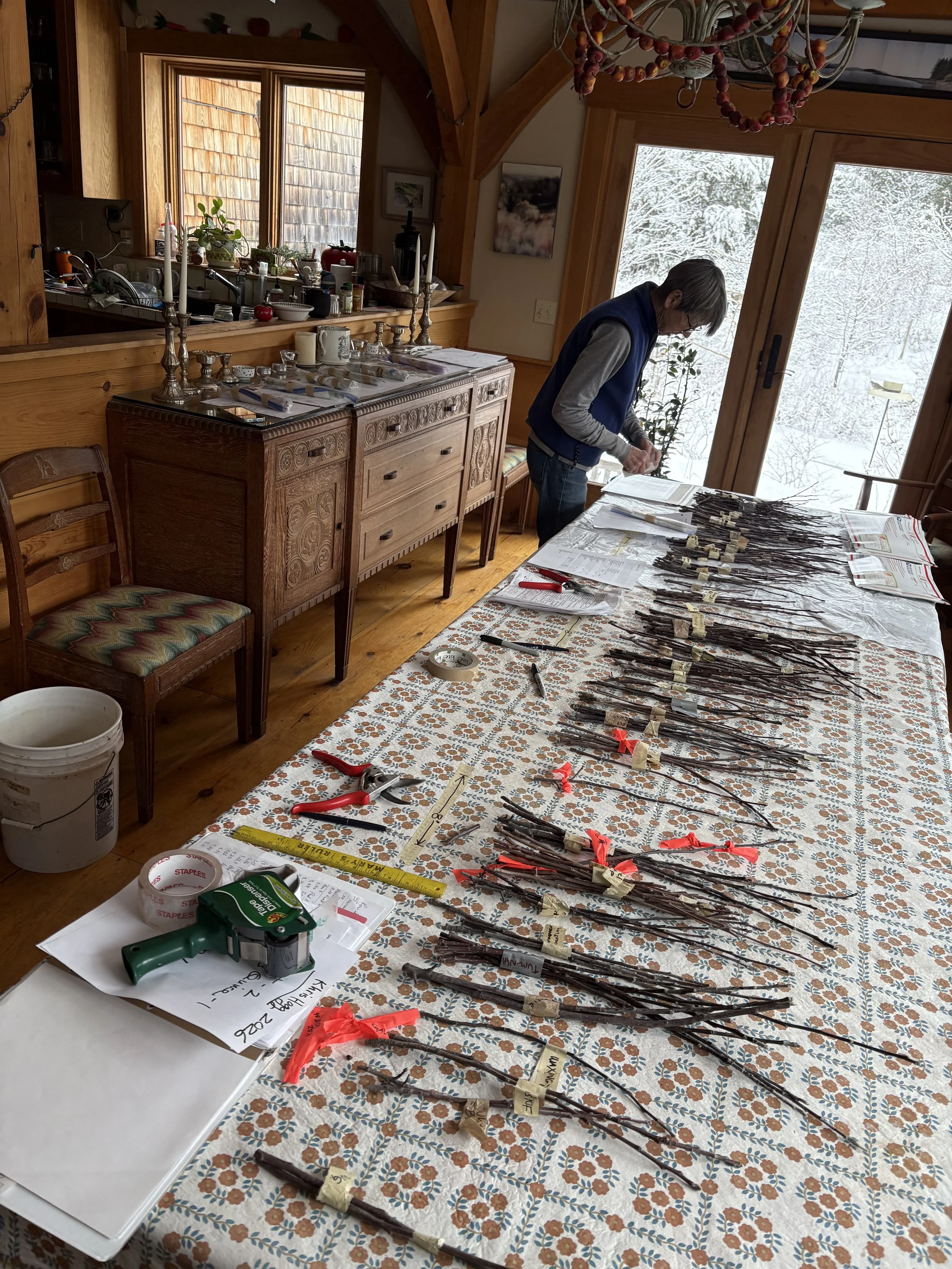
It continued to snow all day today. Not enough to add much accumulation, but more than enough to keep us indoors. It was the perfect day to assemble the last of the scionwood orders. Sorry, it’s now too late. You can still come to MOFGA on Sunday the 29th for the annual Scion Exchange. There will be piles of free scionwood there as well as rootstock, grafting demonstrations, workshops and  a lot more. It’s also not too late to cut your own scionwood in many locations. The scions are still dormant here in central Maine and will be for at least another two weeks.

We had three new visitors to the bird feeder today, all three undoubtedly fugitives from the storm. We can imagine they saw an opening in the woods and the locals crowded around the feeder and said to each other, “Dudes, let’s shelter here.” The newbies were the brown-headed cowbird (Molothrus ater), goldfinch (Spinus tristis) and song sparrow (Melospiza melodia). By the end of the day when the snow had subsided, they had moved on.    

March 21, 2026

Right in the middle of the shortest and most fun month of the year, you get this incredible bonus: Spring! It’s here with all its Earth, Wind and Fire. If you think that the rawness of March resembles November, think again. There is immense power right below the surface of all that mud, and it’s about to explode. It does it every year. This ain’t NO-vember. The tide went out six months ago. Now it’s coming in, and nothing will stop it.  

“It’s Spring, it’s Spring, Springtime again…” So sings the ensemble of Sun Ra and six of his “Arkestra- mates" on the ethereal 1979 album, “Sleeping Beauty,” by Sun Ra and his Intergalactic Myth Science Solar Arkestra. There’s only three tunes on the album. One of the others (a personal fav) is “Door of the Cosmos,” with the lyric, “Love and life interested me so, that I dared to knock on the door of the Cosmos.”

Hilly, Colby & Red Astrachan. March 21, 2026

So why not dare to knock on the door? As Dylan sang, “Knock, knock, knocking on Heaven’s door.” Or as Matthew sang many springs ago, “Ask, and it shall be given you; seek, and ye shall find; knock, and it shall be opened unto you…” It’s March, it’s spring. The door is open. We’re cutting the last of the scionwood. We’re about to plunge into the last big push to get the apple trees all pruned. No time to dawdle.    

That being said Cammy and I did take a short break and headed Downeast to visit friends. We spent much of our visit walking along the shorelands of Sorrento and in the magical spruce and cedar woods along Frenchman’s Bay. One of the trees we visited was a stunted, old, gnarled Red Astrachan. It certainly hadn’t been pruned in fifty years (or maybe sixty), and it looked happy as can be. After all, it’s spring.  

March 20, 2026

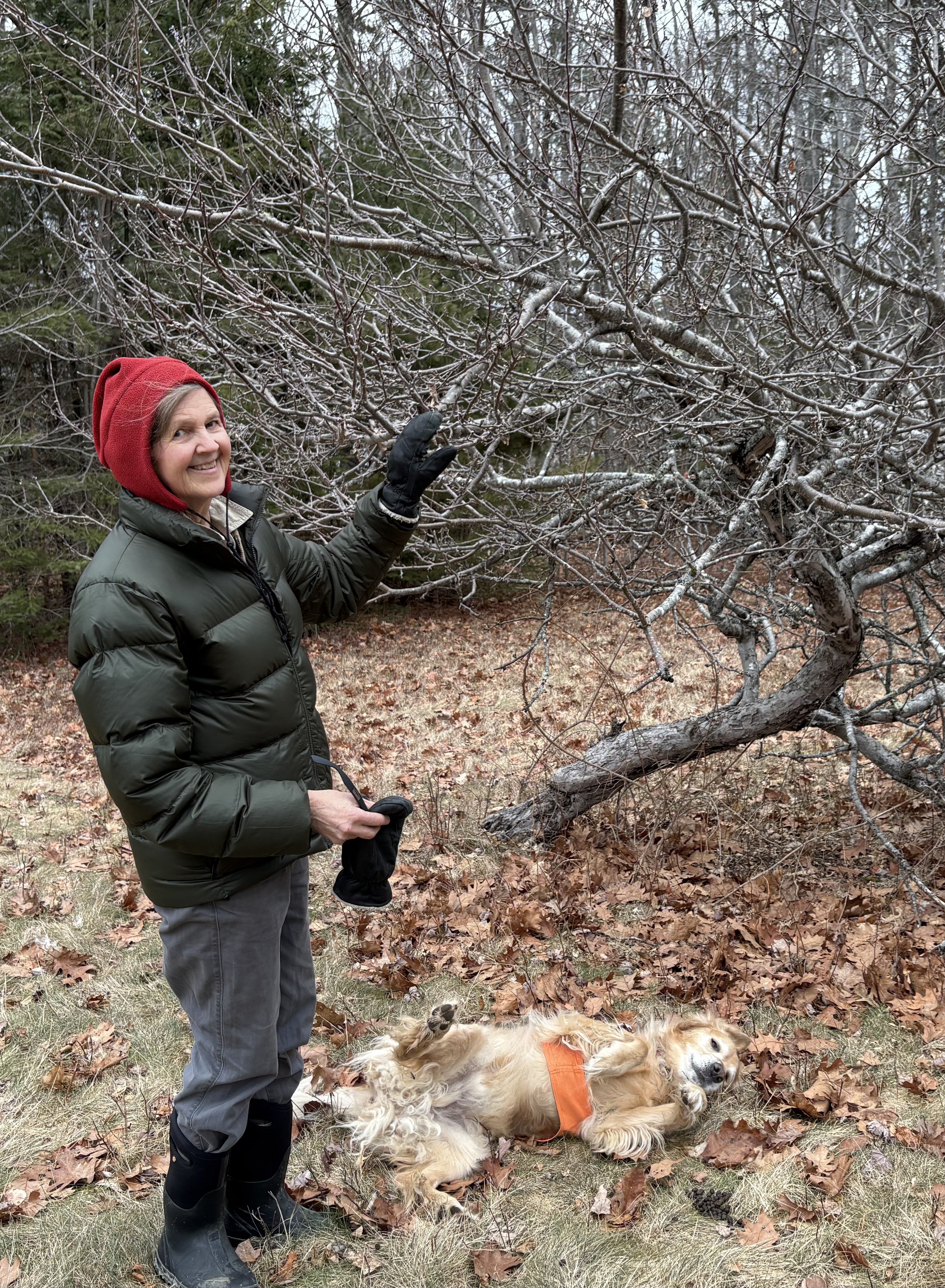
Charette tree, March, 2026

Since I was rambling on about air the other day, I have to mention incorrect information and poetic license. One of my favorite activities of all is contemplating the air I breathe when I’m out in the orchard with the apple trees. It’s like mouth to mouth resuscitation - they breathe out all that amazing oxygen and I breathe it in. I breathe out carbon dioxide, and they’re like, “wow, this is awesome, thanks’’, and they gobble it up. It’s an endless circle, like one of those tape loops in the bizarre music of Steve Reich. Or a skip in an old LP where the same line repeats over and over again ad infinitum.  “Will the circle be unbroken?” It’s the ultimate partnership of people and plants.

Despite what I said in my last post, when apple trees are dormant, they really don’t “make” all that much oxygen. The conifers do a bit since they still have their needles. But the concept remains the same: the air has been unbelievable on these cold, raw March days. And we can thank the plants—although not exactly the apple trees at the moment—for making that all possible.

The applesauce has been excellent this week. Still lots of choices. The latest batch included a bittersweet seedling from Penobscot we call Fuel Service. When I re-heated it this morning, I—oops—scorched the bottom. Well, the sauce survived OK and actually caramelized. It was delicious. Lesson of the week: if you burn your sauce, fret not, it may be even better than you hoped.

Meanwhile March, the shortest month of the year, continues to zip by. Blue sky this morning; snow by 5 PM. Bare ground at noon. Winter wonderland by dinnertime. March’ll be over in a wink. Next big moment? Spring! Tomorrow.

March 17, 2026

While we’re talking water, let’s dig into air. In the Amazing Department, air is right at the top. It’s everywhere, but if you’re fortunate to live in Maine, you usually can’t see it. You wouldn’t even know it’s there. But it is. Everywhere. In Maine air wears its invisibility cloak much of the year, especially in winter. And this winter here on the farm it has felt as if there isn’t a particle of dust in a thousand lungfuls. 

10 PM air at its finest, March 16, 2026

Last night the temperatures began to cool off, and it was down below freezing all day. The puddles remain frozen though the road is muddy, and we bounce from rut to rut as we drive up to the orchard. Some might complain that it’s raw and gloomy, even bleak. But it’s March, and the air right now is as good as it gets. 

Is it even possible to describe what it’s like to live submerged in this vast void? We are fishes swimming in the ocean of air. It surrounds us and cradles us and even permeates us like the love of those who we hold most dear. We inhale, and our throats, lungs and entire bodies are renewed and refreshed. Today the air is delicious. It must be the apple trees sucking up the carbon dioxide. When they exhale, out comes an explosion of oxygen. As our feet walk through the snowless, muddy orchard, we swim our way through this invisible, magical, glorious sea we call air.   

March 16, 2026

Today we had a blast of April showers 2 weeks early. The snow was mostly gone anyway but today made serious dents in the piles along the road and along the orchard edges where the pines and hemlocks shade the ground.

I love the quote from someone — Thich Nhat Hanh maybe — “The miracle is not walking on water. The miracle is walking on land.” Well, land-earth-dirt is certainly a miracle. But water, wow! You can jump into it. You can drink it. You can even walk on it in the winter time. I love thinking about water in all its various incarnations. 

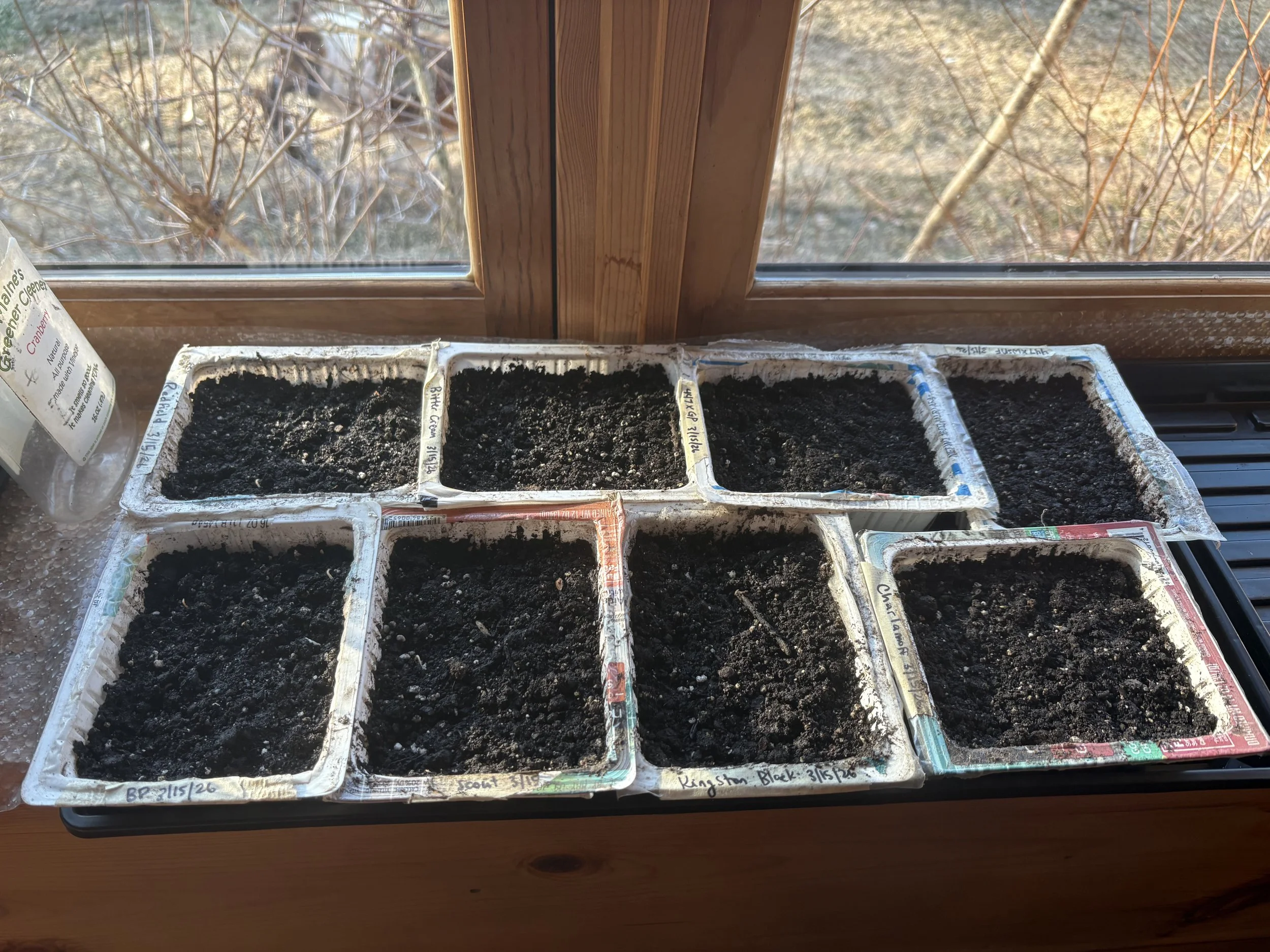
Apple seedlings on the window sill, March 2026

Spring 2025 it rained every weekend for ten in a row. I heard so many complaints. Meanwhile the plants were soaking it up. Then we had ten weeks (or was it 20) with no rain at all. Despite the drought, the orchard trees grew so well last summer. Hmmm. Welcome back, rain. 

The apple seedlings are all on the window sill in their well-worn “tofu-tubs.” A few radicles are poking their tips up through the surface of the soil.  

March 15, 2026

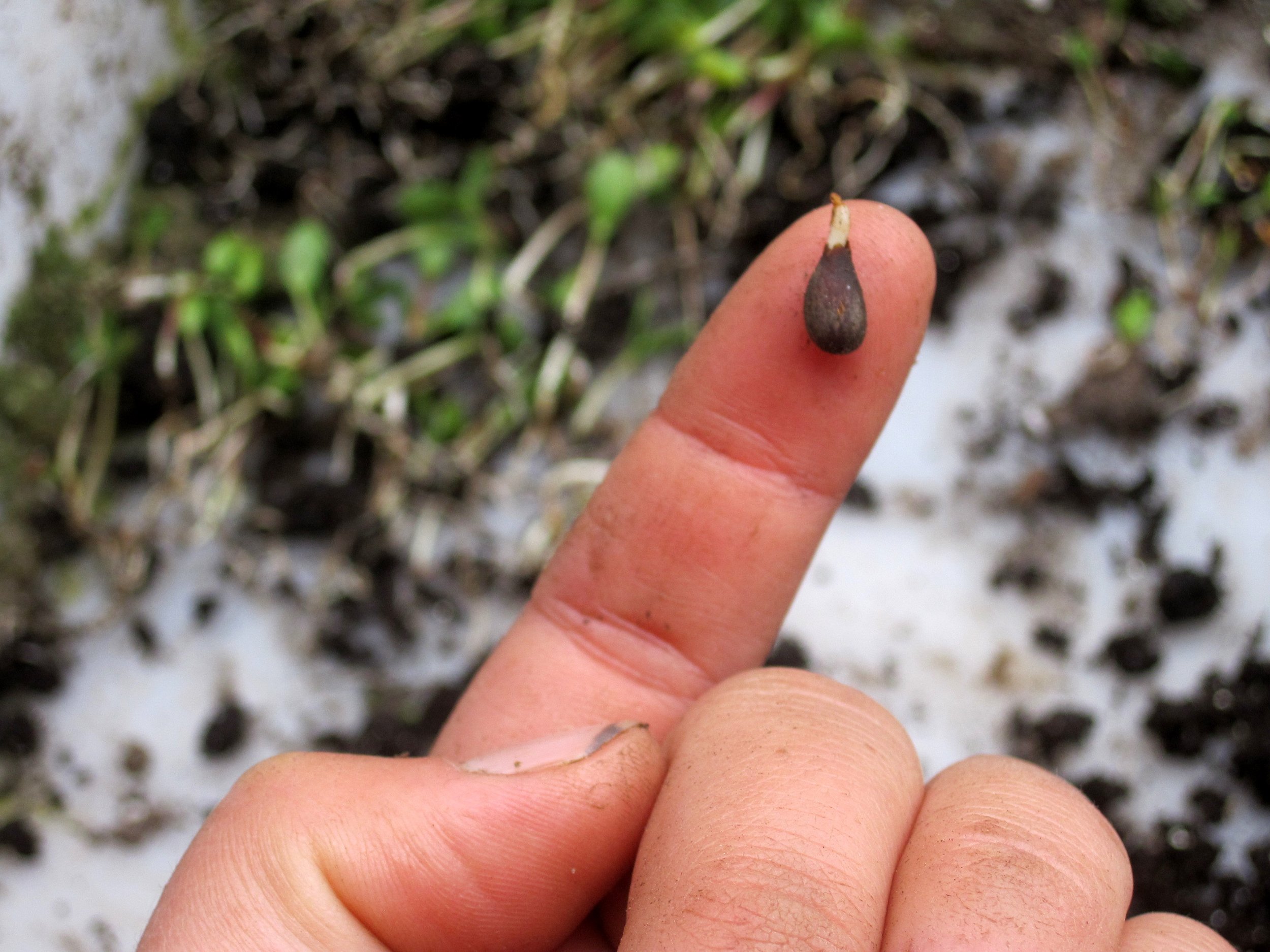
Starting apples from seed is radicle

Today was mostly clear and above freezing, a perfect day for Cammy to continue pruning some of our oldest trees. There’s brush everywhere. It was also a good day to plant apple seeds. The seeds have been in stratification for exactly three months, and Skylar planted 197 seeds, not exactly a huge breeding project, but still that’s a lot of potential trees. Some of the seeds were showing their radical—the tiny white “sprout” that first emerges from the seed. Others were showing nothing but are probably about to sprout out any day now. 

43 of the seeds were from our first effort at hand pollination, where we know both parents. Last May Cammy and I did some of the crosses, and Skylar and I did the rest. All have Frostbite (MN 447) as one parent. We used three male pollen parents: Black Oxford, Gray Pearmain and Westfield-Seek-No-Further. Stay-tuned for more developments. We should have our first fruit in… “a few” years!

March 14 (Three point one four day), 2026

The snow returned to central Maine last night. Much of the farm was bare ground yesterday, and this morning it was entirely covered in white once again. About 3 or 4 inches of beautiful new wet snow. The temperature warmed during the day, however, and by early evening most of the ground was back to bare.  

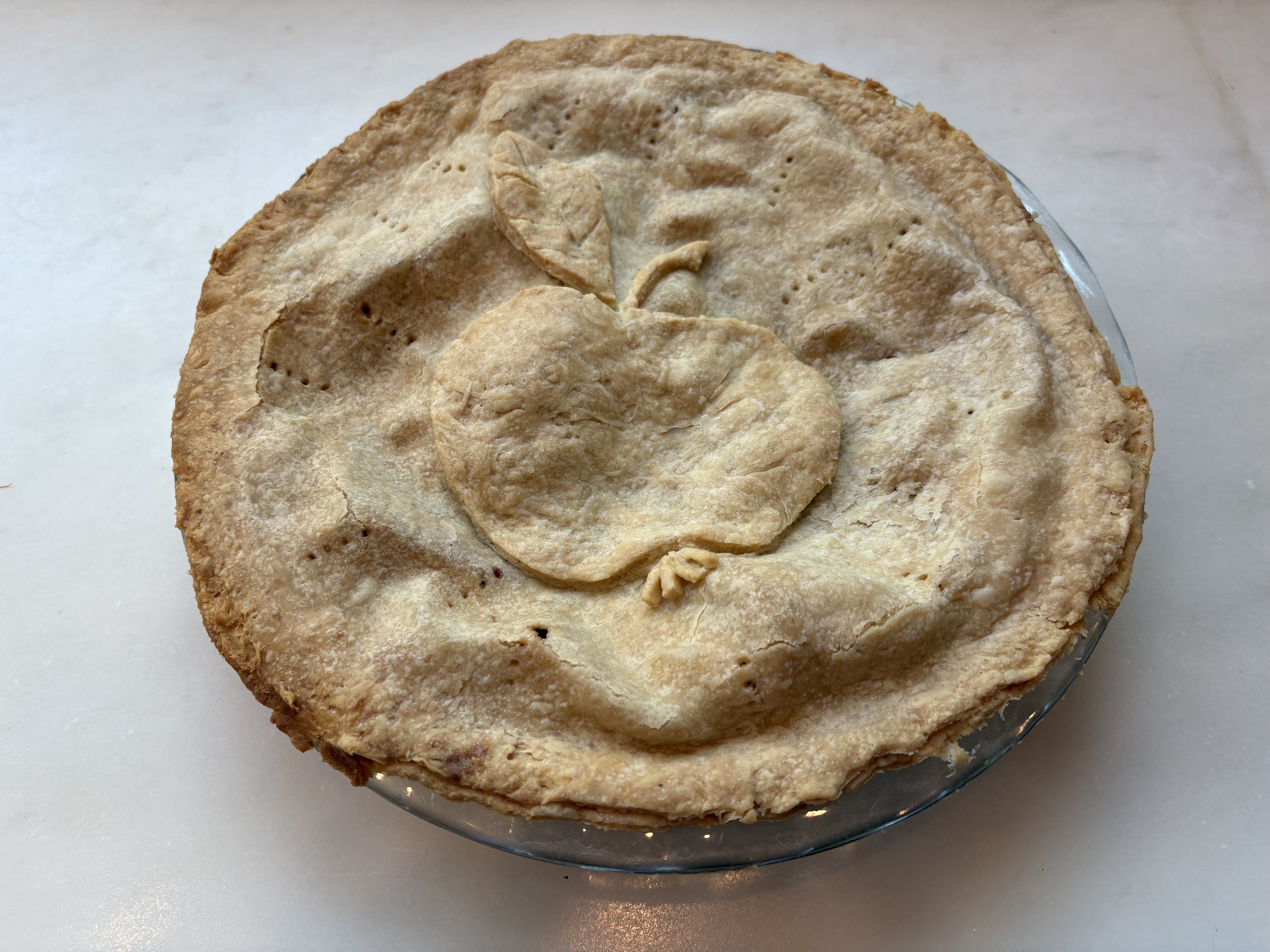
Happy Pie Day

Today is Pi-day. Or Pie-day. March 14, 3.14. I suppose the big moment was presumably at about 3.14159265358979323846. How does that translate into time? If you start with 3.14 being the date, then 159265358979323846 would take you to about 6:35 AM, the perfect time for a slice of Black Oxford apple pie. The Black Oxfords in the root cellar are approaching peak flavor now, and they cook perfectly in the requisite one hour it takes to cook the crust. Perhaps 6:35 AM is a bit early in the morning to pull a pie out of the oven, so let’s say preparations begin at 6:35. Roll out of bed at 6:00, do a bit of this and that and then mix up two cups of flour, a half pound of butter and a few tablespoons of water at 6:35. Massage the dough into a ball, and put it in the refrigerator or pantry if it’s still cold out there. Leave the “crust ball” where it’s cool until early afternoon. Then slice up a dozen Black Oxfords. Mix in the tiniest amounts of cinnamon, nutmeg, cloves and sugar. Cut the dough-ball in half, and roll out two crusts. 

Put it all together, and slide it into the oven at 375 for 15 minutes, then turn down the temperature to 350 for 45 minutes. And voila, you should be ready for the perfect 3.14 celebration. All you need is a few plates and forks and maybe (not required by recommended) a scoop of vanilla. 

March 13, 2026

Never reached 32F today, and what snow we still have didn’t budge. Cammy continued pruning trees, and I cut scionwood. Early in the day I went to Belfast to run errands and to see if I could find Gloria Seigars. Gloria lived up in Aroostook County for many years with her husband, Dick. I met her through Steve and Barb Miller. She was a wildly enthusiastic fruit explorer. She and I went on several memorable exploration trips together in northern Maine and Quebec in the late ‘90s and early 2000’s, often with Steve and Barb and Garfield King, a retired school superintendent. It was on those trips that I first visited the Charette and Pomme d'Or trees. 

Gloria and Garfield were both incredibly generous with their time, their enthusiasm and their knowledge. They were both important mentors to me. They were also models in their love of life. Gloria was always self deprecating. She never thought she had much to offer, and yet the time I spent with her was life-changing. 

Gloria Seigars, fruit explorer and apple mentor

Garfield died some years ago, and I hadn’t seen Gloria since I visited her five or six years ago in Belfast where she now spends her winters. So today I decided to see if I could find her. And I did. She answered the door, and we sat together and talked for a half an hour. She looked great. She’s 98, turning 99 on July 26. She told me about one of her seedling discoveries that finally fruited last fall and was well worth the wait: it’s a small red dessert fruit with excellent flavor. I’ll graft it up at Finley. Apples do keep the doctor away!

March 12, 2026

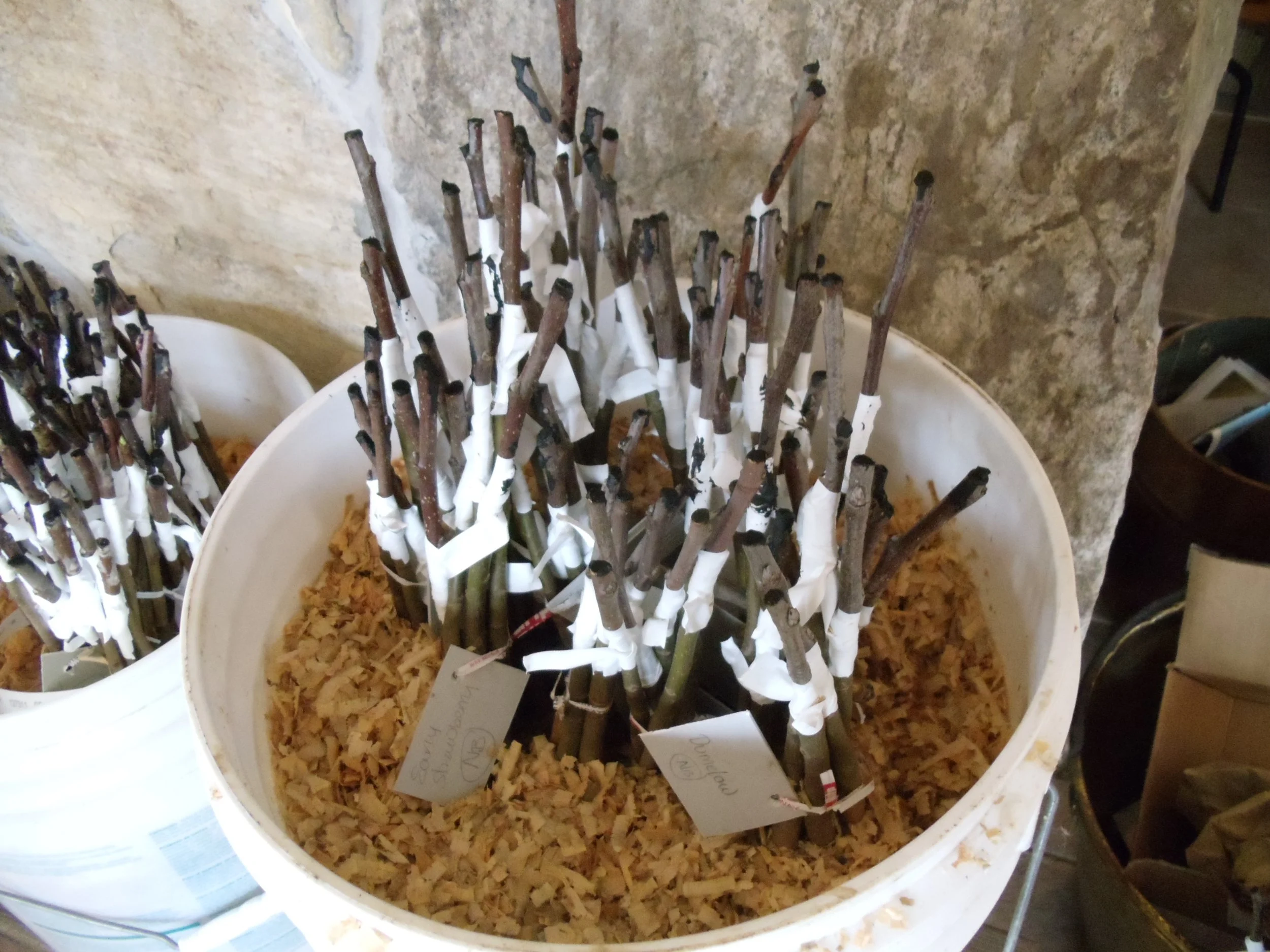
New grafts waiting to callus

The season for bench-grafting is near. We won’t do ours for another three weeks, but some folks have already been slicing away. The question has come up: “What do I do with my newly grafted trees?”

Here’s what we do:

  • Immediately after grafting, we place the trees in a 5-gallon bucket of water, submerging the roots (but NOT the graft). A 5-gallon bucket will fit up to 50 newly grafted trees.

  • Within a day we remove the trees from the bucket of water and place them in a bucket of damp sawdust. Potting soil or wood shavings will work as well. We cover the roots, jiggling the bucket to get the sawdust to work its way around and make contact with the roots, then water them in. The medium should be damp but not waterlogged enough to rot the roots. Again as many as 50 trees can fit in a five-gallon bucket. For just a couple of trees, a large flower pot or small pail will do.

  • We put the bucket in a warm spot out of direct sun in our living room.

  • Over the course of the next couple of weeks, the grafts will callus (fuse) and begin to grow. It’s like magic. 

  • Once the days are warmer we move the buckets out onto a covered porch each morning and bring them back inside at night. We continue to keep them out of direct sun for most of the day. The trees will grow slowly, which is good so they aren’t “leggy” when we set them in the nursery.

  • Once the coldest nights have passed (about mid-May in central Maine), we plant the trees about 12” apart in a “nursery row” where they will live for one or two growing seasons. During this time, we keep the trees weed-free. We also water them and fertilize as needed.

  • One or two years after grafting, we dig up the dormant trees (any time before about May 1 in central Maine) and replant them in their final spot. We even send them through the mail, as long as they are dormant.

Today was cold, dank, wet and raw. I spent the morning indoors looking at apples that I collected last fall in the Bucksport area from some old trees. In the afternoon I continued pruning in the Old Orchard. It felt wonderful to be outside. 

March 10 & 11 2026

The heatwave continued on the 10th, but rain and cold returned on the 11th. The first robins appeared on this morning on the Sargent Crab in our front yard. That’s the famous small-fruited, low-statured Malus sargentii with undulating, pretzel-form branches. Our scionwood came from the old tree at the front gate of Mount Auburn Cemetery in Cambridge, MA. It’s an incredible tree, only about 15 feet high and 40 feet across. I was tempted to steal a stick of scionwood years ago, but I decided to go legit and asked them. They were generous to let me take a foot or two. Now we have it here.

Could this be the true Brigg’s Auburn apple tree? Poland ME, March 11, 2026.

Cammy continued pruning out in the BRC. I did a few meetings on the 10th and gave a talk on the 11th in Topsham--land of the Givens apple--to a large, enthusiastic group at the Topsham Library. En route I did some scion-collecting in Poland and Cumberland. In Poland I collected scions from what I hope is the true Brigg’s Auburn apple tree. I can’t believe it. I’ve been looking for it for over 25 years. Sean Turley found the tree a couple years ago. We’ve done a DNA analysis, and, although I’m not 100% convinced yet, I do think we have probably found it. What a great moment. Thank you Sean.

All this on International Johnny Appleseed Day (or something like that). Why March 11?  Apparently that’s the day he died. (Yikes). Anyway, every day is a good day to celebrate  apples.      

March 8 & 9, 2026

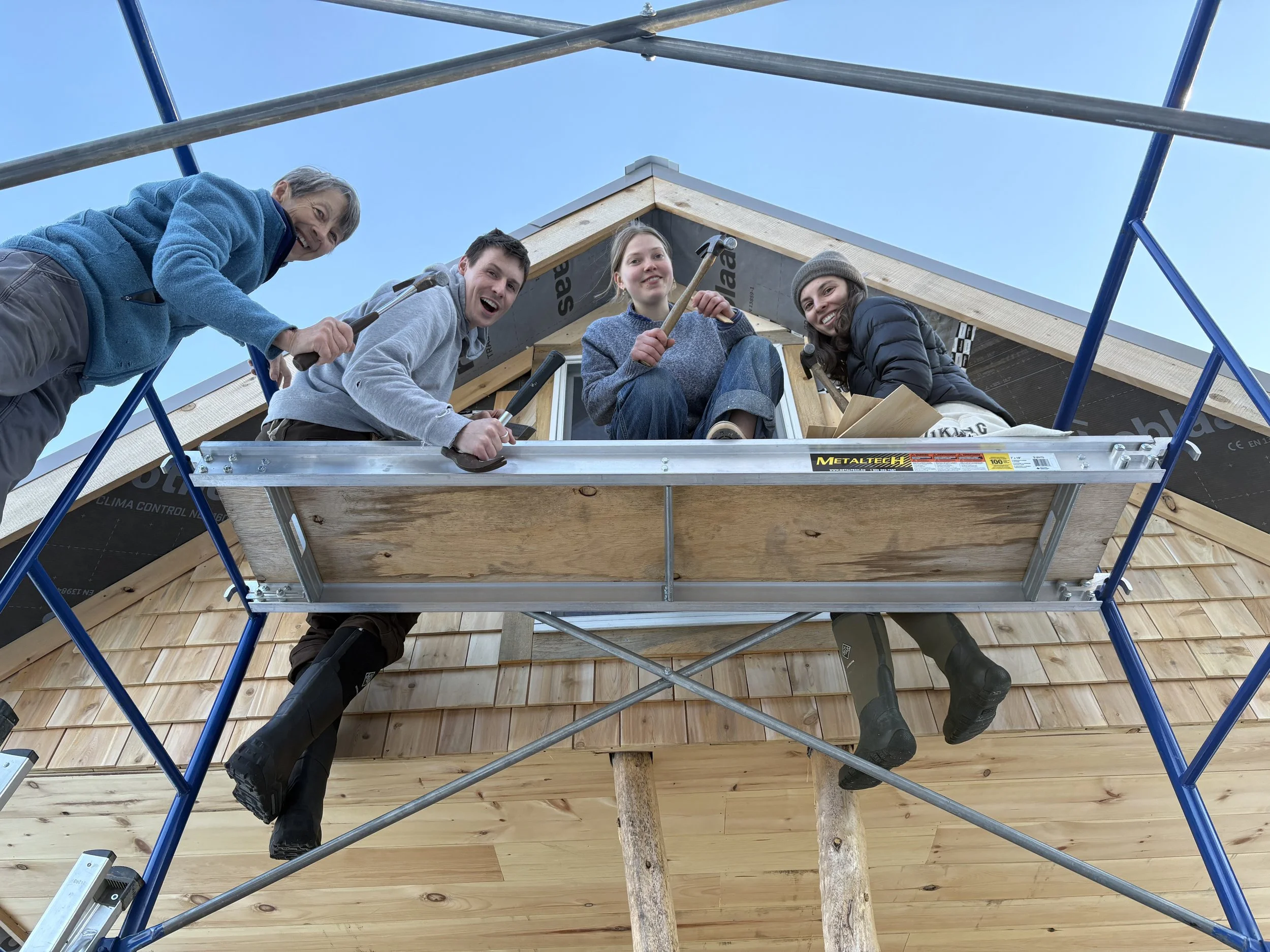
The A-Team

Suddenly it has gotten very warm. We hit 60F both of the last two days. The paths, the driveway and the road are turning to mud. The front lawn is now snow-free. The orchards are still covered with snow, but the fields up the road are bare. The world is changing fast.

On Sunday the 8th our A-team assembled for our on-going building project. We’re shingling a new cabin we’ve been working on since last summer. There were no cold hands. Jackets were tossed aside for the first time in months. Not only that, we got a lot done.

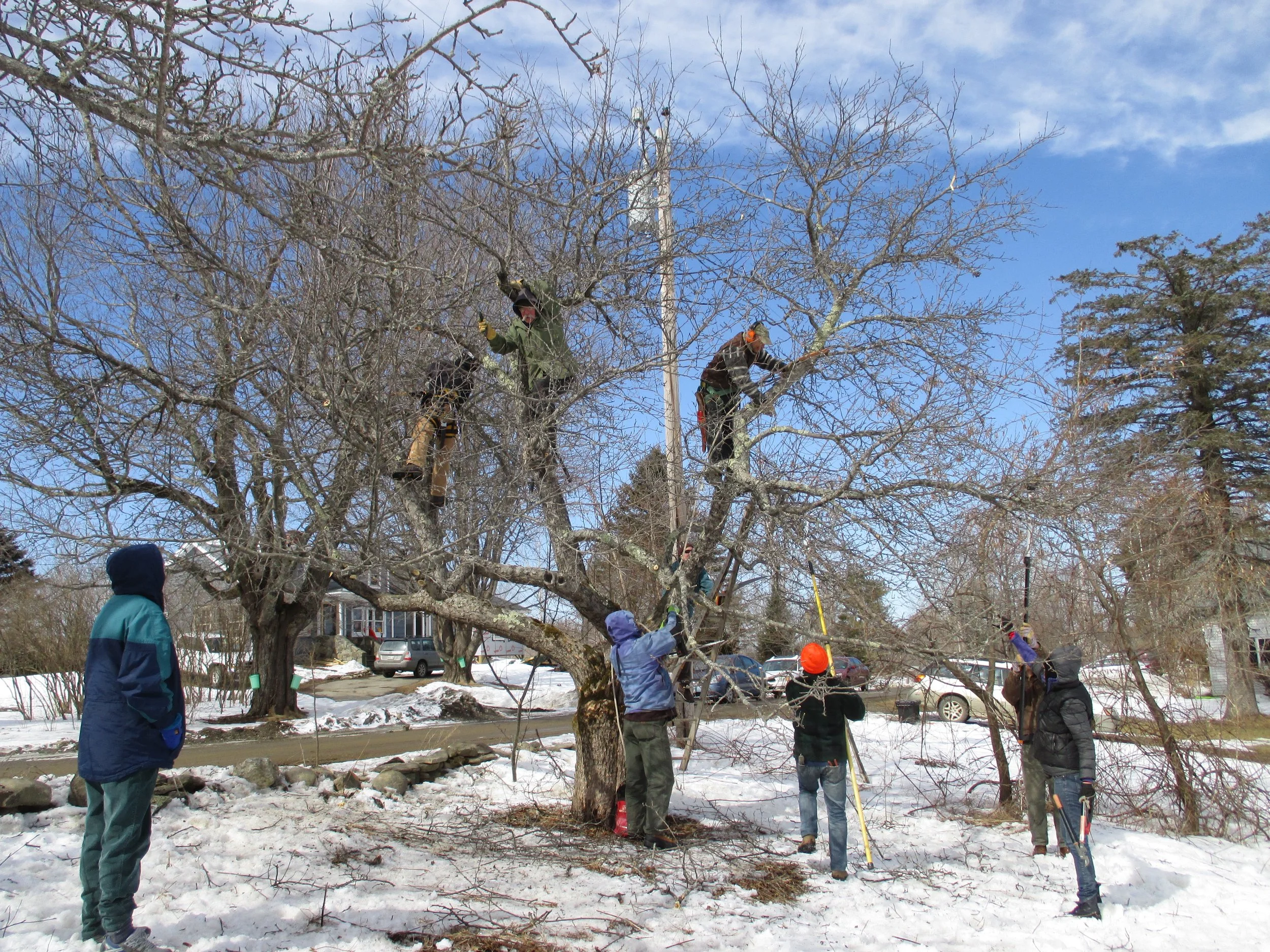
On the 9th Cammy and I pruned much of the day. She in the BRC orchard and me with the (ugh) chainsaw in the old Orchard. I don’t use the chainsaw much on the fruit trees, but it is useful to go over some of the older trees each year and cut out a large limb here and there. I’m a proponent of the “lite-touch.” After all the apple trees did fine without us for 3 or 4 million years with no pruning at all other than that provided by hungry bears, persistent porcupines, and the occasional windy day. We’ll be seriously into pruning most of the rest of the month. Whoopee!      

March 7, 2026

A basketful of scions

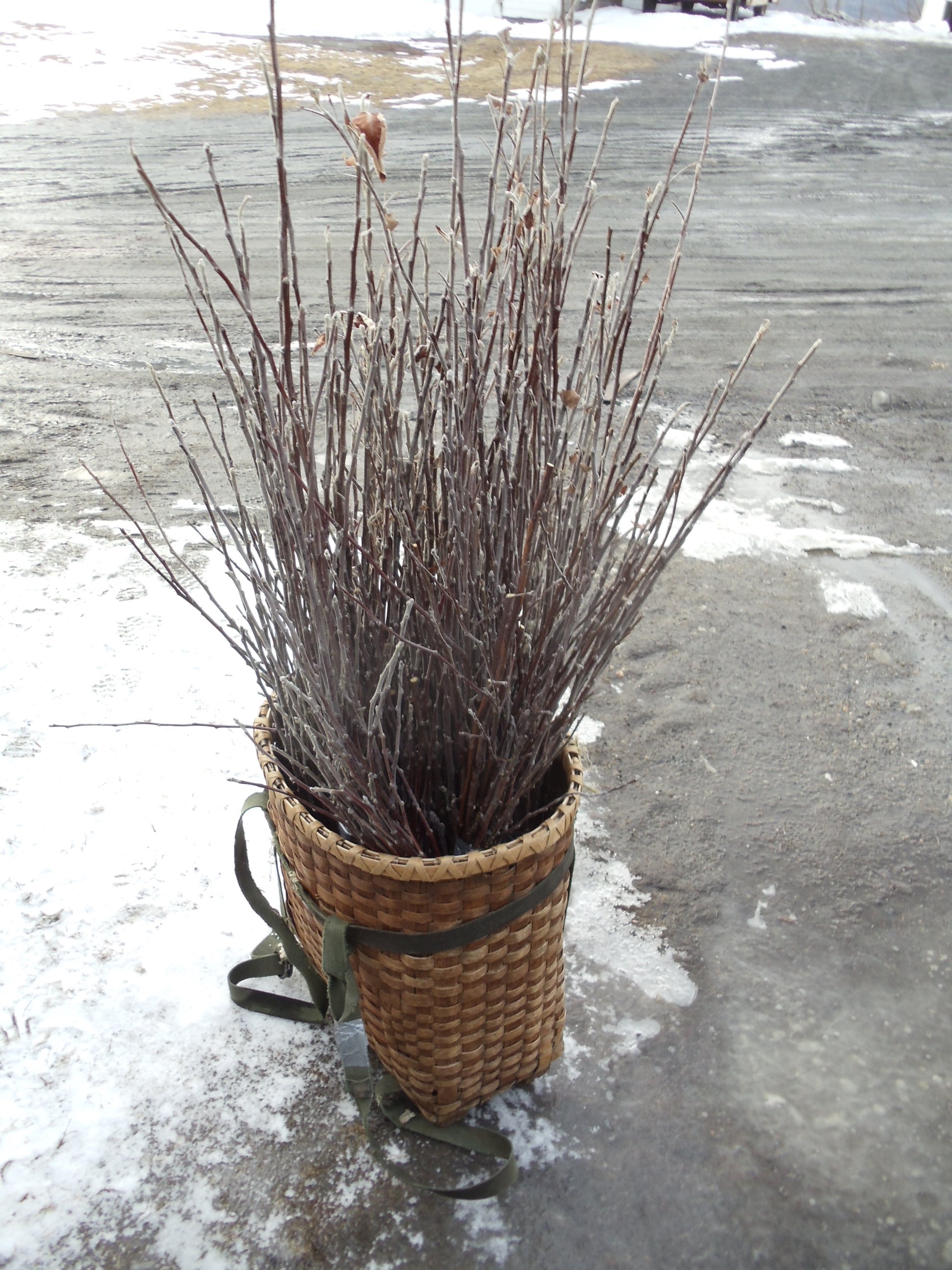
It’s not too late to order scionwood, but as March zooms along, the window for collecting scionwood is drawing towards its inevitable conclusion. We’re still cutting and will be for the next two weeks. If you’re interested in wood for grafting, please check out our list and place an order now. We also have an assortment of apple and pear trees for sale. Check them out too if you have a chance. 

Also, keep in mind that the 29th Seed Swap and Scion Exchange at MOFGA is on the last Sunday in March. It‘s exceedingly fun.

Speaking of which, I spent a chunk of today sorting scionwood. I double (or triple) bag it in plastic garbage bags and then store it in the basement where it’s about 45F. 40F would be even better, but 45 is fine. No need to wet it down or wrap it in damp cloths or paper towels. Never put it in the freezer!.

It rained early and was above freezing all day, though it never hit 40. It won’t be long until we can’t walk on the ponds. So we’re pruning back vegetation along the edges while we still have good access. March goes by too fast!

March 6, 2026

Embrace March

If you love the orchard, you know that March is the shortest month of the year—and the most wonderful. Sadly, it’s already a fifth of the way done. How does it go by so fast? It’s like a swirling whitewater stream in… spring. Or the slippery slope down an icy mountain. Or maybe just a tornado.

The calendarists say that February is the shortest month and that 30 days hath September, April, June and November and all that. But March has them all beat in the shortest department. March 1st arrives, you open the door, step out into the month, blink a few times and it’s over. The days are suddenly long, yet there’s not enough hours to get all the spring chores done - even if I get up early, go to bed late and am outside all day long in the sun, melting snow and the mud. Prune prune prune! Cut wood! Start seeds! Boil sap! Collect scions! 

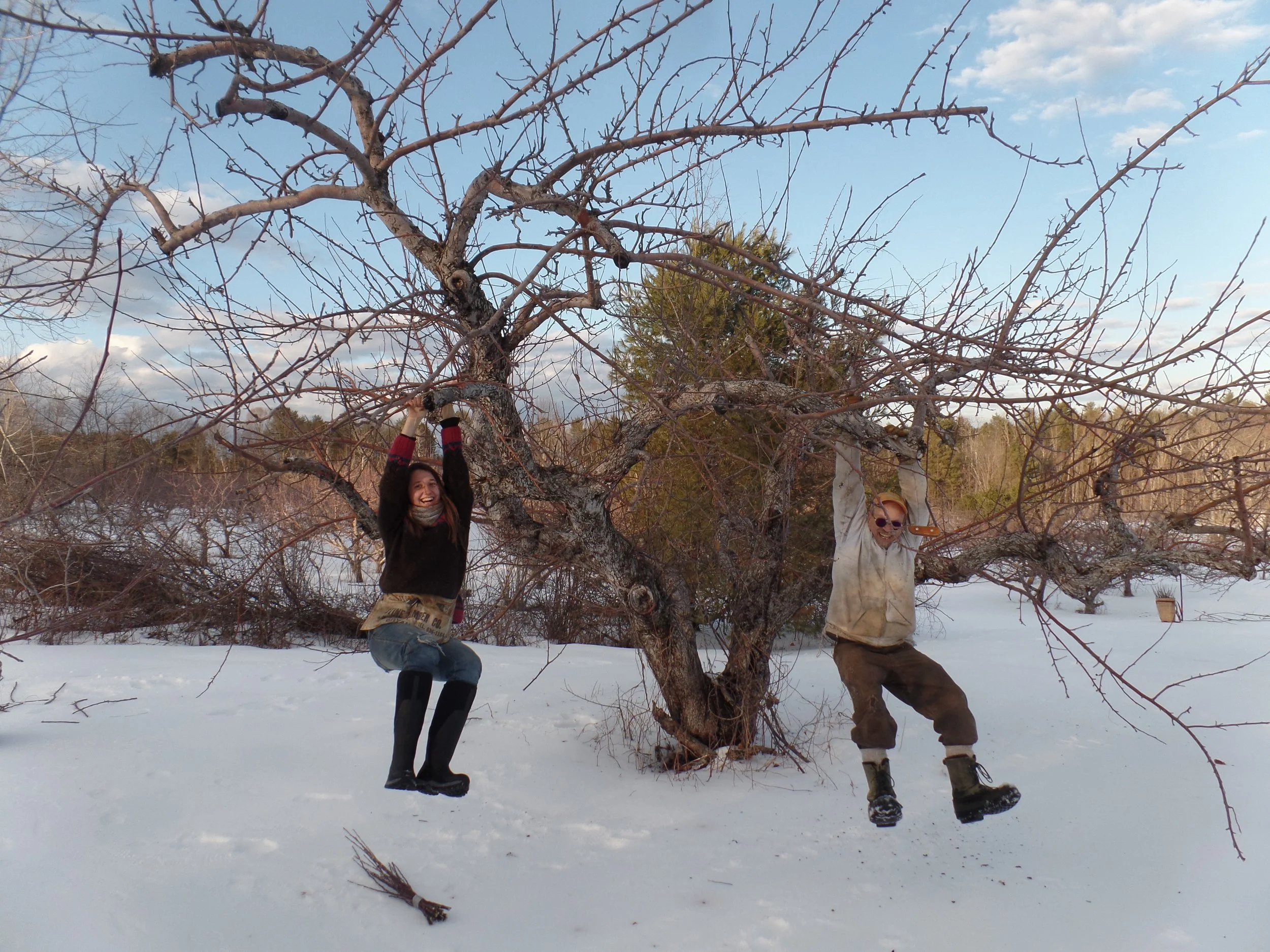
It could be that March is so short because I thought I had lots of time to do all that stuff in December, January and February and now—darn it—all those days are gone. Soon I’ll be digging trees again. So let others go to the islands and sit on the beach. I won’t miss them. I’m too busy here, swinging from apple trees, soaking in those glorious, windy, sunny, snowy, muddy, fleeting days of March.

March 5, 2026

Cosmic forces are coming to an orchard near you!

The warm-up begins. It’s nearly impossible to imagine that just a few short weeks ago it was -20F. Now it’s pushing +40. Cammy spent much of the day pruning in the “BRC” where battling back blackberry and raspberry canes is about 80% of the effort and 20% (or maybe 10%) is pruning the actual trees.

For me it was day two of the Stump Sprouts apple round-table. More inspiring talk, including a brief presentation on the philosophical foundation of Biodynamics, with a focus on the influences—in-streaming cosmic forces—coming into the orchard from Outer Space. This is where rigorous science meets some really way-out thinking. Scientists know this is happening and so did Rudolf Steiner and Sun Ra. The world (and space) is an amazing place.  

March 4, 2026

Pruning season

I left New Haven and drove up to western MA for the annual, apple-orchardists round-table known as “Stumpsprouts”. It’s an informative, thought-provoking and fun event where 40 of us sit in a large circle overlooking the beautiful hills of Franklin County and talk about growing apples - for two days.

Some people say a lot (hopefully not too much), and others don’t say much at all (more, please). There’s no pressure either way. Often the person who doesn’t say much winds up sharing the most profound and valuable insights. Mostly it’s about getting inspired and jazzed up to try some new practices in the orchard. 

A few thoughts from this year’s meeting (some of them pretty far out there):

  • Farm as ecosystem

  • What animals and plants to add to the orchard

  • Paramagnetism in the orchard

  • The trap of repeatability (wow)

  • Out of the impossibility (double wow)

  • The influences coming into the orchard from Outer Space (in-streaming cosmic forces)

  • Suctional space (Yes, suctional)

  • The fourth phase of water

Lots to think about as I headed north on the long drive home. Meanwhile Cammy was pruning our BRC orchard. Way more practical!

March 3, 2026

“… it’s not only the owls that have been acting oddly today.”  (Harry Potter and the Sorcerer’s Stone p6.)

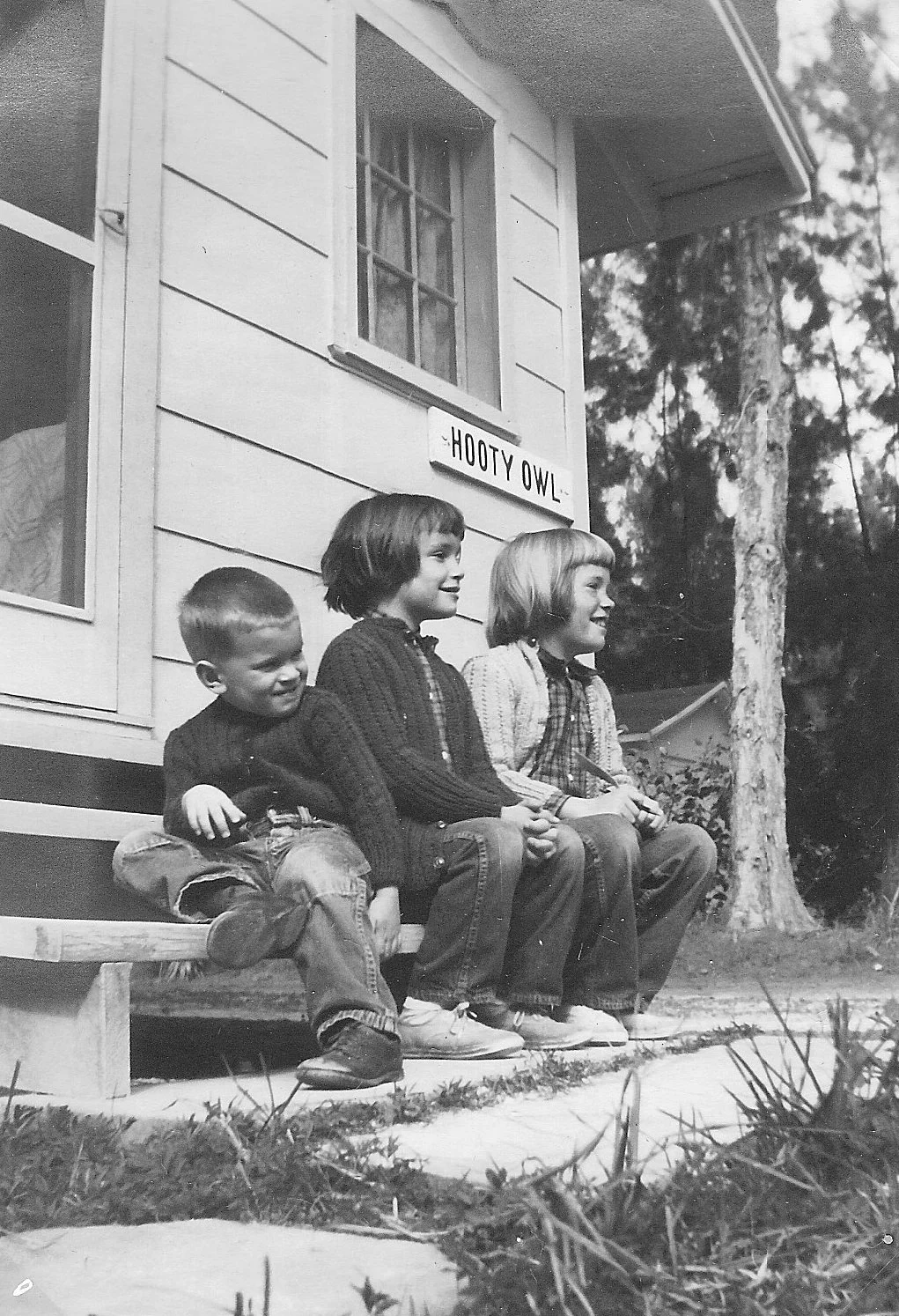
John and hi sisters, Jane and Kathy, with the wise old Hooty Owl, Siesta Key, FL, 1954

After my encounter with the Barred Owl yesterday, Iearned that at least two of our friends in the area had similar encounters with owls recently. Could it be that the wise old owls are telling us something? As readers of the Harry Potter books know, owls play a vital role in all seven books. A very different Harry Potter is our neighbor just a bit up the road, and it was that Harry Potter who sold us the land we call “Finley Lane.” 

We live in an amazing world. A world of direct experience and imagination. Our imagination can trap us in fear, desire, disappointment. “What if it doesn’t rain this summer and the trees all die?” “What if it’s 20F during bloom?” “What if fire blight comes back?” So many things to fear. So many things to want or to disappoint. But our imagination can also set us free. As Sun Ra said (and I paraphrase), “We’ve tried the possible and it has failed. Now let’s try the impossible.” When we free up our thinking, we get to imagine how our orchards can flourish and thrive, how our trees can dance, and how we can dance with them.

When we focus on the experience of life, we get to notice that we are the miracle. Today I was at Yale University where I taught a group of students how to graft apple trees - only a few bandaids needed, and one quick trip to the local urgent care. (Those knives are sharp. Grafting is surgery, after all.) They all got a chance to experience the sharp knife and the green scion and to imagine climbing someday in their very own trees. 

March 2, 2026

The temperatures took a bit of a tumble last night. It was -12F on the back porch at 6 AM.  I don’t remember  many nights below zero in March. But then again, it’s only two days in. 

The owl at Joseph and Phoebe Taylor’s house in Belgrade

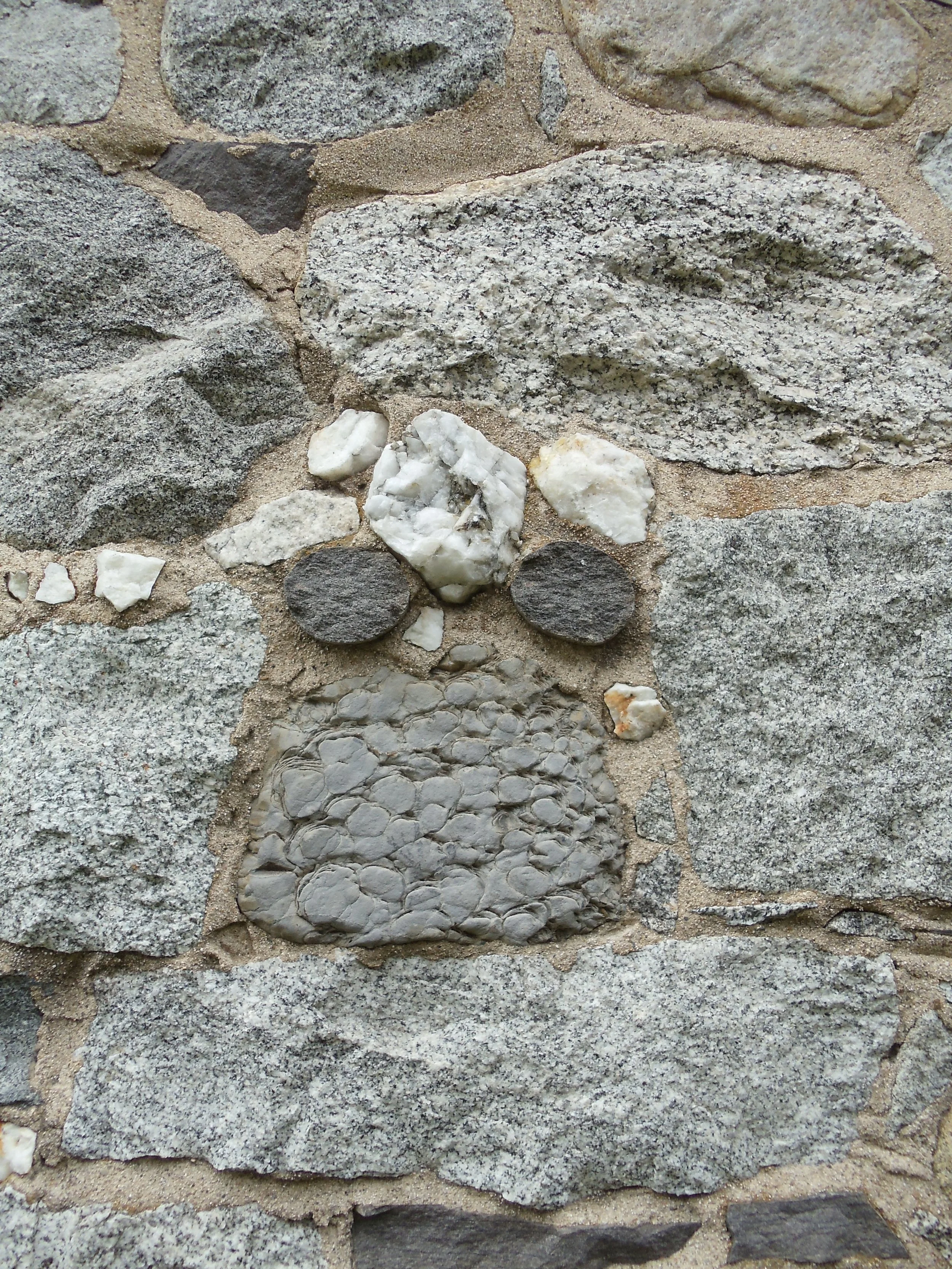
Today I thought more about my encounter with the Barred Owl (Strix varia ) yesterday, Nearly twenty years ago I was informed by a long-time Belgrade, ME resident that I was “the reincarnation of Joseph Taylor”. Taylor was a well-known, Belgrade orchardist (1804-1882) who introduced a number of apple varieties and lived in a hand-made, stone house that featured a stone owl mosaic in one wall. A Barred Owl no less! 

Friends had come for dinner the night before and asked me about how I fell in love with Maine and chose to move here. I recounted the story of my ‘relationship” with Joseph Taylor. Not that I believe in reincarnation, but who knows? I haven’t heard a more plausible explanation for why I had this instant connection with Belgrade at age 11. I could plunge into the many ways that Taylor and I are connected despite living nearly two centuries apart, but suffice it to say that we both love apples and love to work with stone. He had a stone owl in his wall, and we have one in our chimney. 

The day after this conversation with friends, a Barred Owl appeared outside the window. Could it be JT himself, finally coming to check me out?  Although in yesterday’s post I made an effort to translate a bit of what he said, could it be that not a word was even necessary? 

As Mother Goose put it:

The wise old owl sitting in the oak
The more he heard, the less he spoke
The less he spoke, the more he heard
Why can’t we all be like that wise old bird?

With apologies to Mother Goose, I could add:

The wise old owl sitting in the cedar
Quietly by the old bird feeder
Can you imagine my surprise
When he looked into my eyes?

The wise old owl from Belgrade, Maine
Joseph Taylor was his name
He came to visit yesterday
He had a couple things to say.

He spoke to me about the plight
Of focusing on wrong and right
He turned his head without a sound
“It’s not so hard,” he said, “just look around.”

“Listen carefully to the bees
The birds, the bugs, the apple trees
They all have a lot to say
That will guide you on your way.”

The wise old owl understood
That peacefulness is always good
“Be kind,” he whispered, “don’t think too much
Spread love to everyone you touch.”

The wise old owl sat on the branch
By design or maybe chance
He didn’t tell me where to go
He just stopped by to say hello.