May 11 2026

The cold weather continued. Don’t put away the sweaters yet. Even the trees are shivering. The birds are still rallying around the feeders, including a colorful Rose-breasted Grosbeak. They typically pass through the farm en route north just about now.

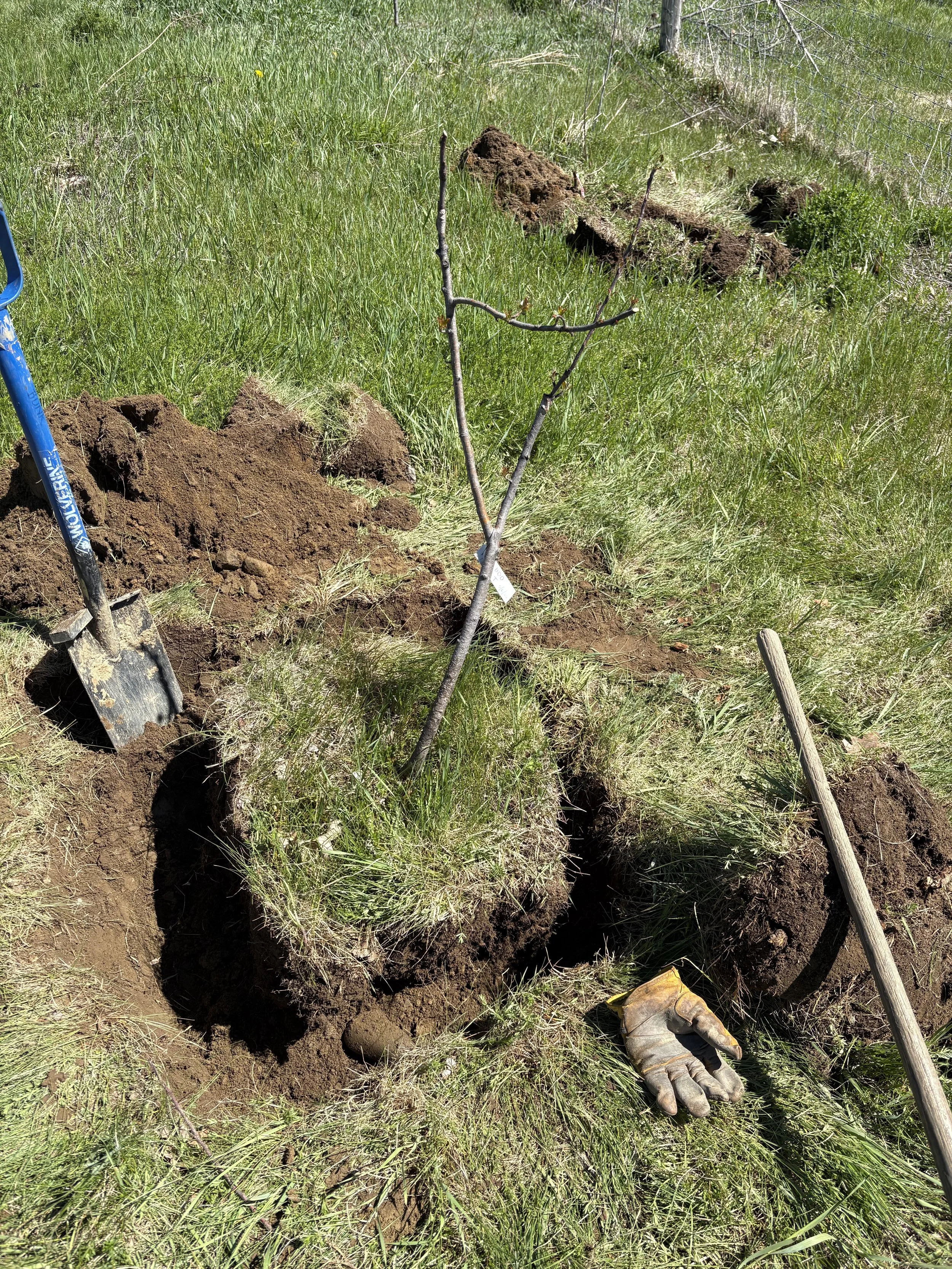
Apple square, May 11, 2026

We stayed warm by working in the nursery, digging the bed for this year’s new batch of 200 grafted trees and planting asparagus. We also moved one apple tree about 15 feet. It was in a less-than-ideal spot, and it seemed like a good idea to relocate it. I cut a big square, and Cammy and I wrestled the heavy block over to it’s new home. It was relatively compliant, and I think it should be happy. It’s an unidentified yellow and russeted apple from Buttermilk Hill in Belgrade, one the Gawlers call “Sueboo Russet.” We had it DNA profiled and the results came back “unique.” Another mystery to solve.   

In the afternoon we went to friends and did some topworking for them. It really put our grafting magic to the test: despite being May 11, the bark was barely slipping. 

May 10, 2026

I created two new planting beds in the BRC orchard. Both will be sites for new companion plants. At least one will have a new apple tree. Over the past few year I’ve piled brush in the two spots—each about 4 feet wide and forty feet long. Today I laid old rotten hay over the surface, dug the tree hole and then partially filled it with gravel. The gravel will act as a bit of drainage as well as a medium for the tree roots to get established. Eventually I’ll cover the entire surface of the two beds with composted manure and woodsy soil I get from an old pile of decomposing stumps.

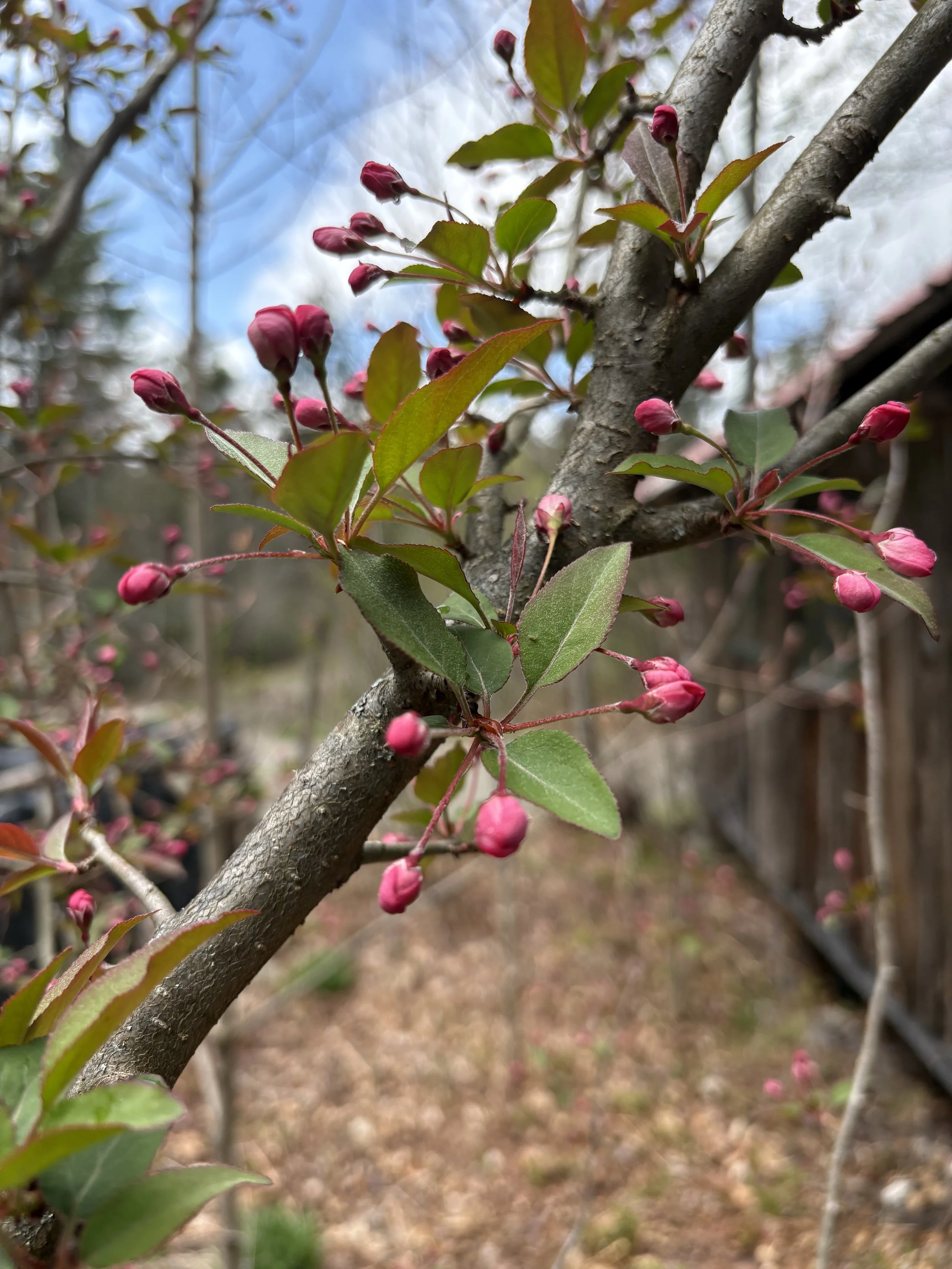
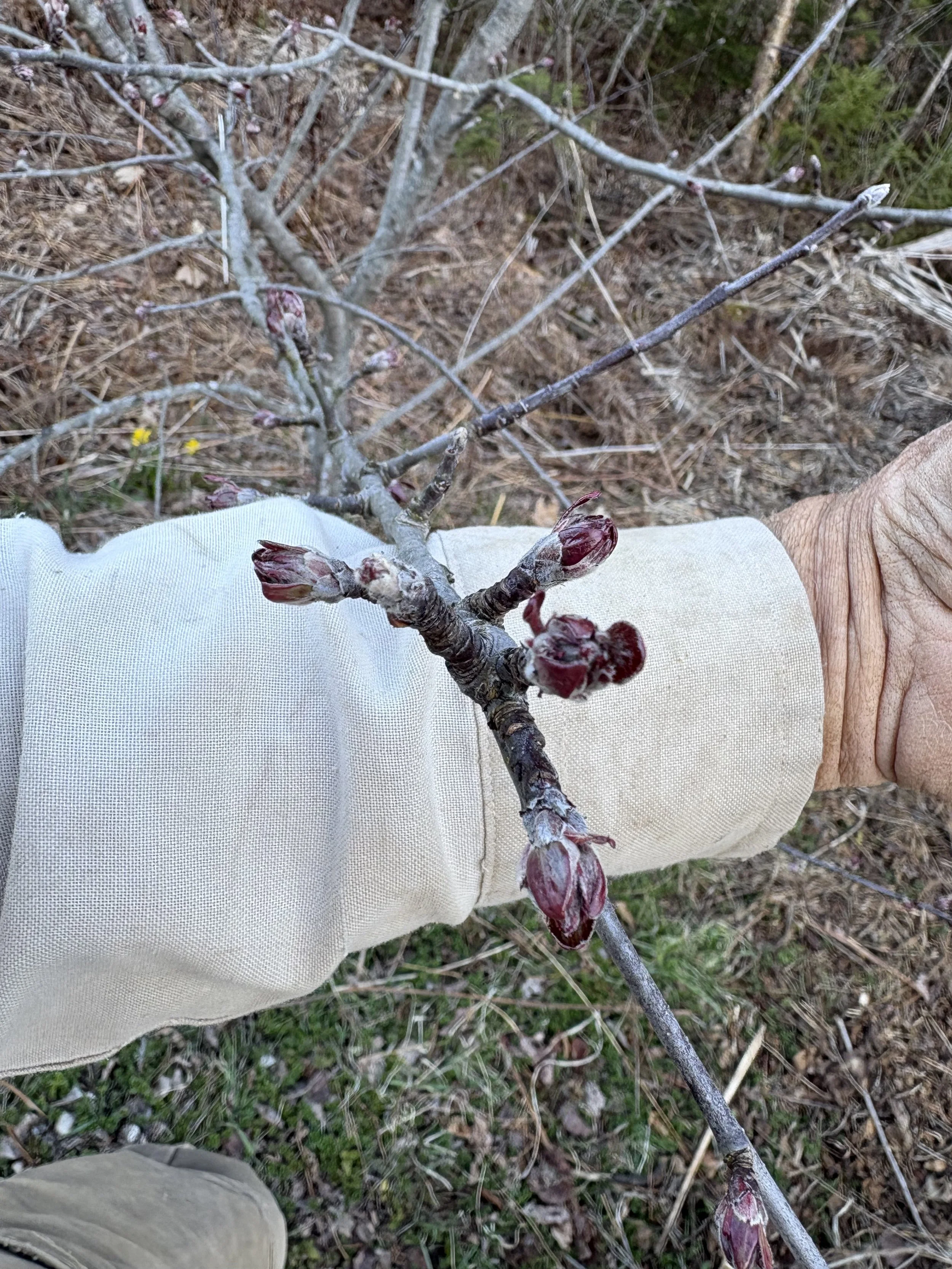
Malus hupehensis buds, May 10, 2026

Meanwhile Cammy dug trenches for more asparagus. Love that asparagus!  We have a large bed but one of the three rows has never done that well so we’re adding plants to that row. Plus, another totally new row for good measure.    

The temperatures remain cool, and we had a brief but insistent shower in the middle of the afternoon. Enough to convince us to come inside. Malus hupehensis is at “pink” now, suggesting it will soon be blooming. I’ve read differing stories about its common name: Tea Crab. Some suggest that the leaves make a delicious tea. Other suggest that it was a tree to sit beneath and drink “real” tea. Either way, it’s a beautiful tree.   

May 9, 2026

Today started out clear and cold (24F at 6 AM), then clouded up after noon and began to rain. But that didn’t thwart our annual celebration of Beltane when we mark the half-way point between equinox and solstice. A group of friends joined us, as they do every year, and we shared readings and stories, ate a long leisurely meal and immersed ourselves in the incredible power of friendship and the return of the growing season. 

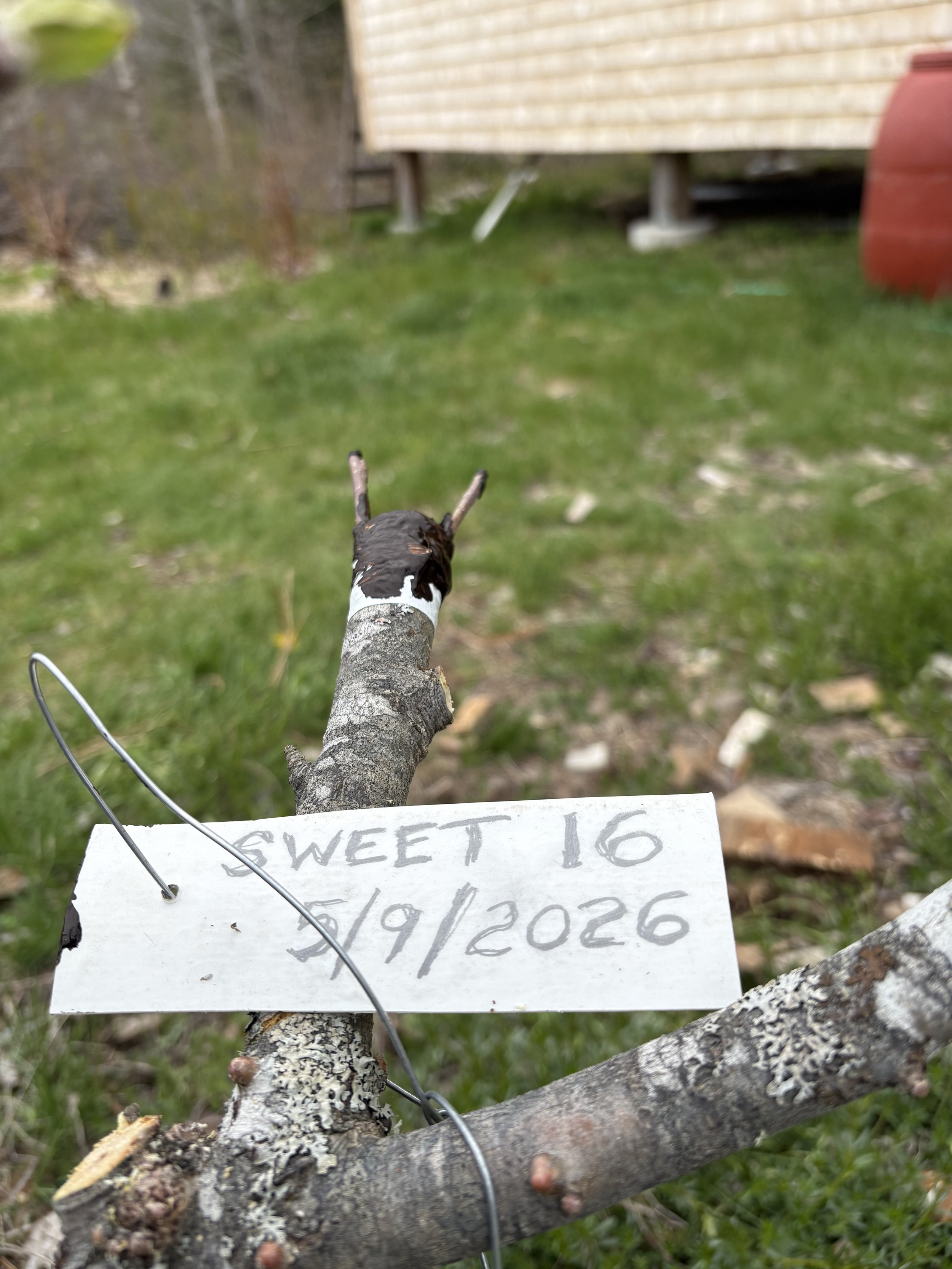
First graft this spring, May 9, 2026

Beltane is an old Celtic celebration, one that dates back many centuries. We like to honor the tradition because it’s yet another chance to notice the magic and mystery of the Universe. We may not celebrate the way the pagans did in pre-christian days (no sending home the guests with a burning log from our fire), but we do have a riotous evening, and the clock struck twelve long before we hit the pillows. 

Just in time for Beltane, the Juneberries have opened up. I did a test graft out in the Finley Lane orchard. The bark is slipping so I’ll be topworking in the next few days. So much power in this Earth. 

May 8, 2026

Spring farm activity is now in full-tilt swing. Although we don’t get rolling as early in the morning as we did in the olden days (think “the old gray mare, she ain’t…), still we cherish the hours in the gardens and orchards and spent well over eight hours outside today. We could have done twelve.

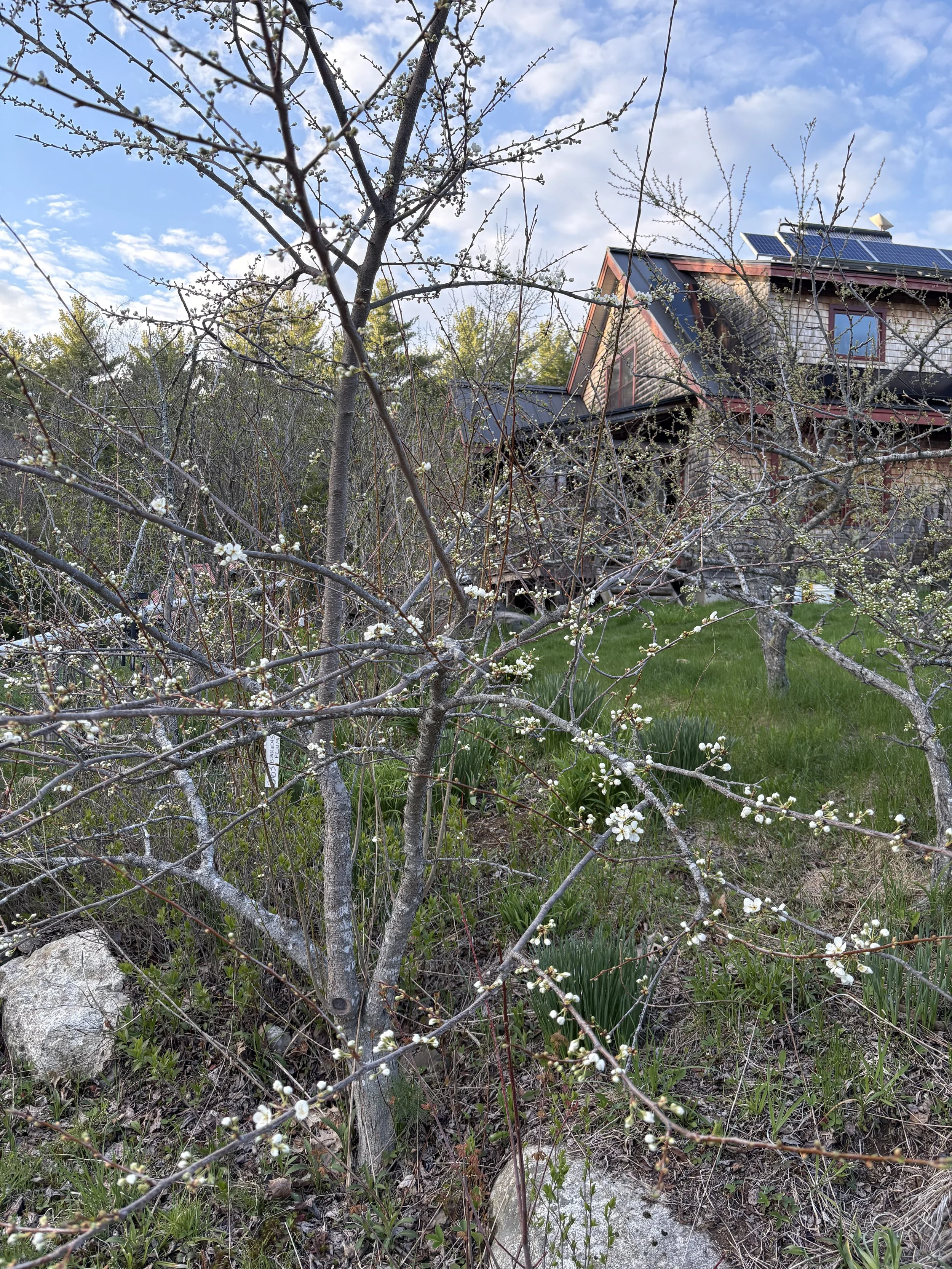
Prunus ussuriensis, May 8, 2026 

Among other things, Cammy cleaned out the chicken coop, potted on brassicas, transplanted lettuce and weeded various gardens. I dug a few more trees for sale, moved a lot of manure (chicken and other) and cut a bit more firewood. I’m extra careful when I cut trees and brush now as I don’t want to cut down any bird-nesting sites.

The Asian plums (Prunus ussuriensis) are opening up, right on cue. A few of the apples are showing a bit of “pink.”   

May 7, 2026

Young grafted trees, May 7, 2026

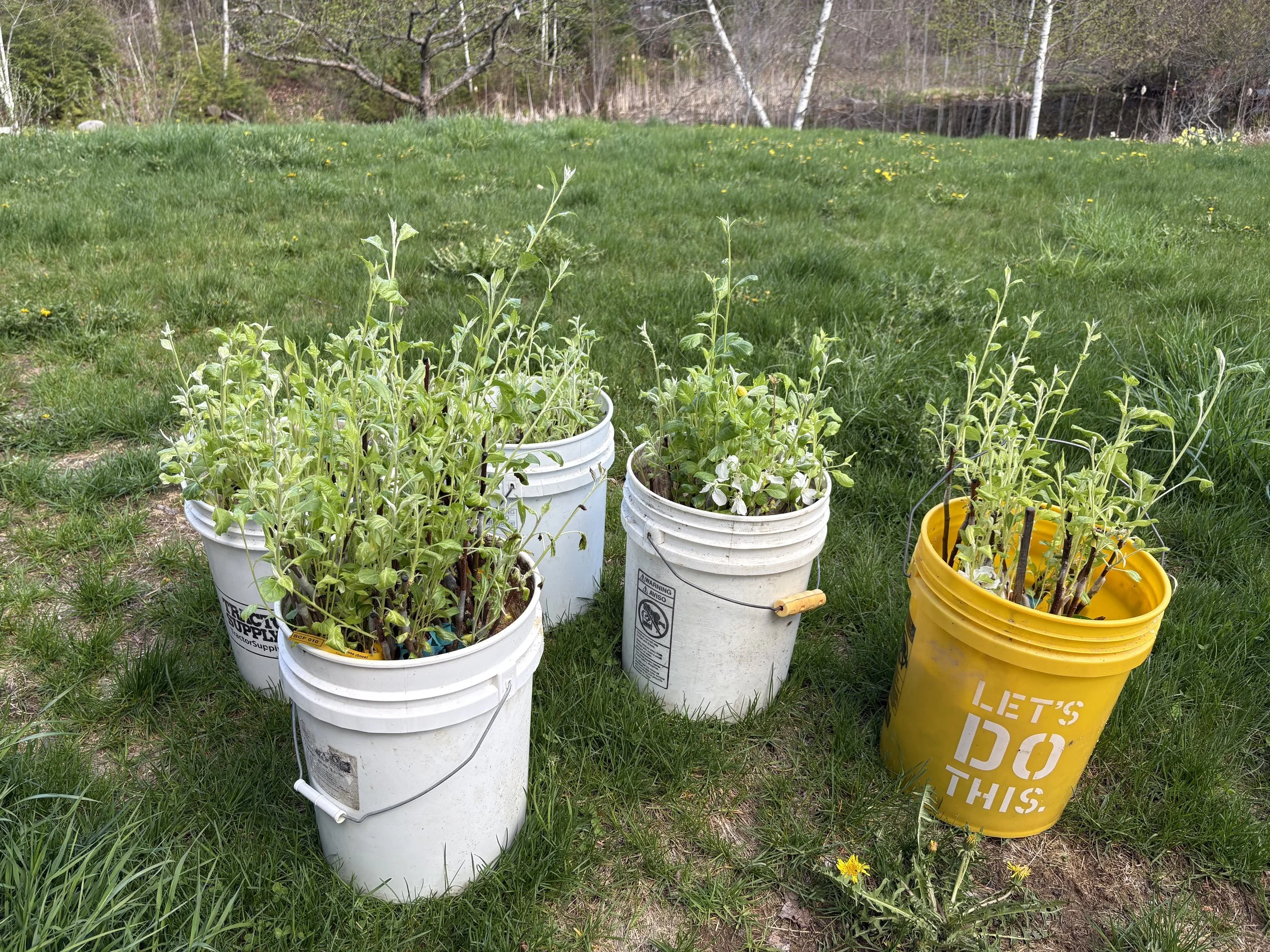
Great to be back home and out in the orchards again. I spent most of today going up and down the rows of apple trees, taking notes on their conditions. I wanted to catch up on how each tree is doing and at what stage they all are. Many are at about 1/2 green though others are barely showing any green at all. None are in bloom. I was also checking out potential topworking sites for about a dozen new cultivars I’m adding to the collection. Looks like there will be room for them all. At home I moved the buckets of young grafted trees outdoors where they can harden-off. We’ll plant them in the nursery next week.

The temperature was cool, and I wore a sweatshirt and a sweater all day. The dandelions (Taraxacum spp) and violets (Viola spp) just bloomed today for the first time (presumably to celebrate my return to the farm.) I was also greeted by not one, but two black flies (Simuliidae family) who ceremoniously bit me on the neck.

In the evening Cammy and I went to the Colby College senior art show. We saw several of my “apple students” there, four of whom were showing their art work. Three of them showed us photos of the apple seedlings they started with seeds from the class. We’re changing the world, one new apple at a time.        

May 2-5, 2026

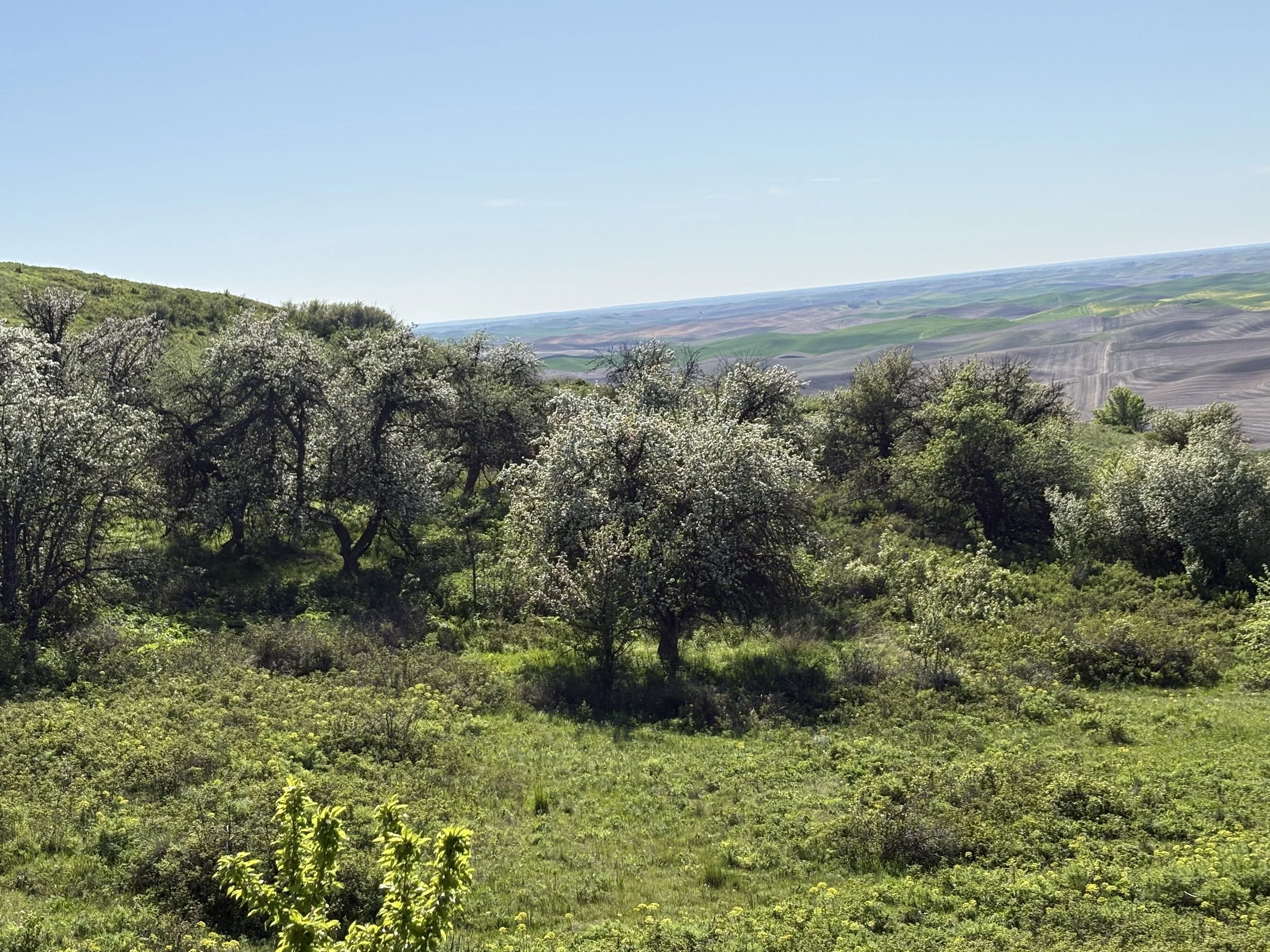
Old apple trees below Steptoe Butte, May 4, 2026

I just returned from a trip to eastern Washington and western Idaho where Skylar and I were visiting apple colleagues and friends as well as meeting apple explorers, breeders, geneticists, enthusiasts, preservationists and more. It was a fantastic trip. We spent our time in the area of Pullman and Spokane as well as over the border in Moscow and Coeur d’Alene, Idaho. We did not get over to the mega-orchards of Yakima and Wenatchee, but that was fine. We had more than enough to keep us excited, awestruck and inspired. 

Eastern Washington is a vast, wide-open landscape. It’s the largest wheat-growing region in the US—maybe even in the world. The topography bears no resemblance to central Maine. You can see for a very long way no matter where you find yourself. At one point we were standing in Washington, looking over Idaho and seeing Montana in the distance. The annual rainfall (20”) is about half that of central Maine. 

Despite the differences, the two places have one very interesting thing in common: just as in Maine, there are apple seedlings growing along nearly every roadside as well as in gullies and anywhere else there’s a bit of water. We saw hundreds of trees—some grafted and others seedlings—many of them exceedingly old. They were at also near peak bloom which made them very easy to find. I felt right at home!

Our hosts were Cameron Peace of Washington State University and Dave Benscoter of The Lost Apple Project. We spent time in Cameron’s DNA lab, the WSU test orchards, their breeding project, greenhouse and more. Dave led us on two fruit exploring days including up Steptoe Butte where we “met” hundreds of exceedingly old apple trees.  

It’s impossible to document everything we did. It was a truly inspirational adventure. I came away with even more appreciation for the amazing apple. Although the cultivars (varieties) we know and love may not last forever, (some of them are already gone), the apple tree has embraced North America and will be here forming communities, fruiting and feeding humans and other creatures for lifetimes to come. Many thanks to Cameron, Dave and everyone else for an incredible trip.  

March 22, 2026

Poorman’s Fertilizer, March 23, 2026

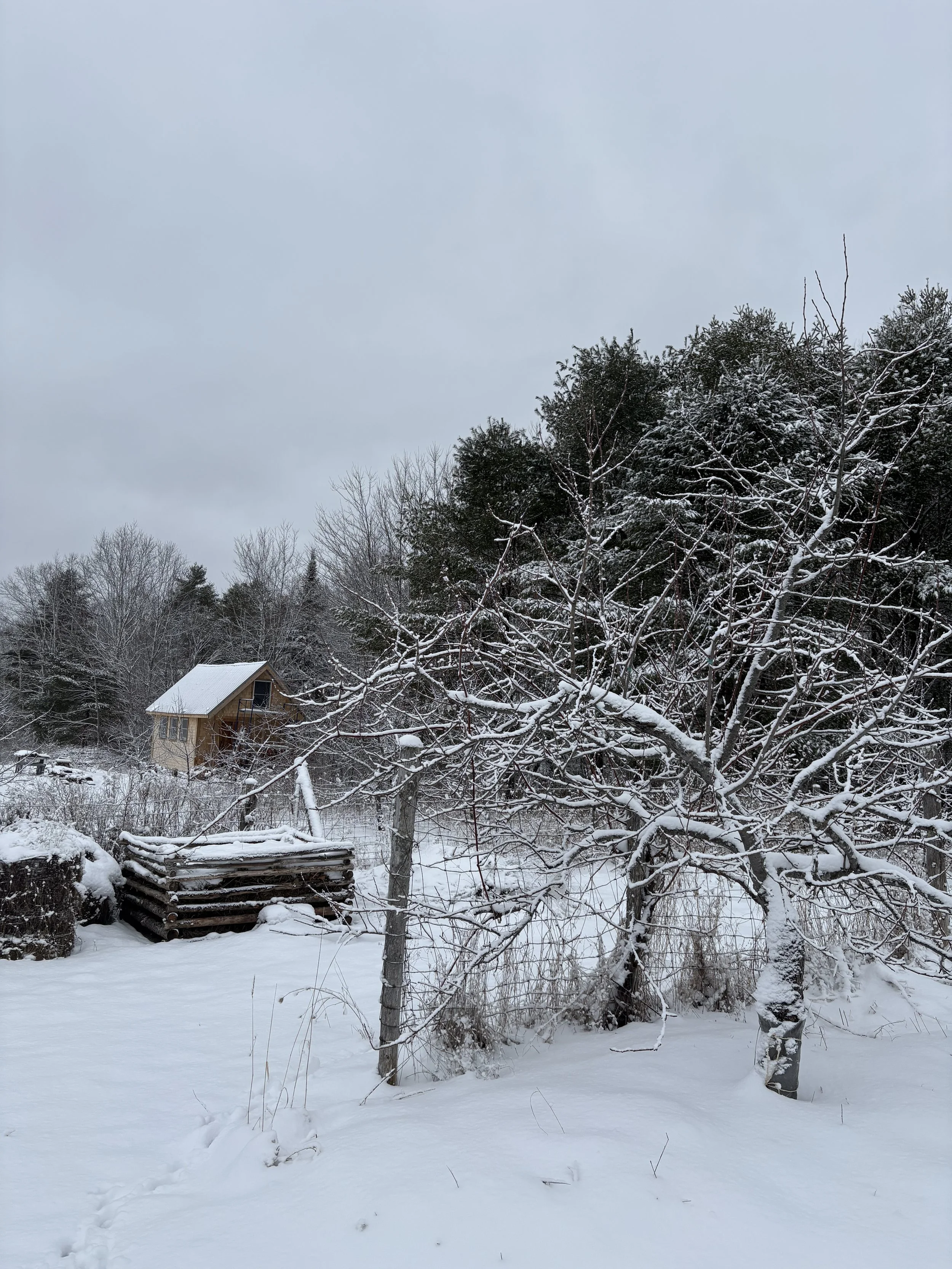
As Johnny Horton sang in 1959, “When it’s springtime in Alaska, it’s forty below!”  It wasn’t quite forty below today, but it did look like Day One of the Iditarod. The snow came in with a vengeance. It started an hour after sunrise and was still going strong at dark. In the end only 6-8” fell, but it was still what I call a regulation snow storm. 

Those spring snows: are they The Poorman’s Fertilizer? According to a friend, only snow after April 10th—the official Poorman’s start date—can be considered as such. April 10th is also the official “return of the Canada Geese” date. Every year I hear them fly over the orchard on the 10th. Maybe these two seemingly unrelated events are not so unrelated. (Like so many things.)

Though the ground is still frozen down under, the surface is softening up, and when this latest snow melts, much of it will be absorbed into Mother Earth. The plants will be glad for it, and we will too. The magic of Water. The snow this past winter has been almost entirely of the dry kind. We had hardly any days over freezing for all of January and February. But the snow today is the wet kind. It’s heavy. Were it dry, it might have been a foot deep. Were it rain, it would already be gone down the Sheepscot River en route to Wiscasset. This way it has a far better chance of getting put to use in the orchard. Give me snow in March!

March 31, 2026

And so wondrous March—the shortest month of the year—comes to end. Hello Spring. Goodbye Winter. Hello. Goodbye. With its cold rain and dwindling snow, its cleansing winds, its powerful light and the rising of an energy that will soon explode into the orchard, March sprints by as it does every year. How can a month go by so fast? If only March was three weeks longer. Too late to stop it. It’s time to say, “Go, go, go!” 

The rain did come last night and lasted into the morning. By noon, however, it was gone. It was ice-out on the pond in the center of the BRC Orchard. The first bulbs are emerging from beneath the apple trees. We planted them there to stand guard and fend off the voles. No damage noticed yet this spring. It appears they’ve done their job for another winter.

Hello Goodbye. Hallowell March 31, 2026

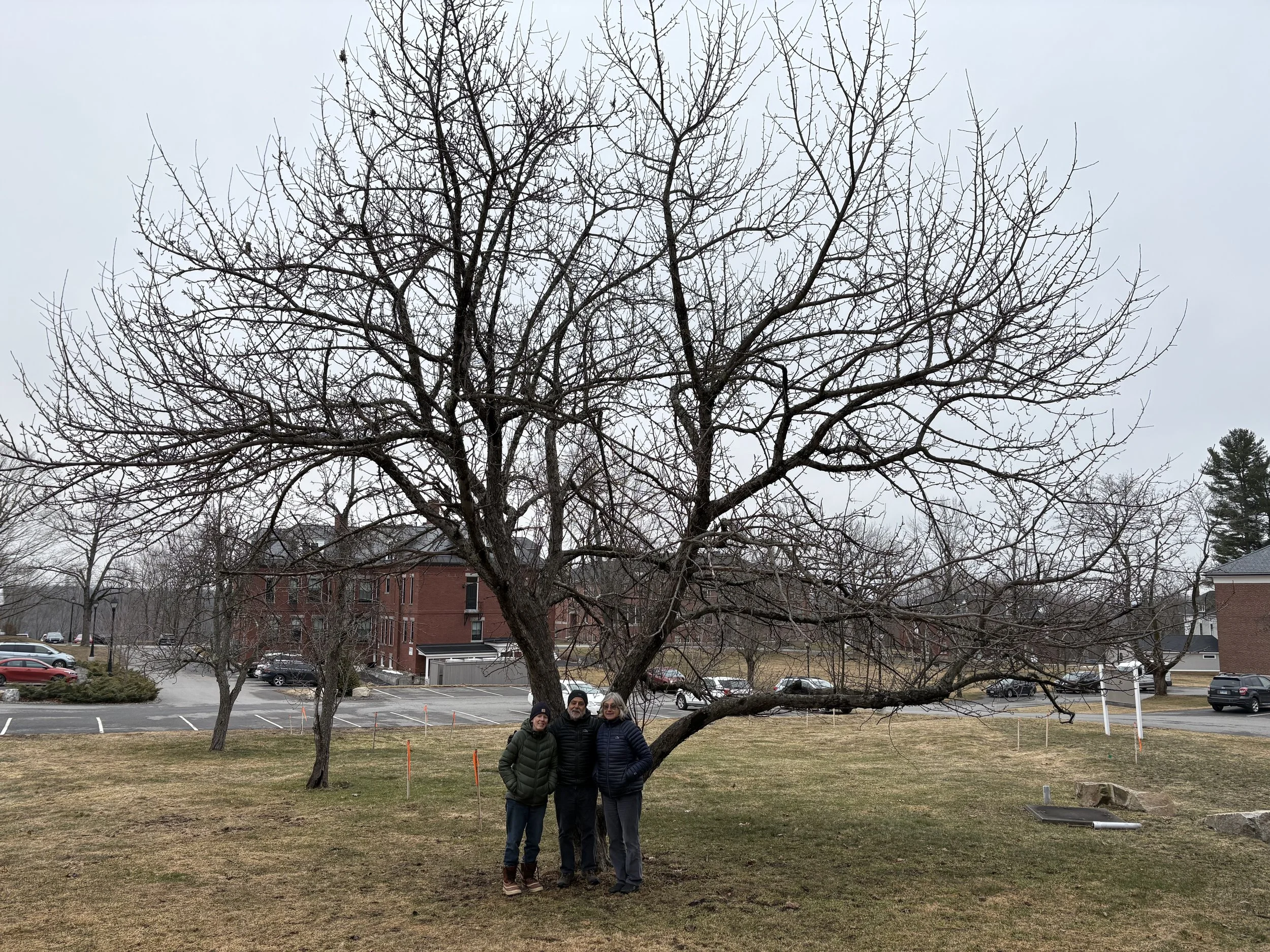
A little sun in the afternoon. I went to Hallowell to commiserate with six trees—4 apples and 2 pears—that will be cut down in two weeks to make way for a new college dorm. There’s apparently some logic there though I can’t find it at the moment. I took scionwood from one of the apples and one of the pears in order to graft new trees. The other trees will remain in the memories of those who joined me there this afternoon. Hello. Goodbye.

April 29, 2026

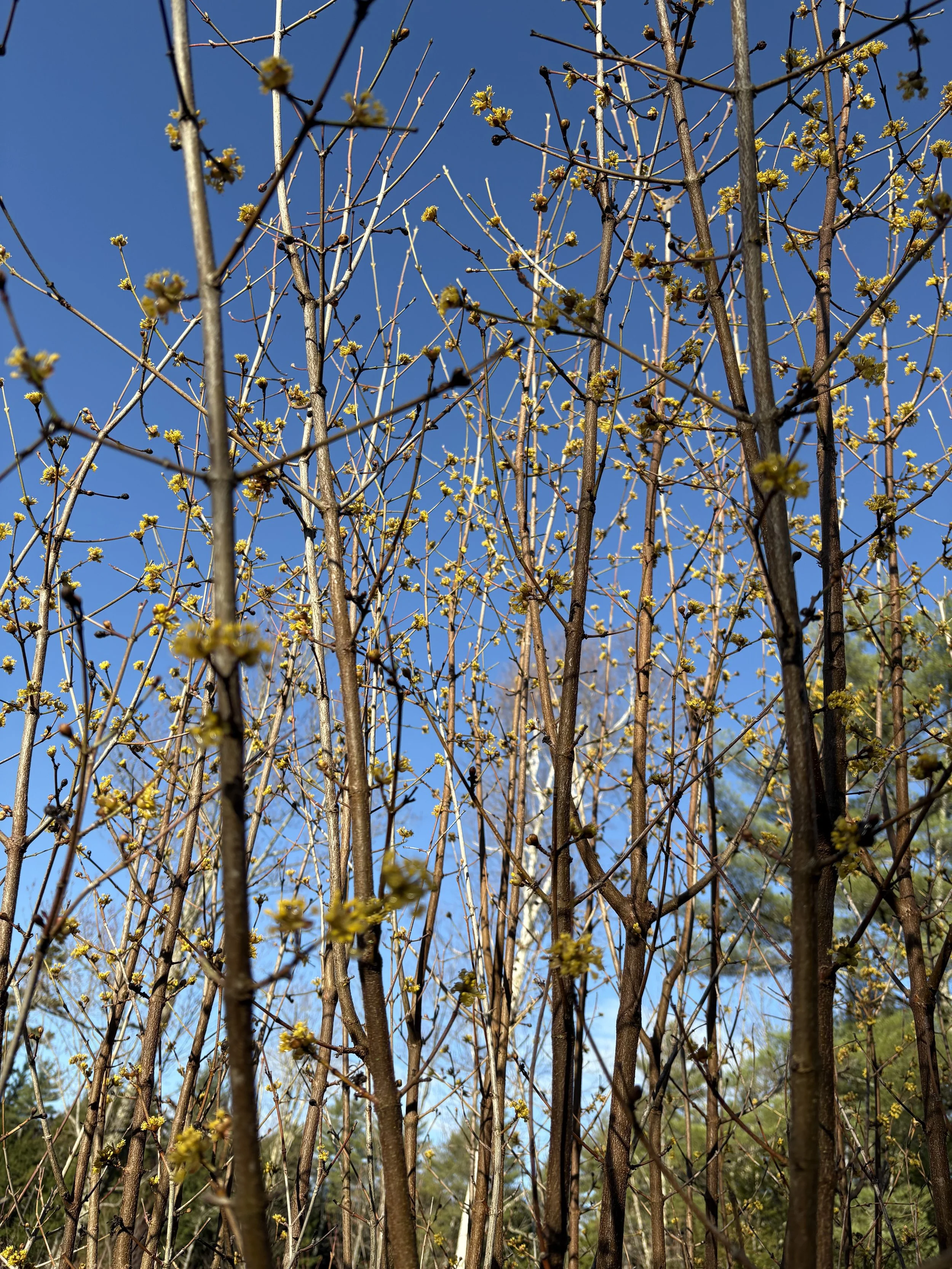
The Forsythia and the Cornus mas (above) are both out in full bloom

We were visited by several Myrtle Warblers. They were right outside the kitchen window at the suet feeder. Maybe “Myrtle Warbler” no longer exists as a name, but if you look at an old bird field guide, you’ll find it. I think it has been renamed the Yellow-rumped Warbler (Setophaga coronata). I may sound like “a broken record” but the birds have just been amazing this spring.

It turned out that I wasn’t quite done planting for the year. I found spots for two more apples: a Hunt Russet and what may be Monroe Sweet. Hunt originated in Concord, MA well before the Revolution. It was one of the first named North American cultivars and is a child of two of the most iconic European apples: Reinette des Carmes  x Drap d'Or de Bretagne. I should have planted one years ago. The second apple is one I was introduced to by Pam and Wayne Sweetser in Presque Isle. It may be the true Hayford Sweet or it may be one of the Monroe Sweets. I say “one of” as there may have been multiple different apples with that name. This one is a true sweet and worth saving. 

April 28, 2026

Pruning has ended for the year. With the buds opening and the trees waking up, it’s time to move on to other activities. That being said, I still had one more pruning job to do. I went up to our neighbor, Bruce Potter’s, and pruned six old trees: 3 apples and 3 pears. They hadn’t seen a saw in so long they didn’t know what they were in for. Bruce said, “a light trim, please.”  That reminded me of 1966 when I went to the barber and asked for “a light trim.” I came out  looking like I was heading for basic training. I did survive that dramatic hair cut and Bruce’s trees will too. Actually I think they look rather good. It was a big job; there’s a lot of brush to lug.

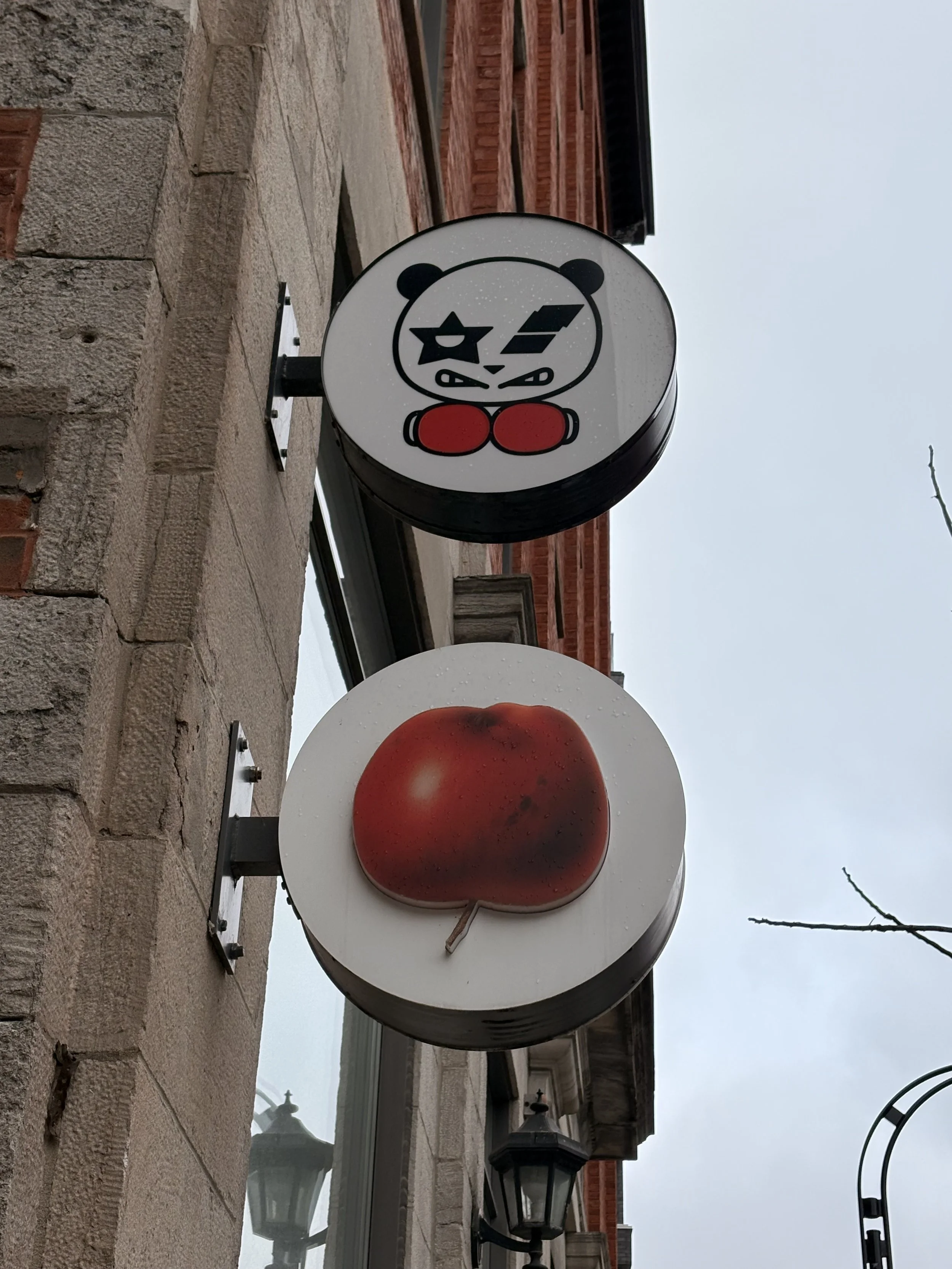
Montreal apple, April 2026.

I had time to cut a bit more firewood before that season also comes to a close. I don’t like cutting firewood when there might be birds nesting up in the trees. Cammy is up in Montreal visiting with friends. She sent this photo. Nice to know the Canadians know which end of the apple (and the world?) is right-side up.

April 27, 2026

Not only are the daffies dancing, the Tree Swallows have been dancing in sky above the orchard. Presumably they’re about to nest. They may be competing with the Bluebirds this year. Saw a male Bluebird this morning up at the Finley Lane Orchard. Meanwhile, the big feeder at the house is emptying once a day. So many birds! It’s been so cold that our various feeders may be the best deal in town. We had a Ruby-crowned Kinglet at the suet feeder this morning.

Emerging leaves on Niedwetzkyana, April 27 2026

Today I planted the last six trees at Finley. We planted 42 new trees up there this spring. I also went to Augusta to deliver trees for the Governor’s orchard at the Blaine House across the street from the Capitol. I’ll go back in May and topwork 3 or 4 of them. When I finish, they’ll have 16 trees, one variety from each of Maine’s 16 counties. Cammy planted peas, early carrots and beets today in the big garden. The first leaves are poking out of the apple tree buds. No more scion collecting this year. Spring is sprung!

April 26, 2026

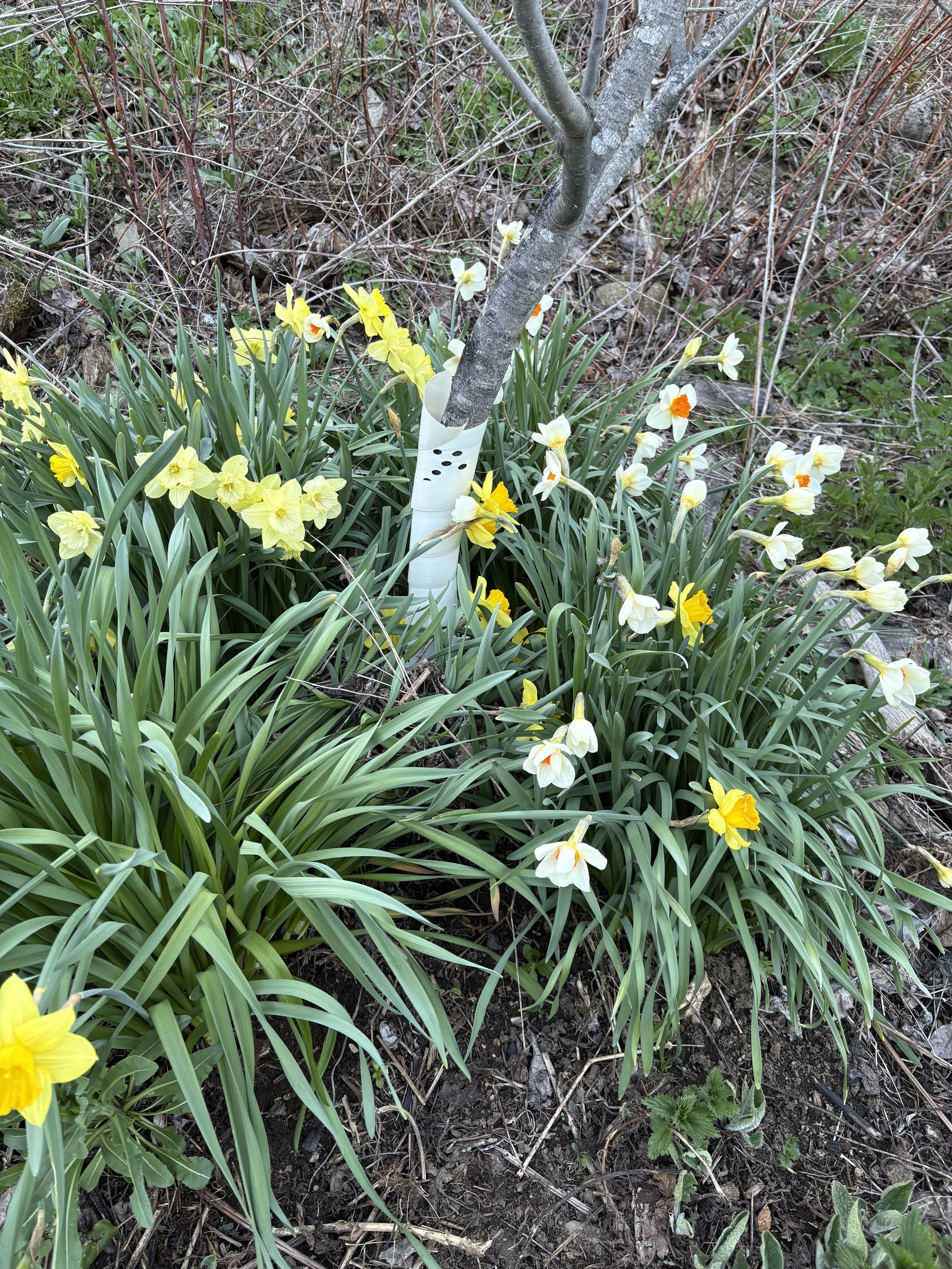
I’m not sure if the poet William Wordsworth was out in his orchard in April, 1802 when the daffodils were, “beneath the trees, Fluttering and dancing in the breeze”, but he could have been in ours. The daffodils are now dancing throughout the orchards. They are an integral part of the team. We planted them to deter voles, and they do a good job. It’s something about the scent or the vibe that the bulbs emit. We also put plastic “tree-guards” around the trunks of all our smaller trees (up to about 15 years old) to fend off the voles. This year we wrapped about 500 trees. It’s a one-two punch to protect the trees. 

The Winthrop Greening tree, April 2026

The daffodils will stay year-round but not so the tree-guards. They have done their work and will now retire to the barn loft for the next 6 months. In the summertime the tree-guards can attract the dreaded, round-headed, apple-tree borer. The borer loves the protected bark under the tree-guard plastic. It also covers up the sawdust-like frass of the borer when you do get an attack. So we remove many a bag-full of the spiral sleeves every April. all the while entertained by so many waltzing ( or rock ’n’ rollin’) flowers. As old Willy Wordsworth put it 224 years ago, 

 “And then my heart with pleasure fills

And dances with the daffodils.” 

April 25, 2026

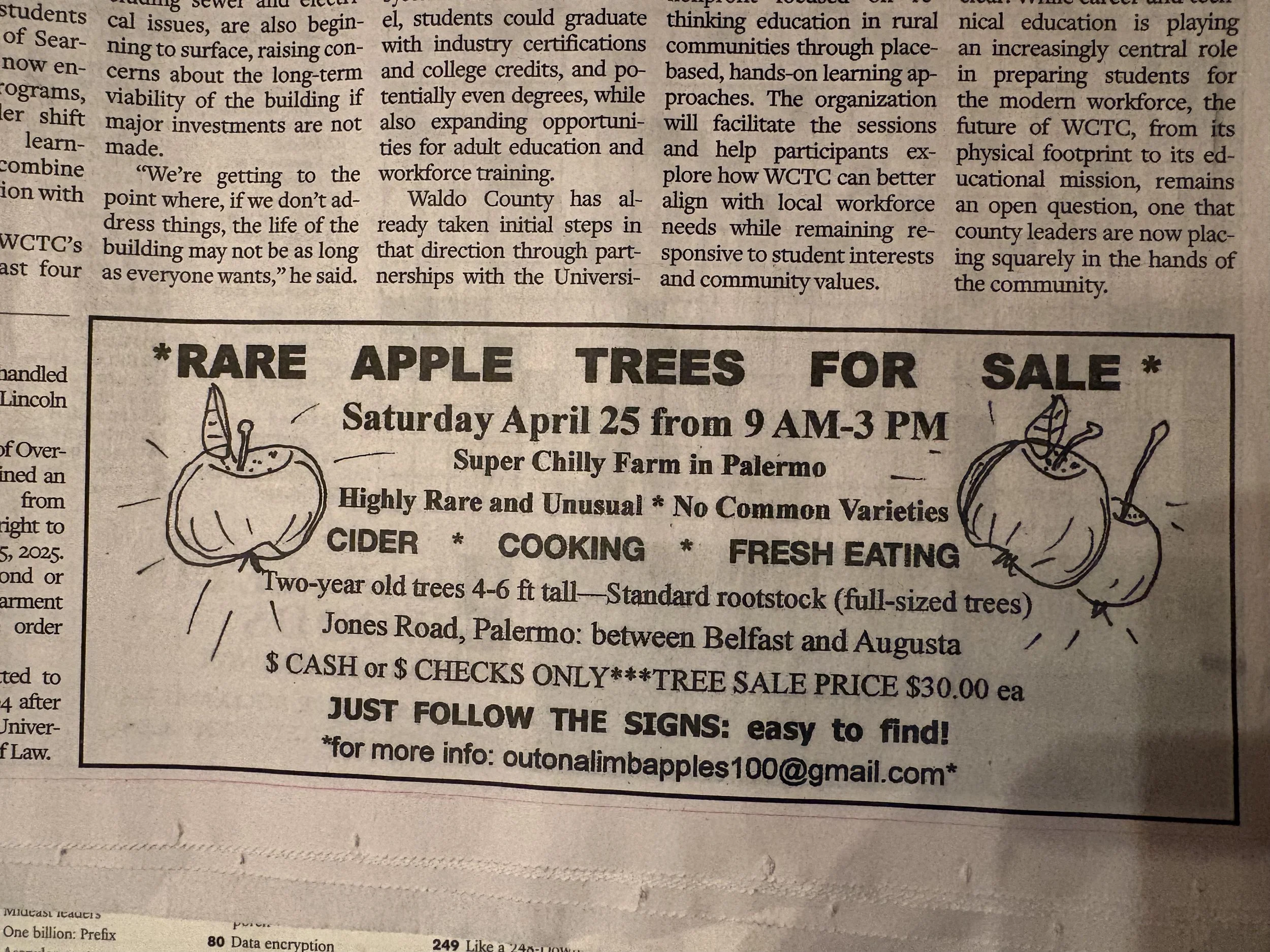
This morning and yesterday morning were cold. - both in the vicinity of 20F. Fortunately the trees are still dormant.  No flower damage yet. It warmed up by mid-morning, and the day was glorious. It was the perfect day for a Tree Sale.

Every year we graft back-ups, replacements and additions for the farm. We also graft special orders for enthusiasts and historians, and have been helping to create a Maine historic orchard at the Governor’s house in Augusta. Some of the trees we graft get to stay here on the farm but many are destined for destinations unknown. Today we hosted a Tree Sale in the hopes of selling the remaining extras.

Cammy greeted the customers and guided them through our list of rare, unusual and sometimes bizarre varieties. Then Skylar and I dug trees on-order. We had a steady stream of customers most of the morning and into the afternoon. In the end Maine will have a bunch more delightfully-strange apples to balance out the normality of the Honeycrisps, McIntoshes and Cortlands that have unfairly dominated the orchards of the state for too long

April 23, 2026

Today we received new and exciting DNA results. Two of our submissions—AMAL 082 and AMHO 470—are both Drap d’Or de Bretagne.  Now we’ve found three trees of one of the most important historical apples in the world: the Cloth of Gold of Brittany, famous in Europe and an ancestor of dozens of North America’s most iconic apples.

These new discoveries make sense both geographically and phenotypically. All three trees are within twenty miles of one another. The first Drap d’Or de Bretagne we identified through DNA profiling, AMHO 504, is on Verona Island at the mouth of the Penobscot River. The second, AMHO 470, is right across the river in Prospect, less than ten miles away. The third, AMAL 082, is in Belfast about twenty miles down the coast from the first two. Phenotypically the three apples are identical. 

Until the Verona Island tree was identified, Drap d’Or de Bretagne had never been found in the North America.  AMHO 470 was found in Prospect by Pete Jenkins. Pete has been scouring that area for old trees for many years and has made some wonderful discoveries. I started to suspect that this one might be Drap d’Or even before I got decent specimens of the fruit. It was known locally (and emphatically) as “Old Maine Greening.” That sounded decidedly suspicious. OMG could have been the perfect local synonym for Drap d’Or. It was.             

AMAL 082 was a marvel of good timing and good luck. Hannah Tays from Belfast brought the apples to Common Ground Fair last fall, arriving on Sunday—the last day of the Fair—about half an hour before closing time. She had forgotten the fruit and had to go back to get it. She almost arrived too late to get in. When those of us left at the Apple Tent saw her fruit, I think we all knew. I went to see the tree a few days later. It was the right age, and the fruit was identical to the Verona apple. By the time we submitted leaves for DNA analysis, it was pretty clear that we’d found two more trees. And so a great story continues. We’ve been grafting it like mad and passing around trees. I’ve also started a bunch of Drap d’Or seedlings. (If it produced great new apples a few centuries ago, why not now?) We set out two vigorous seedlings here on the farm just this past Sunday. Who knows what the future may have in store?

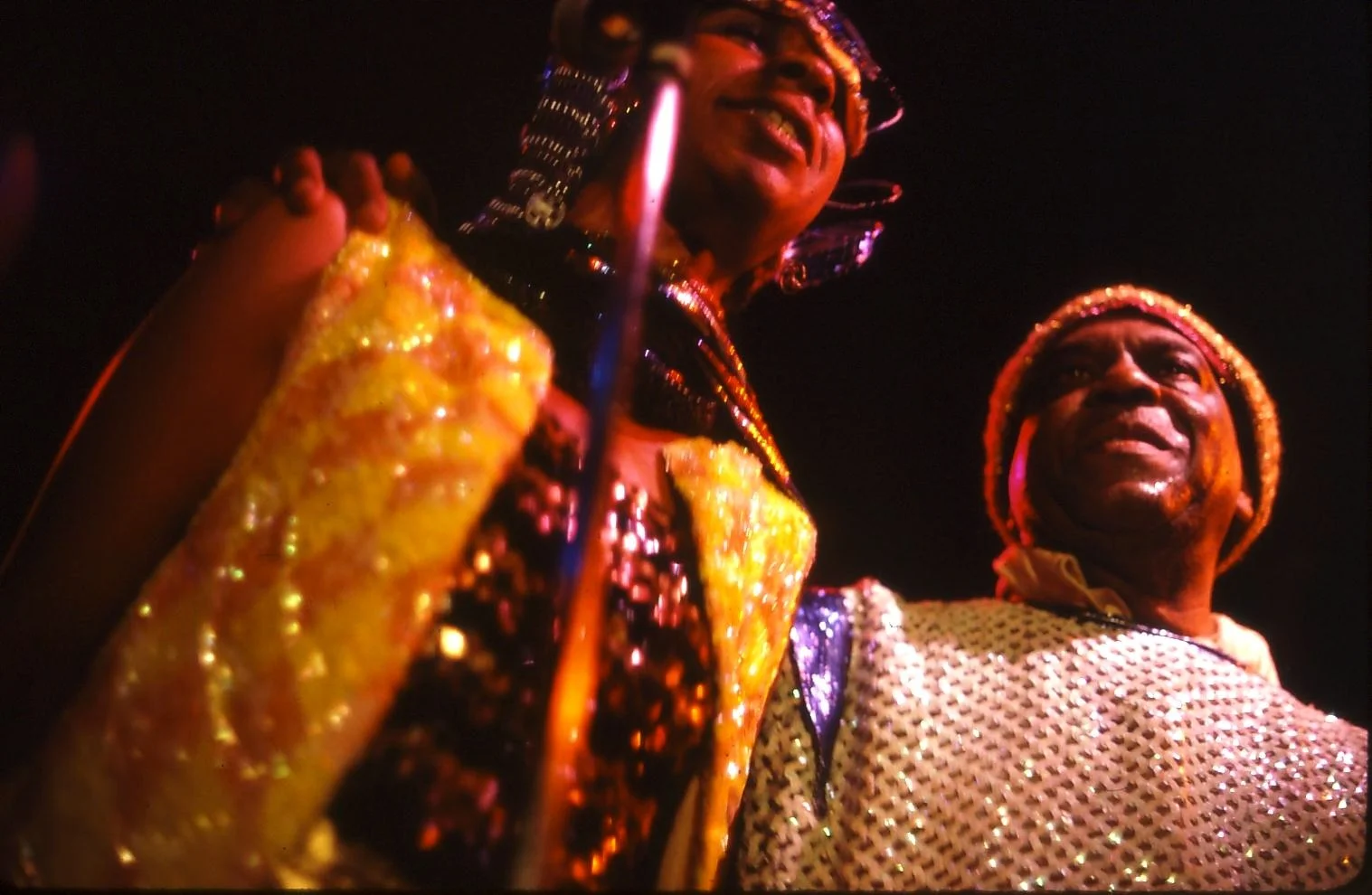
The Cloth of Gold! June Tyson and Sun Ra, 1979 (photo by Jared Crawford)

Final word: We all know Little Red Riding Hood with her red cloak and hood. And there’s Dolly Parton (and Joseph) with their coats of many colors. There were those psychedelic jackets worn by the Beatles in 1967. They were wild and I wanted to “drape” one over my shoulders too. Harry Potter wore the invisibility cloak. That was cool. But none of them beats the Drap d’Or—the Cloth of Gold—like the ones that June Tyson and Sun Ra wore.  

April 22, 2026

Calling Planet Earth! Today is Earth Day in the orchard and everywhere on the planet. It’s a day to celebrate the miracle of life on Earth. If you fiddle around with the letters in the word “earth”, you can come up with the word “three” (or close to it). Earth is the third planet from the Sun. Three is also a sacred number in many traditions. Could the word Earth simply be a take-off on the word three?  

Planet Earth: Remove the letter E from planet and you have plant. Earth is the planet of plants. Remove the A from the word Earth and replace it with that E. Get rid of the H. Now rearrange the remaining letters and you have “plant a tree.” 

It’s not a stretch to say that the tree—more than anything else—is what defines the Earth. Trees are the magic creatures that make earth what it is.  And on Earth Day in many locations around the world, it’s the perfect time of year to plant a tree. If each of us planted a tree this spring—just one tree—we’d have 8.3 billion more trees on Planet Earth. 

Apple tree by the sea, Earth Day 2026

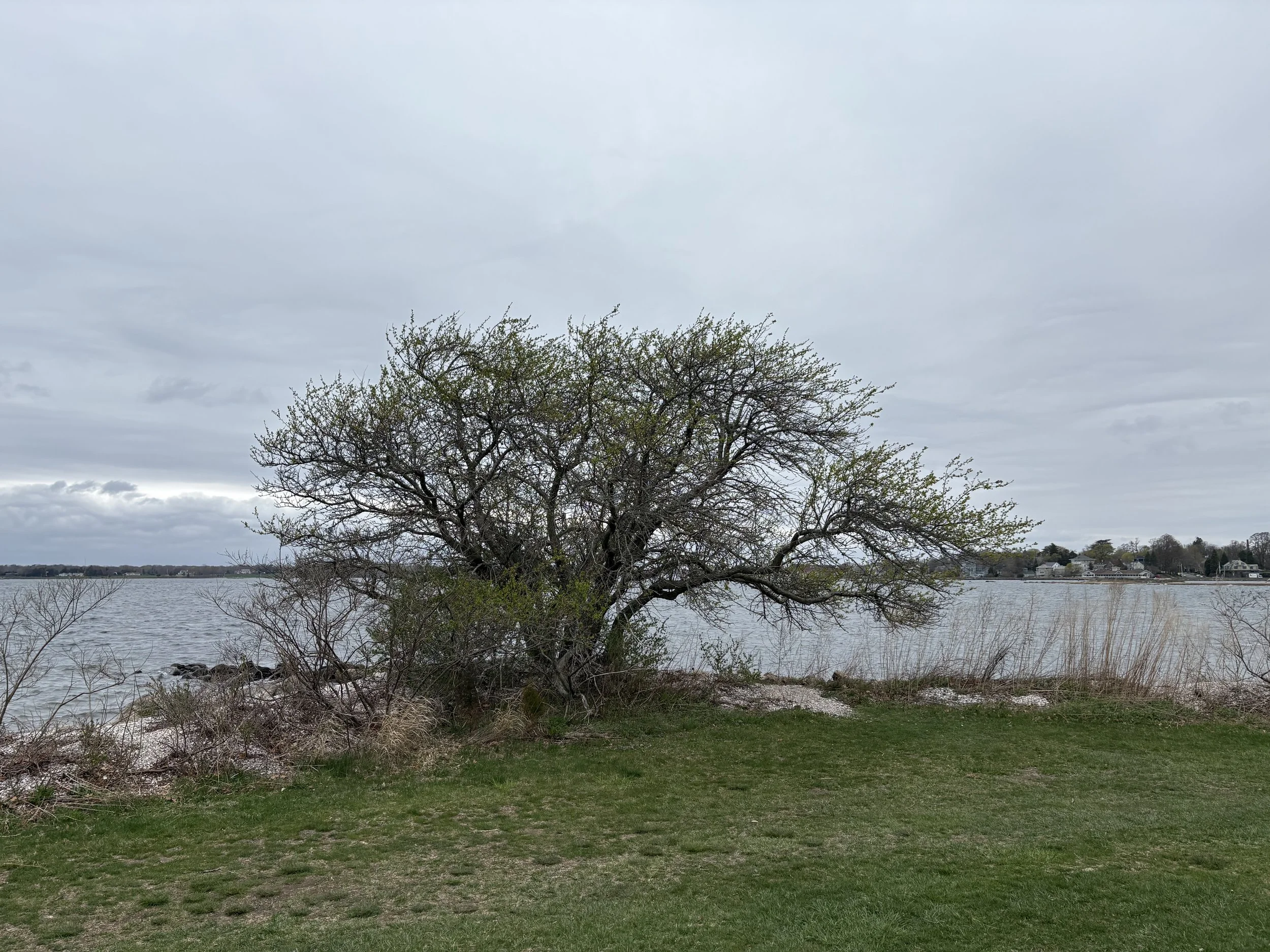
Unfortunately we did not plant any trees today. We did plant 34 on Sunday, but we’re out of town today so—I guess—we get a pass. We’ll plant more this coming weekend. But we did spend a bunch of time with trees yesterday and today. Yesterday we were at the amazing Mount Auburn Cemetery in Cambridge, MA. It’s an incredible place to go see trees. Today we celebrated in Rhode Island with friends who took us to Blithewold Arboretum along the shore of Narragansett Bay. At Blithewold walking along the shore, what did we encounter? An apple tree of course. Who insists that apple trees need well-drained soil and a gentle slope and a special pH? The apple tree we visited was growing about two feet from the high-tide line in a pile of salt and shells and seaweed. And it looked very happy to be there. 

Later in the day we visited relatives across the bridge in Tiverton. What did we see there? More amazing trees of course. Happy Earth Day!

April 19, 2026

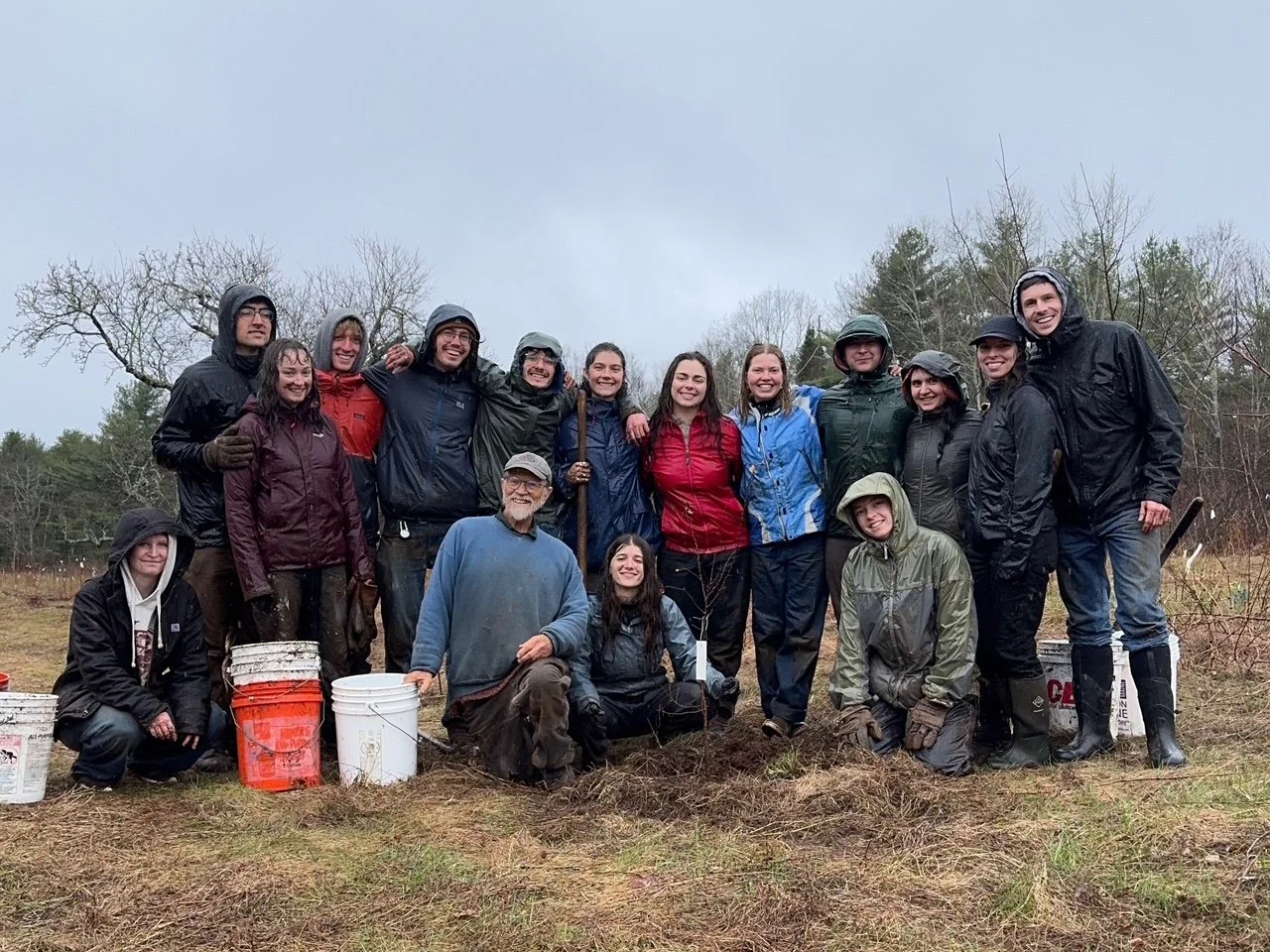
Today was our Spring tree-planting day. It was a fantastic whirlwind of activity, well-lubricated by a whole lot of rain. Skylar, Evacilie and a bunch of their friends from COA arrived yesterday evening and celebrated up in the orchard with a fire, food and Super Chilly Farm cider. This morning Alyssa, Kevin, Todd and I joined them. After the traditional pre-planting Super Chilly breakfast of (what else?) oatmeal and applesauce, we went to work. It was a major team effort all the way. By noon we had planted 34 trees, a quarter of which are grafted selections we’re excited to trial over the coming years. The rest are seedlings grown from some of our favorite “mothers.” All of them are two-year-olds from our nursery: the apples of the future. 

The planting crew, April 19, 2026

The weather was near perfect for planting trees: rainy. It did hold off until mid-morning, but then it came down steadily until after dark. The trees loved it, and despite being rather soaked, we did too. Although it would have been fun to hang out, tour the farm and geek out over all the daffodils, by early afternoon everyone was ready to de-mud, put on dry clothes and find some heat. What a perfect way to spend a rainy day in April. Thank you everyone!

April 17, 2026

Heat came to the orchard today. At 5 PM it was 73F. The apple buds are still locked up tight, but it won’t be long. Farther south the trees are opening up. It’s beautiful there this time of year, but there’s a risk behind that early bloom. April is a month of temperature swings. Here in central Maine, these swings are—knock on wood—not that big a deal. Two or three hundred miles south of here, they are. One night of temps in the low 20’s when the trees are in bloom can wipe out this year’s crop. We won’t be in bloom for another month (we hope). That’s a delay that often works to our advantage. When those inevitable spring swings come through and the temperatures crash to 22F, we’re happy the trees are still asleep.

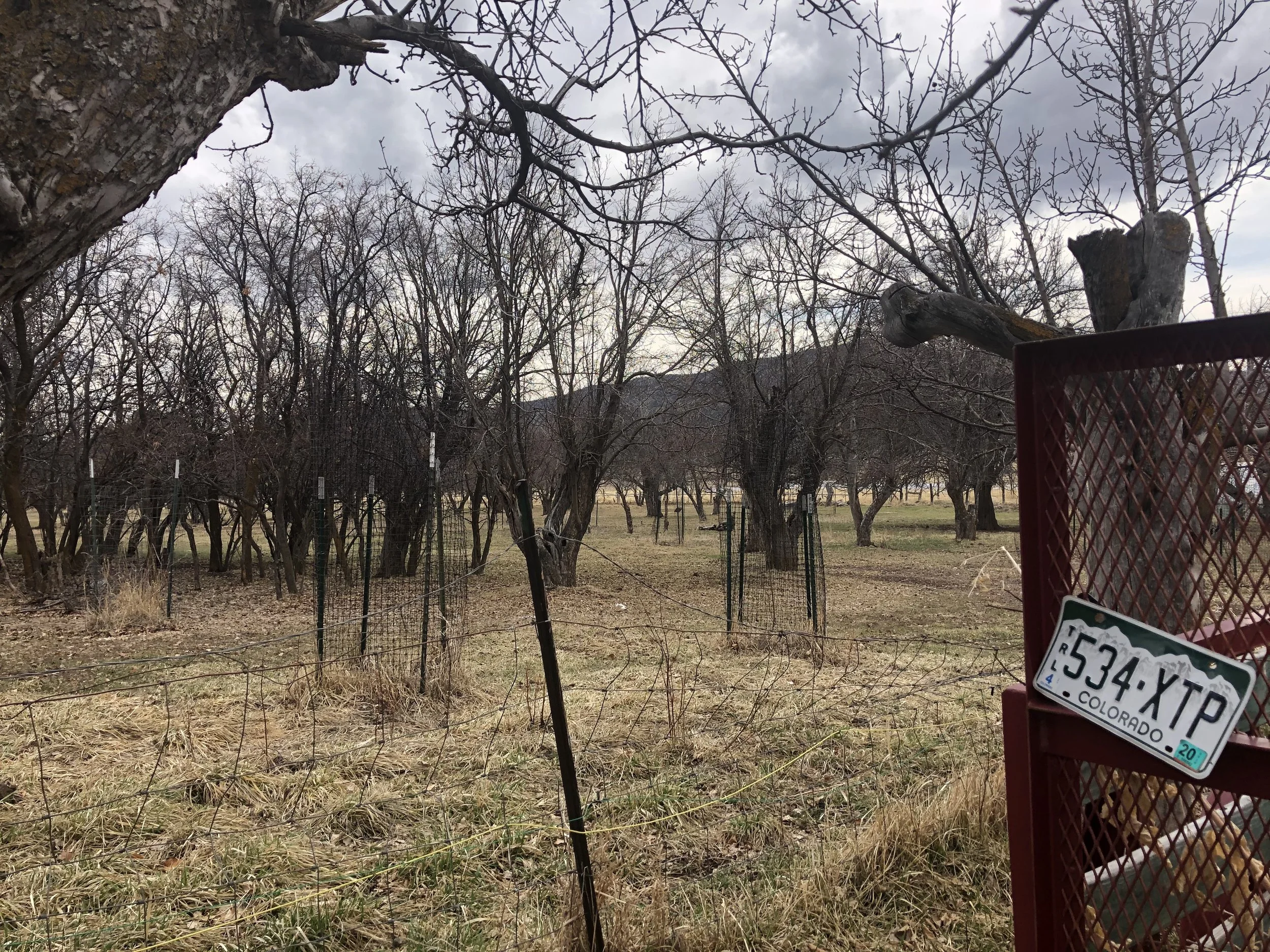
Old apples trees near Cortez, CO, March, 2020

Orchard friends in in Cortez, CO told me that temps tonight are predicted in the low 20’s in their region. That could be a big bummer for the apple crop out there. Gotta love our late spring. We don’t get too many days like today, and we should be happy we don’t. The flowers and the leaves will come. And we’ll have all of July and August to run around in bare feet and T-shirts and go jumping in the lake. Now is the time to kick back and soak up the cold and damp and dreary.     

April 16, 2026

Wow, this is the quintessential April. Have we got showers for you. Thank you Thomas Tusser (1524-1580) whose A Hundreth Good Pointes of Husbandrie should be required reading for everyone. “Sweete April showers/ Doo spring Maie flowers.”  Now those showers are coming nearly every day. Admittedly the accumulation has been minimal, some might say pathetic, but it’s wet, and we need wet. And the plants are responding. The garlic is up and looking good. The bulbs surrounding the apple trees are beginning to show color. Laura mentioned that some fruit tree buds are beginning to swell. Better cut your scionwood before it’s too late.

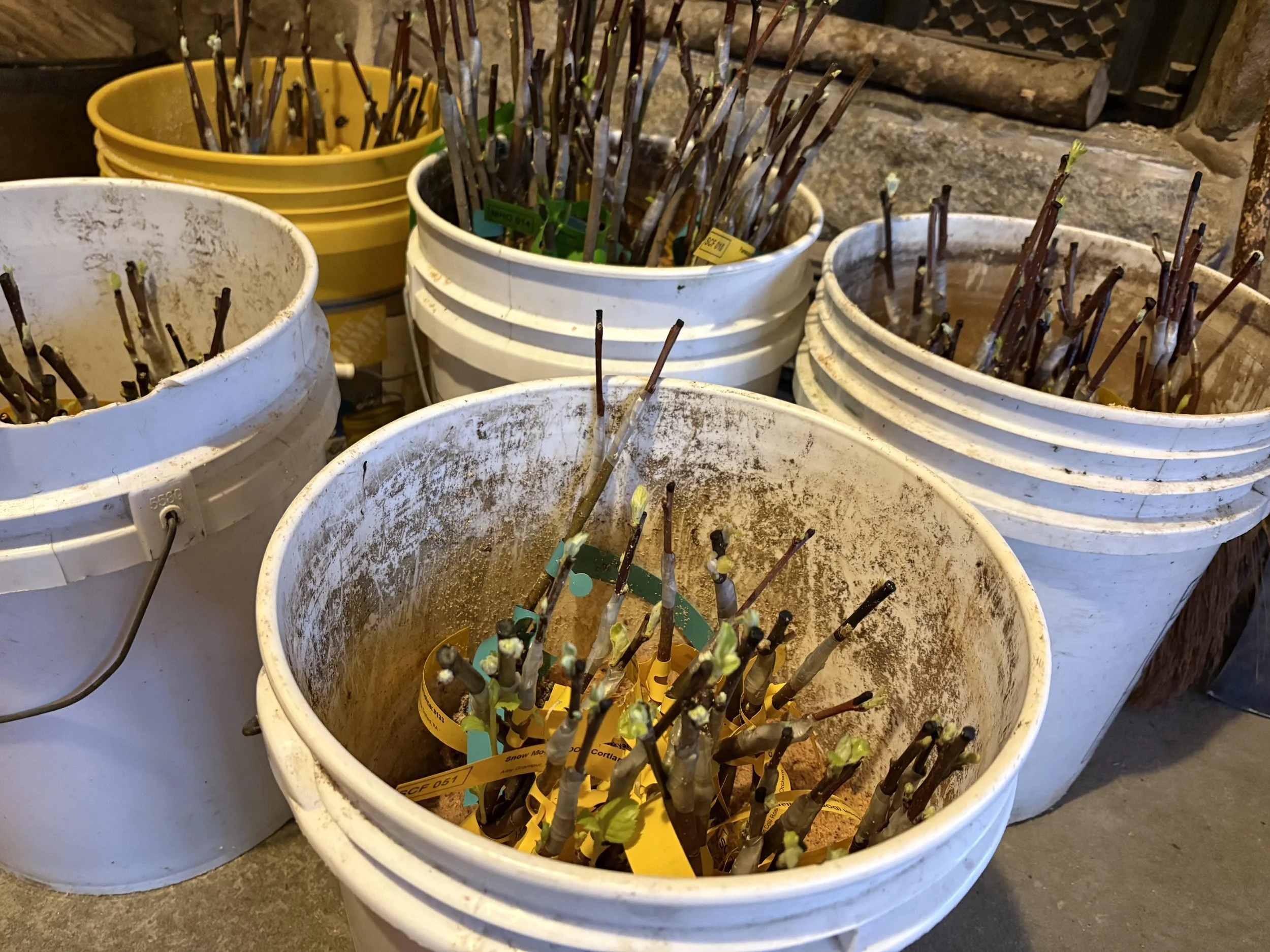
Buckets of young grafted trees, April 16, 2026

Got a phone call today from one of those who attended my talk in Woolwich last weekend. She used to live on the Cathance Road in Topsham—right near the old Givens farm—and thinks there’s a chance that there’s a Givens apple tree on her former property. She contacted the new owners, and they are excited. to help. There were four old trees. One died and was cut down in the last year or two. But three remain. Yes!  They will send me photos of the trees, and I’ll collect leaves and submit them for DNA profile later this spring. Fingers crossed.    

Spring is happening inside as well. The apples we grafted two weeks ago are all showing green. That is exciting. Looks like we still know how to do it.  

April 15 2026

It’s Tax Day in the USA. As far as I know there are no apple cultivars with the word “Tax” in the name. Bussey lists three that include the word “Money:” Money Creek Beauty, Moneybush and—my favorite—Money Maker. Money Maker would be a great name for a cider apple. Too bad it’s been taken. When the apples are ripe, you could “Shake Your Money Maker,” just like that famous old blues song sung by Elmore James (and many others.) Maybe we’ll name one of our seedlings Shake your Money Maker.

We already have one apple on the farm with the word Money in its name with another one to be grafted this spring. “Big Money” is one of our seedlings. It’s what our Grandson Chance used to call the quarter he got for doing chores around the house or under his pillow in exchange for a lost tooth. We’re expecting Big Money to make us zillions in the coming years. “Old Money Bitter” is one of the new cultivars we’ll be topworking in a few weeks. It was discovered by Benford Lepley out on Long Island, NY. He describes it as “really elegant, beautiful, complex bitter,” just like old money.

Dozens of other songs have been written about taxes and money. George Harrison’s Tax Man immediately comes to mind which, I just learned, features a guitar solo by Paul (not George). My favorite money song is Woody Guthrie’s. I find myself periodically singing it out in the orchard. In fact it may be one of my all-time favorite songs.

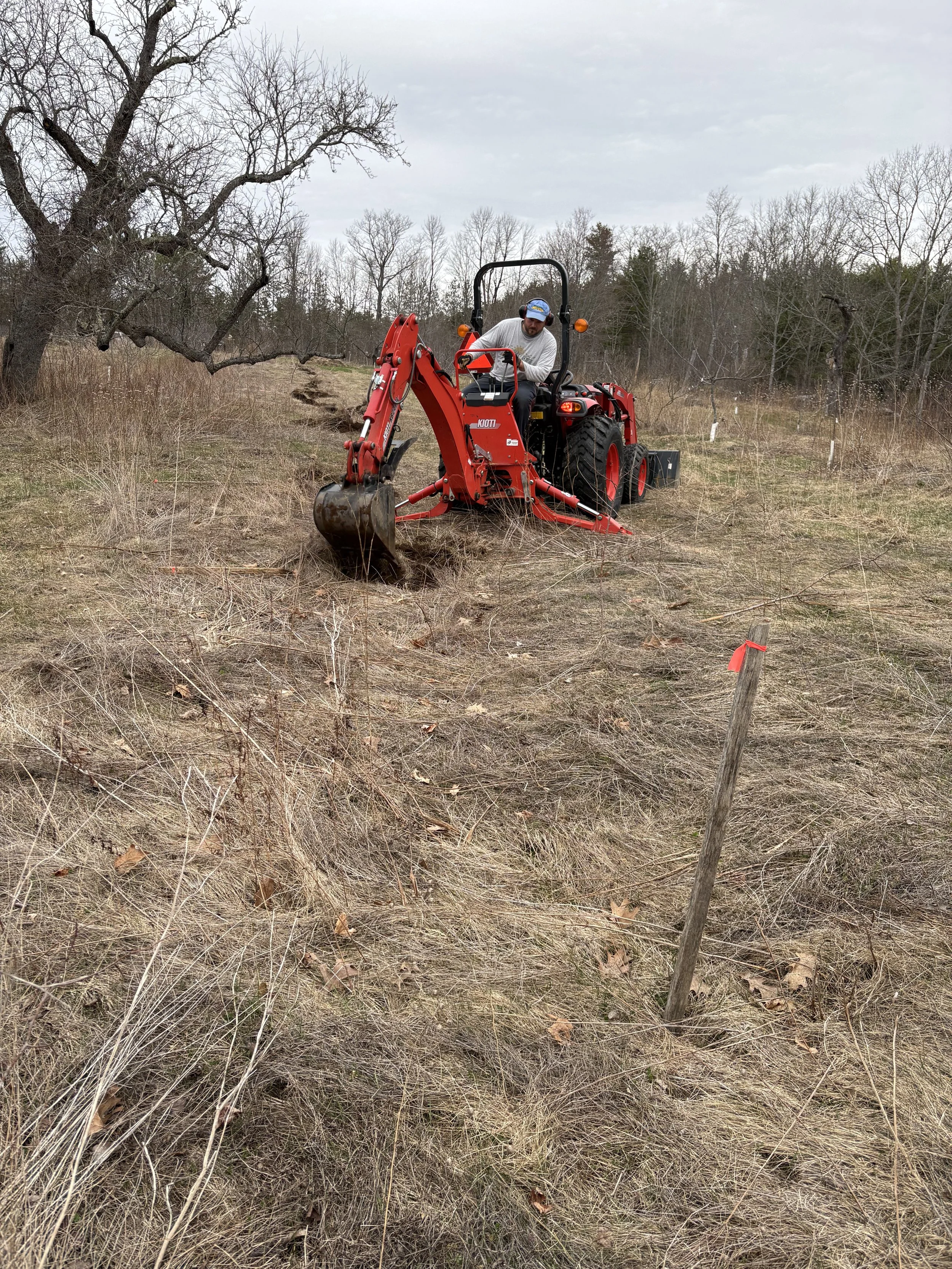
Stever at Finley, Tax Day 2026

If you ain't got the do, re, mi, folks
You ain't got the do, re, mi
You better go back to beautiful Texas
Oklahoma, Kansas, Georgia, Tennessee
California is a garden of Eden, a paradise to live in or see
But believe it or not, you won't find it so hot
If you ain't got the do, re, mi

While others were paying their hard earned do re mi today (or not), I was up in our orchard (a paradise to live in and see) with our friend Stever who came over with his backhoe to “rough dig” forty holes for trees we’ll plant this spring.