May 20, 2026

The warm weather continues. The apples are responding, and the first wave of cultivars are approaching full bloom. It is spectacular. Cammy and I pruned the peaches which we like to do once they’ve leafed-out. After a winter of below-zero temperatures, we know we’ll have dead branches. Waiting until now, we know what is not going to make it. Some of our trees took a real hit. We cut all that out. Amazingly, however, we have peach blooms on every tree, and that could mean a peach crop even after multiple nights of —20F.

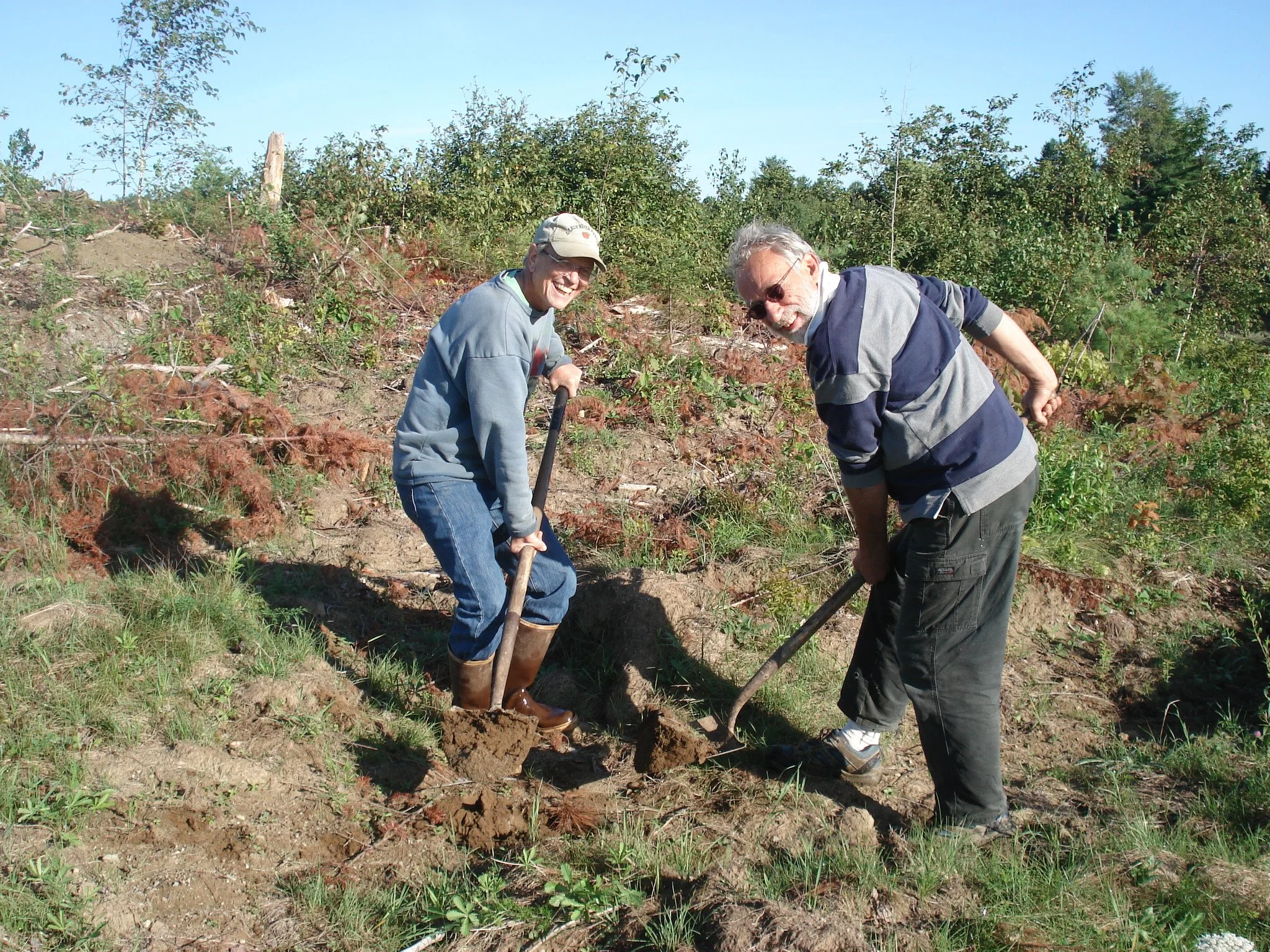
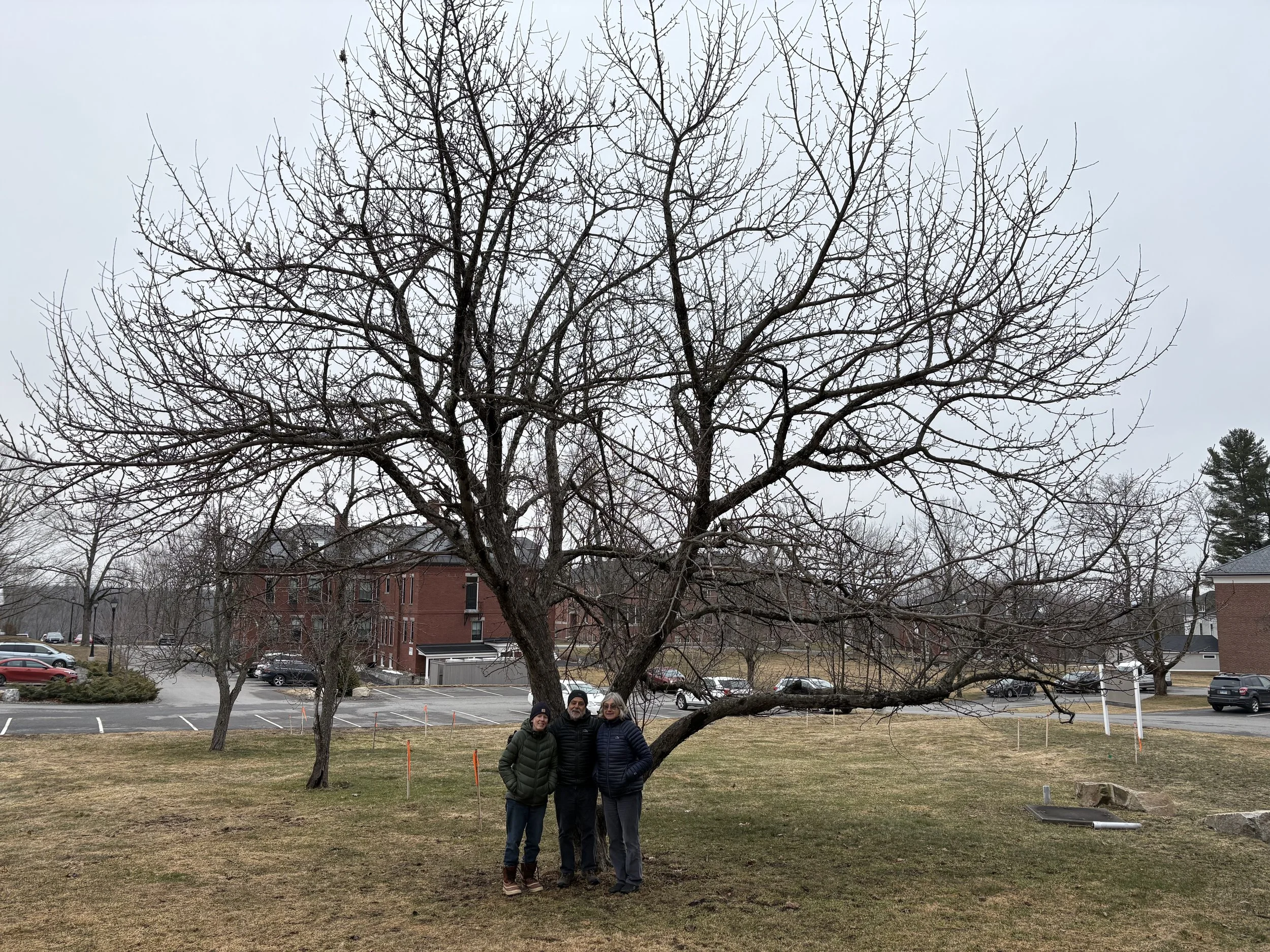
The Maine Heritage Orchard in 2013

The asparagus and rhubarb are up, and we’ve been feasting on both. Rhubarb is better with ice cream. I think we need to go to “John’s” soon.

In the evening I gave a brief talk at the annual apple blossom tour at the Maine Heritage Orchard in Unity. It was warm but very windy. Still it was a beautiful sight.. and site.       

May 19, 2026

Continued extremely warm. Many apples are open with some approaching full bloom. Others still at pink or even just beginning to leaf out. It’s spectacular out in the orchard, and there should be at least another week of this ahead of us.

Wednesday, May 20, you can see the spectacular bloom at the Maine Heritage Orchard at MOFGA. The timing should be perfect. There’s a bloom-tour from 5-7 PM. I’ll be giving a talk which (rumor has it) may focus on the magic of apples. Come join us if you can.

I returned to the governor’s Blaine House in Augusta to graft the last of the 16 apple trees in the Blaine House orchard. They now have an apple from each of Maine’s 16 counties. Governor Mills will leave office in January, and someone new will take her place. I sure hope they love apples.

Do you believe in Magic?

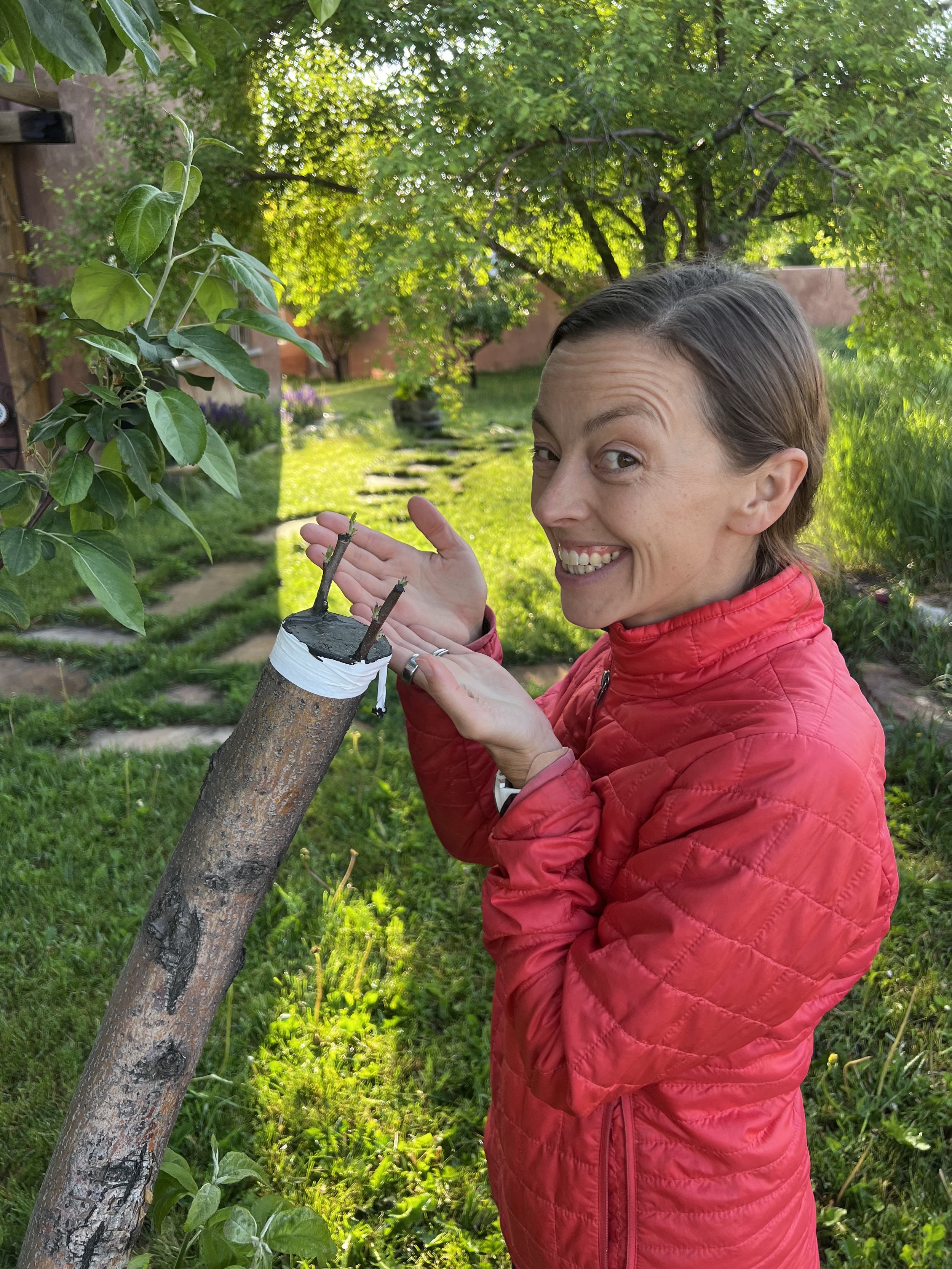
I followed the river down to Hallowell where I topworked the apple and pear we saved from the bulldozers a couple of months ago. Friends had alerted me of the impending demise of the trees and the Save-the-Maine-Trees-Rescue squad rushed over to assist them in collecting scionwood. We’ve grafted them at home and put them in our tree nursery, and today I grafted the pear and apple scions onto older trees in the Hallowell neighborhood. The old varieties will live on. The baton will be passed. As I inserted the scion into the rootstock sprout from the old tree, one of the neighbors declared, “It’s magic!”       

May 18 2026

Warmest weather of the year. The plum flowers are fading. Asian pears are at full bloom. The Trailman, Redfield, Tea crab and Niedzwetzkyana are full , and a hundred other apple cultivars are not far behind. It looks like time-lapse photography out there. New apples opening practically every hour. Maybe every minute.

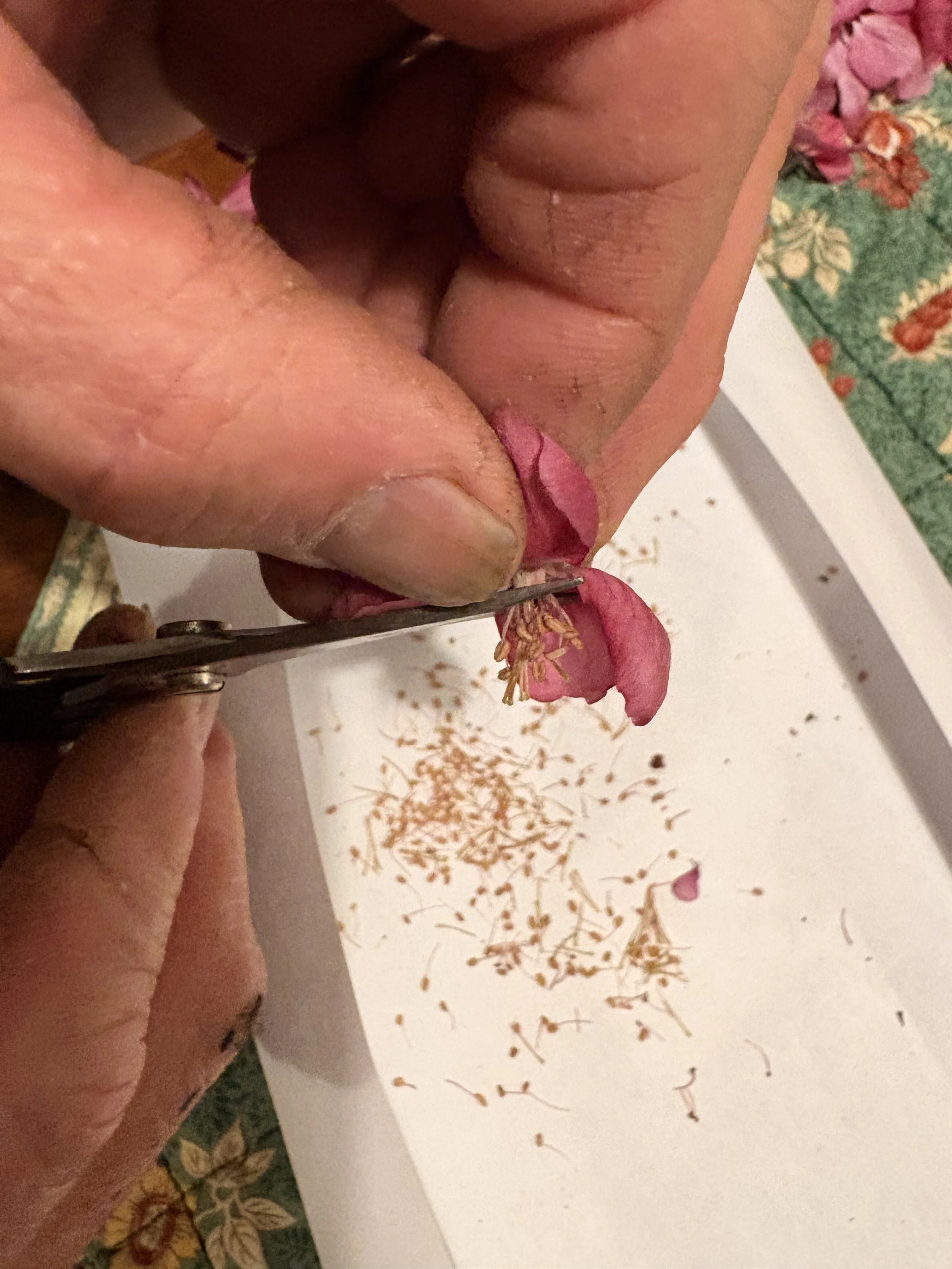
Collecting Redfield pollen, May 18, 2026

Laura came over in the morning, and we wrestled the sprayer onto the tractor together. A true team effort. Cranked it up, and it works good. Later Cammy and I both planted perennials near the house and out in the BRC orchard. I also moved a couple of apple seedlings in the BRC to “better” locations. (Is that arrogance or what?). One of the two was growing out of the fence, and the other was in a path where it surely would have been stepped on or mowed. Later I grafted onto plum rootsuckers in the old orchard and up at Finley Lane. Ended the day collecting Redfield pollen for the hand pollinating in a few days.   

May 17, 2026

Yesterday (May 16) was a notable day in the universe. It was the new moon and the mid-point between two May full moons. The first of them was on May 1, and the second will be on May 31. May 31st will be the Blue Moon.  

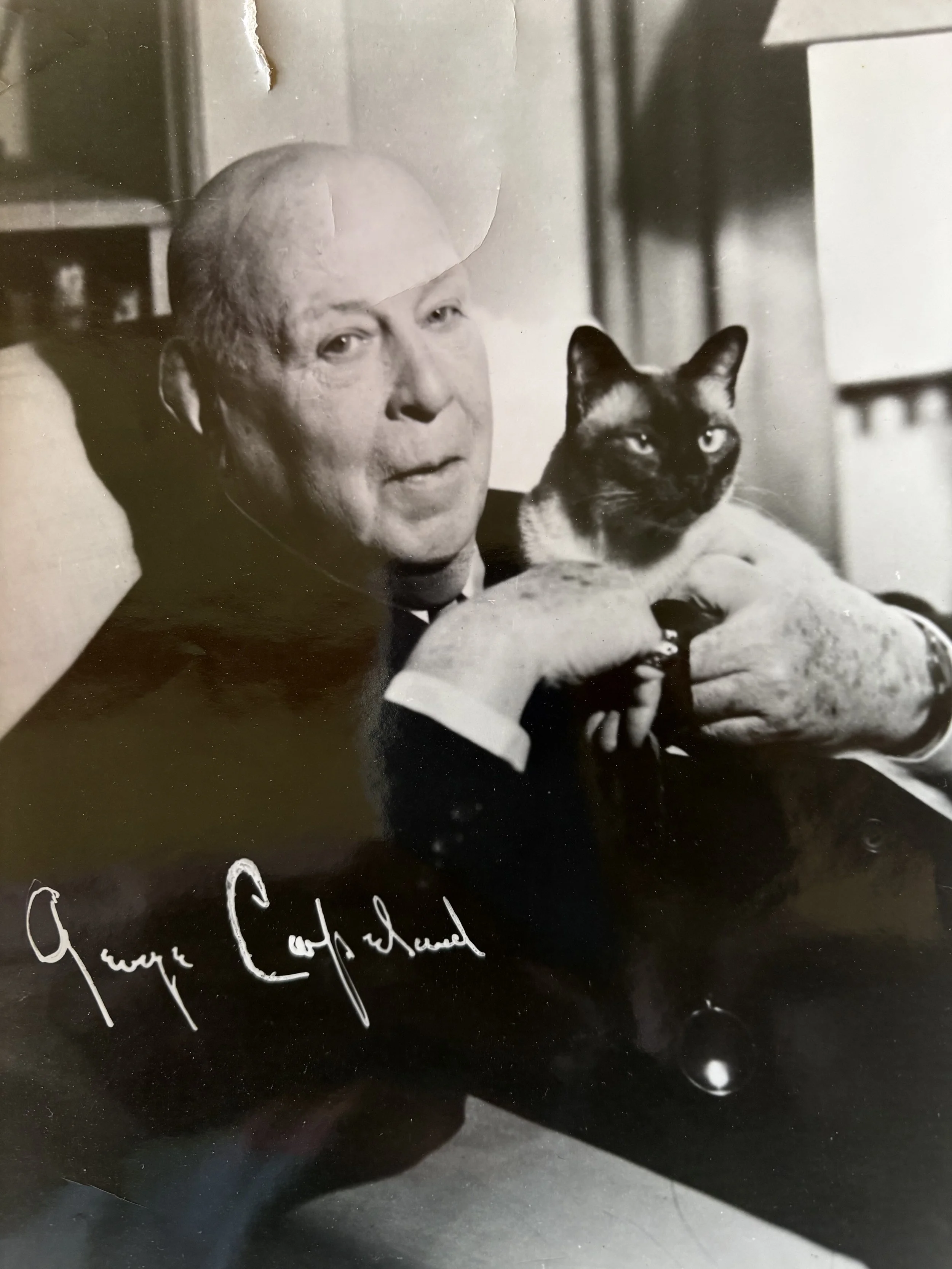
George Copeland c. May 16, 1963

May 16 is also notable for being the recording date of one of my favorite old LP records, fittingly of Claude Debussy’s “Suite bergamasque” which includes “Clair de lune.” The record also includes “Et la lune descend sur le temple qui fut” (And the moon descends on the temple that was) as well as a number of other pieces by Debussy. The pianist is George Copeland, and the recording year was 1963. The record I have belonged to my grandmother. It’s in a plain orange-yellow jacket with no writing. I found it on her record shelf after she died. I’ve listened to the record hundreds of times in the past 55 years, probably more than any other record I own. Copeland was a renowned Debussy interpreter, and his “versions” are fantastic. I don’t know much about the record and why it came in a plain, un-marked jacket. Maybe it was some sort of private recording. Fortunately the record label includes the titles of all the tunes, and there’s a cool photo of George Copeland and his cat tucked inside. 

Thanks George, and here’s to the moon, ever-watching over the orchard with its energy, its power and its light. 

May 16, 2026

I continued grafting in the Finley Lane orchard and the old orchard. The bark is slipping perfectly now, and the short topworking season is coming and going quickly. I’ll do a bit more in the next couple of days and then call it quits.  

Tree paste, May 16, 2026

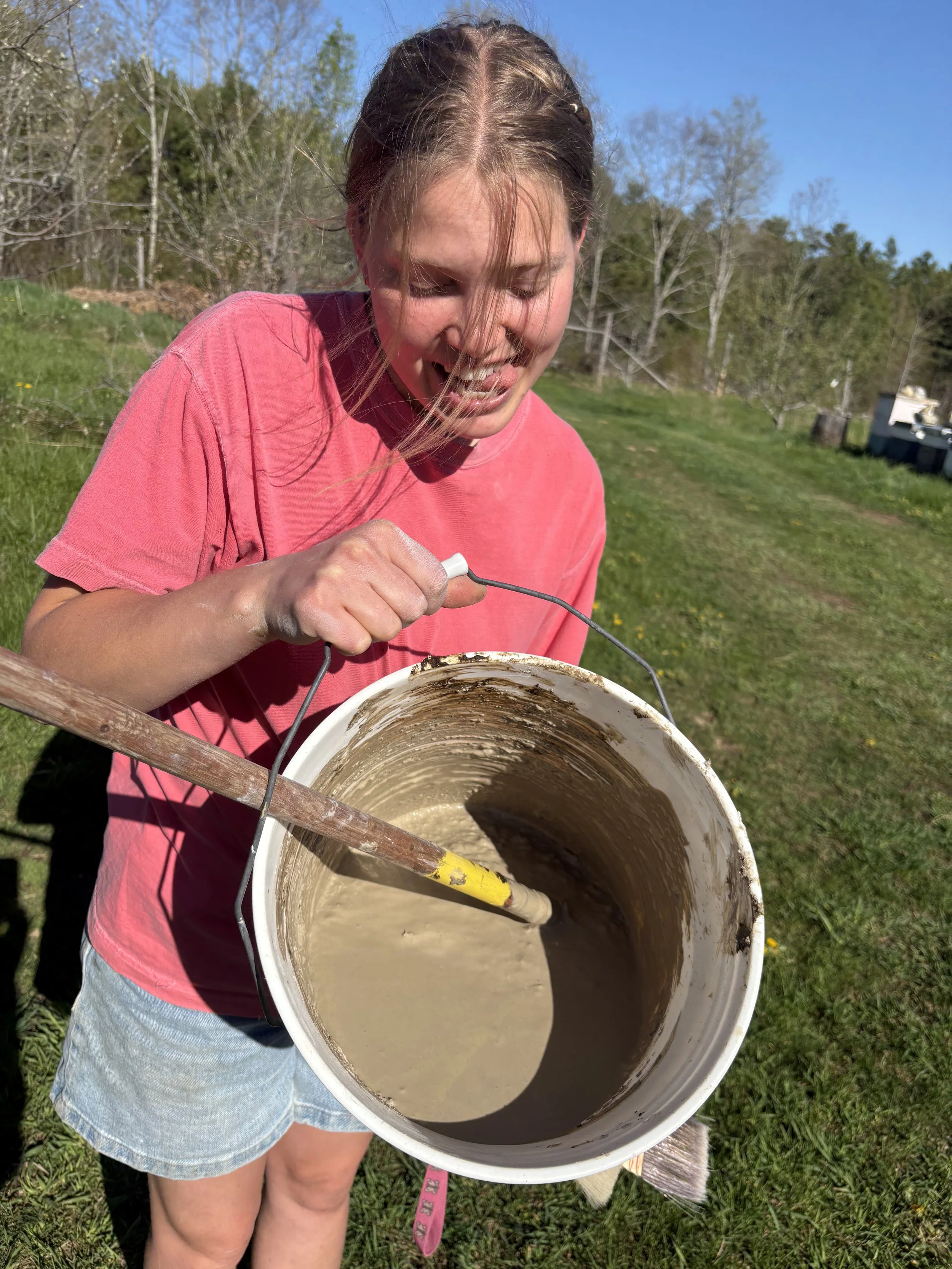
In the afternoon Skylar and I mixed up a test-batch of Bio-dynamic tree paste. It’s my version of a classic Rudolf Steiner-inspired paintable concoction, typically a blend of fresh cow manure and clay, designed to promote tree health and heal the trunks of apple trees. I hope it will also deter apple borers. I’ve been looking for an alternative to painting Neem Oil on the tree trunks. Neem is definitely effective in deterring borers, but it turns the bark black and may damage bark. Neem is also expensive and from far away (SE Asia). Cow poop and clay are definitely local!

According to Biodynamics, clay is a tissue rejuvenator and fresh manure is a rich source of microbes. Some recipes include other materials, such as sand and wood ash. We used fresh cow manure and powdered clay and added zeolites (aluminosilicate lattices derived from volcanic ash) and rock phosphate. We mixed it up with water from the rain barrels and painted it on about 25 apple trees.

May 15, 2026

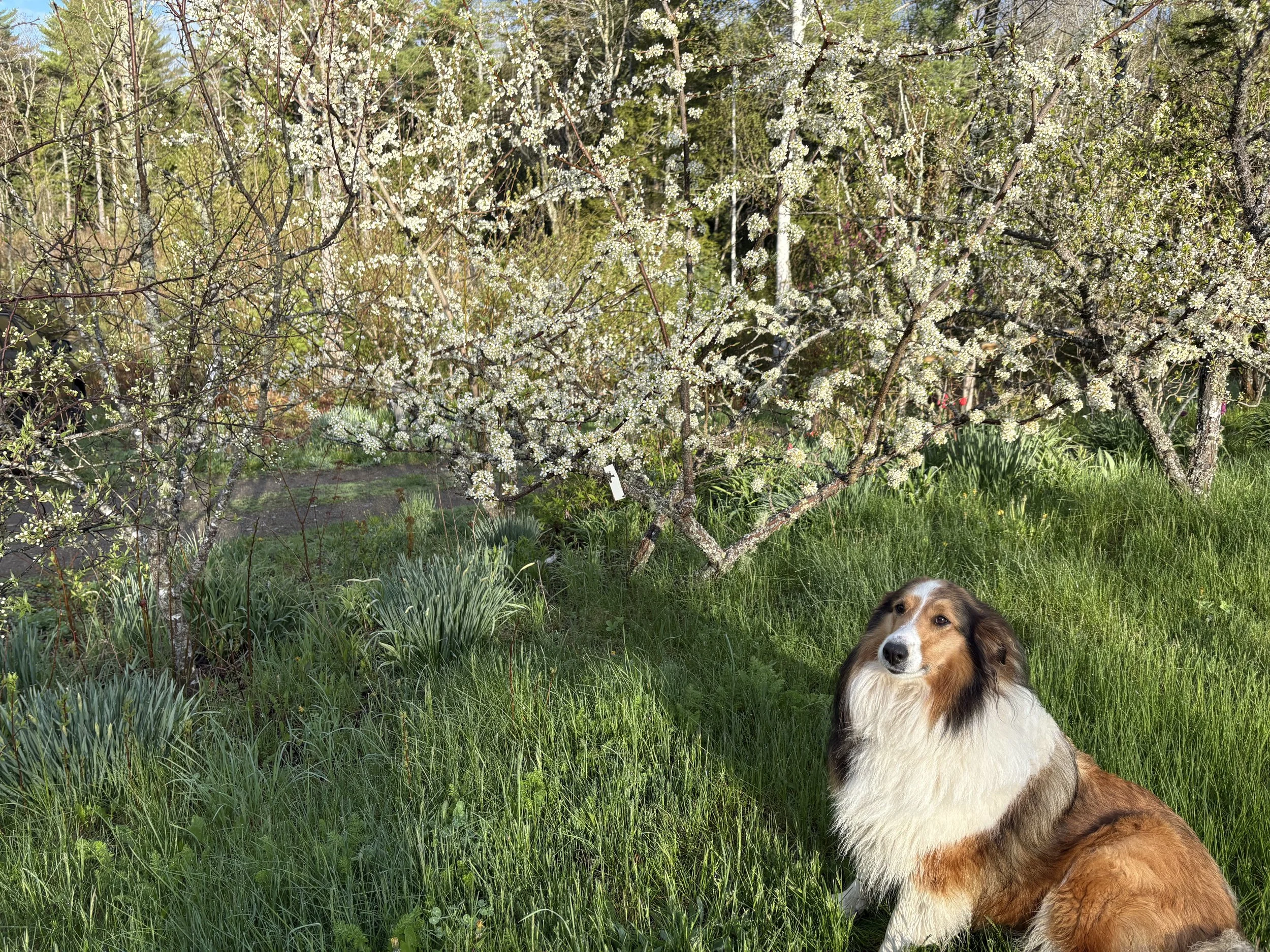
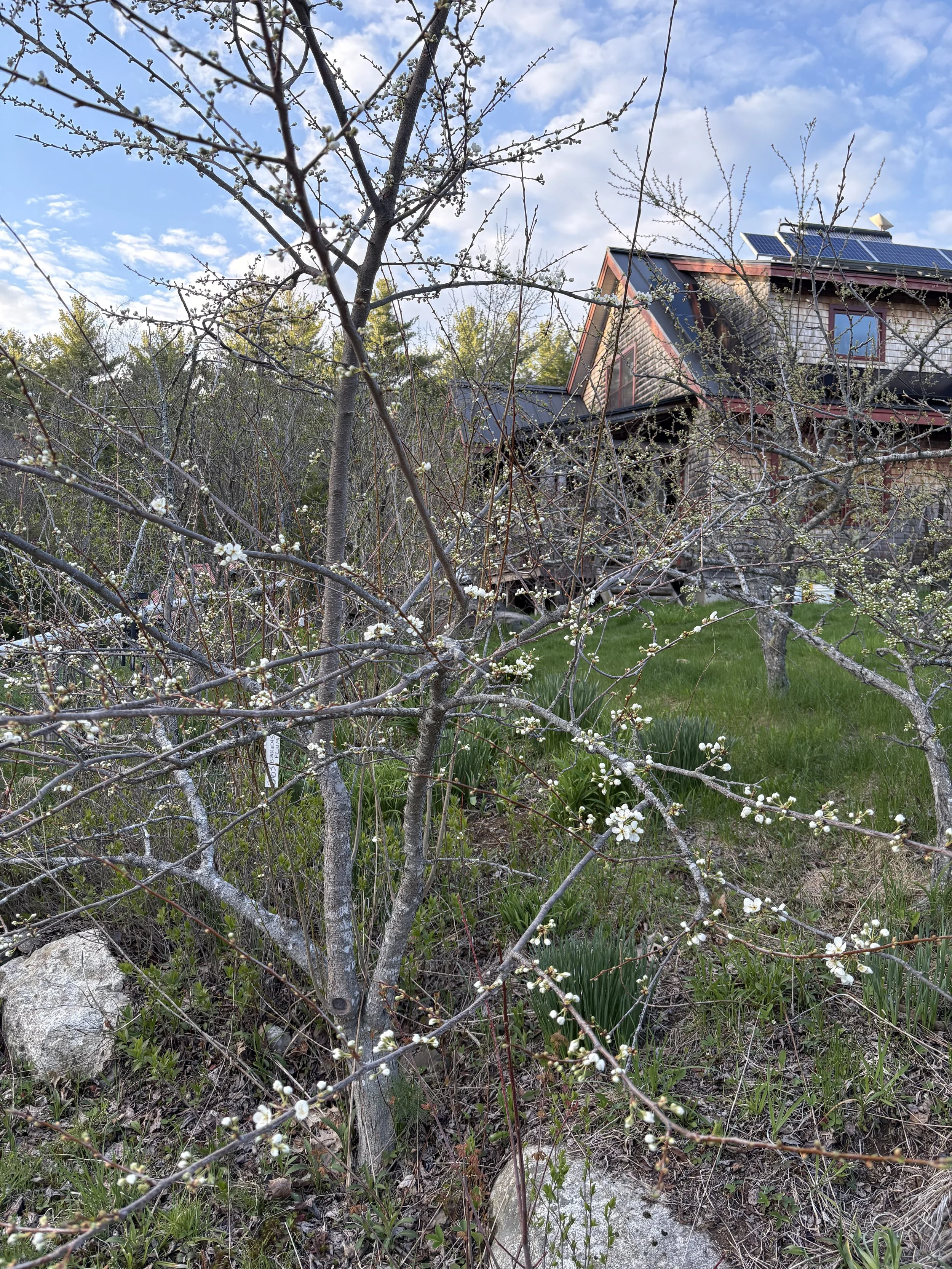
Purple Heart plum (and Spy) May 15, 2026

The plums are entering full bloom now. Our oldest Purple Heart tree has lots of flowers. It’s our favorite plum by far. In the next day or two I’ll hook up the sprayer and spray the plums with Surround and Cueva (liquid copper). Surround deters plum curculio, one of the peskiest pests of the orchard. It doesn’t kill the insects; it just irritates them (“bugs them”) so they leave and presumably head back to the forest from whence they came. Cueva is a fungicide that helps reduce or prevent brown rot, a fungal disease that makes the plums useless. We combine both products together in the spray tank and apply during full bloom and after. Surround and Cueva are both certified organic.   

May 14, 2026

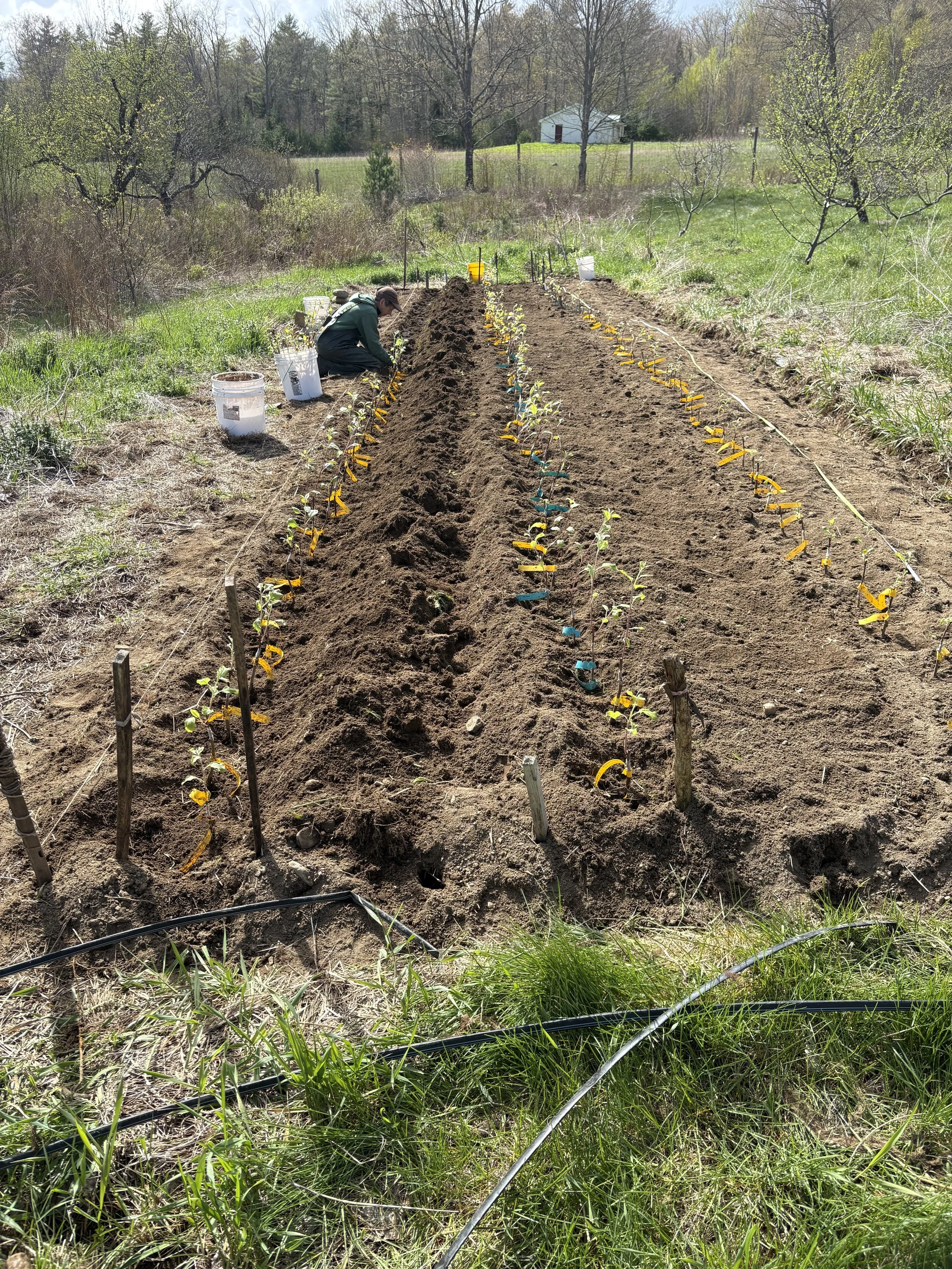
Planting newly grafted trees, May 14, 2026.

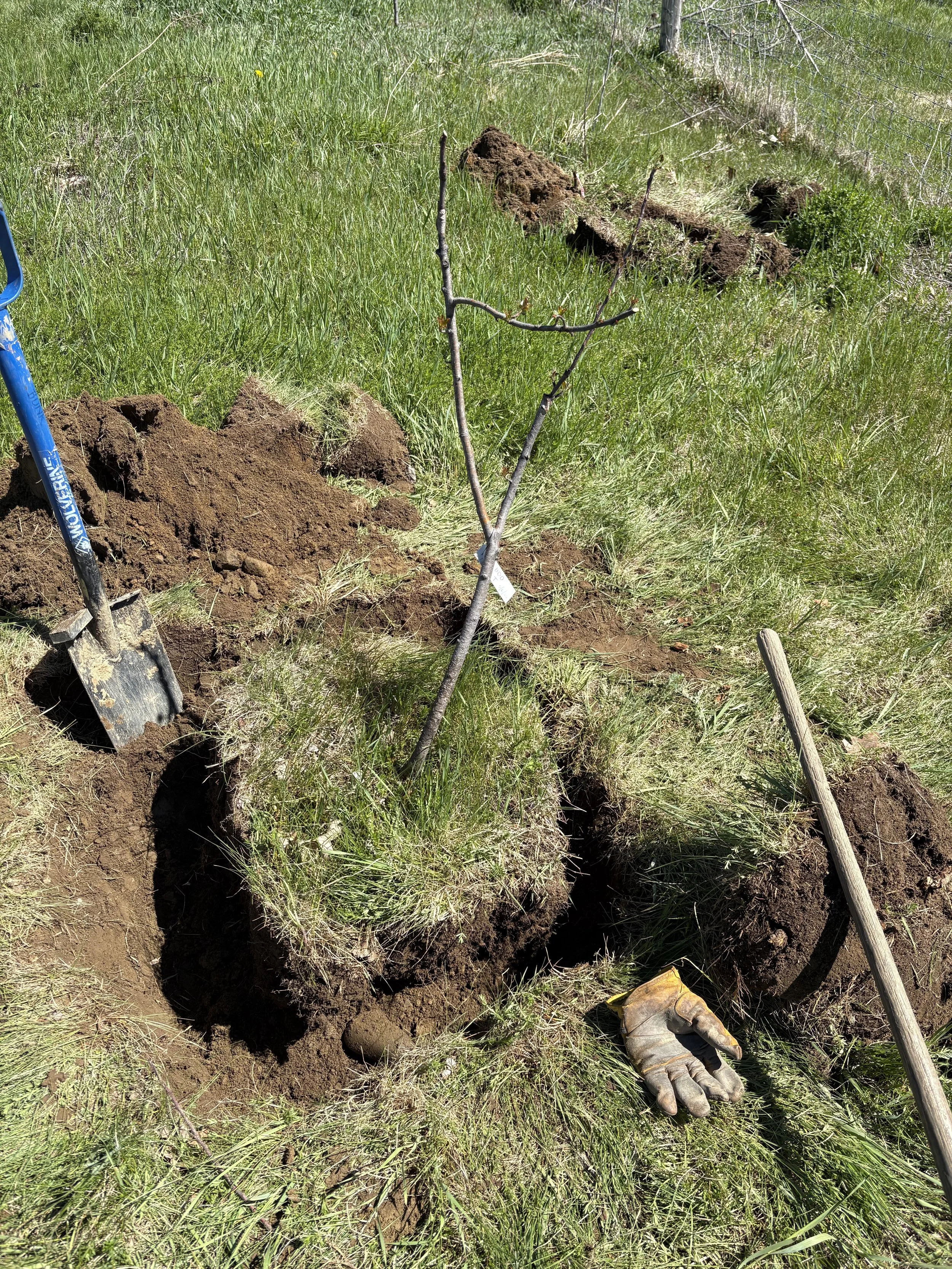
Yes, still cool. Cammy and I planted 200 young grafted trees. It was a long day, but we finished by late afternoon, just before the rain started. The trees look happy in their new home. They will live there for two years. Then we’ll dig them. That will be in 2028.

The grafts did well for the most part. Nearly everything took. A few did not but that’s to be expected. Some of the scionwood was less than perfect. It was certainlly not the fault of the grafters!

We timed lunch to coincide with a Cornell Ornithology Lab webinar on bird migration. That was worth the viewing. We learned that most birds migrate at night which may help to explain why we’ve been seeing so many at our feeder and hearing them out in the orchard. They’re chilling out at Super Chilly, waiting for the sun to go down and good flying weather to keep on keeping on.   

Many apples now at pink. We’ll have bloom soon. 

May 13, 2026

Yes, still cool. Or maybe it qualifies as cold. But digging weeds pumps the blood and warms the soul. The nursery bed is now complete. We’ll plant 200 new trees tomorrow. Hooray. It was a productive morning.

In the afternoon, as the rain fell, Cammy went to Moose Crossing Garden center in Waldoboro to buy more plants. Some might ask, “Don’t you have enough?” The response is (of course) “Never!” 

Help is on the way (photo from Eliza Greenman)

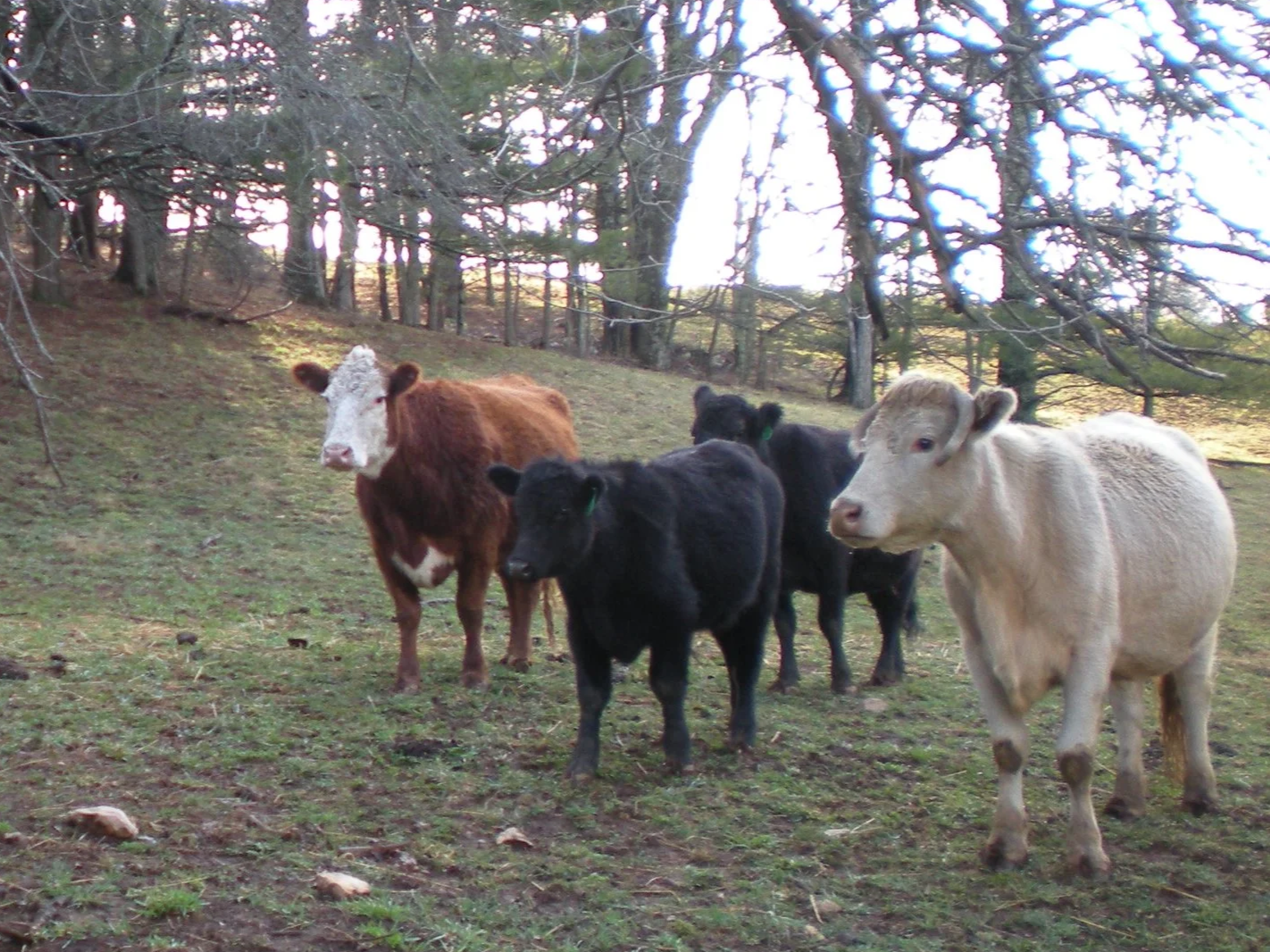
Meanwhile I made a trip to Two Loons Farm in South China to obtain several buckets of nature’s finest, straight out of their Jersey Cows’ rear ends. As fresh as fresh can be. I’ll mix it with clay and other stuff and paint it onto the trunks of our apple trees. It’s a biodynamic paste concocted to protect and heal the trees’ bark. I’ve never tried it before so I’ll do a test run this weekend when the dry, warm weather arrives. Some of the apple tree trunks look a bit funky, and I’m hoping that this manure/clay paste will be akin to attending one of those expensive spas at some snazzy resort. 

The catbird (Dumetella carolinensis) is back. Nearly all the other birds go home by early evening but not so the catbird. She (he?) was visiting our suet just outside the kitchen window while we were cleaning up after dinner.     

May 12, 2026

When we teach what we know to others, we pass the baton. The scion makes a great baton. 

The cold weather continues - 27F at 6 AM. Feels a bit more like March than May. In the morning, Cammy and I worked in the nursery, continuing to prep for planting this year’s new grafts. It’s a long job, but it feels great to have our hands back in the soil. 

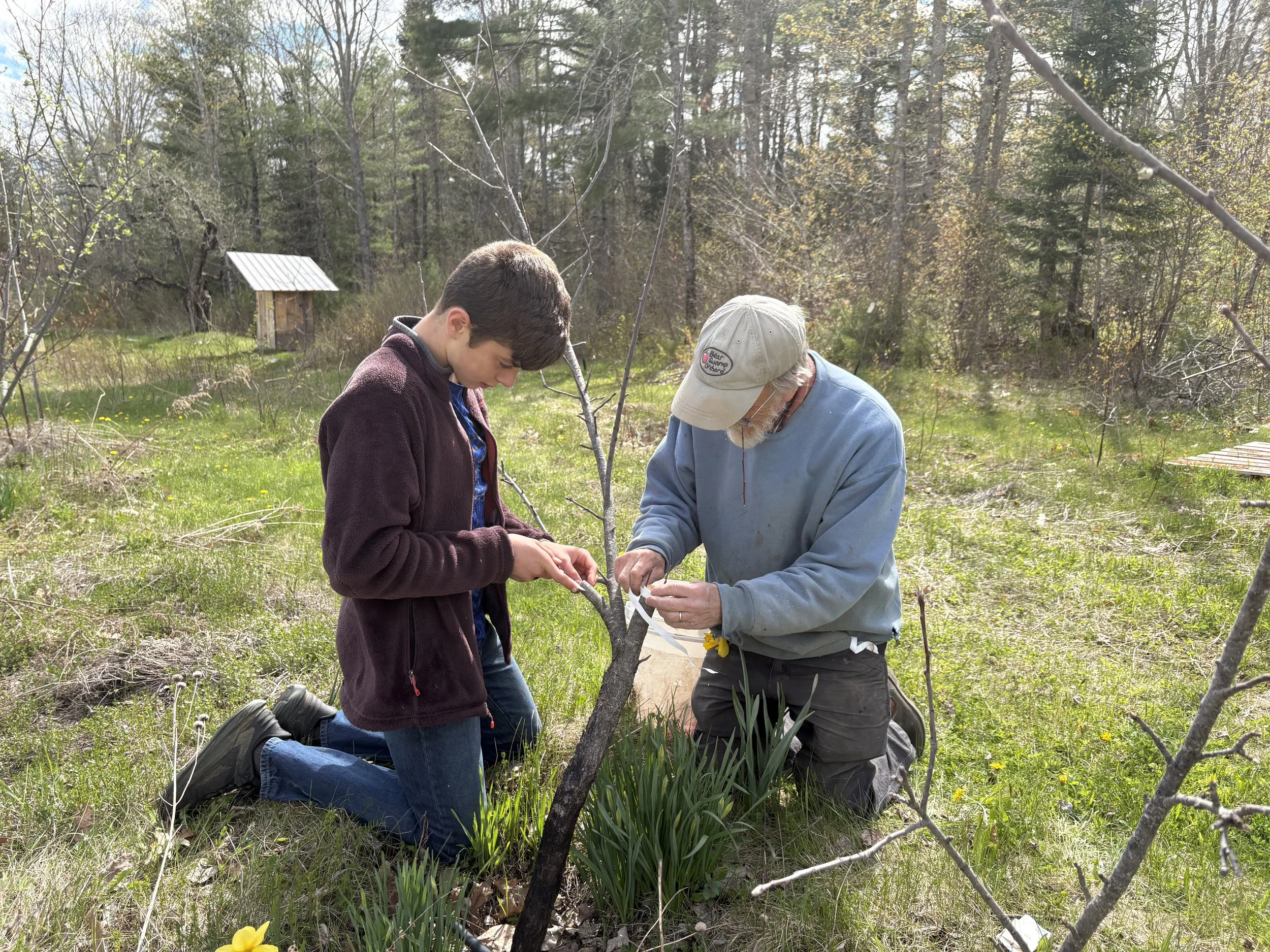
In the afternoon Seamus came over, and he and I topworked together.  After a bit of a refresher on grafting and a lesson in bark grafts, we headed down the rows at Finley Lane to graft over several unproductive trees to some of our recent discoveries. It was fun working together. He’s 13 and a quick learner. He asks interesting questions and makes interesting observations. He hadn’t remembered our collies’ names (Spy and Chaga), so he renamed them. (That was a first. Now, like many of our apples, they have synonyms!) Unfortunately, because it’s been so cold, some of the bark is still not slipping that well. We’ll hope for the best.

May 11 2026

The cold weather continued. Don’t put away the sweaters yet. Even the trees are shivering. The birds are still rallying around the feeders, including a colorful Rose-breasted Grosbeak. They typically pass through the farm en route north just about now.

Apple square, May 11, 2026

We stayed warm by working in the nursery, digging the bed for this year’s new batch of 200 grafted trees and planting asparagus. We also moved one apple tree about 15 feet. It was in a less-than-ideal spot, and it seemed like a good idea to relocate it. I cut a big square, and Cammy and I wrestled the heavy block over to it’s new home. It was relatively compliant, and I think it should be happy. It’s an unidentified yellow and russeted apple from Buttermilk Hill in Belgrade, one the Gawlers call “Sueboo Russet.” We had it DNA profiled and the results came back “unique.” Another mystery to solve.   

In the afternoon we went to friends and did some topworking for them. It really put our grafting magic to the test: despite being May 11, the bark was barely slipping. 

May 10, 2026

I created two new planting beds in the BRC orchard. Both will be sites for new companion plants. At least one will have a new apple tree. Over the past few year I’ve piled brush in the two spots—each about 4 feet wide and forty feet long. Today I laid old rotten hay over the surface, dug the tree hole and then partially filled it with gravel. The gravel will act as a bit of drainage as well as a medium for the tree roots to get established. Eventually I’ll cover the entire surface of the two beds with composted manure and woodsy soil I get from an old pile of decomposing stumps.

Malus hupehensis buds, May 10, 2026

Meanwhile Cammy dug trenches for more asparagus. Love that asparagus!  We have a large bed but one of the three rows has never done that well so we’re adding plants to that row. Plus, another totally new row for good measure.    

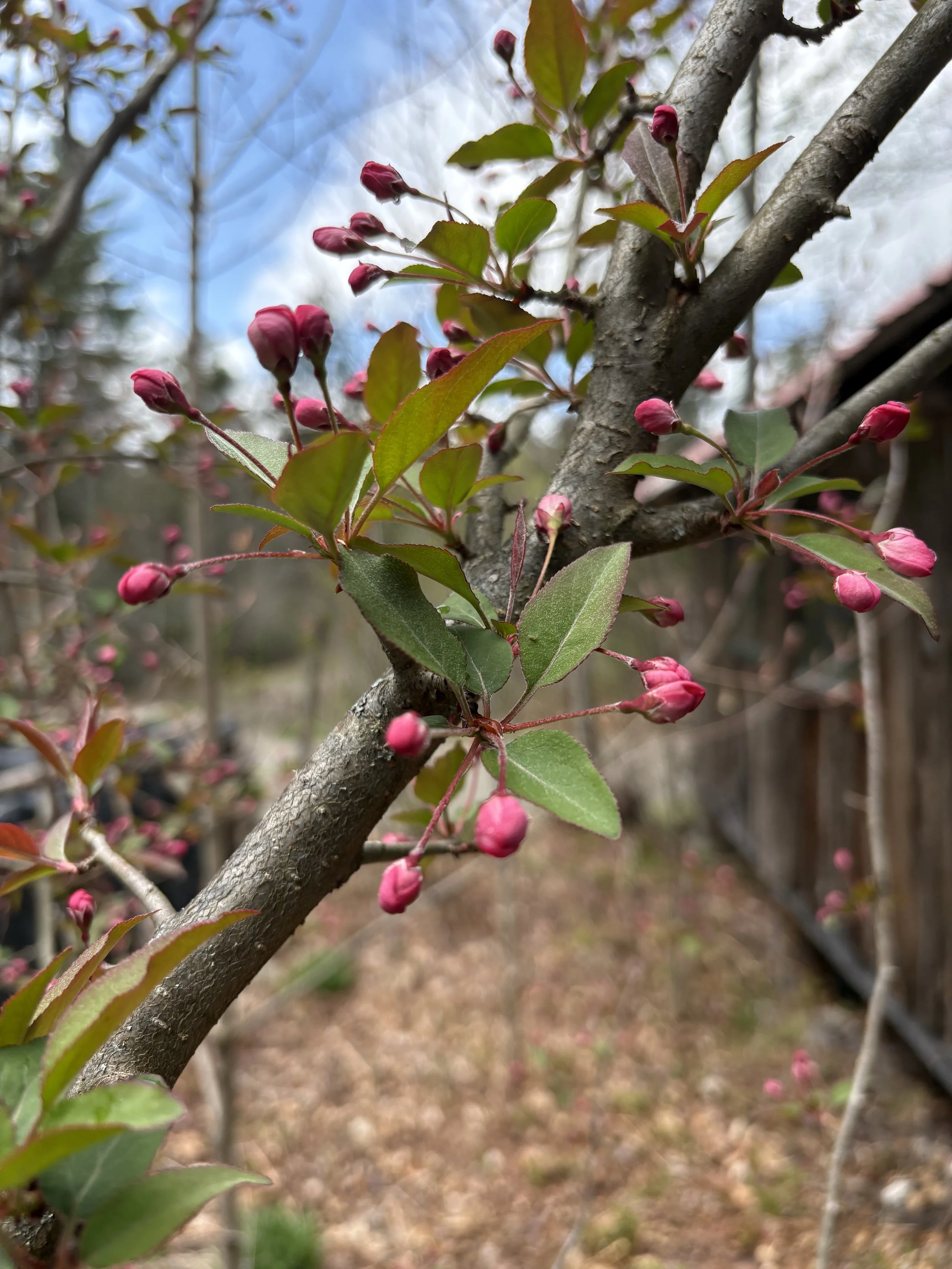
The temperatures remain cool, and we had a brief but insistent shower in the middle of the afternoon. Enough to convince us to come inside. Malus hupehensis is at “pink” now, suggesting it will soon be blooming. I’ve read differing stories about its common name: Tea Crab. Some suggest that the leaves make a delicious tea. Other suggest that it was a tree to sit beneath and drink “real” tea. Either way, it’s a beautiful tree.   

May 9, 2026

Today started out clear and cold (24F at 6 AM), then clouded up after noon and began to rain. But that didn’t thwart our annual celebration of Beltane when we mark the half-way point between equinox and solstice. A group of friends joined us, as they do every year, and we shared readings and stories, ate a long leisurely meal and immersed ourselves in the incredible power of friendship and the return of the growing season. 

First graft this spring, May 9, 2026

Beltane is an old Celtic celebration, one that dates back many centuries. We like to honor the tradition because it’s yet another chance to notice the magic and mystery of the Universe. We may not celebrate the way the pagans did in pre-christian days (no sending home the guests with a burning log from our fire), but we do have a riotous evening, and the clock struck twelve long before we hit the pillows. 

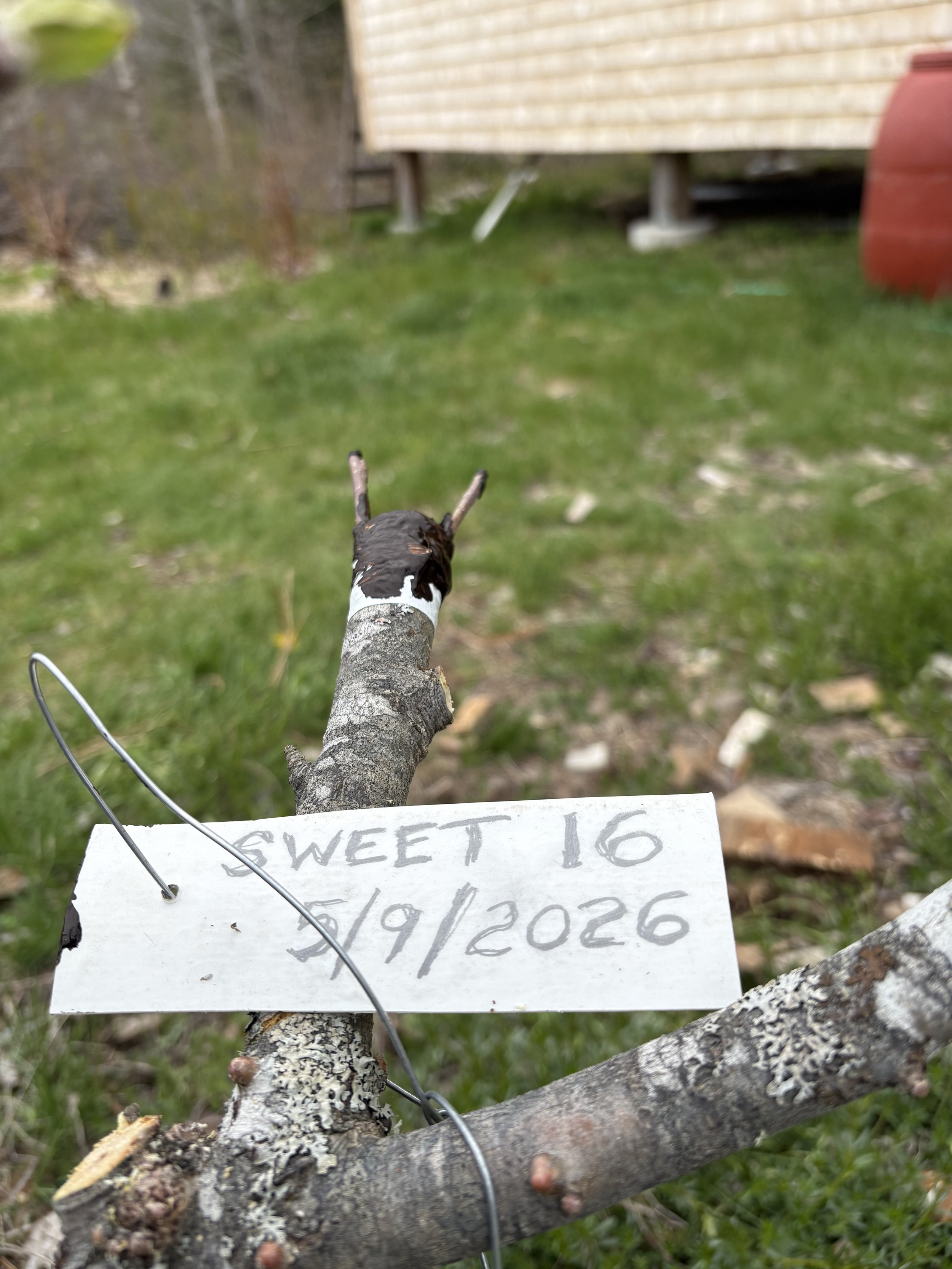
Just in time for Beltane, the Juneberries have opened up. I did a test graft out in the Finley Lane orchard. The bark is slipping so I’ll be topworking in the next few days. So much power in this Earth. 

May 8, 2026

Spring farm activity is now in full-tilt swing. Although we don’t get rolling as early in the morning as we did in the olden days (think “the old gray mare, she ain’t…), still we cherish the hours in the gardens and orchards and spent well over eight hours outside today. We could have done twelve.

Prunus ussuriensis, May 8, 2026 

Among other things, Cammy cleaned out the chicken coop, potted on brassicas, transplanted lettuce and weeded various gardens. I dug a few more trees for sale, moved a lot of manure (chicken and other) and cut a bit more firewood. I’m extra careful when I cut trees and brush now as I don’t want to cut down any bird-nesting sites.

The Asian plums (Prunus ussuriensis) are opening up, right on cue. A few of the apples are showing a bit of “pink.”   

May 7, 2026

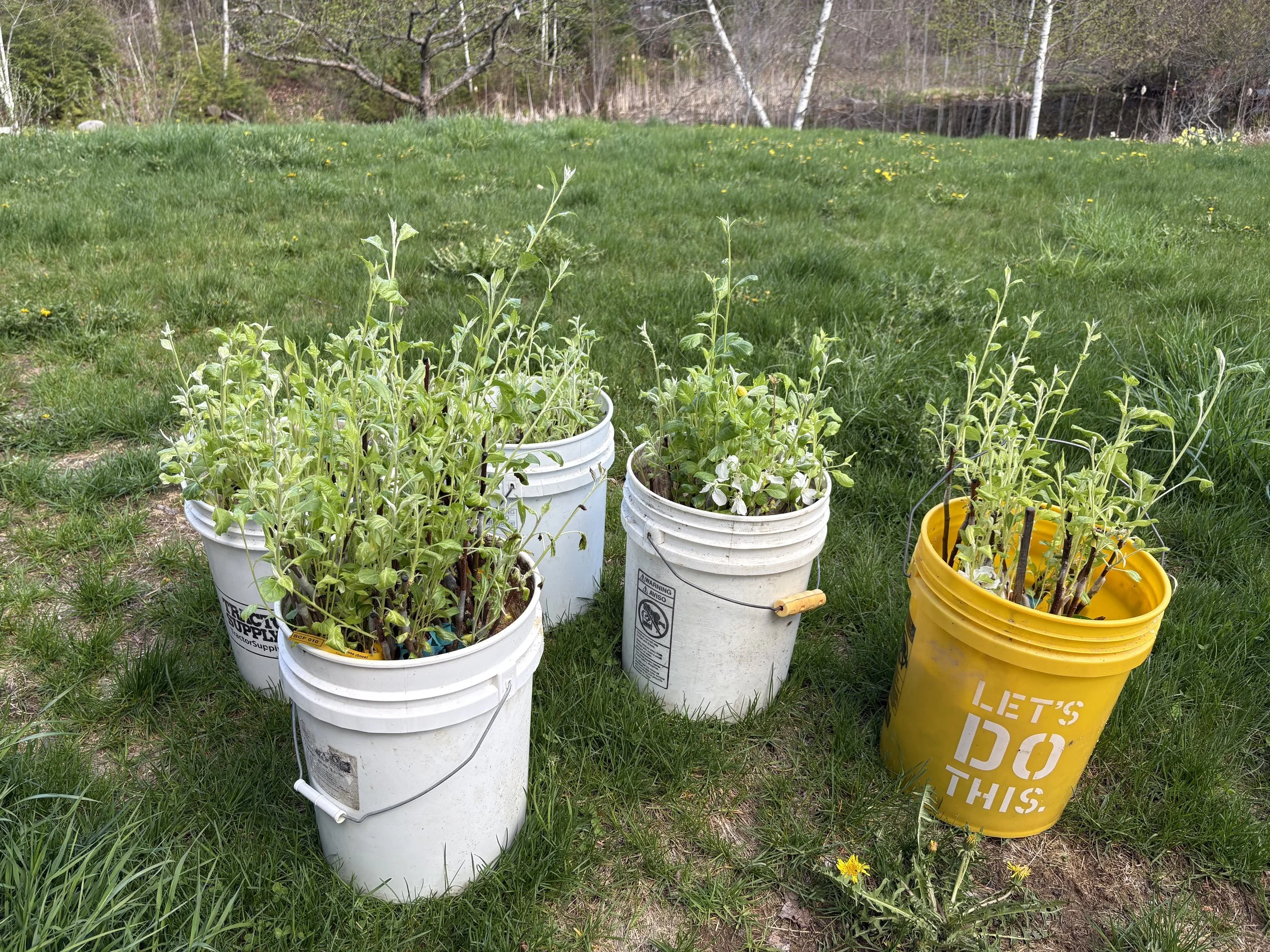
Young grafted trees, May 7, 2026

Great to be back home and out in the orchards again. I spent most of today going up and down the rows of apple trees, taking notes on their conditions. I wanted to catch up on how each tree is doing and at what stage they all are. Many are at about 1/2 green though others are barely showing any green at all. None are in bloom. I was also checking out potential topworking sites for about a dozen new cultivars I’m adding to the collection. Looks like there will be room for them all. At home I moved the buckets of young grafted trees outdoors where they can harden-off. We’ll plant them in the nursery next week.

The temperature was cool, and I wore a sweatshirt and a sweater all day. The dandelions (Taraxacum spp) and violets (Viola spp) just bloomed today for the first time (presumably to celebrate my return to the farm.) I was also greeted by not one, but two black flies (Simuliidae family) who ceremoniously bit me on the neck.

In the evening Cammy and I went to the Colby College senior art show. We saw several of my “apple students” there, four of whom were showing their art work. Three of them showed us photos of the apple seedlings they started with seeds from the class. We’re changing the world, one new apple at a time.        

May 2-5, 2026

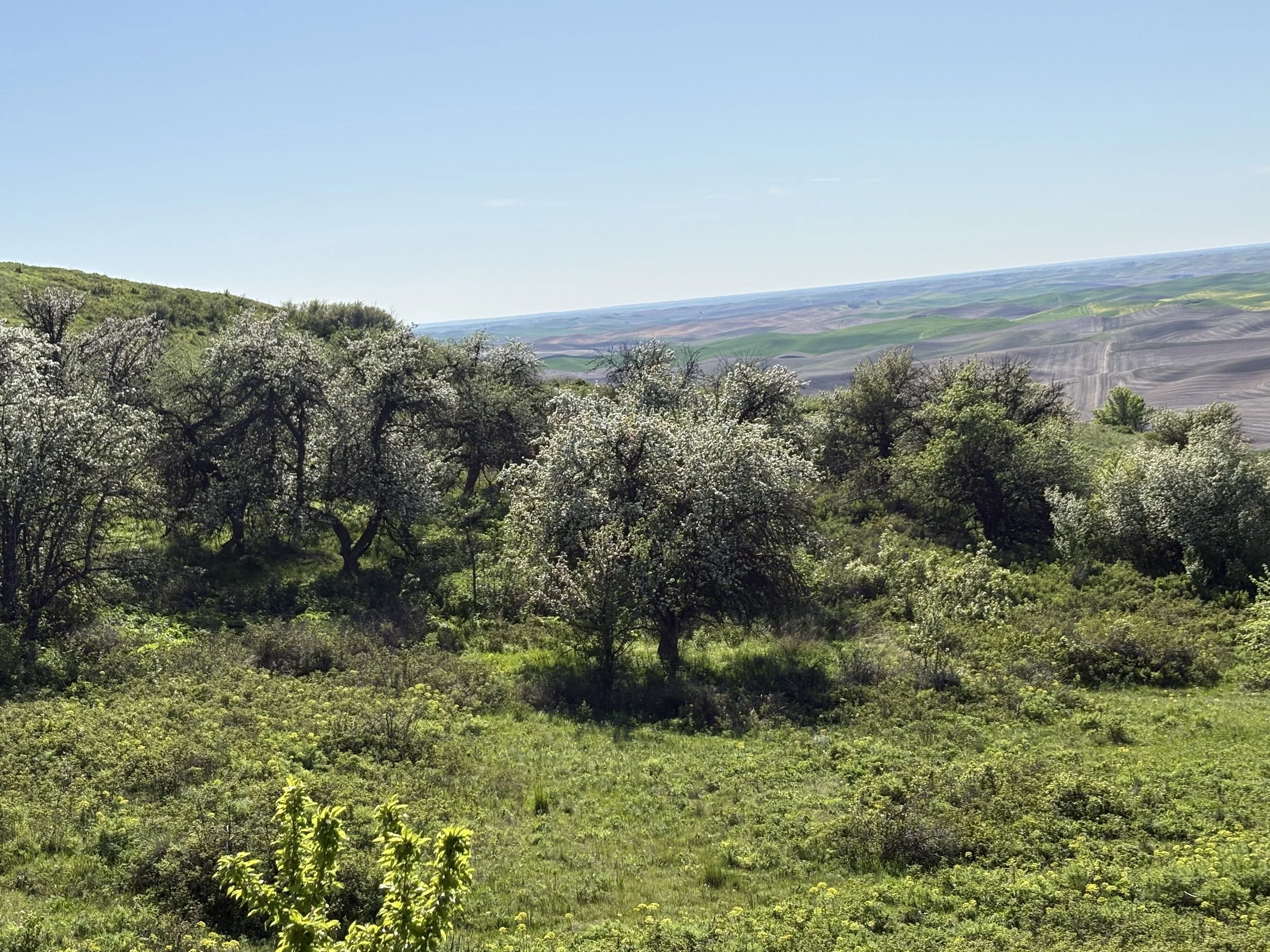
Old apple trees below Steptoe Butte, May 4, 2026

I just returned from a trip to eastern Washington and western Idaho where Skylar and I were visiting apple colleagues and friends as well as meeting apple explorers, breeders, geneticists, enthusiasts, preservationists and more. It was a fantastic trip. We spent our time in the area of Pullman and Spokane as well as over the border in Moscow and Coeur d’Alene, Idaho. We did not get over to the mega-orchards of Yakima and Wenatchee, but that was fine. We had more than enough to keep us excited, awestruck and inspired. 

Eastern Washington is a vast, wide-open landscape. It’s the largest wheat-growing region in the US—maybe even in the world. The topography bears no resemblance to central Maine. You can see for a very long way no matter where you find yourself. At one point we were standing in Washington, looking over Idaho and seeing Montana in the distance. The annual rainfall (20”) is about half that of central Maine. 

Despite the differences, the two places have one very interesting thing in common: just as in Maine, there are apple seedlings growing along nearly every roadside as well as in gullies and anywhere else there’s a bit of water. We saw hundreds of trees—some grafted and others seedlings—many of them exceedingly old. They were at also near peak bloom which made them very easy to find. I felt right at home!

Our hosts were Cameron Peace of Washington State University and Dave Benscoter of The Lost Apple Project. We spent time in Cameron’s DNA lab, the WSU test orchards, their breeding project, greenhouse and more. Dave led us on two fruit exploring days including up Steptoe Butte where we “met” hundreds of exceedingly old apple trees.  

It’s impossible to document everything we did. It was a truly inspirational adventure. I came away with even more appreciation for the amazing apple. Although the cultivars (varieties) we know and love may not last forever, (some of them are already gone), the apple tree has embraced North America and will be here forming communities, fruiting and feeding humans and other creatures for lifetimes to come. Many thanks to Cameron, Dave and everyone else for an incredible trip.  

March 22, 2026

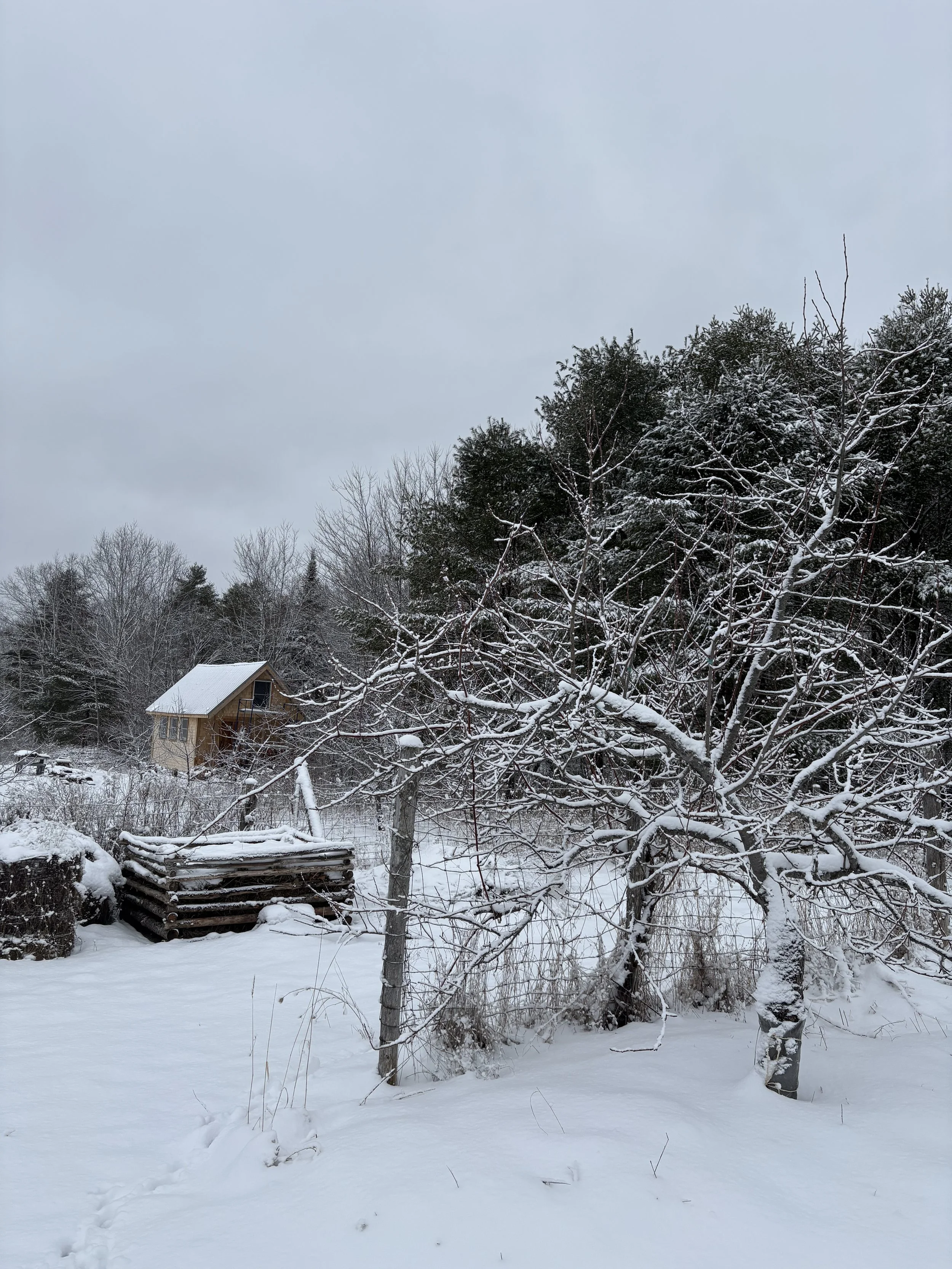
Poorman’s Fertilizer, March 23, 2026

As Johnny Horton sang in 1959, “When it’s springtime in Alaska, it’s forty below!”  It wasn’t quite forty below today, but it did look like Day One of the Iditarod. The snow came in with a vengeance. It started an hour after sunrise and was still going strong at dark. In the end only 6-8” fell, but it was still what I call a regulation snow storm. 

Those spring snows: are they The Poorman’s Fertilizer? According to a friend, only snow after April 10th—the official Poorman’s start date—can be considered as such. April 10th is also the official “return of the Canada Geese” date. Every year I hear them fly over the orchard on the 10th. Maybe these two seemingly unrelated events are not so unrelated. (Like so many things.)

Though the ground is still frozen down under, the surface is softening up, and when this latest snow melts, much of it will be absorbed into Mother Earth. The plants will be glad for it, and we will too. The magic of Water. The snow this past winter has been almost entirely of the dry kind. We had hardly any days over freezing for all of January and February. But the snow today is the wet kind. It’s heavy. Were it dry, it might have been a foot deep. Were it rain, it would already be gone down the Sheepscot River en route to Wiscasset. This way it has a far better chance of getting put to use in the orchard. Give me snow in March!

March 31, 2026

And so wondrous March—the shortest month of the year—comes to end. Hello Spring. Goodbye Winter. Hello. Goodbye. With its cold rain and dwindling snow, its cleansing winds, its powerful light and the rising of an energy that will soon explode into the orchard, March sprints by as it does every year. How can a month go by so fast? If only March was three weeks longer. Too late to stop it. It’s time to say, “Go, go, go!” 

The rain did come last night and lasted into the morning. By noon, however, it was gone. It was ice-out on the pond in the center of the BRC Orchard. The first bulbs are emerging from beneath the apple trees. We planted them there to stand guard and fend off the voles. No damage noticed yet this spring. It appears they’ve done their job for another winter.

Hello Goodbye. Hallowell March 31, 2026

A little sun in the afternoon. I went to Hallowell to commiserate with six trees—4 apples and 2 pears—that will be cut down in two weeks to make way for a new college dorm. There’s apparently some logic there though I can’t find it at the moment. I took scionwood from one of the apples and one of the pears in order to graft new trees. The other trees will remain in the memories of those who joined me there this afternoon. Hello. Goodbye.

April 29, 2026

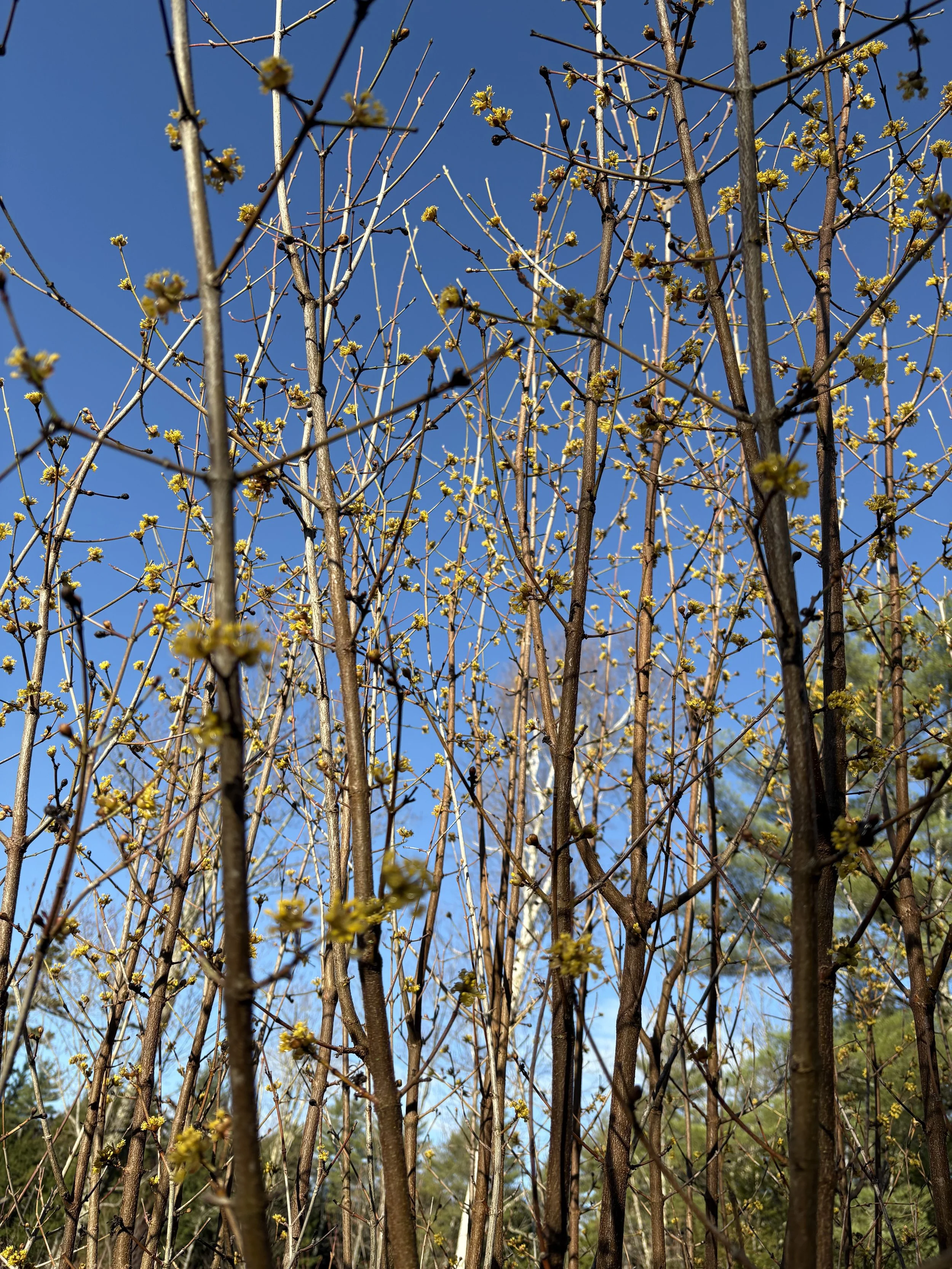
The Forsythia and the Cornus mas (above) are both out in full bloom

We were visited by several Myrtle Warblers. They were right outside the kitchen window at the suet feeder. Maybe “Myrtle Warbler” no longer exists as a name, but if you look at an old bird field guide, you’ll find it. I think it has been renamed the Yellow-rumped Warbler (Setophaga coronata). I may sound like “a broken record” but the birds have just been amazing this spring.

It turned out that I wasn’t quite done planting for the year. I found spots for two more apples: a Hunt Russet and what may be Monroe Sweet. Hunt originated in Concord, MA well before the Revolution. It was one of the first named North American cultivars and is a child of two of the most iconic European apples: Reinette des Carmes  x Drap d'Or de Bretagne. I should have planted one years ago. The second apple is one I was introduced to by Pam and Wayne Sweetser in Presque Isle. It may be the true Hayford Sweet or it may be one of the Monroe Sweets. I say “one of” as there may have been multiple different apples with that name. This one is a true sweet and worth saving. 

April 28, 2026

Pruning has ended for the year. With the buds opening and the trees waking up, it’s time to move on to other activities. That being said, I still had one more pruning job to do. I went up to our neighbor, Bruce Potter’s, and pruned six old trees: 3 apples and 3 pears. They hadn’t seen a saw in so long they didn’t know what they were in for. Bruce said, “a light trim, please.”  That reminded me of 1966 when I went to the barber and asked for “a light trim.” I came out  looking like I was heading for basic training. I did survive that dramatic hair cut and Bruce’s trees will too. Actually I think they look rather good. It was a big job; there’s a lot of brush to lug.

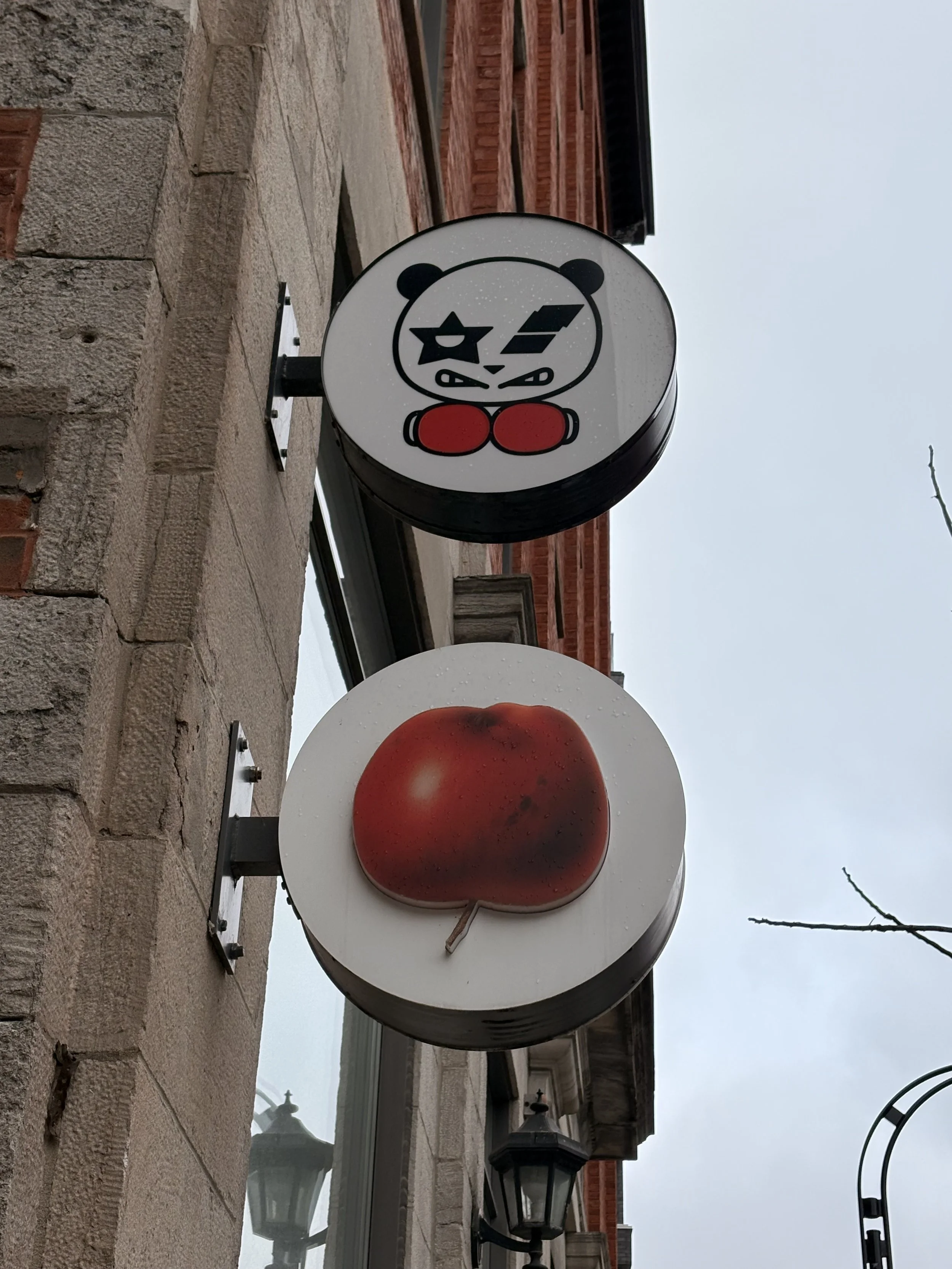
Montreal apple, April 2026.

I had time to cut a bit more firewood before that season also comes to a close. I don’t like cutting firewood when there might be birds nesting up in the trees. Cammy is up in Montreal visiting with friends. She sent this photo. Nice to know the Canadians know which end of the apple (and the world?) is right-side up.