
+18F at dawn. Some light snow last night though not enough to measure. In the morning I jumped into one of our highest priority apples, Martha Stripe. What a mess!
In January 2019 Cammy and I went to Tower Hill Botanic Garden in Boylston, MA to cut scionwood from all 119 cultivars in their historic apple collection. The trees were suffering badly from decline and fireblight and were going to be cut down. Fedco offered to re-graft the entire collection for them. There were two trees of each cultivar, and with one exception, at least one of each was still alive. The exception was Lyscom, both trees of which were dead. No scionwood. Where would we get Lyscom?
Then I remembered that thirty years earlier I had received a letter about another apple, Martha Stripe, which was known as a synonym of Lyscom. The tree was in Orland, Maine. If I could only find it. I eventually located the letter in my files from Millard A. Clement dated October 21, 1998. He wrote, “I read your article in the paper today 10/21/98 about apples. I have a tree that I was told by my father is a ‘Martha Stripe.’ When I moved here in 1954 there was three of these trees. Only one is left. The apples are sometimes 3” across. … We make apple sauce and add nothing to it just cook the apples and eat.”
I never got around to visiting Mr. Clement, but in the late winter of 2019 I did go visit his former home to see if I could collect scionwood from the last remaining tree. The owner at the time did not recognize the name Martha Stripe, but when I described the apple, she thought she knew which tree I wanted. I collected the wood, propagated trees, and two years later, sent them back to Tower Hill. Another old cultivar saved… or so I thought. When the Tower Hill collection was DNA profiled, my “Martha Stripe” profiled as Twenty Ounce.
Meanwhile we also determined that, despite the description in Bradford (Apple Varieties in Maine), Martha Stripe probably was not a synonym of Lyscom. Mathew Stripe was the synonym, not Martha. How do you keep this stuff straight?
For the moment we think we have found the true Lyscom in Southborough, MA where it originated. And we continue to hear the name Martha Stripe as a cultivar grown in the Orland—Castine area, on the very road where Mr, Clement had lived. It has to be there somewhere. So last October I returned to the Clement farm, (now owned by someone named Doucette) and collected fruit from all the trees in hopes that one of them would be the true Martha Stripe.
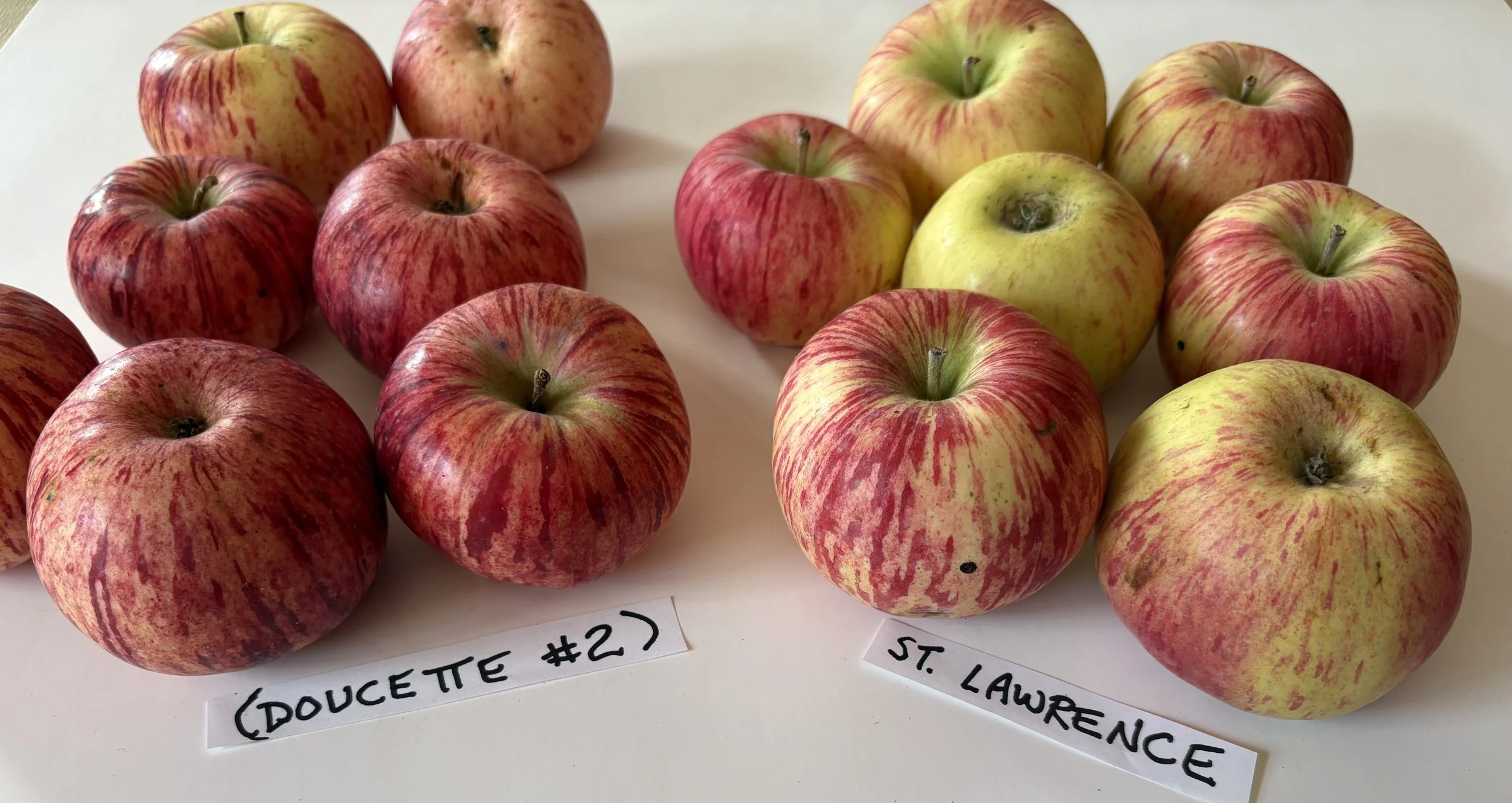
Today I did a detailed phenotype of “Doucette #2”, one of the top candidates. As far as I can tell, it is not Martha Stripe. I suspect that it is the excellent, very-striped apple, St. Lawrence, though perhaps the DNA profile will prove me wrong.