
Yesterday it snowed most of the day for a total of 3”. Today was clear and tickled 32F. I spent some time cutting scionwood, but mostly I delved into the identity of one of our longest-standing, mystery apples -AMHO_151. It seemed as though the time was right to finally figure this one out.
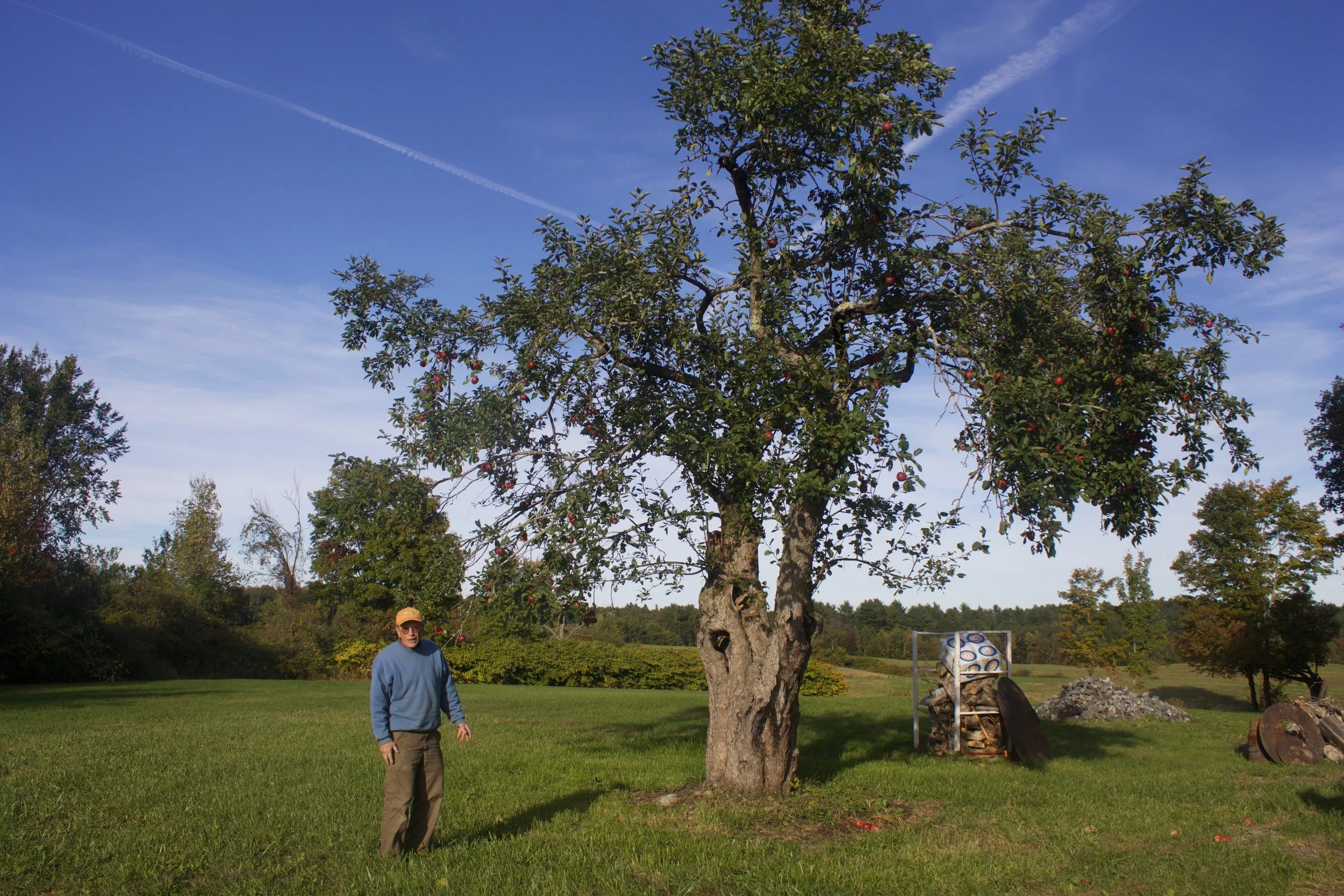
The original tree of AMHO_151, Oct. 2015
Over the course of multiple years of DNA testing in central Maine, 13 old trees (c 120-140 years) have tested as genetically identical. The first of them that is referred to as AMHO_151, is a beautiful old tree growing behind a barn on the West Road in the central Maine town of Belgrade that I first visited in September 2011. Even before genetic testing, I believed that I kept finding the same cultivar over and over again. At first the trees were all from the Belgrade Lakes region, but DNA testing confirmed that the geographical parameter of this cultivar included a large swath of the central part of the state. As far as I know, it has not been found outside of Maine.
I’ve had a number of suspicions about this apple since I first saw it in 2011. Originally I thought the apple might be one called Zachary that was introduced by Joseph Taylor. Taylor (1804-1882) was a Belgrade orchardist who was active in the Maine Pomological Society. I also considered that it might be another Taylor introduction called Childs, Childs being a common last-name in the Belgrade region. And I couldn’t rule out the possibility that the apple might be the Delaware County, PA apple, Pennock, aka Pennoch, Red Winter Pennock etc. as suggested by a number of others.
My latest thinking is that the apple may be Arctic, a historic cultivar that most likely originated in either New York or Vermont about the middle of the 19th century. Arctic is distinct from “Autumn Arctic” and is not currently in any DNA tested database, as far as I know.
Since Joseph Taylor died in 1882 and his introductions were never broadly popular, any Taylor introductions, still surviving, are likely to be ancient trees. This makes it less likely that AMHO_151 would be one of his. There are two Belgrade trees that could be his introductions - “Dots” (AMHO_011 & AMHO_052) and Janetha’s Yellow (aka Stone Wall/E Sabins, MHO 2014 H3) (AMHO_300 & AMHO_487). These ancient trees are still growing at what was Joseph Taylor’s parents’ farm—later known as the Sabins Farm—about 2 miles from Joseph Taylor’s own home. The Sabins Farm is currently owned by Janetha Benson. AMHO_052 was submitted from the state of New Hampshire by Jared Kane. (AMHO_300 and AMHO_487 are the same tree.) Dots and Janetha Yellow each DNA profiled as unique. Janetha Yellow has Reinette Franche as a likely grandparent and Drap d’Or de Bretagne as a close relative.
How about Pennock? There is a possibility that AMHO_151 is Pennock. Phenotypically, Pennock does closely resemble AMHO_151. References to Pennock are scarce, however, and one would hope that an apple that appears as frequently as this one would have found more representation in the literature. Bradford (1911) writes of Pennock, “…grown in the state probably since 1835. It was fairly well known around Bangor in 1850 and has been grown to a limited extent since that time.” Although these AMHO_151 trees are old, they are not ancient. It would be safe to say that any Pennock trees would likely have to be older than the trees we’ve found.
Most recently it was revealed that six trees (Holli Trees #1-6) from one farm in the town of Embden, about 40 miles due north of Belgrade all tested as identical to AMHO_151. I contacted Holli Cederholm immediately. Holli works for MOFGA and used to work for Fedco. I was hoping for a good clue or lead. She wrote to me: “ A few of our neighbors have been around for decades and know the apple as a winter keeper. One neighbor says he has one of the same variety, he suspects, at his camp down the road. Another, who is 84, says the previous farm owner called the apples "Arctic Baldwin." This was exactly what I had hoped for. There are multiple references to Arctic being grown in central Maine at the proper time and being compared to Baldwin. It was also known as “Hardy Baldwin.” AMHO 151 is a “Baldwin type.” It is a dark red, long keeper—like Baldwin.
Why had I not considered Arctic before? I had been introduced to Arctic twice in the past. The first tree was at Earland Goodhue’s farm in Sidney, near Belgrade, in about 1997. Earland’s Arctic (one large branch) was ID’ed by the famous, NH professor and breeder, Elwin Meader who was an acquaintance of Earland’s. Earland had collected the scionwood from an old tree in Sidney, not knowing what it was. He was skeptical and somewhat dismissive of the ID which made me skeptical as well. Although I grafted a number of Earland’s cultivars, I never grafted his Arctic. In light of the fact that we’ve found multiple trees of the possible Arctic in the Belgrade area, maybe his was, in fact, correct. We will probably never know. Earland died over ten years ago, and his orchard has been mostly abandoned. I might still be able to find the Arctic branch though it’s doubtful. I do not have photos of that apple.
In the late summer of 2013 I was contacted by Nancy Homes of Jefferson who told me about an Arctic tree she had been introduced to in Jefferson. I visited that tree in September 2013. I returned to the orchard in March 2014 and collected scionwood from which we grafted five trees that spring. Presumably one of those was the tree planted at MHO in the spring of 2016. That was tested once (AMHO_085) and came back as Black Twig. That test appears to have been contaminated or mixed up. It should be tested again. I never phenotyped the Jefferson Arctic though I do have multiple photos of the apple. It is similar to AMHO_151.
Pennock and Arctic phenotypes on paper are nearly identical. I’ve assembled an excel spreadsheet of the characteristics using Bussey’s descriptions of Pennock and Arctic and comparing them to the descriptions I’ve done of AMHO_151 et al. That comparison shows very little difference in the three.
It may be possible to get some clues by looking at the parentage of these apples. Knowing parentage can reveal what an apple can—or can not—be. Bussey writes that Arctic originated in about 1862. Pennock was first recorded in 1810. If at least one of the parents of AMHO_151, originated after 1810 but before about 1840 that would eliminate Pennock from contention. The genetic testing revealed that AMHO_151 is a triploid and that one parent is (or may be?) Newtown Spitzenburg. Newtown Spitzenburg was first recorded in 1817 but almost certainly predates 1817 by a number of years, possibly a half century or more. This would mean that Newtown Spitzenburg could be a parent of either Pennock or Arctic. Pennock is likely from PA, and Arctic is likely from New York or Vermont. The probable dates and locations of origin for both fit plausibly with Newtown Spitzenburg as a possible parent.
Can I gain some clues from tree locations? There are multiple references to Arctic being planted in the last ten years of the 19th c. in Somerset and Piscataquis Counties, not far from the location of all but one of the 13 trees we’ve found. As far as I know, no such references have been found for Pennock. This is strong, but not conclusive evidence.
What about the 84 year old neighbor? Having a neighbor indicate that the apple was known locally as “Arctic Baldwin” is huge. This is also strong evidence that we may have a positive ID.
Case solved? Although I think we have found the Arctic apple, there are a few steps moving forward that could close the case. A complete test of AMHO_151 should be done with the hope of confirming the one parent and determining the second. We should retest the possible Arctic from Jefferson (AMHO_085). I should return to Earland Goodhue’s farm in Sidney in the fall to see if I can locate the branch that may have Arctic. Lots to do. The mystery continues.