
Today in the orchard
I generally prefer making single-variety pies because I love to see what a particular apple can do. But now it’s Thanksgiving, and I want to go all out with a blend. Yesterday I mentioned Northern Spy, Rhode Island Greening and Gravenstein—all excellent choices. But I prefer to be more adventurous. So I will use Redfield, Blue Pearmain and Grandfather.
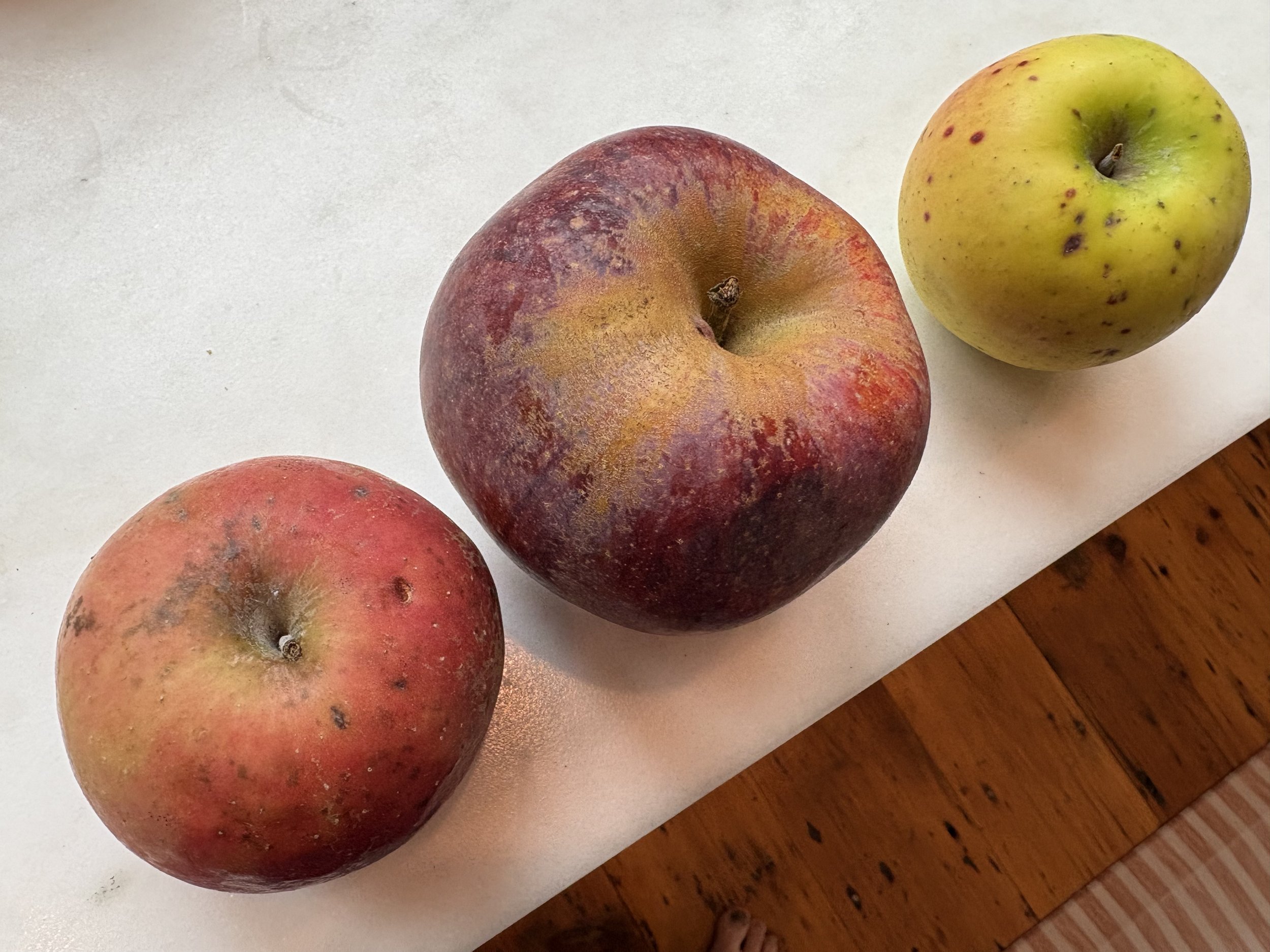
Redfield, Blue Pearmain and Grandfather
Redfield is a modern (1938) apple and one of my favorite apples ever. It knows how to make sauce, and it definitely knows how to shine in a pie. The slices hold their shape, the texture is tender yet firm, and it has flavor. The tree itself bears prolifically, annually and is relatively easy to grow. And the flesh is red. Who could ask for more?
Blue Pearmain is exceedingly old (c 1725), originated somewhere in Suffolk County—Boston, is of unknown origin and parentage but has the famous ancestor, Reinette Franche as a grandparent. On the beauty-scale it’s up near the top - magnificent. It’s also one of the parents of Black Oxford and a favorite unidentified apple we can “Guptill Lavender.” It is a bakes well whole, so today I’ll give it the ultimate test.
The third (a risk) is a local apple, “Grandfather,” which may be a seedling but which is quite old nevertheless. We grafted ours from an old tree a few miles from our farm. I chose it in part because it is acidic. The pie apple requires acidity. The low-acid apples do not cook well into a pie. I don’t even consider them. Grandfather is also beautiful. True, beauty doth not an pie apple make, but it’s also mostly yellow. Neither Redfield nor Blue Pearmain has a dot of yellow on them, and it seemed like I needed at least some yellow to balance the red. Balance is good for a pie.
What apples should you use? Better to lean on the acidity side. You can tell—just take a bite of the apple fresh. Love that simple crust. Go easy on the spices and sugar. Use lots of butter. And if all else fails, there’s always ice cream or whipped cream. Or both! Happy Thanksgiving.