
Today in the orchard
A balmy zero this morning - fourteen degrees warmer than yesterday. It snowed all day although the new accumulation was less than an inch. The temperature rose to the mid-teens by early afternoon. I took the opportunity to do some outdoor chores before the ground is entirely frozen. That could be soon.
I was able to spend some time identifying apples, today’s focus being “Faux Tremletts,” or, as some call it, “Geneva Tremlett’s.” It was sent to the US as Tremlett’s Bitter from Long Ashton Research Station in the UK in 1949 and became part of the Geneva, NY apple collection with the number PI_175550. It was presumed for many years to be correct, but its identity was thrown into question about the time that cider-makers realized that the US “Foxwhelp” was incorrectly labeled and became known as Fauxwhelp. The tip-off was that, as “Tremletts” began to be passed around, grafted and fermented, it became clear that PI_175550 is a bittersharp. The true Tremlett’s Bitter is a bittersweet. There was a problem.
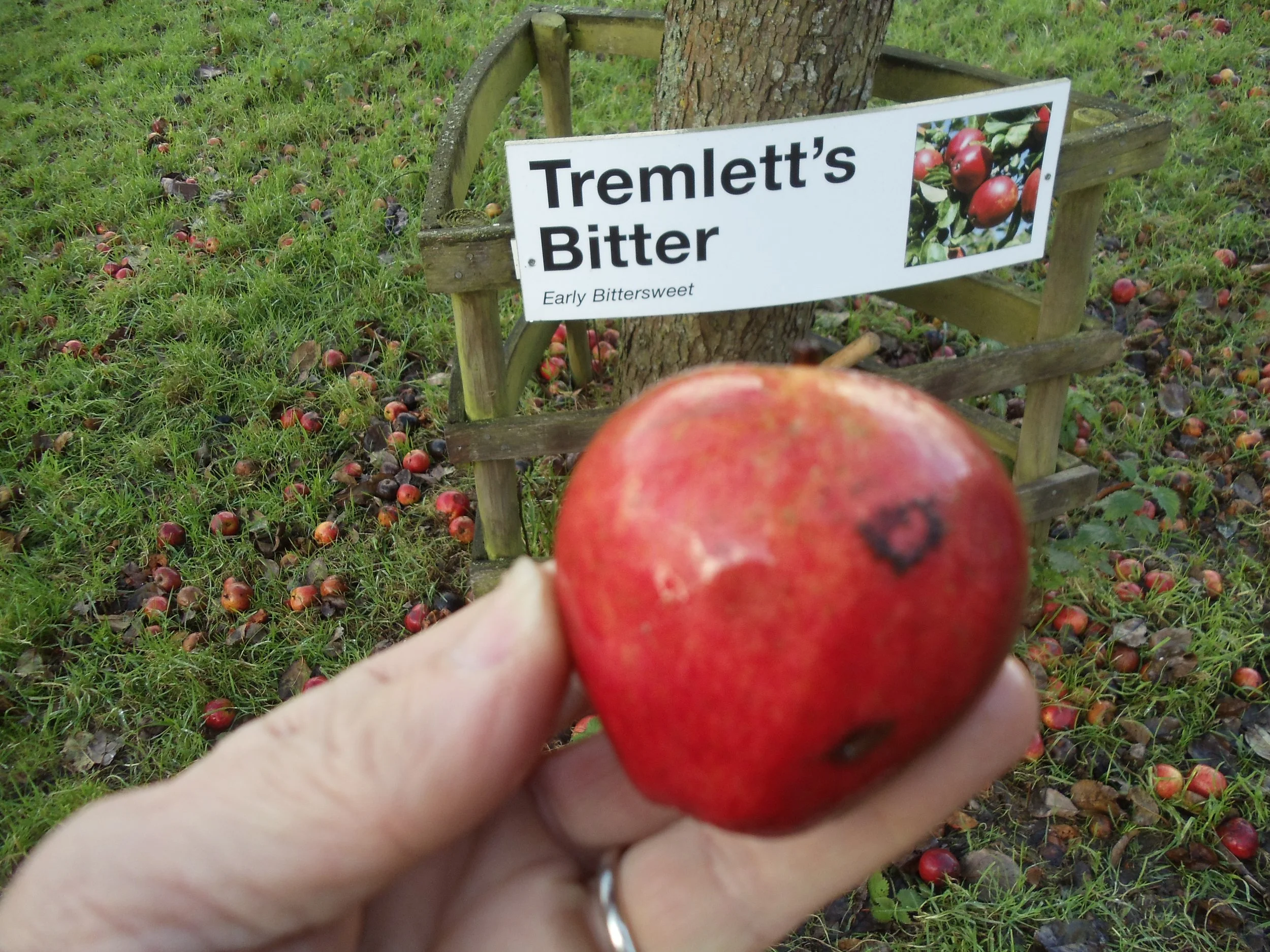
Dick Dunn wrote in Cider Digest in June, 2015, “The pleasant irony is that the mis-ID'd variety is actually a rather nice cider apple. I haven't been nearly bold enough to make a varietal cider of it, but it's a real help in a blend that needs a nudge in character. So I'd like to be able to describe it to other cidermakers/orchardists without resorting to a short essay of its provenance...I just want a name.”
There was some attempt to identify PI_175550 but without success. For a while it was thought that it could be Skyrme’s Kernel, an English bittersharp. But Geneva has Skyrme’s, and it appears to be correct. (We also have Skyrmes from Geneva growing here. It’s a beautiful, hardy and prolific bittersharp, one we recommend for trial in colder districts.) In 2019 the true Tremlett’s Bitter was imported from the UK and is now in the Geneva, NY collection as PI_703244.
So now both “Tremlett’s” are here in the states. While it’s great to have the real Tremlett’s, unfortunately trees and scionwood of both are being sold, sometimes with no clear indication of which is being offered. Some nurseries say that they are selling the faux. Others say they have the real one but clearly do not. Some descriptions are confusing or even bizarre. One site suggests that the apple can be bittersweet or bittersharp depending on this or that.
After looking through my various books of UK cider apples, I’ve begun to zero-in on a possible ID for Geneva Tremlett’s. There are clues to be found here and there. Greg Peck of Cornell wrote to me that they have compared the Geneva Tremlett’s DNA profile with DNA results from the US and Europe but have found no match. Greg has sent me that list, and I'll look it over tomorrow. As Sherlock always loved to say, “Eliminate the impossible!” Once I can see what’s been discounted, I’ll be ready to flip the latch and open the next door of possibilities.