
A Prince and a Pauper? How two good apples got mixed up
(with quotations from and apologies to Bertie Thomas Percival Barker, Liz Copas, Mark Twain, Roger Way, and everyone else.)
“A few minutes later the little Prince of Wales was garlanded with Tom's fluttering odds and ends, and the little Prince of Pauperdom was tricked out in the gaudy plumage of royalty. The two went and stood side by side before a great mirror, and lo, a miracle: there did not seem to have been any change made!” Mark Twain, The Prince and the Pauper, 1881 (or so)
This is the story of Tom Tanners, an obscure, historic bittersharp cider apple from somewhere in the west of England. Though high in sugar and high in tannins, and coveted here and there, the apple was eschewed by the modern commercial cider powers-that-be and never made it to the big-time echelon of cider royalty, eventually slipping into obscurity, destined to be lost forever. Well, almost.
Like much about the apple, Tom Tanners’ beginnings remain a mystery. Its original name may have been Tanners Red, though we may never know that for sure. It was first recorded as Tom Tanners about a century ago at the famous Long Ashton Research Station near Bristol in the UK, having been submitted from the village of Butleigh, east of Street and south of Glastonbury.
From the research of the modern pomologist Liz Copas, we know that after Tom Tanners was brought to Long Ashton, it was subsequently planted in various trial orchards and was included in the now extinct Whettons Museum orchard at Broxwood, Herefordshire. (Many of us in the cider world know the name Broxwood from the Broxwood Foxwhelp, a seedling of the famous “Old Foxwhelp,” itself one of the most important cider apples in the world. Maybe, the most. The mis-identification of Foxwhelp in the US is another story!) During the first half of the 20th century Tom Tanners was locally well-known in Rodney Stoke, near Wells, Somerset where it gained a reputation for its intense tannin and high sugar content.
But as time went by and the demands of the commercial cider apple industry took precedence, Tom Tanners was pushed to back of the bus by other, more desirable cultivars such as “Michelin” (we’ll get to that), Yarlington Mill (another mix-up in the USA), Dabinett, Harry Master Masters Jersey and a few others, some correctly named and others, not so. And so, this very good cider apple was on the rusty track to oblivion—along with dozens of other worthy historic cultivars—were it not for one small error and a subsequent case of mistaken identity that appears to have saved Tom, with all his “fluttering odds and ends,” and insured his survival for generations to come.
It all began in 1949, when the famous and beloved American pomologist Roger Darlington Way of the old New York State Fruit Testing Station in Geneva NY, in collaboration with another equally beloved pomologist, Professor B.T. P. Barker of Long Ashton, arranged to have a number of cider cultivars sent to the US to become part of Way’s test collection, a collection that was later to become the foundation of one of the most important apple collections in the world, that of the USDA ARS PGRU: The Agricultural Research Service/ Plant Genetics Resources Unit. What interested Dr. Way in cider apples, we’ll never know. The commercial cider industry in the USA had been dead for a hundred and fifty years. But, whatever the reason, we can all be thankful none the less. One of the cultivars Barker planned to send to his colleague and friend that spring was to be a highly-touted bittersweet cultivar called “Tremlett’s Bitter.” Tremlett’s Bitter— sometimes called Tremmies in parts of Devon—was a well-known and popular Devon bittersweet variety which was—and still is— commonly found throughout all the cider growing counties in both bush and standard orchards. In the cider world, it was “tricked out in the gaudy plumage of royalty.”
The fateful day came in the late winter of 1949 when it was time to cut the scionwood for the shipment to America. Clippers in hand, the trusted technician—perhaps it was B.T.P. himself—headed out into the orchard. Although no one knows for sure what happened next, someone was not paying attention. It wouldn’t have been a case of a distracting text message or cellphone call. No, the invention of the Smartphone was nearly a half-century away. And it probably wasn’t cannabis. The first pot in the UK wasn’t being rolled up in wheatstraw papers until Eric Clapton, Jeff Beck and John Lennon discovered it in 1965 (or maybe it was ’64). Was it too much cider sipping? We’ll never know. But, as it’s been done way too many time before, someone cut the wood from the wrong tree.
The trees, as is often the case, were conveniently planted in alphabetical order, TR and TO being only a few feet apart. Alas, unbeknownst to all, Tom Tanners got cut that day instead. Oh, how easy it is to take one too many a sip from the costrel and then, oops, snip a beautiful long scion from the wrong branch!
And so, in the late winter of 1949, lowly Tom Tanners was packaged up, signed, sealed, and delivered to Geneva NY where another technician—or perhaps it was the great Roger Way himself—innocently grafted it onto a rootstock and carefully wrote on the tag, “Tremlett’s Bitter.”
And when Tom T fruited a few years later, no one cared or even noticed that the fruit should be a true low-acid bittersweet and that this imposter was anything but. Not much of anyone was making cider anymore in the USA and who cared, anyway? Bittersweet? Bittersharp? What’s the difference? (The last few cider-makers of the day were collecting their apples off the stone walls and down the ancient dirt roads of Maine, New Hampshire, Vermont and upstate New York.) So when Tom Tanners fruited, no one thought twice—or even once. At least, not yet.
Fast forward fifty years. Tom lived on in disguise. All the guilty parties are to be forgiven. They weren’t cider-makers in the first place and none of them knew the English cultivars. Not only that, one stick of scionwood looks like another, especially if you aren’t out there pruning in the orchard all winter long.
Then, as North Americans began to dabble in cider again, cidermakers began to show an interest in all the wonderful material available at the USDA ARS PGRU in Geneva, including the cider cultivars from the west country of England. And, with that interest came the ensuing revelations.
First to get the axe was the mighty Foxwhelp. (We still haven’t figured out what the US “Fauxwhelp” really is. We may never know. But, at least it’s gone!) And then, as the dominoes tend to fall, someone asked the inevitable question about Tremlett’s Bitter. “Isn’t this supposed to be a bittersweet?”
So the day had come when Tom was exposed for who he wasn’t. Meanwhile however, USA growers merrily continued to plant trees, press fruit and produce very acceptable cider, even a very decent single varietal. Tom Tanners was having his day though his true identity was still unknown. And, yes, it may never be.
Some suggest that the discrepancy in ripening dates rules out him being Tom Tanners, but as we know, ripening dates vary even within the states themselves. It’s true that the “Faux Tremletts” ripens earlier in the US than Tom Tanners does in Somerset, but the US fruit keeps quite well and we can still press it in mid-late October as they do in the UK. The phenotypes match quite well. The history also makes sense. Expert apple identifiers have stepped forward, thrown in their two cents (while the last cents are still around) and think they’ve made an ID.
Yes, the guilty ones are presumably all up in orchard heaven by now, where they should be. After all, they did great things for us. And, Tom Tanners really is an excellent apple, whatever his name. Just ask the folks in Rodney Stokes, near Wells, Somerset. Or those in several old orchards along the north Dorset—south Somerset border. Or, for that matter, the US cider-makers scattered across North America.
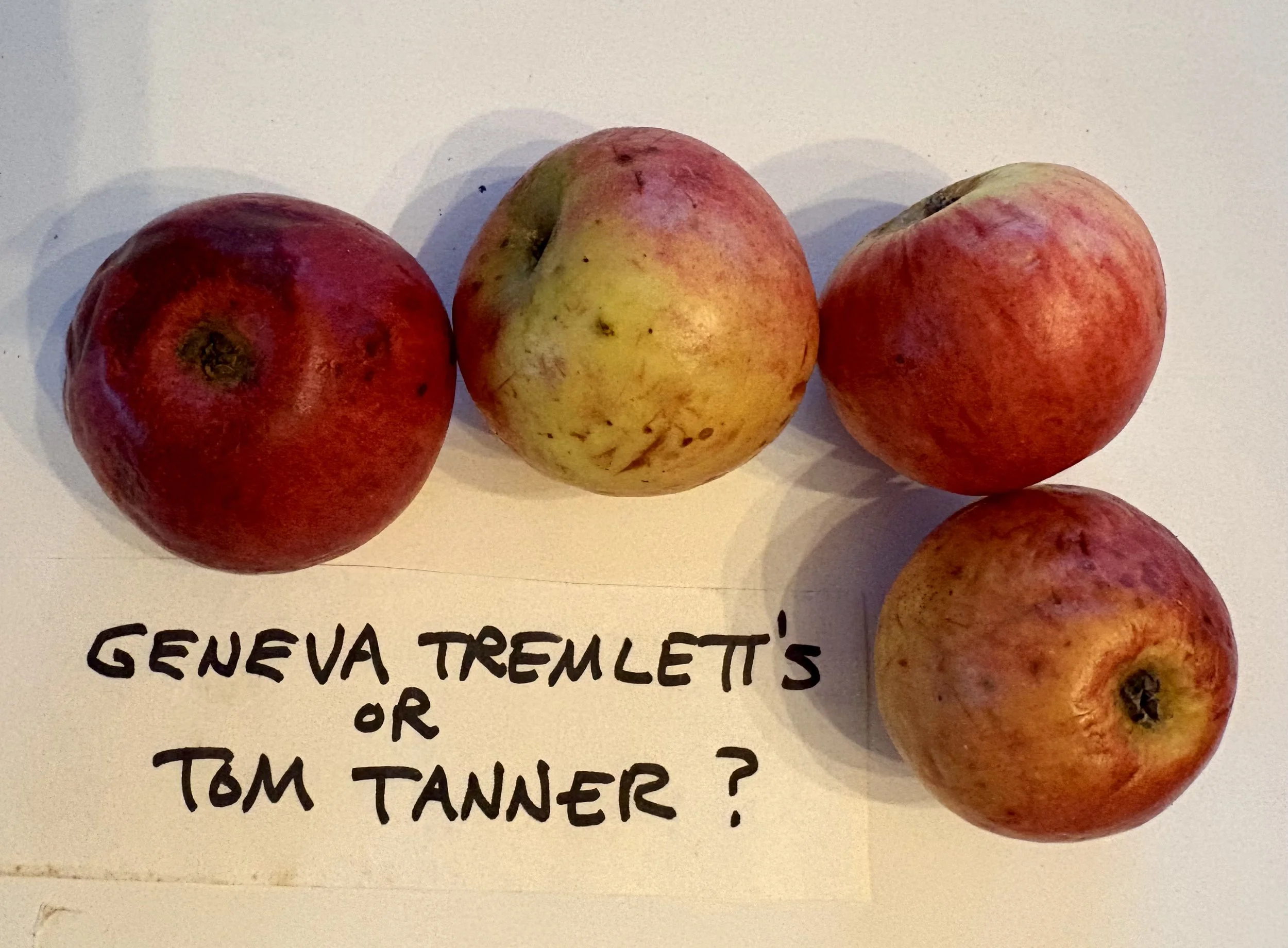
And does the correct name matter anyway? What if it isn’t Tom Tanners? We could ask the “Michelin” growers in Herefordshire. Didn’t someone long ago say something about smelling roses by any other name? (And, by the way, who was Shakespeare, really?)
Meanwhile, we have a good bittersharp growing out in our orchard. We’ll graft a few more of them this coming spring. It’s also being grown and picked and pressed across the US. We now know it’s not Tremlett’s Bitter. It might not be the obscure historic apple called Tom Tanners. But then again, maybe it is.
“It may be history, it may be only a legend, a tradition. It may have happened, it may not have happened: but it could have happened.” Mark Twain, The Prince and the Pauper, 1881