
(By Skylar Bodeo-Lomicky) I’m in a food preservation frenzy right now. Teas, pickles, wines, syrups, sauces, seeds. Never in my life have I had the space and means to store as much of my harvest as I do this year, and I am jumping on this opportunity. On the long list of reasons why I love food is how it functions as a creative outlet in my life. I’m nearly always inclined to try out a new experiment rather than make the same dish or drink over and over again. That said, a goal of mine in preservation is to have items that I’ll want to eat all winter long that celebrate the plants themselves and emphasize exactly who they are.
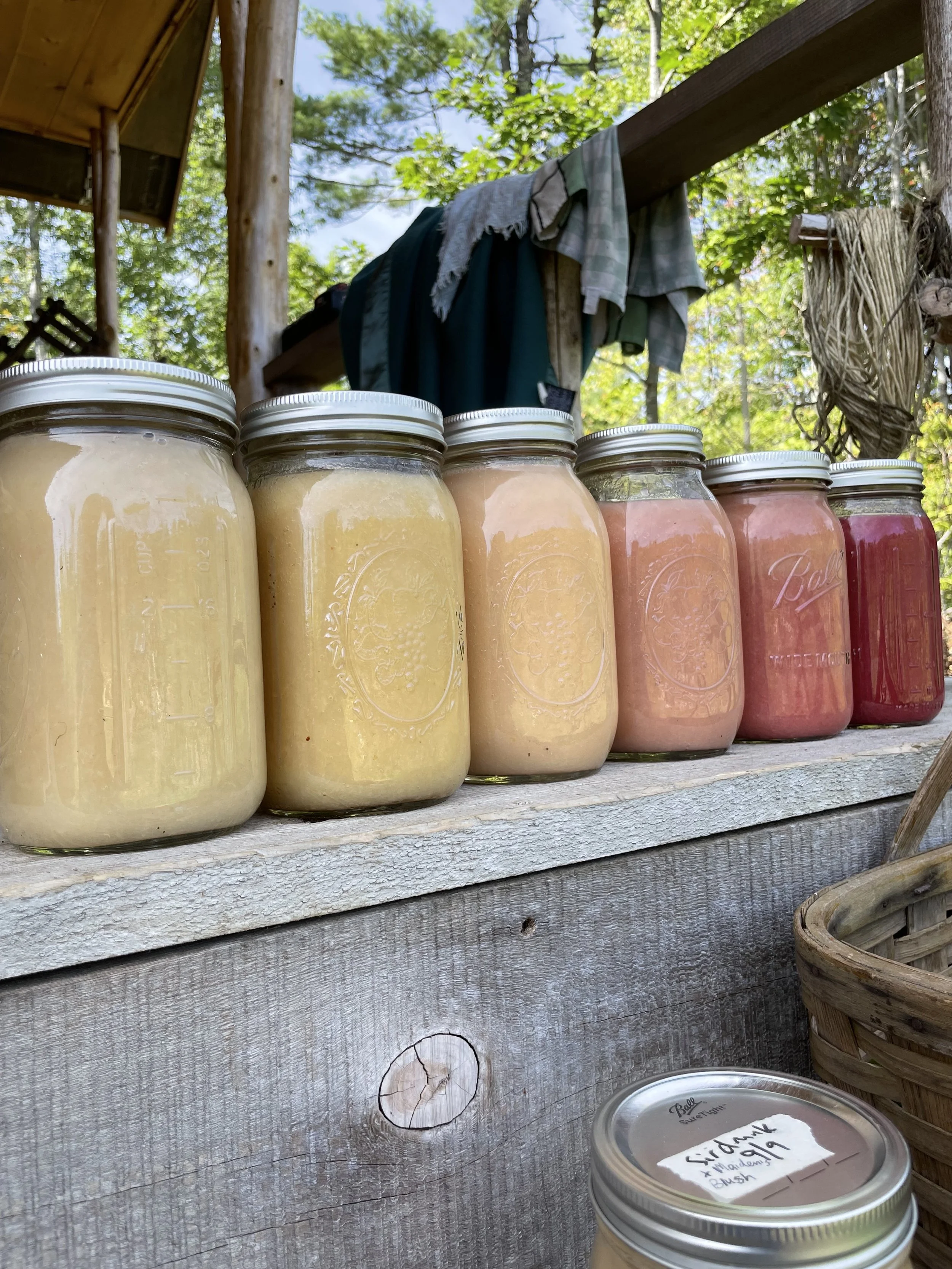
Six kinds of applesauce from five kinds of apples. Left to right: Maiden’s Blush, Sidrunkollane Tallioun, Gauguin, Charlamoff, Sidrunkollane Tallioun + Red China, and Red China. September 15, 2026.
A single variety applesauce is as pure and simple as it gets. Select a variety. Chop up your apples, core and all. Cut out the caterpillars and insect holes. Cook the apple pieces, adding water to prevent it from burning. Mash and push it through some sort of strainer (I use a chinois). Voila, applesauce.
The funny thing is that applesauce is not at all simple. Apples in their whole form vary in cell density and size, amount of malic acid, fructose and tannins, in ripeness and therefore the amount of starch, in pigmentation, and in aromas. Each of these factors influences the final sauce. In my experience the starchier the apple the creamier the sauce, but at a cost to its aroma. More acid tends to mean faster cooking. Tannins break down so astringent apples don’t necessarily mean astringent sauce. But many mysteries remain— if only it was a little more simple.