October 11, 2025

Today in the orchard
Mt. Joy Orchard

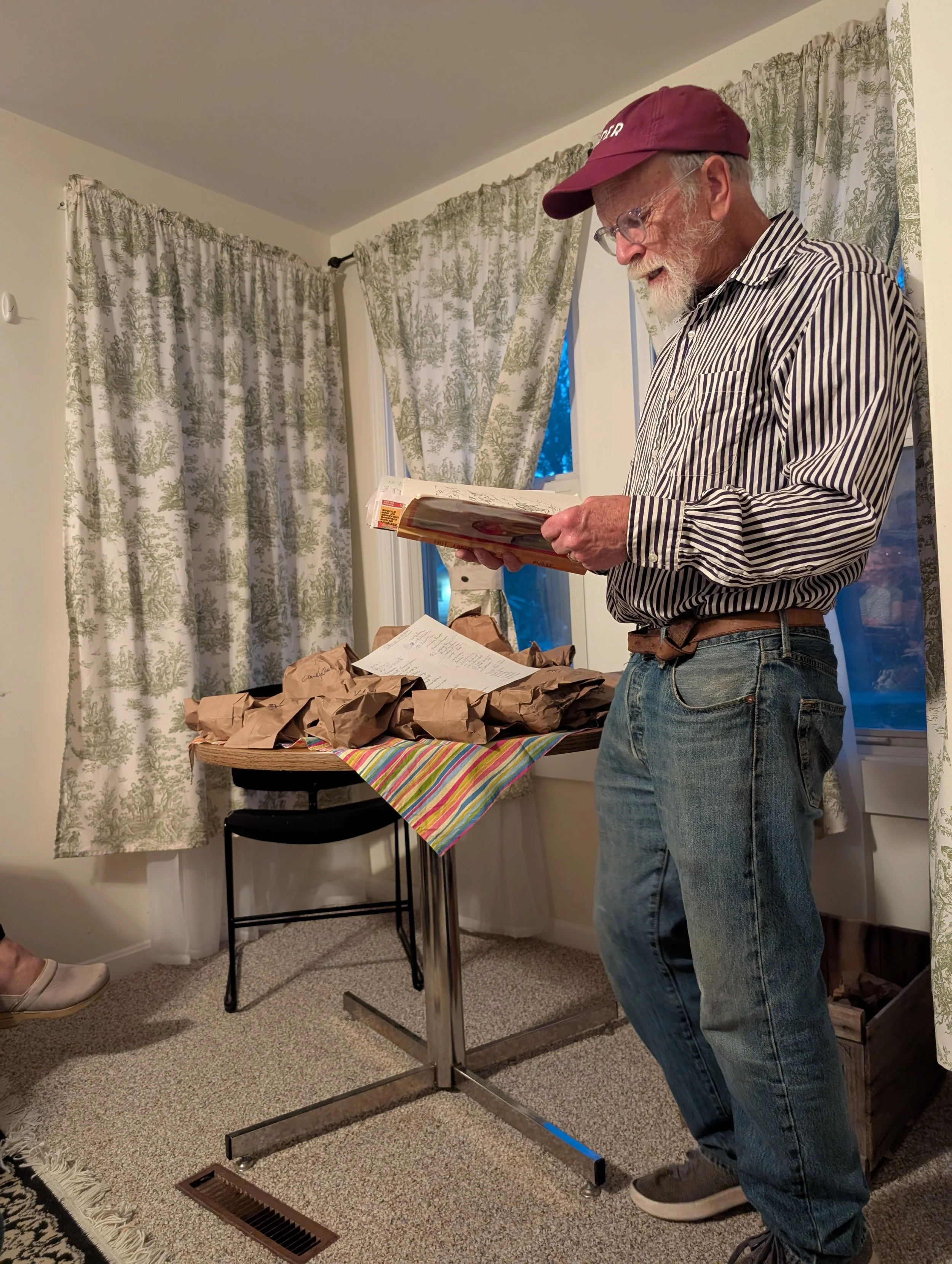
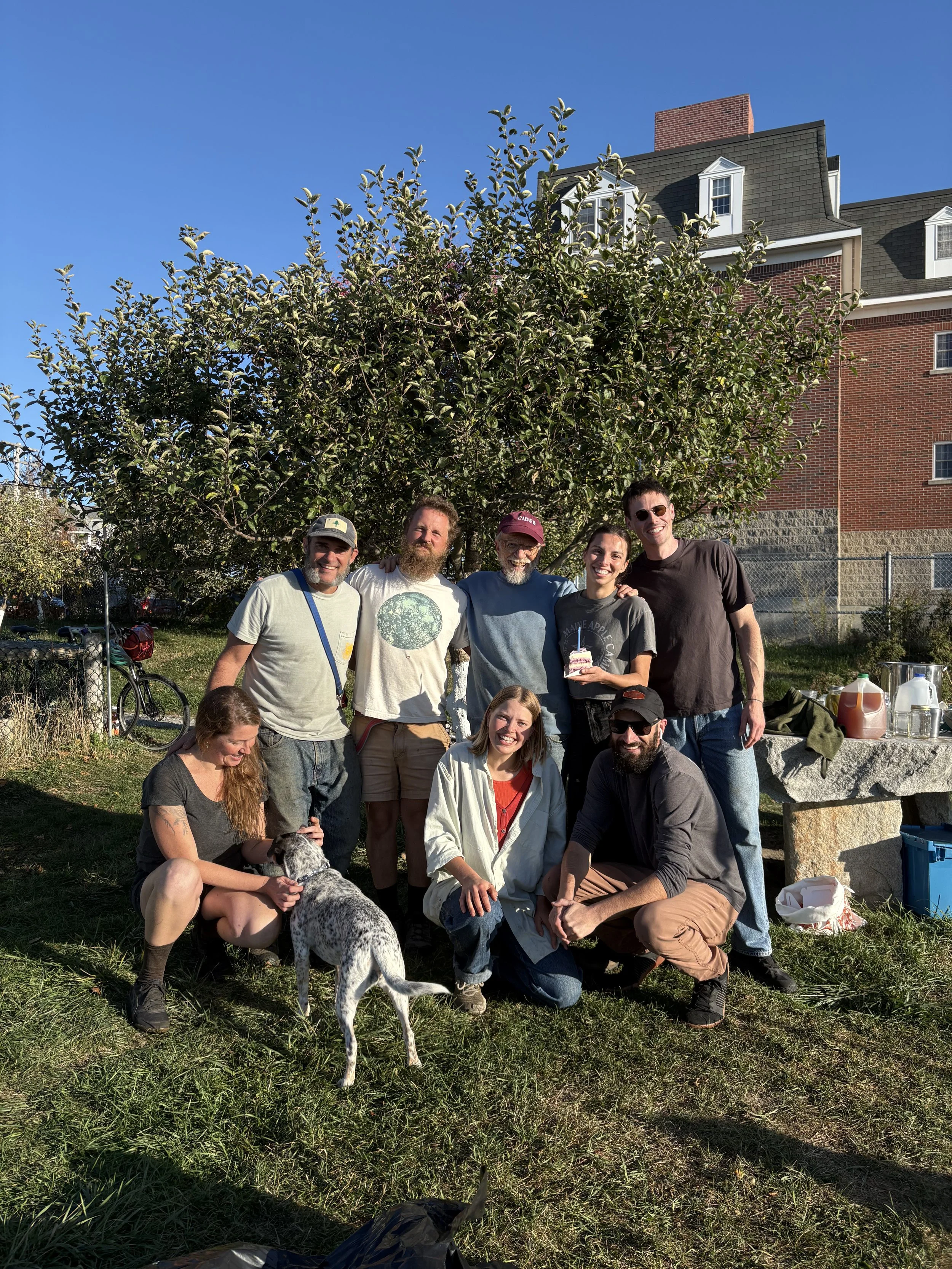
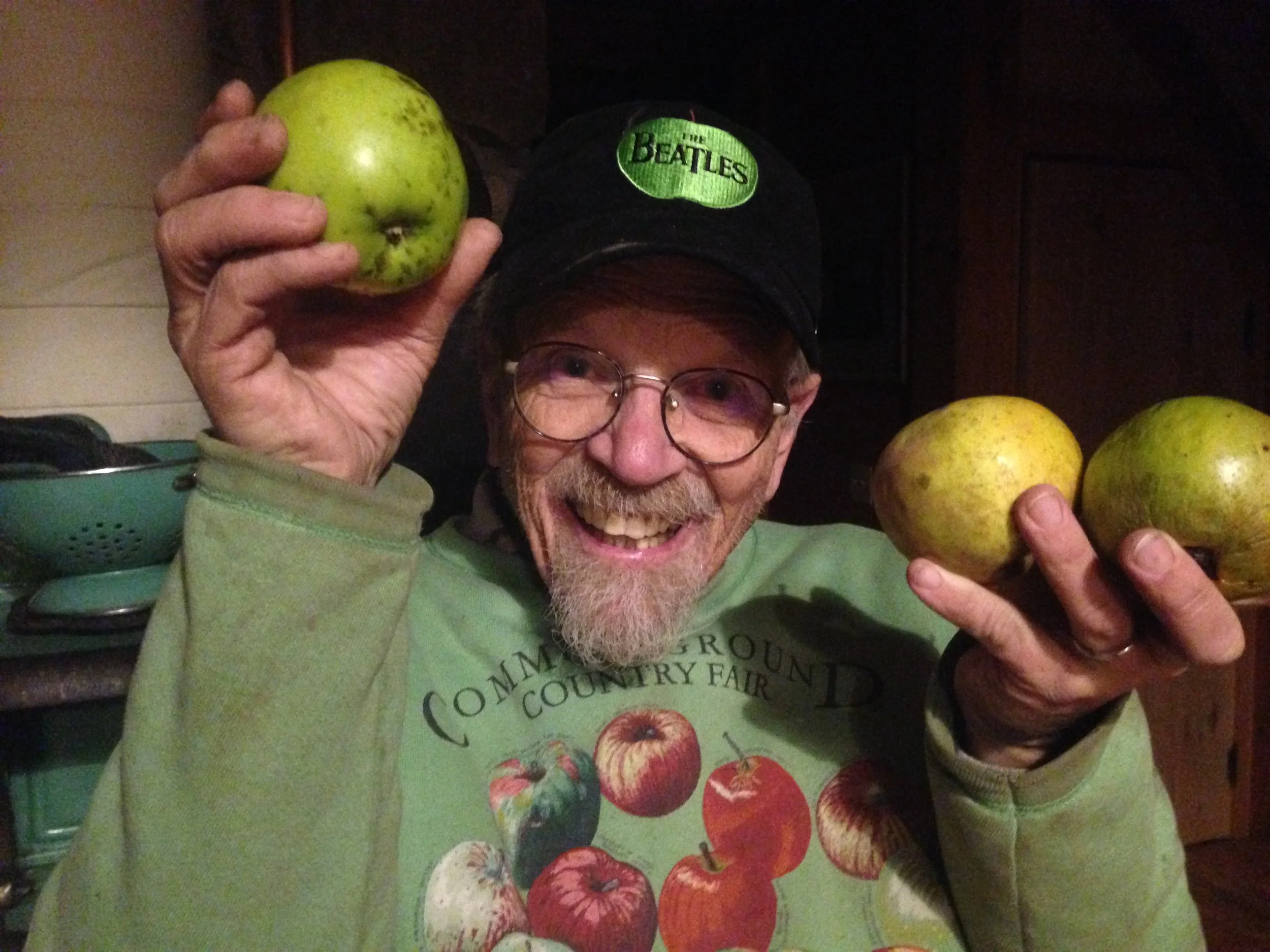
I took our large cider press down to Portland’s Mt. Joy Orchard for their annual community cider-pressing event. It’s a family event, and all the cider is given away to whoever shows up with a jug or a bottle or a cup. There’s no visible organization, and yet everything gets done with perfection. Apples get ground up, buckets are filled with pomace, cider gets pressed, funnels appear, and vessels of various sizes and shapes get filled. No one was counting, as far as I know, but I’d say there were a hundred attendees at one point or another and many gallons were distributed or consumed on the spot. Mt. Joy Orchard is planted on a steep hill-side overlooking the north end of Washington Ave. At the top of the hill is a community garden with an open space large enough to have a good-size gathering and press a large amount of apples. At the end of the afternoon I even received a piece of birthday cake! 
October 9, 2025


Today in the orchard

This time of year my eyes are on full-time, road-side, apple-alert. This is tricky stuff when you’re at the wheel. You do have to have your attention on the road in front of you (and behind) but somehow devote just enough attention (2%?) to seeing the fruit on that tree you never noticed before. It helps to have a full-time, highly-trained driver who isn’t into apples, (or, even better, one who is but is willing to share the driving.) 


Blue Pearmain, October 12, 2025


Although my focus has been largely on the historic Maine apples for the past several decades, I do love to find seedling trees. Today I made a detour to one of my new favorite seedlings—this one in South China (Maine not China). It’s a true sweet (low acid). The fruit is large, mostly yellow and ripening now. Although many have been dropping over the past month (I’ve been watching), the majority are still on the tree. They are gorgeous. So I stopped by today and picked a shopping bag-full. I don’t know who owns the tree. No one was home at the closest house. I’ll go back on a weekend soon, knock on the door and pick the rest. 

While I’m on the subject of seedlings: The 6th annual Seedling Exhibition in Williamsburg, MA is happening on Halloween. If you’re interested in submitting fruit and/or attending, go to gnarlypippins.com and check out the details. See you there!

October 8, 2025

Today in the orchard

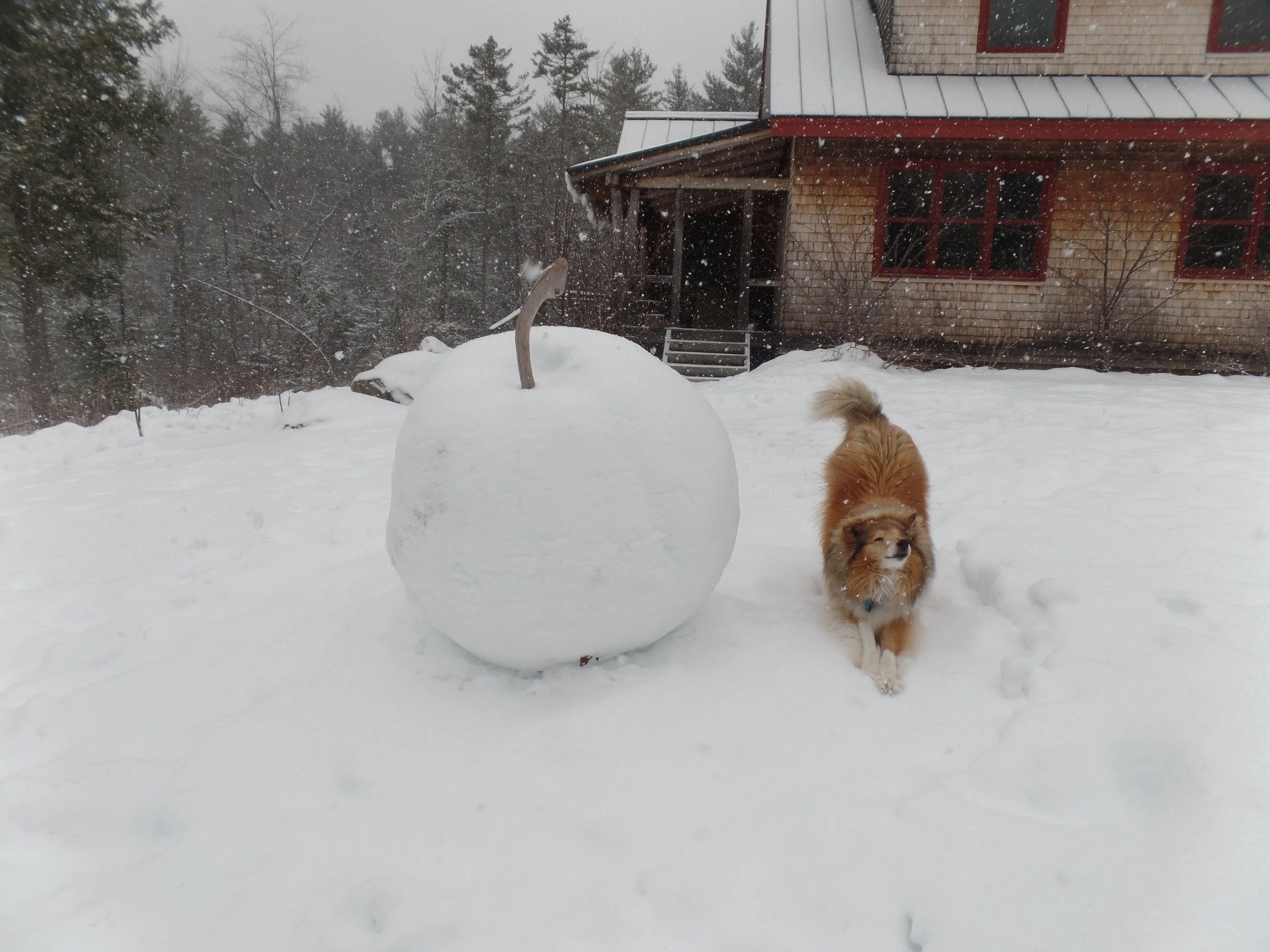
People and dogs have been living together for the past thirty thousand years—or maybe forty. By the time the first farms appeared ten thousand years ago, dogs were a well-established part of the team. We couldn’t live and farm the way we do without our collies. They live outside 24-7-365 with the occasional night inside for good behavior or when the weather is particularly gross. They bark all night sometimes. (That’s actually a good thing.) They keep the deer and the bear out of the orchards. They occasionally get too close to porcupines. (Ugh) We’ve had seven collies on the farm over the past forty years. Some have “belonged” to us and others to others living on the farm. A number of friends have purchased collies after spending time with ours. They are truly fantastic dogs.

Now we have sad news on the farm. Our wonderful old collie, Radar, died earlier this week. She lived her entire life on the farm. Every day of it. She dutifully protected the gardens and apple trees, and she welcomed hundreds—or maybe even thousands—of friends and visitors with love and affection. She loved to wiggle her way between your legs and snuggled with everyone. If there ever was a loyal creature, the epitome of love, it was her.

Radar doing "downward dog"

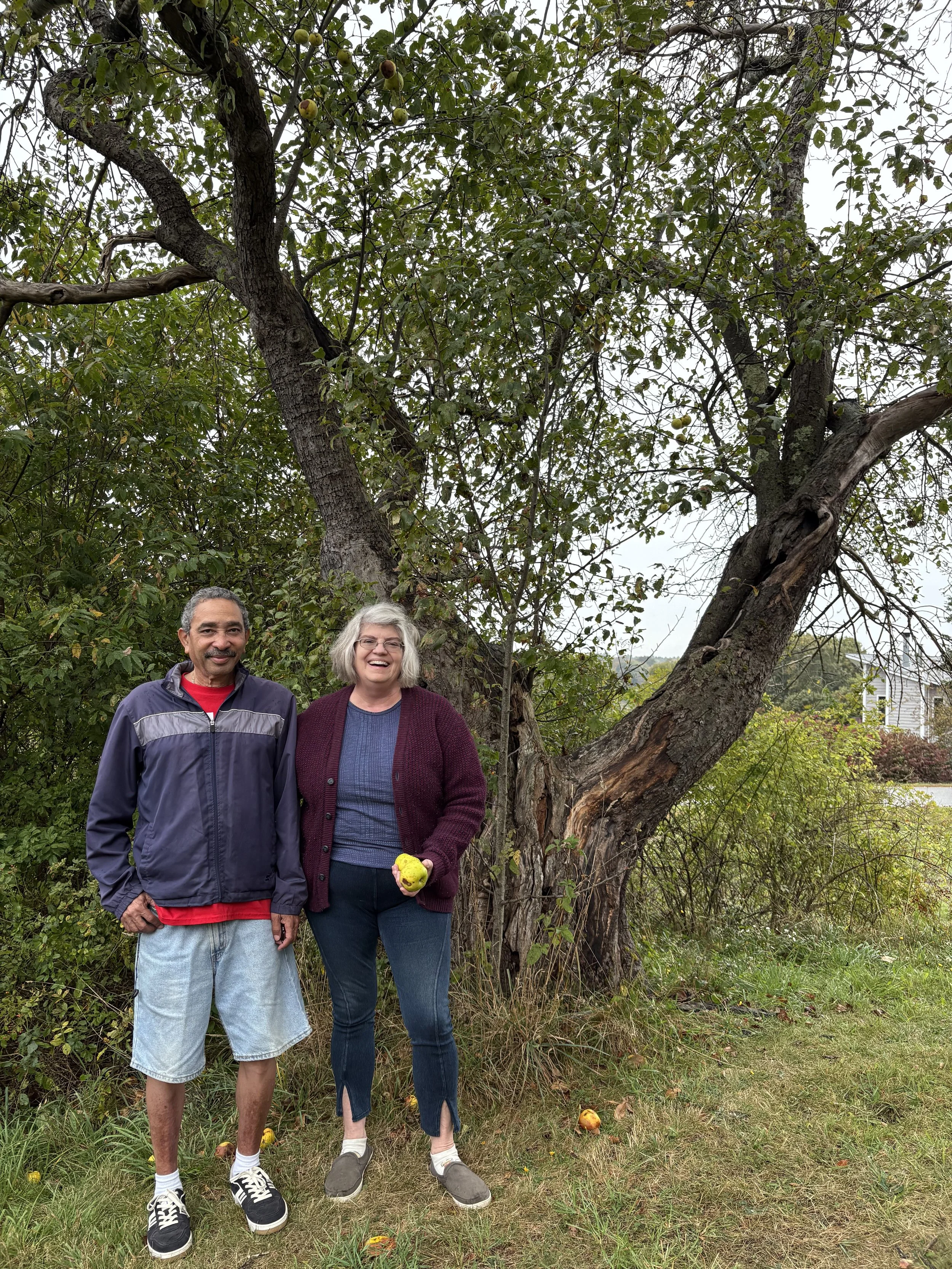
We buried Radar under an apple tree in the orchard. It’s a seedling tree with red-fleshed apples that fruited for the first time earlier this month. When we planted it in the orchard years ago, Cammy named the tree Radar Love. Goodbye old dog. We miss you.  

October 7, 2025

Today in the orchard

I spent a few hours touring around Palermo saying hello to some of my favorite old apple trees. There are many. Some of them I’ve grafted into our orchards, some I stop by and visit every year, and others I rarely get to see. One in particular that I wanted to check out is a russet that’s growing in the middle of a hay field on the road up to Freedom. The tree is exceedingly old, and I’ve never attempted to do an ID or take leaves for a DNA profile. There were two apples left, and I snagged them both (with permission). I’ll “phenotype” them soon. Then I’ll send in leaves for a DNA profile. At first glance I’m not sure if it’s a GR-1, GR-2 or another of the Golden Russet-types that were grown in central Maine long ago. 

In the evening I gave an apple talk at the Palermo Historical Society. I brought in a couple dozen apples, all from around town, and used them as props while telling stories about the old-timers who were my guides as I soared off into the incredible universe of apples. I even did a bit of reading from my first book about the apples of Palermo. It was a fun evening.      

October 6, 2025

Today in the orchard

Grimes Golden, October 6, 2025

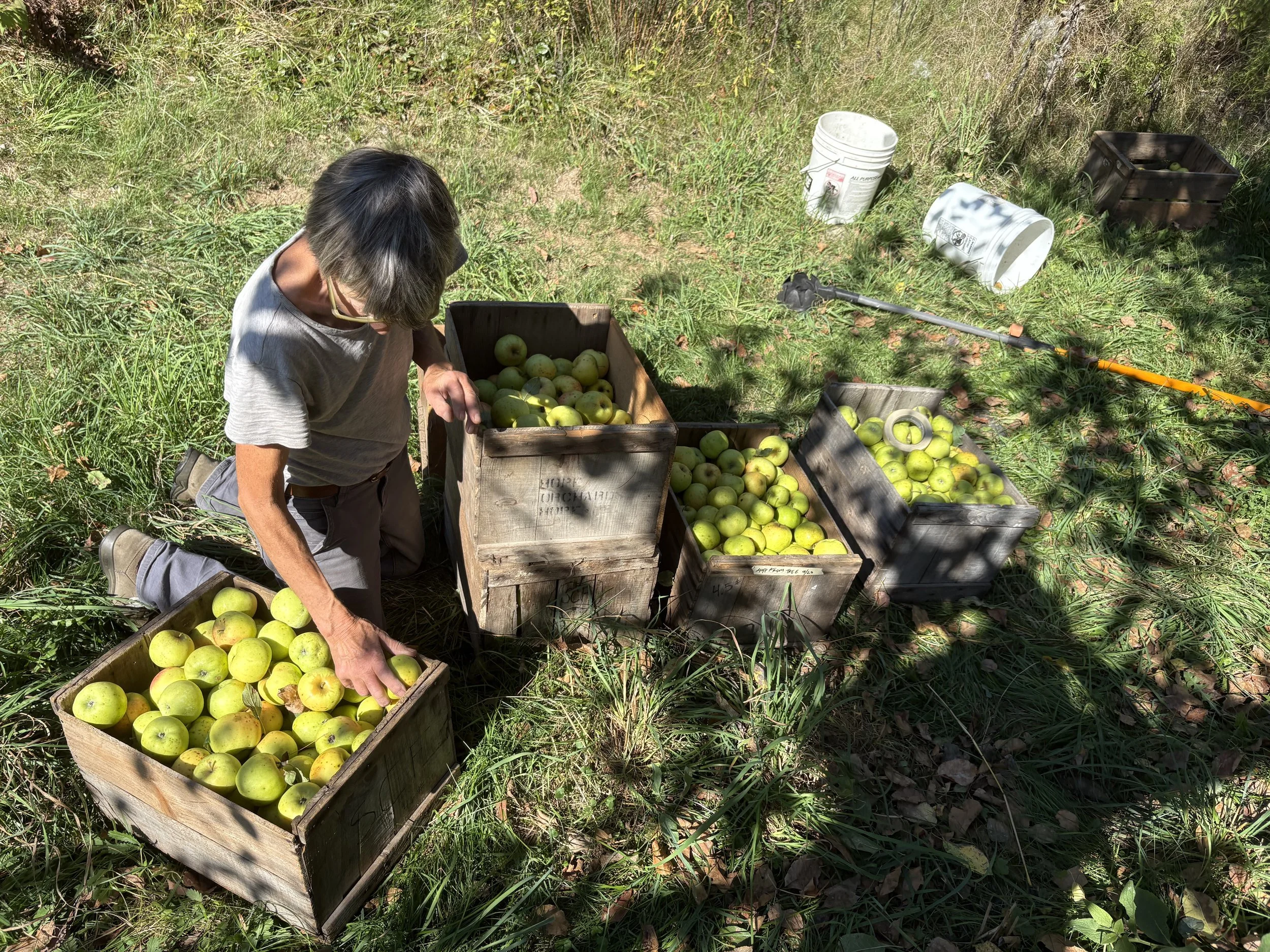
After a brief pause the apples are now insisting to be picked. The rush is on. We get occasional mini-respites during apple season, giving us enough time to blink a few times, and then in comes the next frenzy. Today we picked the bulk of the Grimes Golden, Pomme Grise, Sweet Sixteen, Norton Greening and lesser amounts of several others. 

“Grimes” is probably one of the most important of all apple parents. Its child is the internationally famous Golden Delicious (GD), itself one of the most sought after and used apple-parents in the world. (Gala is just one of the numerous children of Golden Delicious.) 

Grimes is southern apple (West Virginia) that was adaptable enough to northern areas to be grown a century ago in orchards here in central Maine. Our trees are grafted from scionwood I cut from an old tree just up the road. Grimes fruit is a bit more blocky and less conic than GD. It has the same yellow skin as GD, although the surface has an chalky-opaque quality to it, almost as though it was russet (which it is not). It is excellent for both fresh eating and cooking. It has one characteristic that is considered a flaw in the commercial orchard world. Around the beginning of October it begins to drop fruit daily. It doesn’t drop all at once (which would be a signal to hustle out there and pick it), and it doesn’t hang on for you to harvest at your convenience. It just starts dropping one or two fruits at a time like water dripping from a slowly leaking faucet. Although we don’t mind using drops, in an age when selling drops is forbidden, this can be a real problem. So we let them drop for a few days, collect them off the ground for us, hope the rest are ripe enough, and then pick them all… today.  

October 5, 2025

Today in the orchard

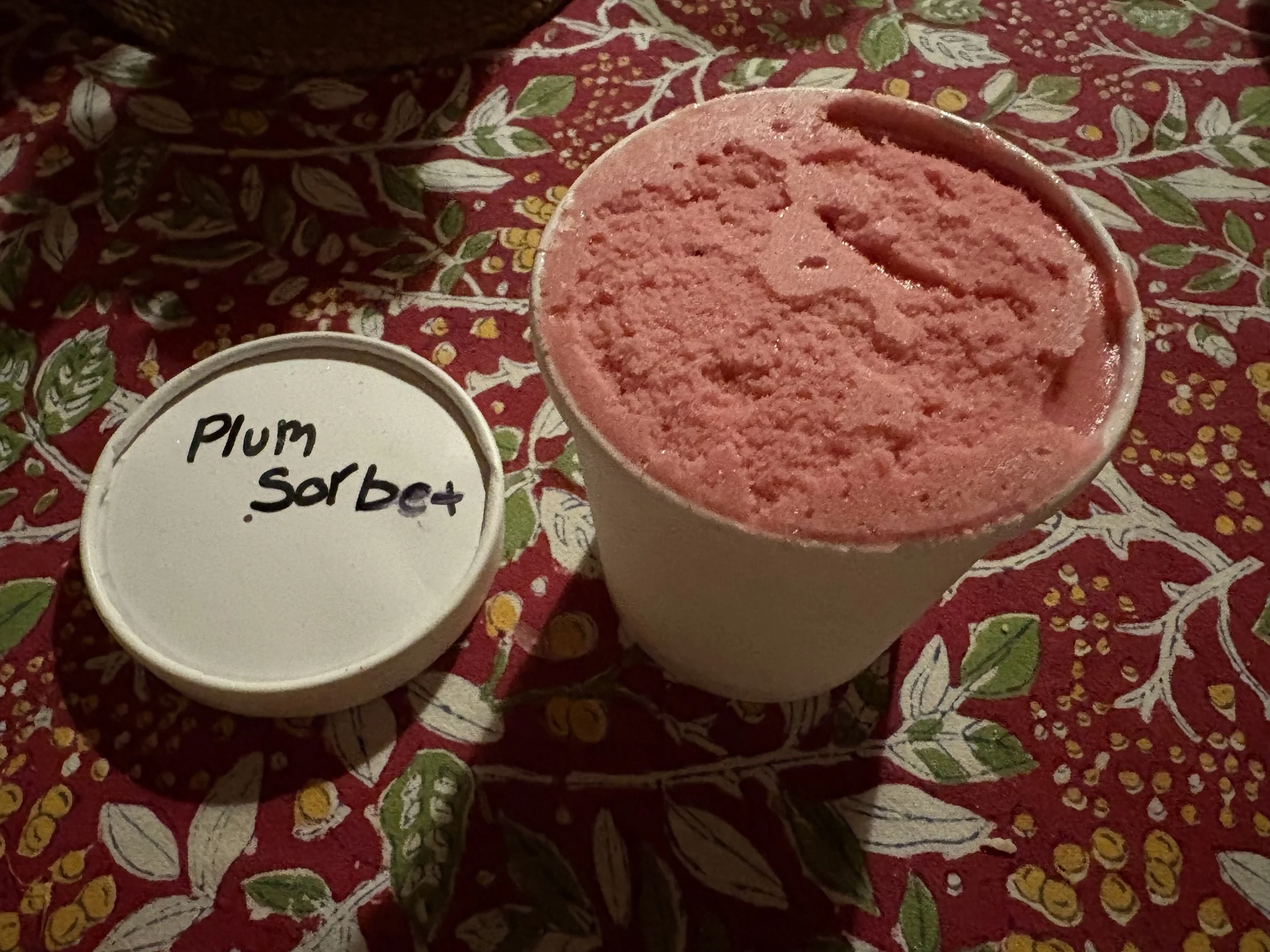
Plum Sorbet with SCF plums, October 5, 2025

In August John’s Ice Cream in Liberty purchased a few flats of two of our favorite plums: Purple Heart and Black Ice. (see Orchard Reports from August 23 and August 25, 2025) Both are juicy, delicious and deep-red-fleshed. Louis Pontillo, who took over the business from John Ascrizzi, just released a non-dairy Plum Sorbet from the plums. Today we got to try it. Our conclusion: excellent!  Better hustle down to John’s and get a quart for yourself before it’s all gone.  

October 4, 2025

Today in the orchard

This morning I gave a talk at the Windsor apple festival, a few miles from here, to a small but enthusiastic group of apple lovers. I went from there to visit an ancient Tolman Sweet tree that is growing nearby. It is still in excellent shape with long, robust, horizontal lower branches. Although it hasn’t been pruned in many years, it is un-shaded, growing out in the open and is mostly still intact. Meanwhile, Cammy picked the Tolman Sweet at home, along with the Fuel Service and some of the Grimes Golden. We’ll pick the rest of the Grimes ASAP.

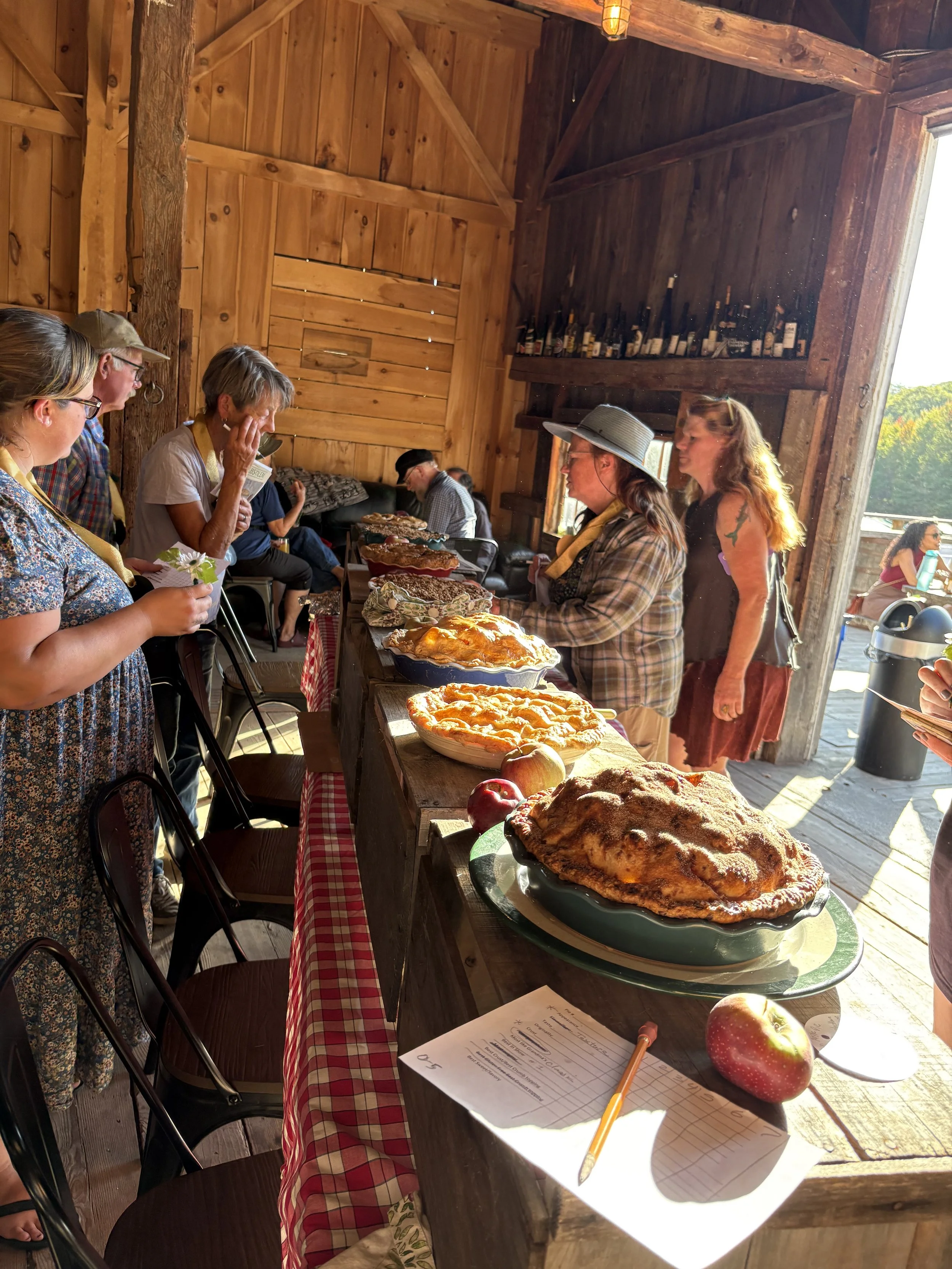
Judging pies, October 4, 2025

In the afternoon we both judged apple pies at Absolem Cider in Winthrop. They were having their own apple pie contest and apple festival. The place was mobbed. It was fun to see the pies and the people. Sadly, it was clear that the chefs don’t have access to real pie apples. (We both agreed that the tastiest pie was the one made from foraged apples.) I look forward to seeing pie apples back in the commercial orchards and the backyards of every Maine home. Those modern apples are not fit for pies!

There are a few old apple trees at Absolem. One that’s growing not far from the tasting room is a Roxbury Russet. Although ubiquitous in the Maine landscape for two hundred years, nearly all of the “Rox” are gone. It’s a great apple, and it’s fun to connect with an old tree.    

October 3, 2025

Today in the orchard

Second night in a row of frost. Two nights ago it was 26F. Last night, 32F. Today we weeded the asparagus patch for the last time this year. It took several hours, but it looks great. All those weeds—as well as the stalks—will go into the compost piles in the next few days. We’ve  been amassing robust piles of weeds, stalks, canes, and vines, all of which will migrate into the heaps. It is compost season. 

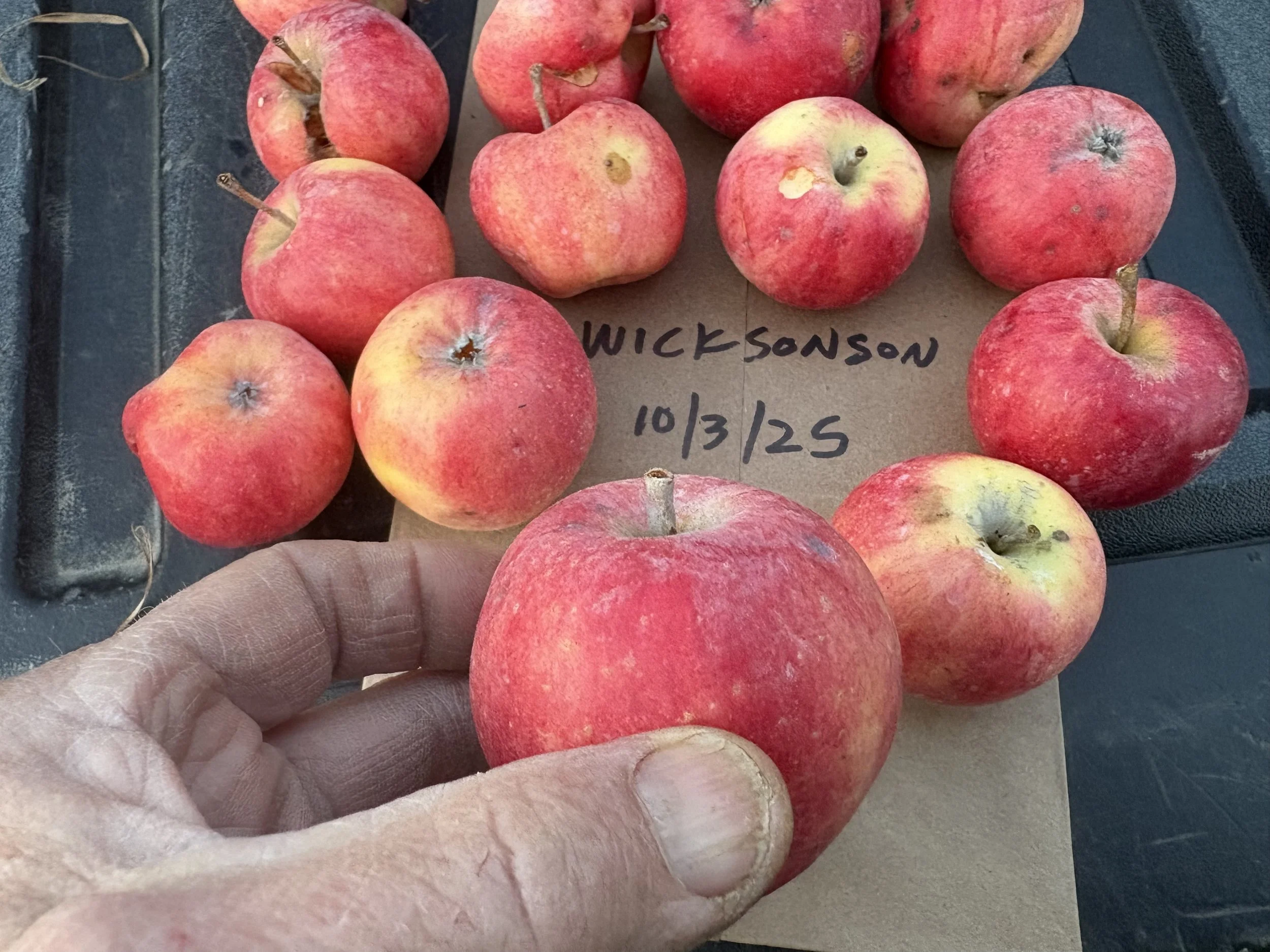
Later in the afternoon I harvested the Wickson seedling fruit. Not having a name yet, I’ve been calling it “Wicksonson.” (I know it’s a pretty lame name. We’ll come up with a better name now that we have fruit.) Wickson itself is one of the best-known introductions of Albert Etter (1872-1950). Wickson fruit is small, red-skinned, high in acid, high in sugar, good for dessert and recognized as one of the few single-varietal cider apples that receive almost universal acclaim. (One of the few others is Kingston Black.)

“Wicksonson” is considerably larger in size than its namesake parent. The texture is somewhat soft, the flavor is a bit bizarre and less acidic than Wickson. The sauce is lip-smacking tangy and a cheerful pink color. We had about 20 apples this year. Searching for the name...

History of Apples in Palermo, ME - October 7th, 6:30

Join John Tuesday night, October 7th at 6:30 PM as he takes us on a tour of the apples grown and growing in his hometown of Palermo, ME. This is where he began his apple journey as he knocked on the doors of local farms to ask if he could scoop up the apples that were littering the ground under the old orchards. As he foraged for apples, the old timers who no longer took much interest in harvesting the apples, came out to join him, tell him the names of the varieties he was picking and enchant him with stories of apples they had planted, picked, pickled and pressed. John will share these stories and many of his own adventures over the past 45 years of fruit exploring in Palermo. Free and open to everyone. Apple treats at 5:30. Talk at 6:30. Worthing House, 54 North Palermo Rd., Branch Mills, Palermo. Sponsored by the Palermo Historical Society.

October 2, 2025

Today in the orchard

The Marlboro apple? October 2, 2025

I remind myself every fall to minimize the days I’m off the farm. Ideally it would be none. But fall is the time to explore the world of apples beyond the farm. It’s the time to see other people’s trees. It’s the time to attempt to solve some of those apple mysteries that might just need one more visit to put it all together. It’s the time to spread the gospel of apples. Who can do it all? Luckily the answer is easy: no one. 

It was a clear blue day and, instead of working on the farm, I went “Downeast” and visited apple trees. I was joined by Todd Little Siebold and Sean Turley. Todd planned the trip, and we had multiple locations to visit. He knew where we needed to go. It was a marathon but a good one. Our mission was to track down three old cultivars that were grown in Hancock County: Garden Sweet, Martha Stripe and Marlboro. it was pitch dark when I opened the door to the cooler back at Super Chilly Farm and slid in three bushel boxes filled with bags of apples. Somewhere in those boxes maybe we’ll find all three of those illusive apples. And a whole lot more.  

October 1, 2025

Today in the orchard

Our big activity today was collecting leaves from fifteen apple trees for DNA samples. We pinch off two or three small leaves of each specimen and stuff them in special tubes half-filled with desiccant. Each tube is carefully labeled with a name and a number. We send them off to the Washington State University where they are “profiled” and compared with a huge international data reference set. Our goal is to learn names of cultivars and the names of their ancestors. It's one of the most valuable tools we have as we work with others around the world to assemble an apple family tree. We’ll tell you what we learn from this batch in about six months.

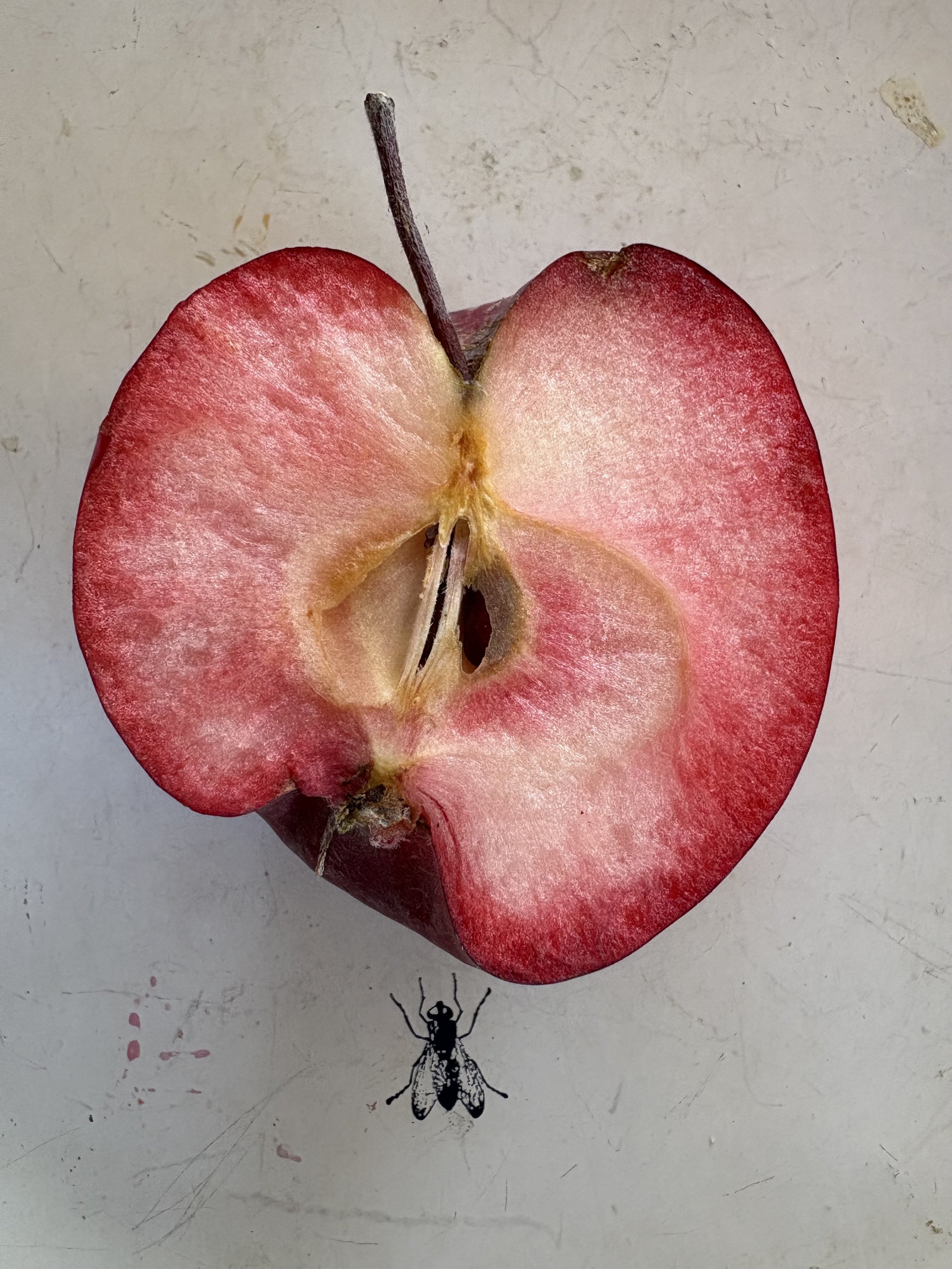
Radar Love (and fly) October 1, 2025

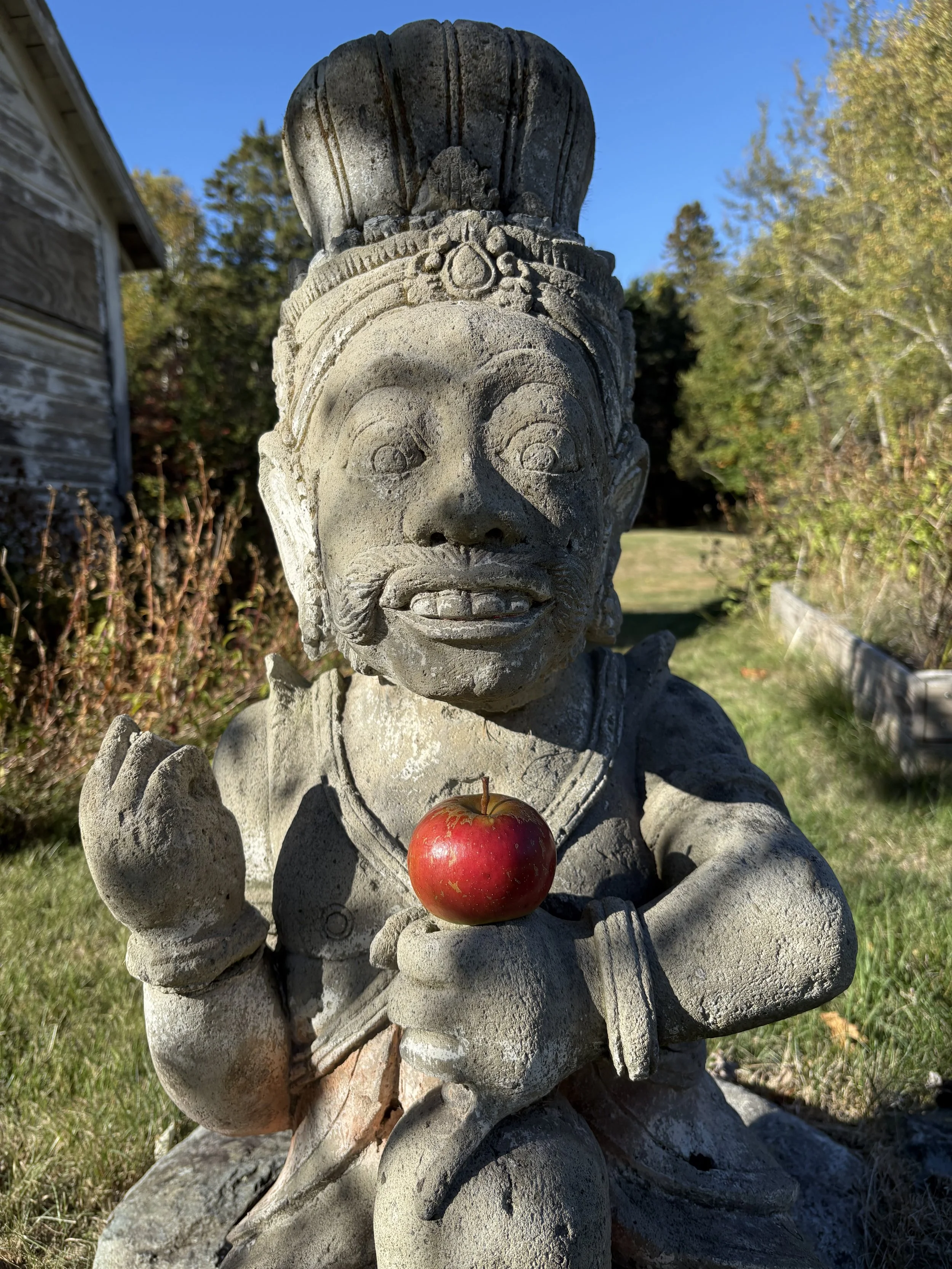
At noon we tasted two Frostbite red-fleshed seedlings that fruited for the first time: “Radar Love” and “Mo.” We’ve been waiting for this day for twelve years. Cammy, Skylar and I all agree that both have real potential as dessert fruit.

More apples are beginning to drop, and we picked the Kenrick Sweet and the Kilham Hill. Both are rare and will be DNA profiled and phenotyped. We checked out the wild trees down Finley Lane for potential cider fruit (we found two good candidates) and harvested the Strike Anywhere peppers (the small, prolific hot pepper we’ve been developing over the past 30 years). Tonight frost is anticipated. Time to get the tender stuff under cover. It was dark by the time we hung the last pepper plants from the rafters and called it a day.

September 30, 2025

Today in the orchard

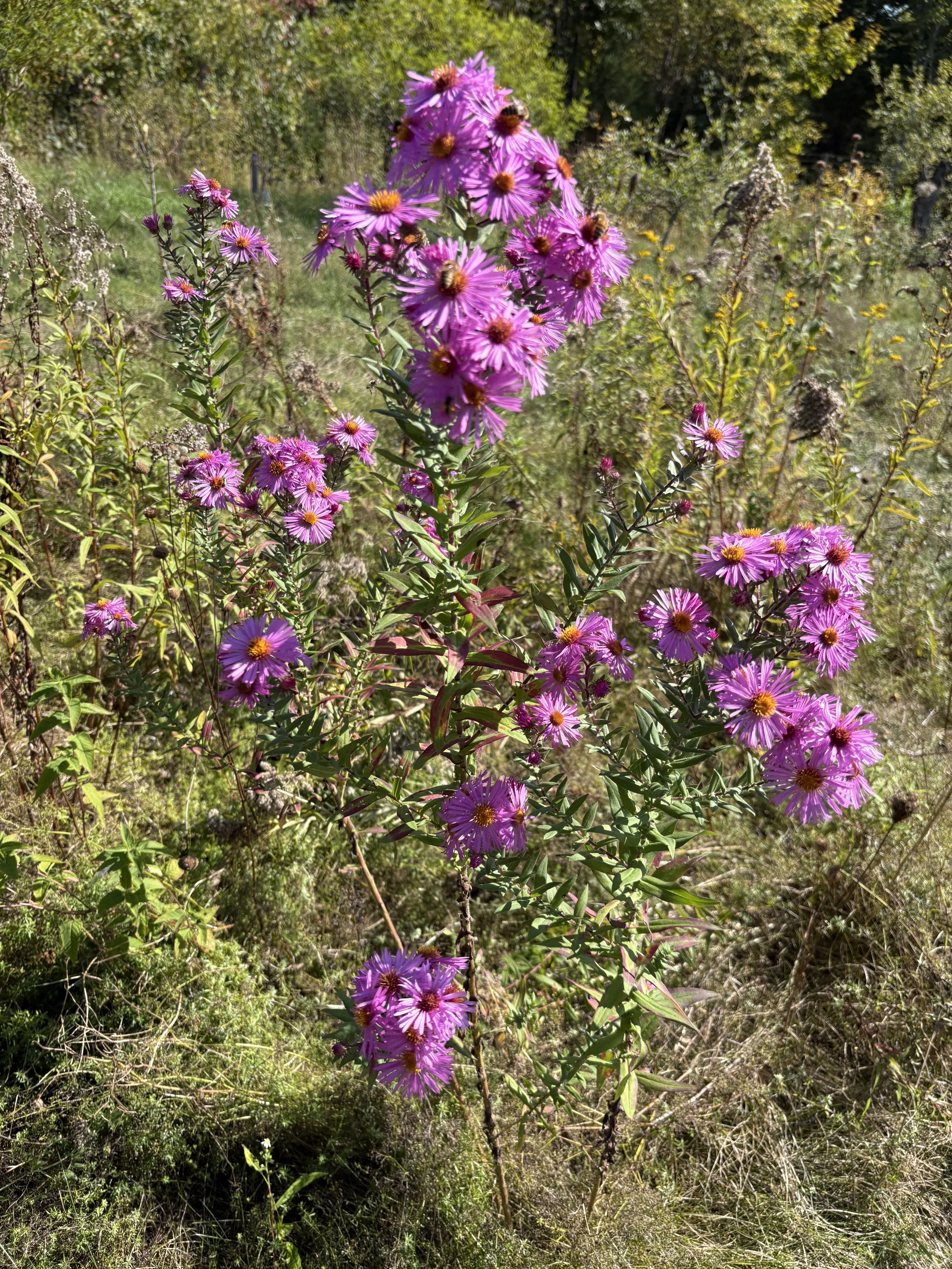
Purple Asters in bloom, September 30, 2025

The Asters are now in bloom in the orchard. The bees love them, and so do we. Although I can hardly call myself an Aster-expert, I think we may have two of the hundred or so native species: New England Asters (Symphyotrichum novae-angliae) and New York Aster  (Symphyotrichum novi-belgii). I’m not entirely sure which is which. 

The deep purple Asters in the orchard are likely a named selection of New England Aster. I planted a couple plants a few years ago, and now they are migrating across the orchard with new purple-flowering clumps appearing every year. The bees are happy to have the Asters for their late honey production, and the Asters are happy to have the bees. Aster flowers require cross-pollination to produce viable seed, and it’s the bees that make that happen.

September 29, 2025

Today in the orchard

I spent several hours staring at apples at the dining room table. Although the weather is begging me to be outdoors, the bags of apples are building up and they’re threatening to bury me. Besides that I’m finding some really interesting apples, and I need to spend time observing, photographing and describing them.  (And tasting them!)

Francis Sutherland, after a year in storage, September 29, 2025

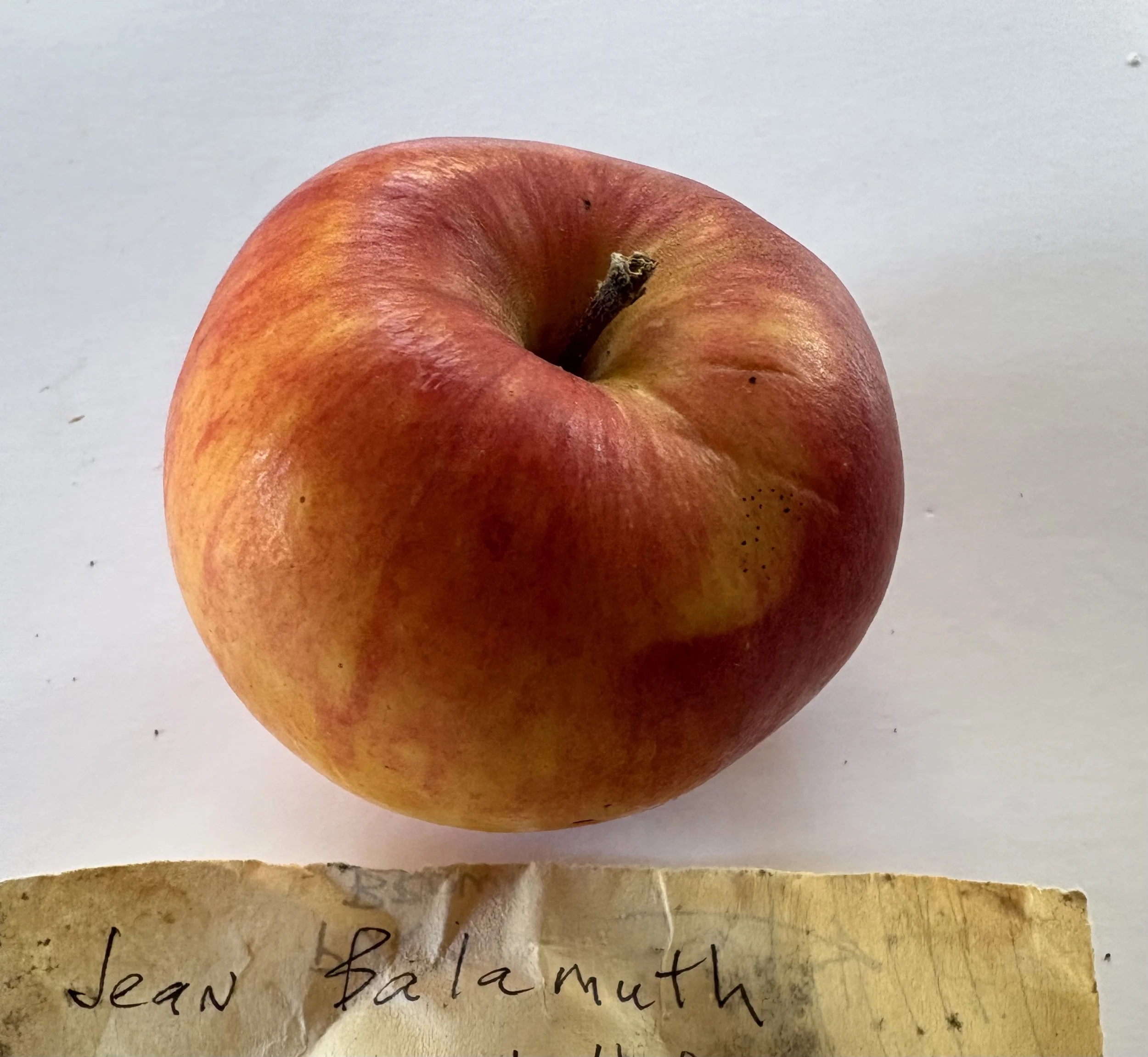
Today’s featured apple is one that was given to me not this year but, incredibly enough, a year ago. It came from Jean Balamuth in Alstead NH. As I was going through the boxes in the basement, I found it. It has been in cold storage for eleven and a half months and still looks great!

From an email dated November, 2024:

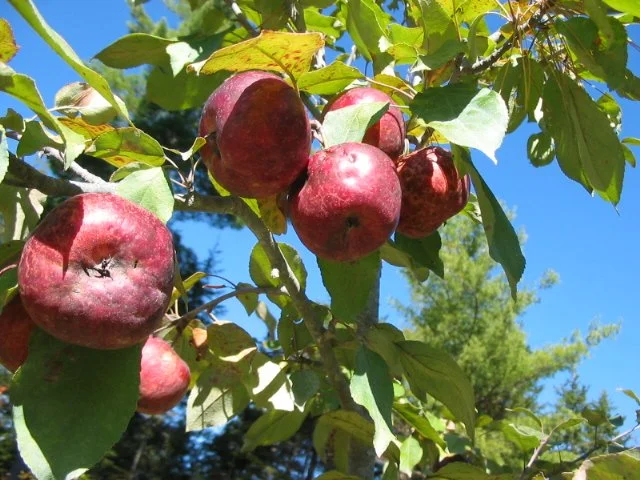
“ I believe all of mine are seedling trees… Here is the first tree I'd like help with. The apples are late, small and deep red. I've labeled it "Late Red". Three trunks in there. The biggest measures 34" around. I would guess 20 ft tall.”

I was in touch with Jean today. She'll send me scionwood this winter, and we'll trial it in our research orchard. She has now named it, "Francis Sutherland." 

September 28, 2025

Today in the orchard

Today we picked the Frostbite trees (aka MN 447). I admit it was early.  In a normal year we’d pick them a couple of weeks later. But in 2025 nearly every cultivar has been early. As a result, the flavors have been less than optimal. But when the seeds are dark brown and half the crop is on the ground, we pick. The fruit does look good. Frostbite often cracks around the cavity (stem end). This year there’s hardly any cracking at all. Maybe that’s a result of the drought. With less water being sucked up by the roots, the fruit is smaller but the skin stays more intact.  The less than optimal flavor is a bit of a mystery. With less water, you’d think the flavors might be more pronounced. But with the fruit dropping early, it could be that the flavor just doesn’t have time to develop. Still, “447” remains one of our favorite apples.

Frostbite (aka Minnesota 447)

There’s a long story behind Frostbite. It was selected nearly 100 years ago and then spent decades languishing in the forgotten-apples repository at the University of Minnesota. No one seemed to know what to do with it. The flavor was dubbed too weird. Meanwhile it was used as one of the parents of Keepsake and Sweet Sixteen, two excellent apples. That subsequently made it a grandparent of Honeycrisp. The University sent us scionwood about 20 years ago, and we now have 8 trees. We love it. Although the tree-growth vigor is subpar, pollination and production is good even when the weather during bloom is poor as it was this past May. The fresh dessert quality is unusual but—we think—delicious and, on top of all that, 447 seedlings almost always have superior fruit. Several of our 447 seedlings have proved to be wonderful apples themselves. This is a great apple.

September 27, 2025

Today in the orchard

Wooly Aphid colony

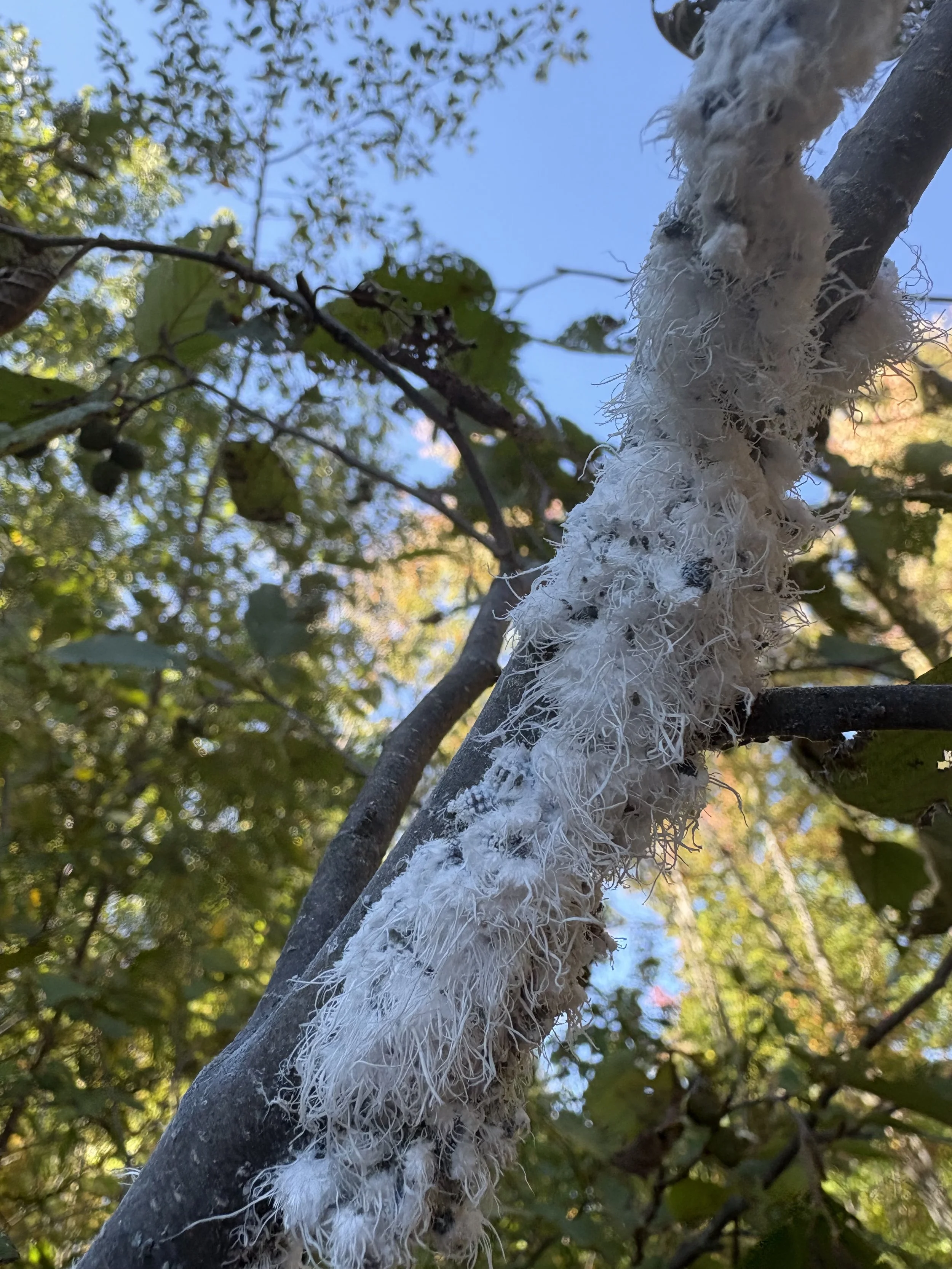
Today I found a really bizarre creature in the orchard, if it was a creature. Whatever it was, it looked like a horrible disease or maybe something that had descended upon us from outer space. It occurred to me that it might be a huge colony of woolly apple aphids (Eriosoma lanigerum). Woolly apple aphids look like fluffy cotton, and they surround the thin stems or trunks of apple trees. Over the years I’ve found them on our trees—in particular the young nursery trees—but never like this massive bunch which was about a foot long. I still remember the first time I ever encountered them (decades ago). I panicked and tore out several nursery trees and burned them, only to find out from an experienced orchard friend that they were nothing to worry about them. (Haste makes waste?) They’re not monsters, just weird. I hadn’t noticed any in the nursery or orchard in as long as I can remember. 

This colony of woolly aphids (if that’s what they are) was on the orchard edge in an Alder tree. (Alnus incana) . That suggests that it likely is Woolly Alder Aphid (Prociphilus tessellatus), which is very closely related to the apple version. (family Aphididae, subfamily Eriosomatinae) Wow. Very impressive. They are just another crazy inhabitant of the amazing plant world that feeds us, clothes us, houses us and propels us. Welcome to our orchard!

September 26, 2025

Today in the orchard

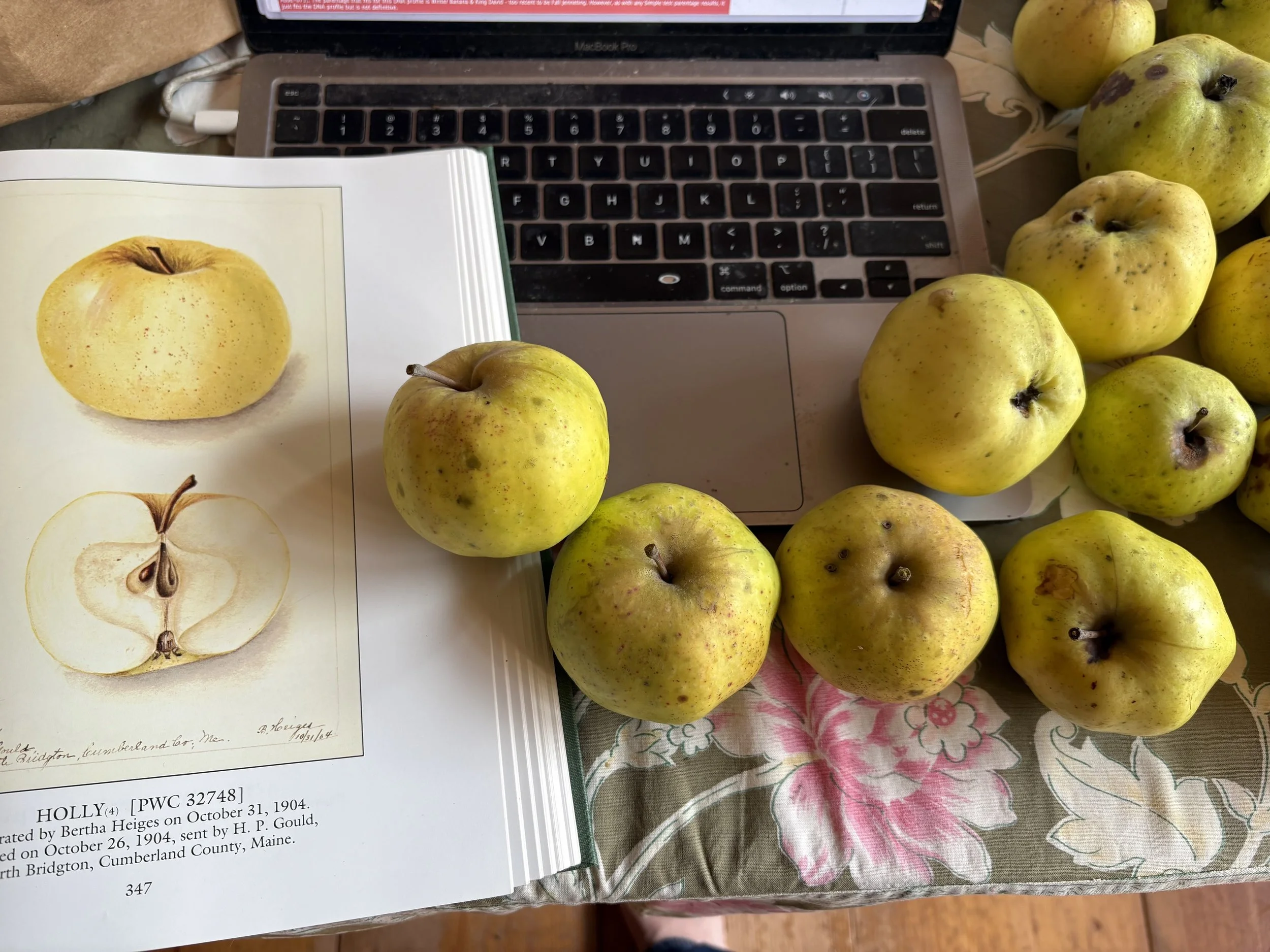
The second ID I worked on yesterday was one from Sandy River Orchard in Mercer, ME. As I recall, this was an apple that Francis Fenton told me he found on an old tree in nearby Norridgewock and grafted into his orchard. That was in the days when Francis was actively fruit exploring, years before he and I met and spent many hundreds of hours together. Francis died at age 99 in 2015. Unfortunately he never took me to the source tree, nor do I have any idea where it might be. Happily we have a large branch of the apple here on the farm, and I picked them all a day or two ago. For now I’m calling it “Fenton’s Ribbed Yellow.” 

Fenton’s Ribbed Yellow, Holly? Sept 26, 2025

“Fenton’s Ribbed Yellow” somewhat resembles Calville Blanc d’Hiver, (and for awhile I thought maybe it was Calville), but has a DNA profile (AMHO 103) showing it to be “unique far from all.” Like Calville the apple is yellow and distinctly ribbed. From “above” it is pentagonal. The cavity and basin are generally medium in size though they are sometimes so shallow as to be almost non-existent. Occasionally the cavity is also lipped. This is one unusual and cool looking apple. It is ripe now (mid-late September). The closest match I’ve find so far is to an apple named Holly, submitted to the USDA watercolor program in 1904 from Bridgeton, ME. (Bridgeton and Mercer are about 70 miles apart.) It also may turn out to be one of those many hyper-local selections that may forever remain unidentified.

September 25, 2025

Today in the orchard

Don’t we love the rain when it only shows up once or twice a month? The last rain was three weeks ago. This time it rained for nearly 20 hours, and we got slightly over 2”. Fantastic. It was a good day to do apple ID’s.

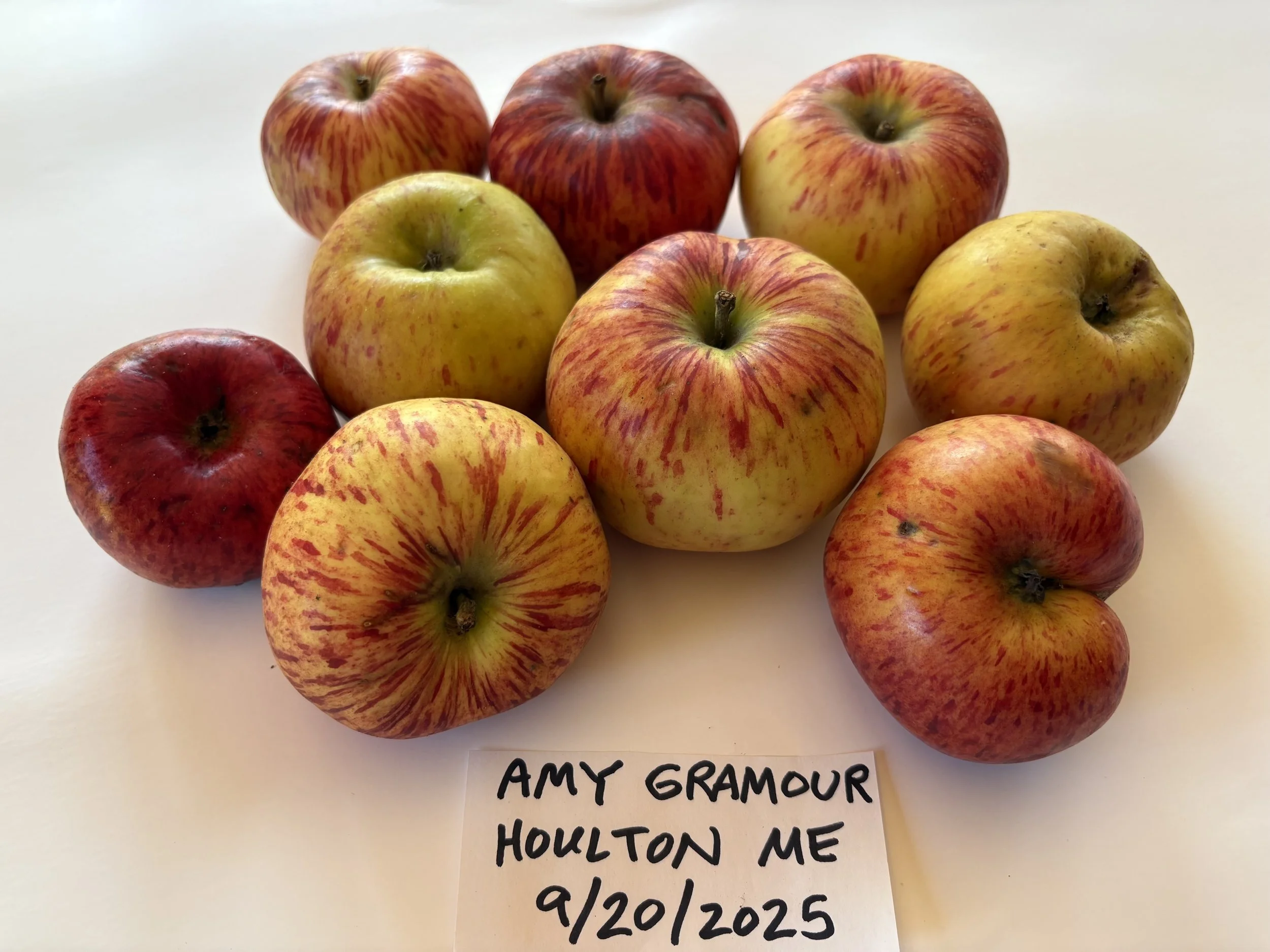
I pulled out a bag of apples sent to us by Amy Gramour, a friend and fruit explorer from Houlton in Maine’s northernmost County. Amy has been on the search for the Houlton apple, “Bloom,” for some time and was hoping this one might be it. These apples come from a huge old tree in Houlton. Bloom originated in Houlton or in nearby Woodstock, New Brunswick. Back then the borders were porous, and people and plants flowed back and forth with complete freedom. (The good old days.) Bussey lists three cultivars named Bloom and two of them—numbers 1 and 3—would be the apple in question. Had he been aware that Houlton and Woodstock were only 15 miles apart, he might have concluded that the two were one and the same. The historical record matches well enough. Amy’s apple could be it.

Next, the phenotype. I read the description in Bussey and examined Amy’s apples as I did so. Unfortunately the phenotypic description—incomplete as it is—did not match the apple. Although historic descriptions are often incomplete and writers differ on how they define and describe characteristics, in this case, the apple can not be Bloom. 

So what could it be? The prominently red-striped fruit has “Russian” written all over it. Think Duchess, Charlamoff and even Gravenstein. Amy’s apple could be Haas, an apple with Russian roots that matches the description and was trialed in Houlton during the late 19th century when many hardy apples with Russian pedigree made their way to the cold of northern Maine. 

Next steps?  How about a DNA profile?  Tomorrow: my umpteenth attempt at Francis Fenton’s ribbed yellow apple.

September 24, 2025

Today in the orchard

Skylar and I spent a bunch of time editing our list of apple mysteries to solve this fall. We have some interesting adventures ahead. Later we walked the orchards to inventory the ripe fruit. We’re currently in a late September ripening lull, but we’ll be picking again before long. We need to plant a few more late September cultivars. 

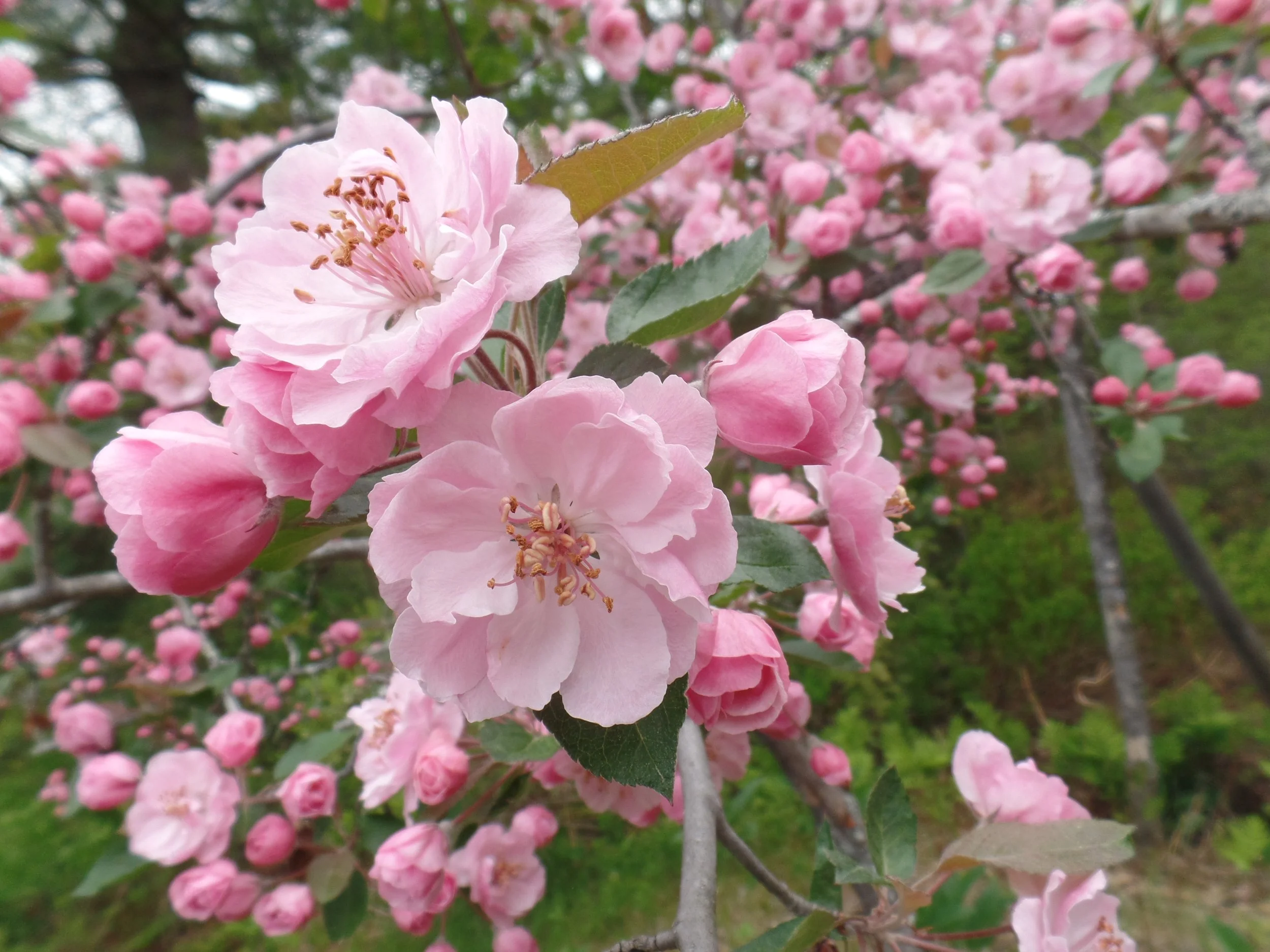
Brandywine in bloom

We did pick the Brandywine, one of the most bitter and unpleasant-tasting fruit we grow. A true spitter. Of course, that makes it one of my absolute favorites. Brandywine was originally selected as an ornamental. The double flowers (multi-petaled) are incredibly beautiful and fragrant. The one-inch fruit has largely diminished (or ruined) its popularity with ornamental growers. For cidermakers, however, it’s got everything: flowers, fragrance and nasty bitter fruit.    

September 23, 2025

Today in the orchard

Drap d’or de Bretagne? Belfast, ME Sept 23, 2025

Today I visited the apple tree in Belfast that might be a second Drap d’or de Bretagne in Maine. This is the apple that was brought to the Hayloft tent just before the end of the Fair this past Sunday. Although the tree is only a couple hundred feet from Rte 1 and I’ve probably driven by it five hundred times, I’d never seen the fruit. The tree is exceedingly old, and the fruit phenotypically resembles the Drap d’or de Bretagne we found on Verona Island only fifteen miles from Belfast up the coast and over the water. I took leaves to DNA profile and will phenotype the fruit, comparing it to the Verona Island discovery.

PS: For all you jazz fans, today is the 99th birthday of John Coltrane.  A year from now we'll have a big celebration of jazz and apples and cider. What a "combo!"