February 12, 2026

+18F at dawn. Some light snow last night though not enough to measure. In the morning I jumped into one of our highest priority apples, Martha Stripe. What a mess!

In January 2019 Cammy and I went to Tower Hill Botanic Garden in Boylston, MA to cut scionwood from all 119 cultivars in their historic apple collection. The trees were suffering badly from decline and fireblight and were going to be cut down. Fedco offered to re-graft the entire collection for them. There were two trees of each cultivar, and with one exception, at least one of each was still alive. The exception was Lyscom, both trees of which were dead. No scionwood. Where would we get Lyscom?

Then I remembered that thirty years earlier I had received a letter about another apple, Martha Stripe, which was known as a synonym of Lyscom. The tree was in Orland, Maine. If I could only find it. I eventually located the letter in my files from Millard A. Clement dated October 21, 1998. He wrote, “I read your article in the paper today 10/21/98 about apples. I have a tree that I was told by my father is a ‘Martha Stripe.’ When I moved here in 1954 there was three of these trees. Only one is left. The apples are sometimes 3” across. … We make apple sauce and add nothing to it just cook the apples and eat.” 

I never got around to visiting Mr. Clement, but in the late winter of 2019 I did go visit his former home to see if I could collect scionwood from the last remaining tree. The owner at the time did not recognize the name Martha Stripe, but when I described the apple, she thought she knew which tree I wanted. I collected the wood, propagated trees, and two years later, sent them back to Tower Hill. Another old cultivar saved… or so I thought. When the Tower Hill collection was DNA profiled, my “Martha Stripe” profiled as Twenty Ounce.

Meanwhile we also determined that, despite the description in Bradford (Apple Varieties in Maine), Martha Stripe probably was not a synonym of Lyscom. Mathew Stripe was the synonym, not Martha. How do you keep this stuff straight? 

For the moment we think we have found the true Lyscom in Southborough, MA where it originated. And we continue to hear the name Martha Stripe as a cultivar grown in the Orland—Castine area, on the very road where Mr, Clement had lived. It has to be there somewhere. So last October I returned to the Clement farm, (now owned by someone named Doucette) and collected fruit from all the trees in hopes that one of them would be the true Martha Stripe.

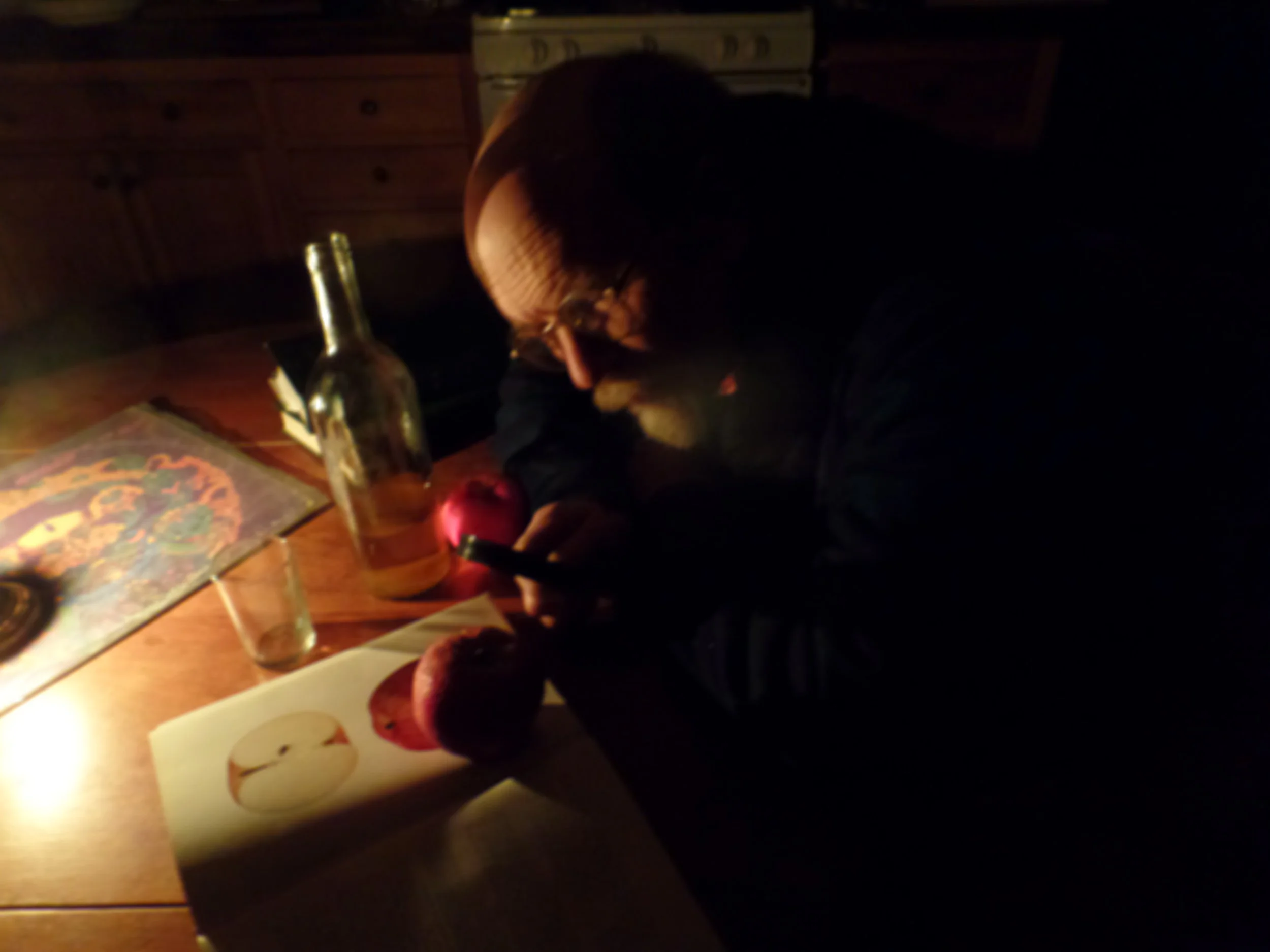
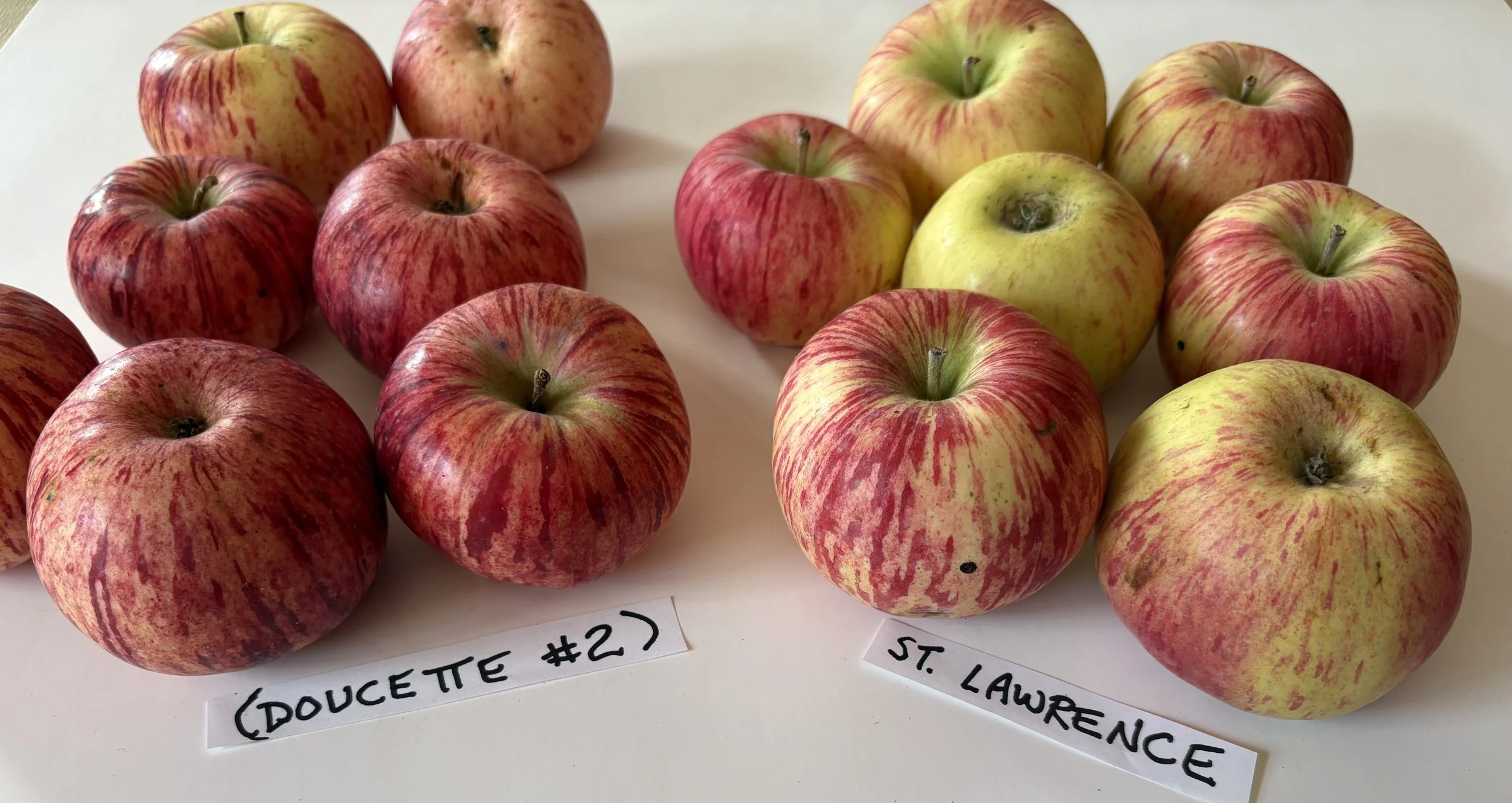
Today I did a detailed phenotype of “Doucette #2”, one of the top candidates. As far as I can tell, it is not Martha Stripe. I suspect that it is the excellent, very-striped apple, St. Lawrence, though perhaps the DNA profile will prove me wrong.

February 11, 2026

It was a balmy +20F this morning at the farm. We had a few inches of snow last night, and it kept on snowing all day. I felt like I was in a snow globe, looking out at the Evening Grosbeaks and Jays crowding  out the Titmice, Juncos and Chickadees at the feeder. 

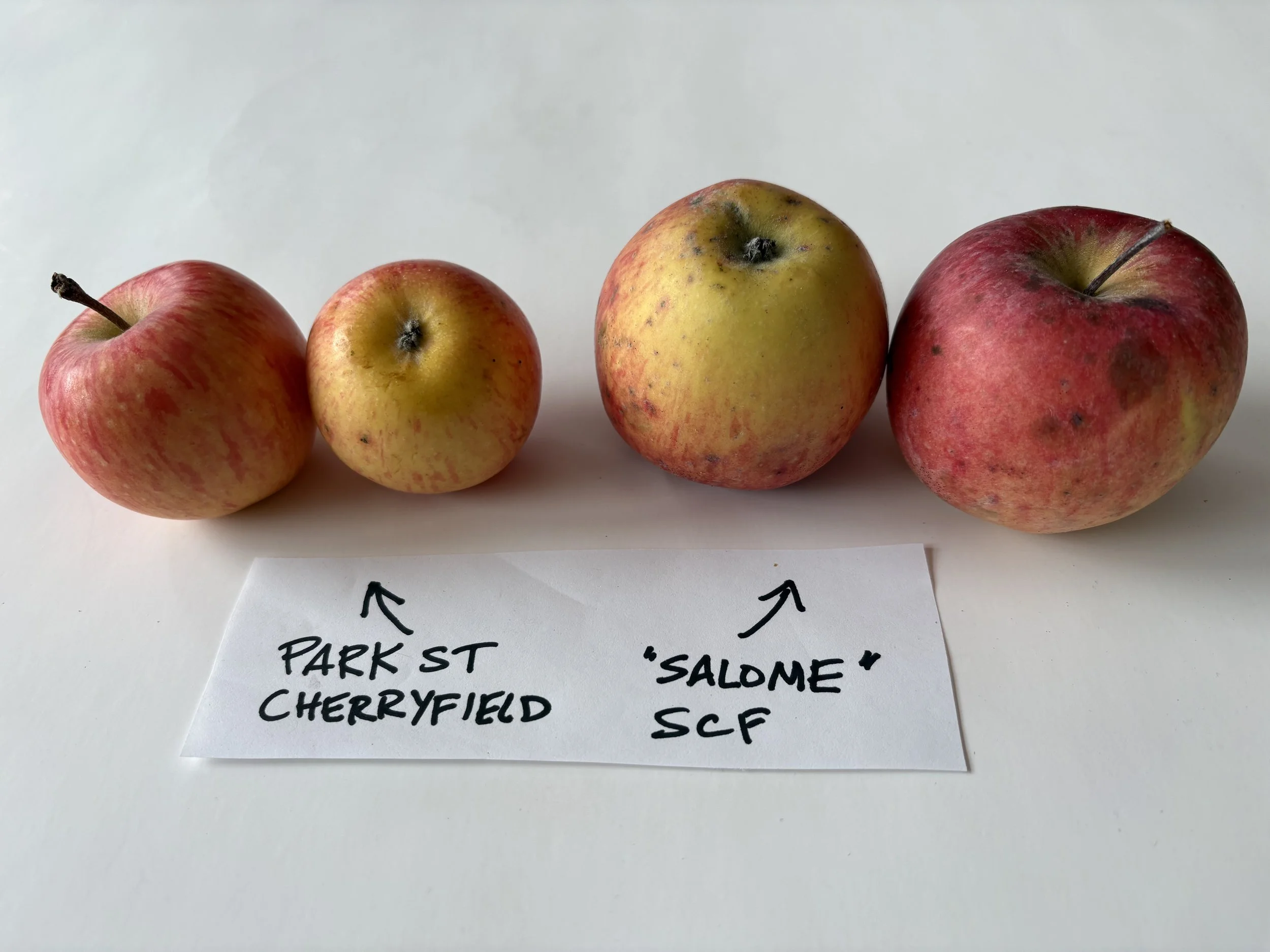
All morning I continued looking at apples obtained last fall. Today it was the apple Todd and I collected from the “Brown Place” on Park Street in Cherryfield. We were taken to the spindly, shaded tree by Larry Brown who topworked it about thirty years ago. 

Larry’s sister and her friend sent me fruit in 2006 wondering if they had found the Cherryfield—aka Collins—apple, a cultivar that originated in Cherryfield in the late 19th century. (see AOD chapter 20). Unfortunately, I think that they did send me the correct Cherryfield and that I may have mixed it up and lost the scionwood. The apple I grew out as Cherryfield DNA profiled as the mid-western cultivar, Salome (pronounced Sa—loam). Salome is an excellent apple but not Cherryfield (unless, of course, they are synonyms.) It could be that they never did have Cherryfield except that the original photos I took in 2006 look disturbingly different than the apple I eventually grew out and profiled. Did I mix up the scionwood somewhere along the way?  Argh!

Could they be Cherryfield?

I’ve been meaning to track down Larry Brown for the past few years to see if he could take me to the tree from which the original fruit came. He did that on October 13, 2025. The original tree had died but Larry took Todd and me to a tree on Park Street that he thought he’d grafted from that tree. It was that fruit that I phenotyped today.

To add to the confusion, years ago I sent Larry’s sister a tree that I grafted for her. It’s possible that Larry grafted his tree using my scionwood, not the original wood. The fruit I pulled out of the bag today closely resembles the one ID’ed as Salome. The fruit is smaller than our Salome and coloring is somewhat different though this could be due to the shady roadside location of Larry’s tree. Otherwise the two are remarkably similar.  Todd and I did take leaves in October and sent them in for a DNA profile.  We’ll see what the results show. I think it may be another Salome. Of course, another possibility is that Cherryfield and Salome were synonyms all along! 

I finished up the phenotypic comparison and headed out to the orchard to cut firewood along the fence line. Fortunately I can tell a maple from an apple tree!      

February 10, 2026

De-mystifying the mysteries

It was zero at dawn and soared to 30+ by early afternoon. I felt like running through the orchard in barefeet.  (I resisted.) Todd came over, and we looked at lists of high-priority apples that we need to examine before spring pulls us outside and the winter indoor-season comes to its inevitable conclusion. We also “attended” a zoom planning meeting for Maine Apple Camp. Get it on your calendar now! It’s the last weekend of August. You need to be there. 

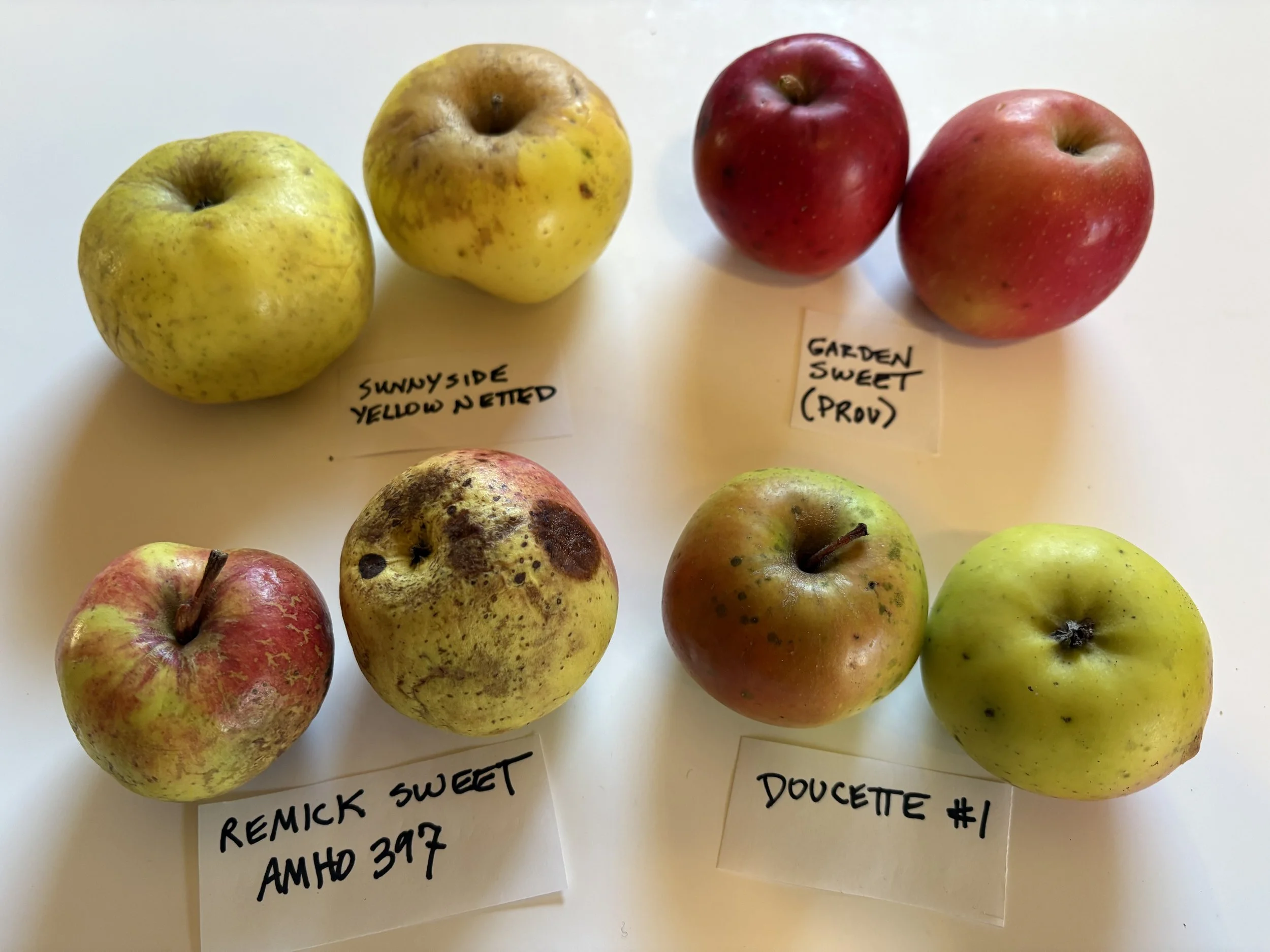
Today’s priority apples—with provisional names—include  Sunnyside Yellow Netted, Garden Sweet (prov), Remick Sweet and Doucette #1 (There are several Doucettes, all interesting.) Sunnyside Yellow Netted may be the local cultivar, “President.” Doucette #1 may be another local cultivar, “Prospect Greening.” Garden Sweet (prov) was apparently collected from the wrong tree. It’s the modern British Columbia cultivar, Spencer. Good tasting but dull. (McIntosh x Golden Delicious.) Remick Sweet is a seedling of the French bittersweet cider apple, Bedan. Bedan seedlings were shipped over from Normandy and used as rootstocks. The Remick tree is the second full sized, old Bedan seedling we’ve found. Presumably Seneca Remick’s original graft never took—or maybe he just wanted to see what they’d get if they grew it out. It’s a true spongy, low-acid, bittersweet that I will certainly graft up at Finley Lane. The yellow ground color is an interesting, dull, mucky-dirty-mustard-yellow. I love that color!

February 9, 2026

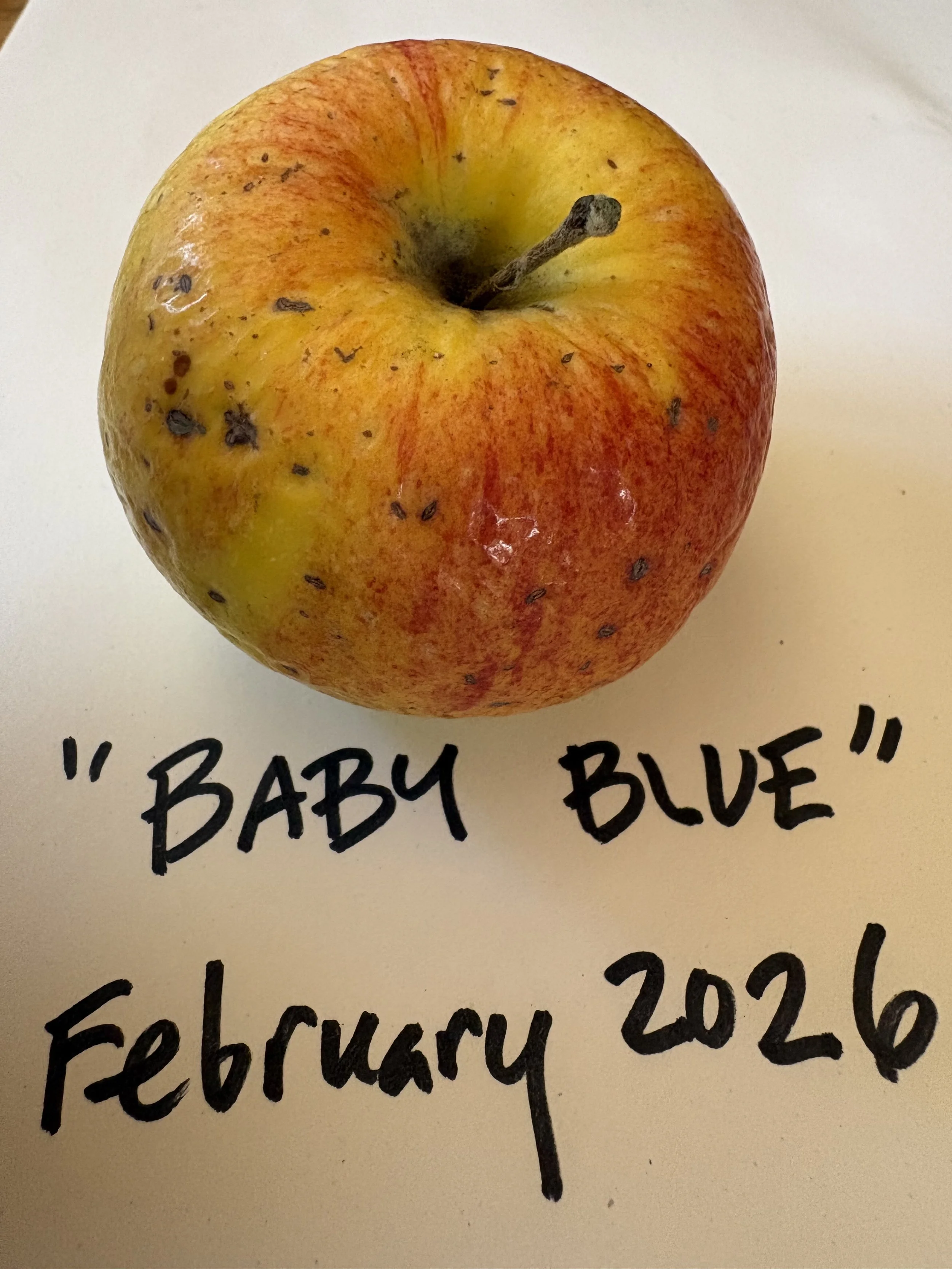
—12F at dawn but warming up to +30F by mid-day. Spring is only 5 weeks away! Spent time today continuing to attempt to ID the “Baby Blue Group” apple, the one we think could be Walbridge.

BBG and McAfee

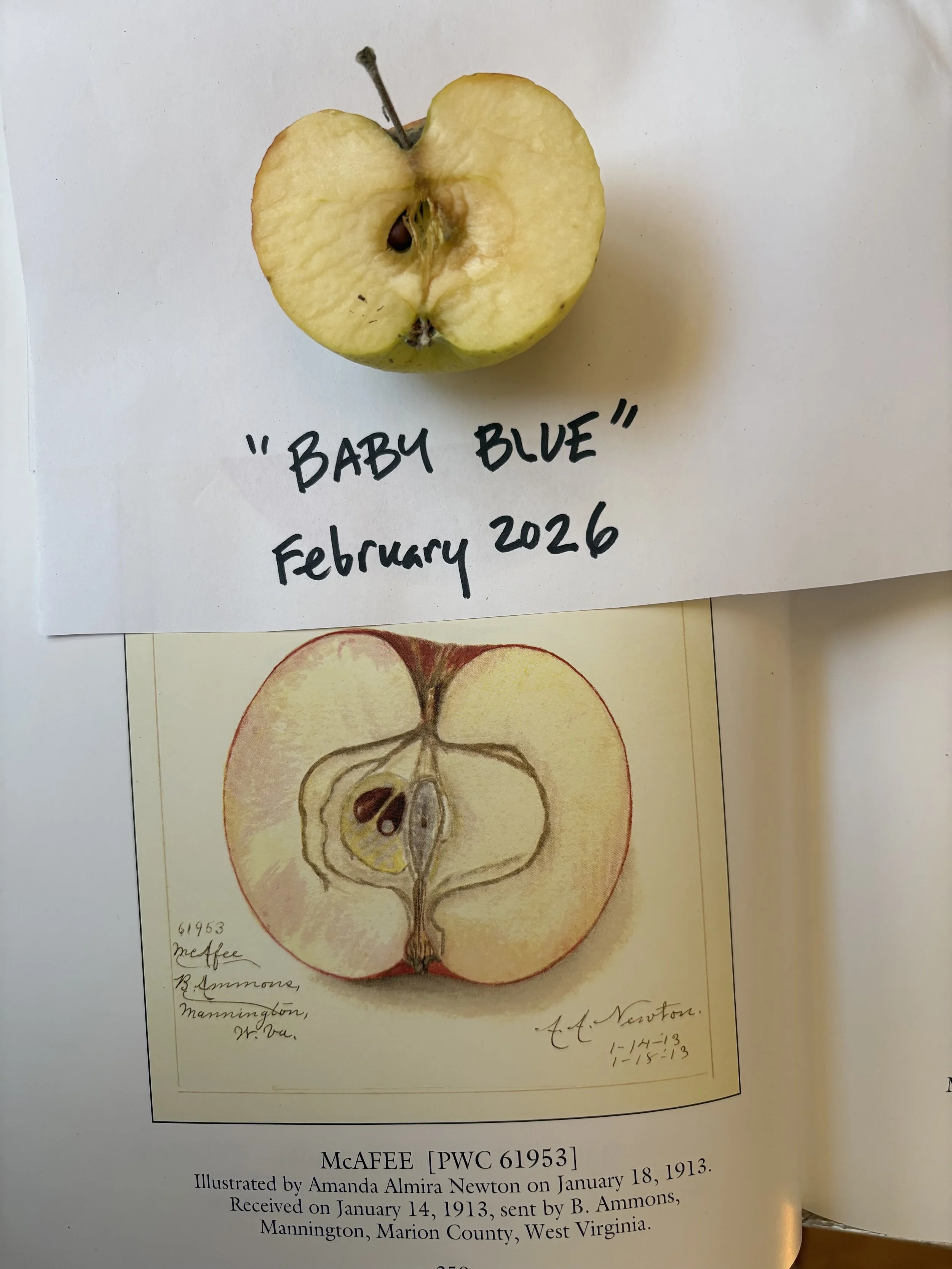
During our Working Group meeting on February 6 there was some thought that the Baby Blue Group (BBG) might be another popular apple out west called McAfee. So today I dove into McAfee, one apple I know even less about than Walbridge. I compared the BBG phenotype with Dan Bussey’s description of McAfee in The Illustrated History of Apples in the United States and Canada.

I think it is unlikely that BBG is McAfee. McAfee is medium to large in size. All of the BBG apples I examined were a solid medium. The shape of the two apples is also different. Although the general description of McAfee’s shape is similar to BBG, the depiction of the apple in the historic USDA watercolors is quite different than that of BBG. McAfee’s calyx tube is distinctly long and funnel-shaped. Not so, BBG. McAfee’s core is described as “decidedly abaxile.”  (Presumably “decidedly” means something like “pronounced” or “obviously”.) BBG’s is “decidedly” axile. McAfee’s carpels are said to be tufted. (That’s when the seed cells are partly covered with small fluffy, cottony bits.) BBG’s are not.

So much minutiae. When it comes to attempting to pry a name out of an apple that no one’s been growing for a hundred years and there’s no one left who can identify it from sight and only a few who’ve even heard of it, what do you do?

When focusing on apples you don’t grow or know much about, you’re forced to trust the writers of the past. You read the old books, and you hope that whoever wrote the description was a keen observer and an articulate writer whose understanding and use of the terminology matches with yours. Did they mean what you think they meant? You hold the apple, you cut the apple, you stare at the apple, you translate the old words, and you see where it leads you…  

February 8, 2026

Although we have over a foot of snow on the ground, the drought continues here in central Maine. The deep snow is deceiving. It certainly looks like a lot. I’m glad we have it, but we could use more. The fact that it hasn’t been above freezing for nearly a month means that nothing is melting. Not only that, the snow is so dry that the wind is still causing drifts across the roads two weeks after the last big snowfall. 

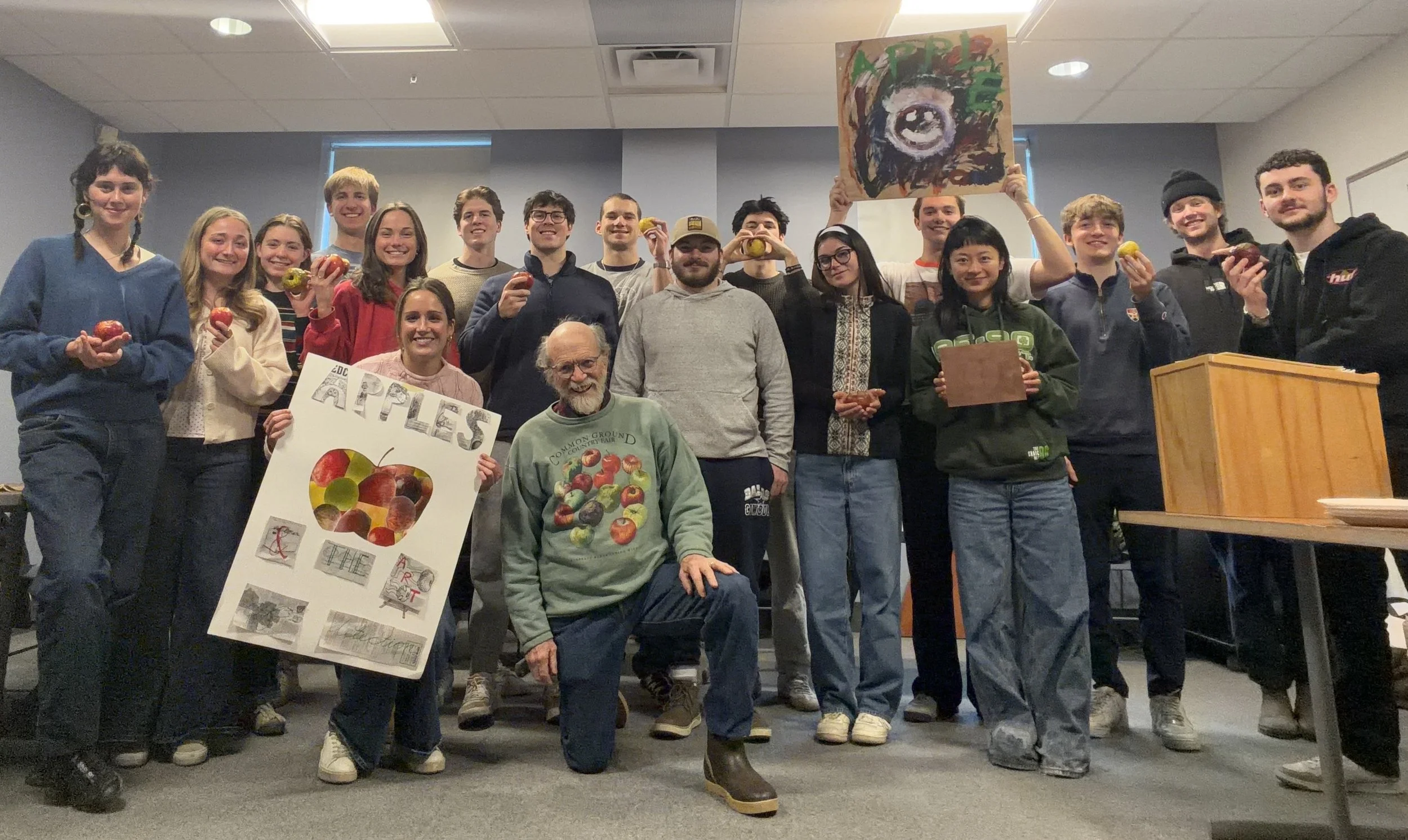
Today I created grades for the 18 apple students I taught for the month of January at Colby College.  There was one inflexible requirement for the course: they must attend every class. If you aren’t out in the orchard, how can you hear the trees and what they have to tell you? In the classroom it became my job to speak for the trees. The students came. They did their part. It was up to me to be the tree and share the experience of being in the orchard. What a responsibility the trees have to pick their words with care. And what a responsibility we have—as humans—when we share with one another.    

Being there

February 7, 2026

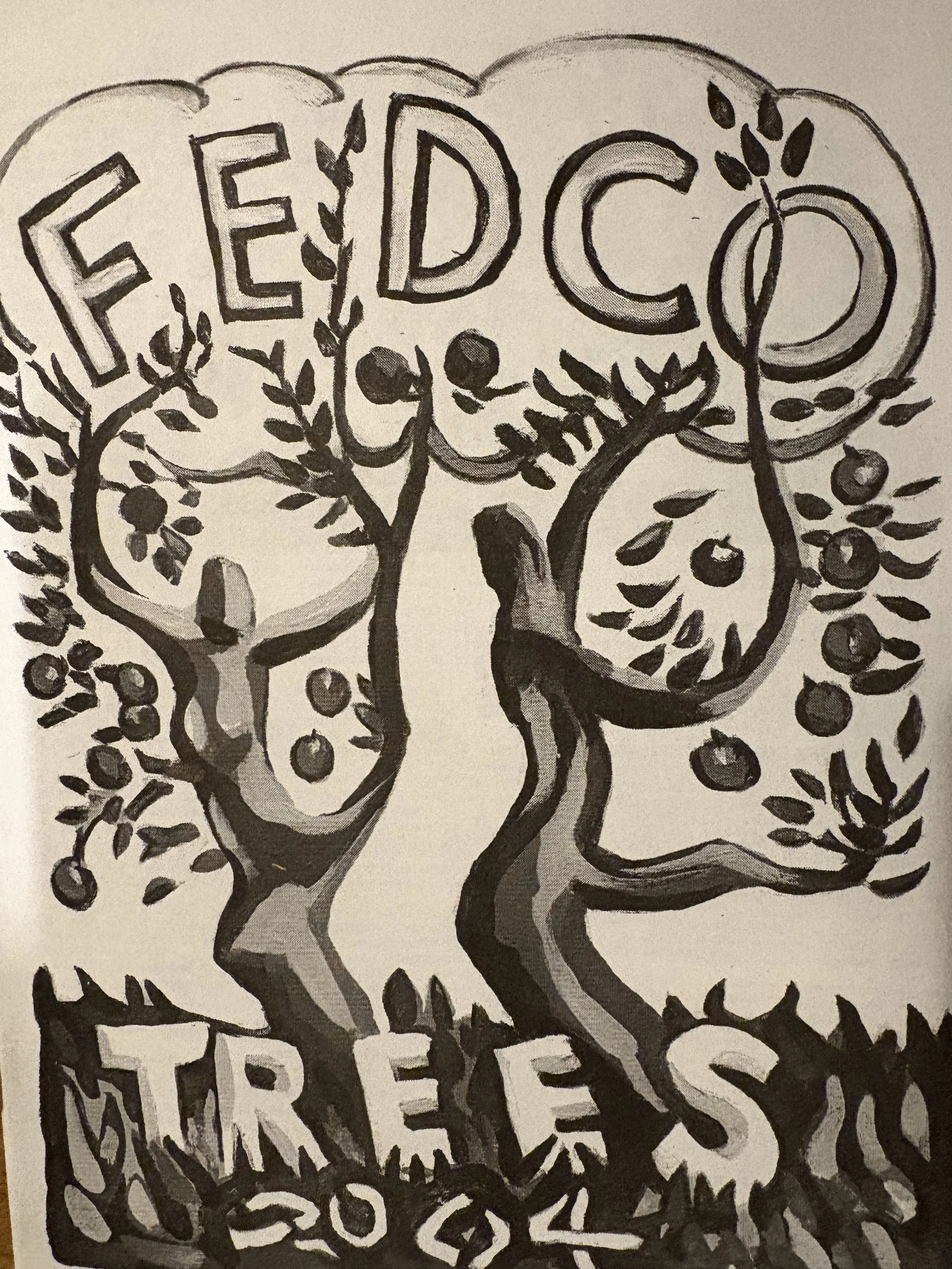
Dancing apple trees by Abbott Meader, 2004

Still below zero early, but a light snow came in for much of the day, and it warmed up a bit. Skylar came by, and we went up to the Finley Lane orchard to check out the trees. We walked the rows and listened to what the apple trees had to tell us. As I expected, they were happy to fill us in. They love winter. They were all dancing, spreading their branches in the most wonderful ways, and soaking up that clear winter air. It’s true they’re beautiful in the summertime in all their greenery, and in the fall when they’re decorated with fruit. But in winter they love to dance naked in the snow. They shimmer and vibrate and glow. It’s magical, beautiful, incredible. 

In 2004 my college art teacher, Abbott Meader, created a black and white dancing-apple cover for the Fedco Trees catalog. I think he must have been up at Finley checking out our trees. He got it perfect.ly.

February 6, 2026

It continues to be abnormally cold in central Maine, —10F at dawn and not much above zero (if at all) all day. In the afternoon our national Apple Working Group met via zoom to see if we can sort out the identity of an apple we’ve found in Washington, New Mexico and Colorado.  We think it’s Walbridge, a high quality, winter, dessert cultivar that historians and explorers in the west have been searching for. 

Walbridge likely originated in Illinois in the early 19th century where it may have been named Edgar Redstreak. It was apparently taken to Wisconsin and was eventually renamed Walbridge. From there it was widely disseminated in the western states where it thrived. Over time, along with numerous other heirlooms, it disappeared, or maybe we should say, it went under cover. 

It's all over now, Baby Blue?

Over the past few years, leaves submitted for DNA profiling from multiple locations across the west turned out to be a match to each other, but not to any of the apples in the reference panel. This apple became known provisionally as “Baby Blue Group”.  We think it might be Walbridge. So the Working Group is developing a process to assess all the information we’ve gathered in hopes of making identifications. Today we dove in.

We looked at the historical evidence, the genetic evidence and the phenotypic evidence. Where was it grown? How old are the trees? What else is growing in the orchards with it? Does the DNA profile make sense? Do the characteristics of the fruit itself match the historical description? We ask ourselves all these questions and more. We focus on the actual evidence and let it take us wherever it will. Our meetings are scheduled for an hour and a half, but today’s was nearly twice as long. In the end we weren’t sure. Do I think we’ve found Walbridge? I think we have.    

February 5, 2026

Today was the last full day of Cider Con. In the morning I attended an excellent session on making champagne-style cider. Three ciders were served and discussed. All three were quite delicious.  

Yesterday I was on a second panel with Jamie Hanson of Seed Savers’ Exchange and Todd Little-Siebold of College of the Atlantic. Our topic was apple genetics in the 21st century. It’s impossible to overstate the value of genetic profiling in apple identification, cleaning up our collections and coordinating preservation efforts around the world. What an amazing tool to use in combination with historical literature and good old-fashioned observation. I particularly enjoyed having the opportunity to talk about several cider apple cultivars that have been majorly mixed up over the past 100 years and the role of genetics in sorting them out. Those include Foxwhelp, Tremlett’s Bitter, Michelin, Hughes/Hewe’s and Bedan.  

In the afternoon I headed back to Maine. It was great to catch up with many apple friends and make some new ones as well. Don’t get confused by the name CIDER CON. It may sound rather corporate, but it’s chockablock filled with apple and cider geeks, just like you and me. 

February 4, 2026

Lots of snow in Providence. Hard to negotiate the sidewalks, but most of the Cider Con activity is in one gigantic, high-ceilinged conference center. Not exactly like being in the orchard, but, hey, it’s February and it’s cold. 

Today I participated on two panels. Steve van Nocker, Matt Kaminsky and I teamed up for the first panel: “Cider Apples of the Future.” We led off with a brief history of how we got to this place of needing new cider cultivars. Then we dove into the annual western MA Pomological Seedling Exhibition, Steve’s red-fleshed cider apple breeding program at Michigan State University, the widespread effort to track down seedlings, and the importance of large scale trials of potential new cultivars. One exciting new development is Matt’s project to grow out a couple acres of eleven of the most promising seedlings from the Exhibitions. I will grow all eleven on Super Chilly Farm as well. Although the three of us had never done a talk together before, I thought we were able to pull it off quite well. The audience was enthusiastic and asked many questions. The future’s looking bright for cider apples!

February 3, 2026

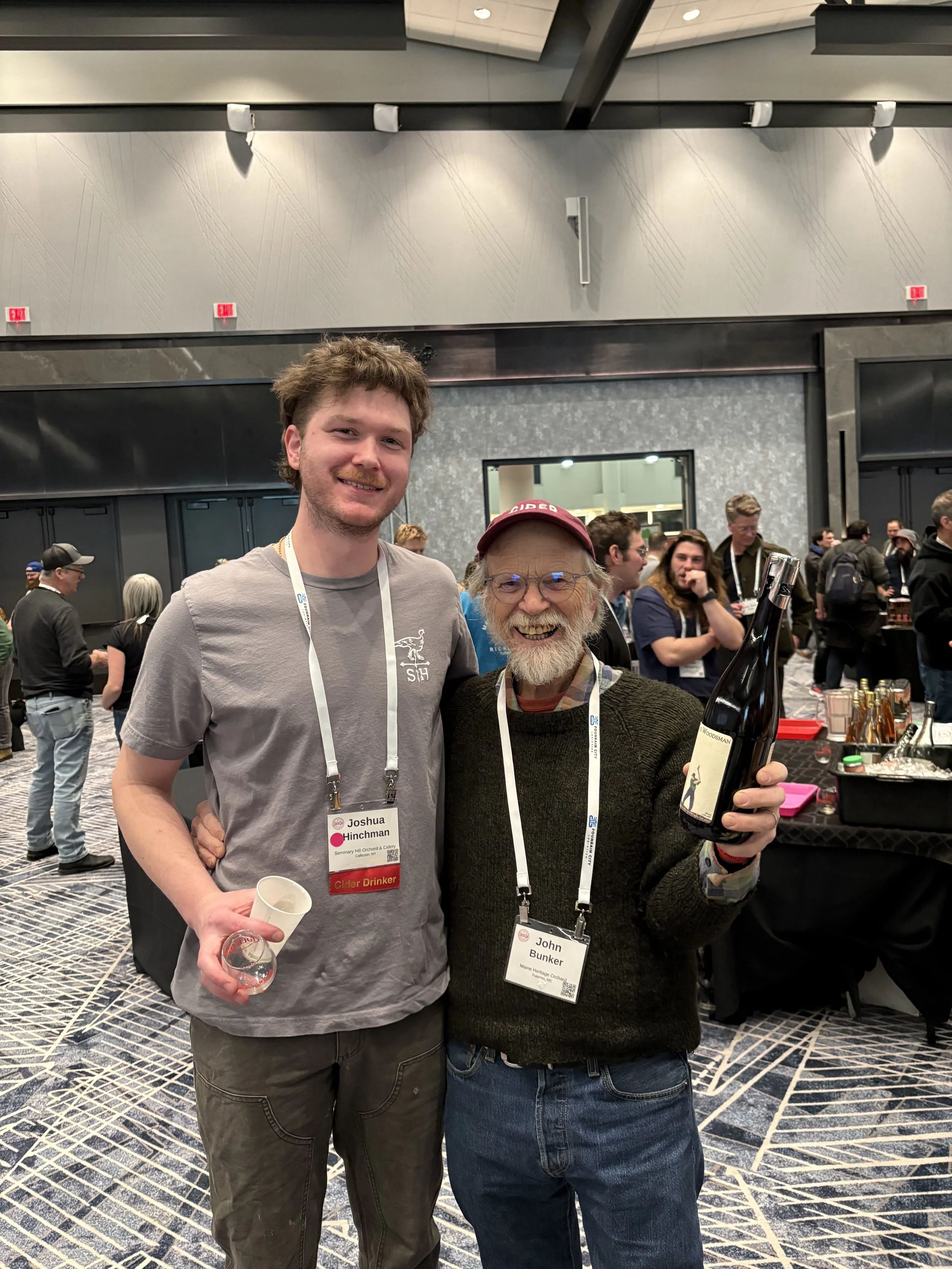
Our former apprentice, Joshua Hinchman from Seminary Cider in NY, February 3, 2026

I headed south to Providence, RI with Todd Little-Siebold to attend Cider Con, a major annual apple and cider conference. We’ll be giving a talk together on apple genetics with Jamie Hanson of Seed Savers Exchange tomorrow. I will also give another talk tomorrow with Matt Kaminsky and Steve Van Nocker. That one is on cider apples of the future. It should be a busy day!

Tonight was an opening “cider share” in a huge packed convention hall. There were at least fifty different cideries from across the US and beyond pouring their ciders. I couldn’t try them all though I made a reasonable effort. I also connected with many folks in the cider and apple world who I don’t often get to see. Some of them are among my favorite people in the world. What a great community!     

February 2, 2026

It warmed up today - at last. By early afternoon it was nearly +25F. That made it feel like summer. Jacob, Laura and I cut scionwood for Fedco for nearly six hours. I don’t think I ever felt cold, a far cry from yesterday. By late afternoon we’d probably cut a thousand sticks. I had forgotten how nice it is to be outdoors all day when the temperature is above 20 and below 32. It’s almost perfect. Or maybe it is perfect. 

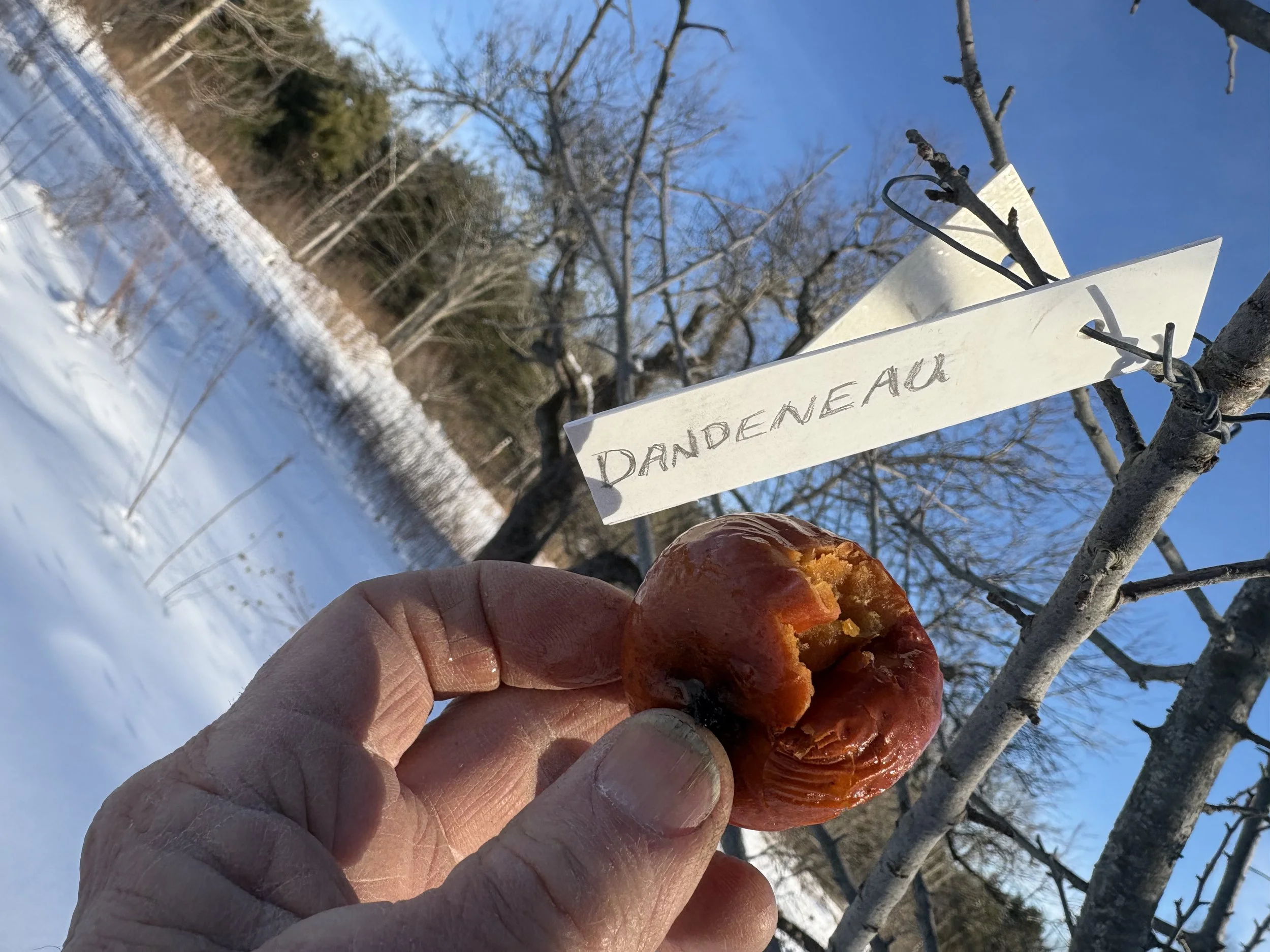
After Laura and Jacob left ,I cut a few varieties to take with me down to Providence tomorrow for Cider Con. There will be a scion swap one day, and I want to bring along a few favorites to contribute. I also found a frozen apple that was missed when we picked the Dandeneau tree in row 3 three months ago. Or maybe we intentionally left it for the birds who in turn intentionally left it for us. It still tasted pretty good! 

Today is Groundhog Day. The old adage is half your firewood and half your hay. We’re doing great in the hay department with no oxen or horses on the farm these days. The firewood is holding up, but there may not be a lot left come April 15th. The chickens are beginning to lay again with the increased light, though the output is still rather pathetic. They are eating more grain so maybe that will translate into eggs. Let’s hope.

February 1, 2026

It was another cold night last night, though —10F is not as cold as it’s been. I worked on phenotyping apples this morning. Amazingly enough, most of the apples I collected in the fall are still in very decent shape. That means that there’s still hope that I’ll get to yours! 

Late morning, Skylar and I went up to the Finley orchard to cut scionwood. Although the temperature did finagle its way above  zero, it was still cold, the snow was deep and the wind was piercing. But I needed to cut a scionwood order for some folks in Texas who will be grafting soon. Supposedly it’s warm down there. Our scionwood is going to be mighty surprised when the box is opened and the scions discover they’ve just gained about 70 degrees.  Hopefully they won’t die of shock.

Colby College apple class, January, 2026

Once it begins to warm up a bit, I’ll spend more and more time pruning and cutting scionwood. The Apples class I taught during Jan Plan at Colby College is over. That took a big chunk of my time in January. I think the students enjoyed taking a deep dive into all things “Malus” over the month. I had fun too. On the final day (January 28) they each made a presentation, all of which were interesting and often hilariously entertaining. I will miss the students. Some have promised to come visit the farm in the spring. I hope they do. 

January 31, 2026

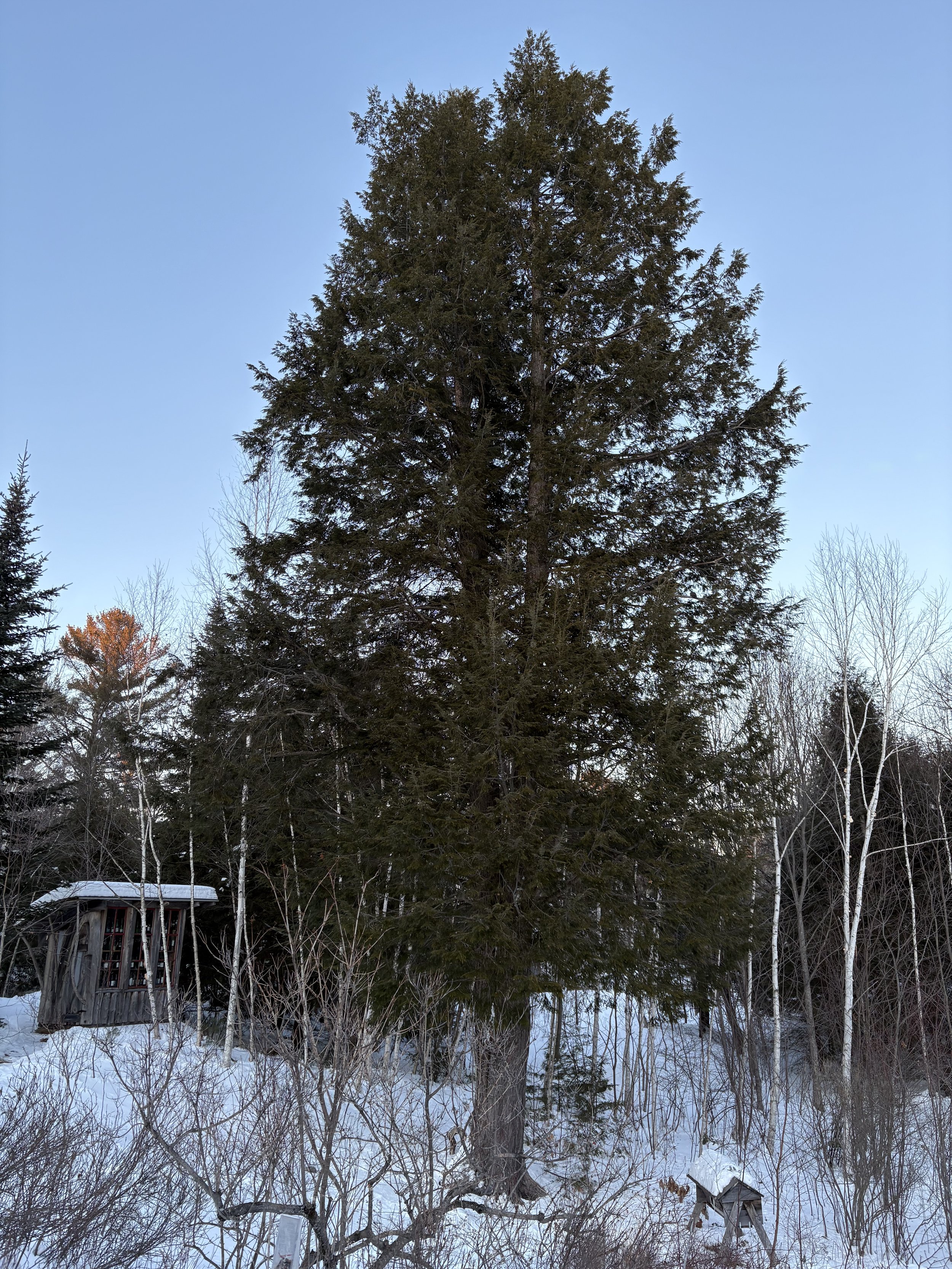
Hemlock (and the Northeast Cider Bottle Museum) at SCF, January 31 ,2026

They say that the eggs of Adelges tsugae, the hemlock woolly adelgid, (HWA) are killed when wintertime temperatures fall to —10F, presumably for a few nights over the course of the winter. Some winters that’s been a challenge in central Maine as the HWA creeps its way northward. We can assume that no HWA will be showing this coming spring on our farm. We just had —25F this morning. That is the tenth time the morning temps have been —10 or colder since New Year’s.  HWA may arrive and kill all our spectacular hemlocks one of these years, but not in 2026. 

Today it never made it above zero all day. There wasn’t much incentive to be outdoors. I spent most of my time at the desk preparing for Cider Con, the big cider event coming up in a few days in Providence RI. I’ll be participating in two panels: one on cider apples of the future and a second on genetics and apple identification. Zack Kaiser of Absolem Cider in Winthrop is organizing a Maine cider share. And… we’ll be pouring several bottles of “Good Idea Cider” from SCF.  A first! Watch out Angry Orchard, Good Idea Cider is heading to a liquor mart near you. Well, don’t hold your breath.

Meanwhile, the hemlocks look happy, and if it stays this cold for the next few days, I should be more than ready ( and happy) for Cider Con.     

January 23, 2026

We’ve continued to have snow a few times a week—mostly overnight— and not more than a few inches at a shot. It’s beginning to add up. The Northern Lights are back but not bright and spectacular. Hopefully that’ll come. The snow isn’t deep enough yet for good skiing, but it’s great for cutting firewood. So I head up to Finley Lane most days and put in a few hours. Because I’m primarily harvesting small diameter trees, most of the work can be done with hand tools, not all that dangerous and lots of time to reflect on the amazing experience of being alive.

I never liked the song, “The Twelve Days of Christmas ” so I’ve been working on a new Wassail-centric version. After all, Wassail is traditionally celebrated on The Twelfth Night. Here’s my rough draft. Maybe you have some suggestions. If so, please submit!  We have about 11 months to finalize.

On the twelfth day of Wassail, my true love gave to me:

Sun descending over Finley Lane, January 2026

Twelve fires burning 

Eleven neighbors singing

Ten friends a-laughing

Nine children sledding

Eight couples dancing

Seven poems for reading

Six toasts for toasting

FIVE CIDER KEGS

Fo-ur everyone

a Three-handled cup

Two celebrate

And   a  bowl   of   cider   from   our   apple   trees!!  

January 17, 2026

For hundreds—or even thousands—of years, rural farm folk have been celebrating apples, apple trees, agricultural life, and cider on a cold night in January. The celebration typically took place on the “old twelfth night” which, by the pre-1752 Julian calendar, was on January 17. We usually do ours on the third Saturday night in January. This year it fell on the 17th. 

Families started arriving at the farm late in the afternoon before dark, which gave everyone time to play in the snow, catch up with friends separated by the winter cold and snow, and wander about the farm. When darkness descended, we gathered by a large bonfire, cider in hand, and watched ten thousand sparks ascending into the night sky and ten thousand snowflakes falling to Earth. It was magical. 

After a welcome and a brief introduction to Wassail, everyone joined in for our favorite call and response cider poem, “The Cider’s Gittin’ Low” and sang two traditional Wassail songs with lyrics we’ve heavily “adapted” over the years. Eventually we circled around one of our oldest apple trees where we acted out a skit we write each year that often tends toward improv and chaos. It’s a tribute to the apple trees for past harvests and a humble request for a bountiful crop in the coming year. It’s all in good fun but also quite serious. We are profoundly grateful to all the plants and what they give us year after year with unbounded generosity. They are truly amazing!

We end our official program with these words, some version of which was written many generations ago:

Old apple tree, we Wassail thee and hope that thou doth bear,

For Lord knows where we shall be when apples come another year.

So the bear well and fruit well, so merry let us be,

Let everyone drink up their cup 

And cry “Health !”  to the old apple tree.

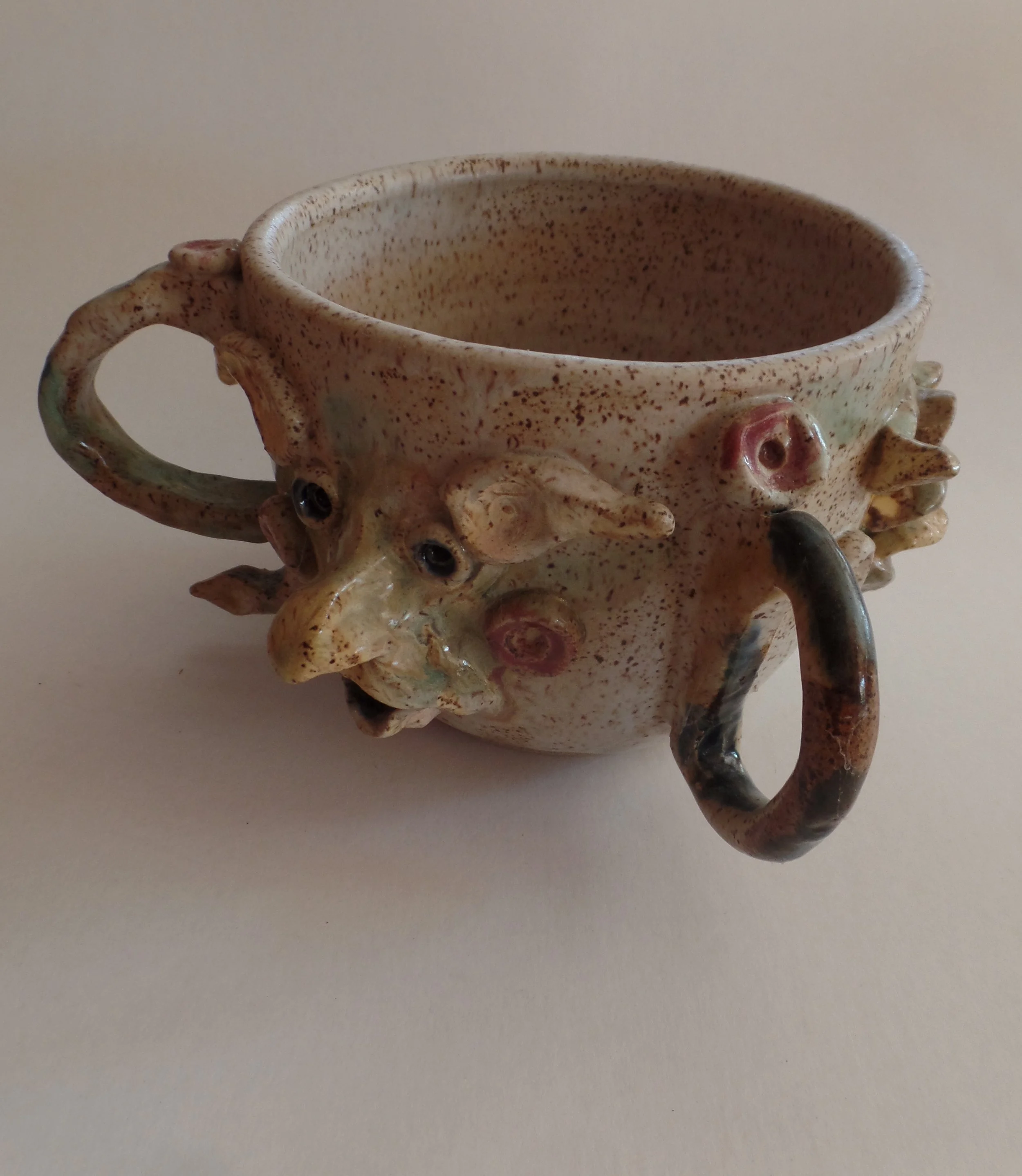
Three handled Wassail mug made by Nancy and Abbott Meader.

Hat’s full!

Caps full!

Barrels full!

3-bushel bags full!

Barn-floors full!

(and even a little heap under the stairs!)

WASSAIL!

January 15, 2026

The weather has continued to be warm here during the past week. Nights are in the +20’sF and the days have been in the high +30’s and even +40F. The grass has largely reappeared in the open areas of the orchards and the fields, although we still have snow cover under the shade of the old apple trees as well as along the west edges of the orchards where the sun disappears behind the pines and hemlocks by mid-afternoon.

Our old friend, Bob Sewall, came by this morning with a few apples he hoped I’d identify. (One is a Northern Spy). I helped plant part of Bob’s beautiful hillside orchard in Lincolnville in 1983. Nice to catch up and hear that the orchard still thriving. My payment that day 43 years ago was a bundle of the first apple trees I ever planted. One of them is still alive! Bob and his wife Mia have a cider vinegar and fresh cider business. They make several thousand gallons of organic vinegar every year.

South China Sweet

Later this morning we sold the last dozen bushels of our cider apples to Zack at Absolem Cider. I was hoping we’d press them ourselves but—alas—we have too much else going on. About half the apples are Black Oxfords, the other half are a pure “sweet” seedling from South China that Skylar and I picked in late October. That apple has real potential. I’ll topwork it onto something up at Finley this coming spring. Zack will ferment a blend of the two apples, and I’ll look forward to trying the finished product in a few months. 

January 11, 2026

The weather has turned warm in the last week. That has slowed the assault on the wood pile. For a while there it was looking like we might not have enough to last until May. I think we will. Warmer weather means more ice and we all prefer less ice these days. Fortunately we have a few barrels full of ashes which we’re sprinkling liberally on the paths to the chicken coop, the outhouse and the vehicles. The essential paths on any farm.

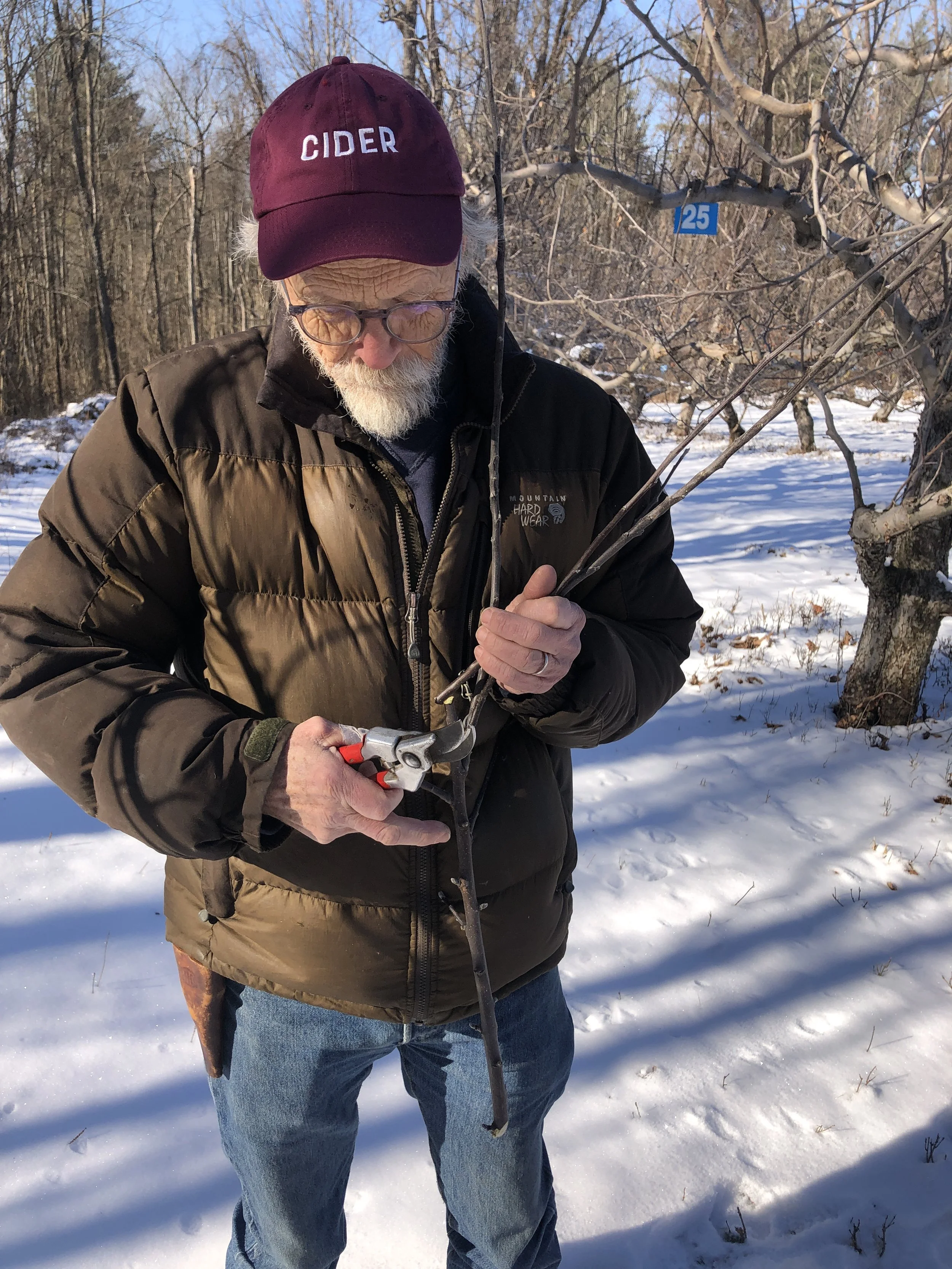
We’re into the New Year now and that means time to cut wood. We trim back the competing trees and shrubs in the orchard, we thin back the forest along the orchard edges, we prune 500 fruit trees (or so) and we collect the scionwood for this spring’s grafting. The tools are sharp. We have warm boots. Time to cut wood!

We learned last night that Bob Weir of the Grateful Dead has died. It’s fun to time-travel back to 1966 when the band was newly formed only about 5 miles from where I was a kid in Palo Alto. I remember most of my friends dismissing their music back then as not worth listening to. So I didn’t. But I was curious so on May 18, 1968 I went to an all-day, outdoor music festival of a dozen bands at the Santa Clara Co. fairgrounds. At that point the Grateful Dead had one album released and the second one—Anthem of the Sun—due out a few months later. They only played one song that afternoon but it lasted 45 minutes and changed my life forever. They swung, they improvised and they clearly had a sense of humor. They also appeared to be living in an alternate universe. I had wanted to do the same for a number of years and had been looking for the perfect portkey. I wasn’t exactly sure yet where I would find it but, I was keeping my eyes—and ears—peeled. That afternoon, listening to “Alligator” for an hour under the Sun, I found it. 

The bus came by and I got on, that’s when it all began..." Doing another apple ID with the ever-inspiring "Anthem of the Sun" always nearby.

I attended several of their concerts over the next few years, during the early days of long improvisations and small crowds. Those were amazing evenings. Eventually I mostly stopped listening. I didn’t really need to. Once you find the portkey and go, you’re all set for life.  Thanks Bobby.

January 4, 2026

Our list of 2026 scionwood offerings is now posted. If you’re a grafter or inclined in that direction, check it out. Each variety listed includes a brief description. Some are also more fully described in the varieties section of our website. All are rare or extremely so. Some are only available from us. (Is that a good thing?) If you’re looking for more common varieties (aka cultivars), check out the Fedco Trees website (fedcoseeds.com). There are also a number of other scionwood sources around the US. As far as we know, all of ours are correct. Many have been genetically profiled. Where we have questions about their authenticity, we’ve noted that in the description. If you’re looking for something exceedingly rare that you can’t find anywhere, send us an email. We might be able to find it for you.

There have been questions about hardiness, as well as disease and insect resistance. We suggest that you look for growers near you and ask them to share their experiences with you. There are so many variables that it is impossible to tell you how one of our cultivars will do in your neck of the woods (neck of the orchards?).  You just need to experiment. Spray less!

Look over the list and see if anything sounds interesting. We’ll be cutting the scionwood over the course of the next two months. We typically ship in mid-March. If you need scionwood sooner, let us know. We can probably accommodate your preference for shipping date.

December 30, 2025

As 2025 wound down, I finally got back to the rootcellar, pulled out two boxes of apples from our orchards and went through them bag by bag. Each box holds a dozen bags or so, and each bag holds about a dozen apples of a particular selection. You might think I’ve seen them all a hundred times, done all the descriptions and taken every possible apple-photo that could ever be taken. I haven’t. At least not yet. Maybe I never will. Maybe it’s an infinite process.

I do fill in a few more blanks each time I pull them out. Any new or updated information goes into my descriptive key where I can access it as I attempt to speak or write intelligently about this cultivar or that. And of course I can also use the key to do ID’s. Every year new trees fruit for the first time, or maybe they produce their first decent size crop. Or maybe it’s the first time I actually got to them before they fell to the ground and rotted!

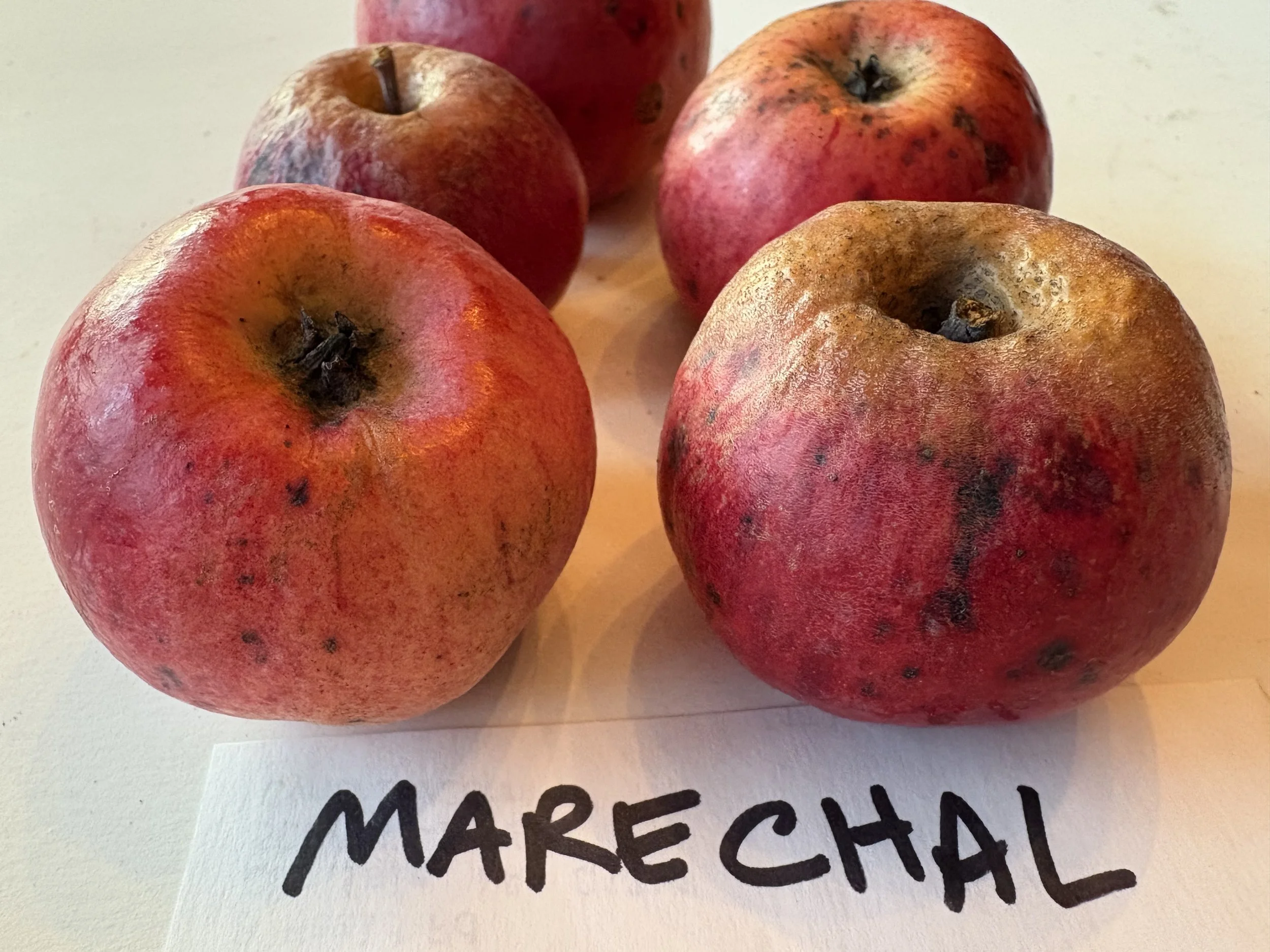
I’ll mention one in particular that I spent some time with today. It’s become a favorite. Marechal is a small-medium-sized, partly russeted, French bittersweet. For starters, it has this rather amazing patch of lumpy, bumpy russet that emerges from the cavity. I know, looks aren’t everything. In fact, they’re way overrated, but you have to start somewhere. Right? But, Marechal also has a lot going on in the inside where it really counts. Its spongy, white flesh “literally” explodes with flavor. It’s sweet, juicy, floral, perfumy and mildly bitter. It also ripens late. We pick ours a week before Halloween. That gives the apple all that much more time to develop its flavors. I think it’s a fantastic apple. 

I obtained our original Marechal (PI 589128) scionwood from the USDA ARS PGRU in Geneva NY. So far, our ten-year-old standard trees are hardy and productive. But, how does it translate into cider? Although I’ve only pressed the apples into our barrel-blends which makes it challenging to pinpoint what it contributes, I suspect it will be a great addition when we begin to get sizable crops. 

Last but not least, the apple reminds me of my favorite pitcher in the 1960’s when I was a fanatic San Francisco Giants fan. One of the best games I ever attended was on July 2, 1963 when “Juan Antonio Marichal Sánchez” (aka Juan Marichal)  and the Milwaukee Braves’ Warren Spahn both pitched 16 scoreless innings until Willie Mays hit a one-run walk-off homer to win for the Giants. My Dad and I were there! For that reason alone, all cidermakers should grow Marechal!

December 29, 2025


A Prince and a Pauper? How two good apples got mixed up

(with quotations from and apologies to Bertie Thomas Percival Barker, Liz Copas, Mark Twain, Roger Way, and everyone else.)


“A few minutes later the little Prince of Wales was garlanded with Tom's fluttering odds and ends, and the little Prince of Pauperdom was tricked out in the gaudy plumage of royalty. The two went and stood side by side before a great mirror, and lo, a miracle: there did not seem to have been any change made!” Mark Twain, The Prince and the Pauper, 1881 (or so)


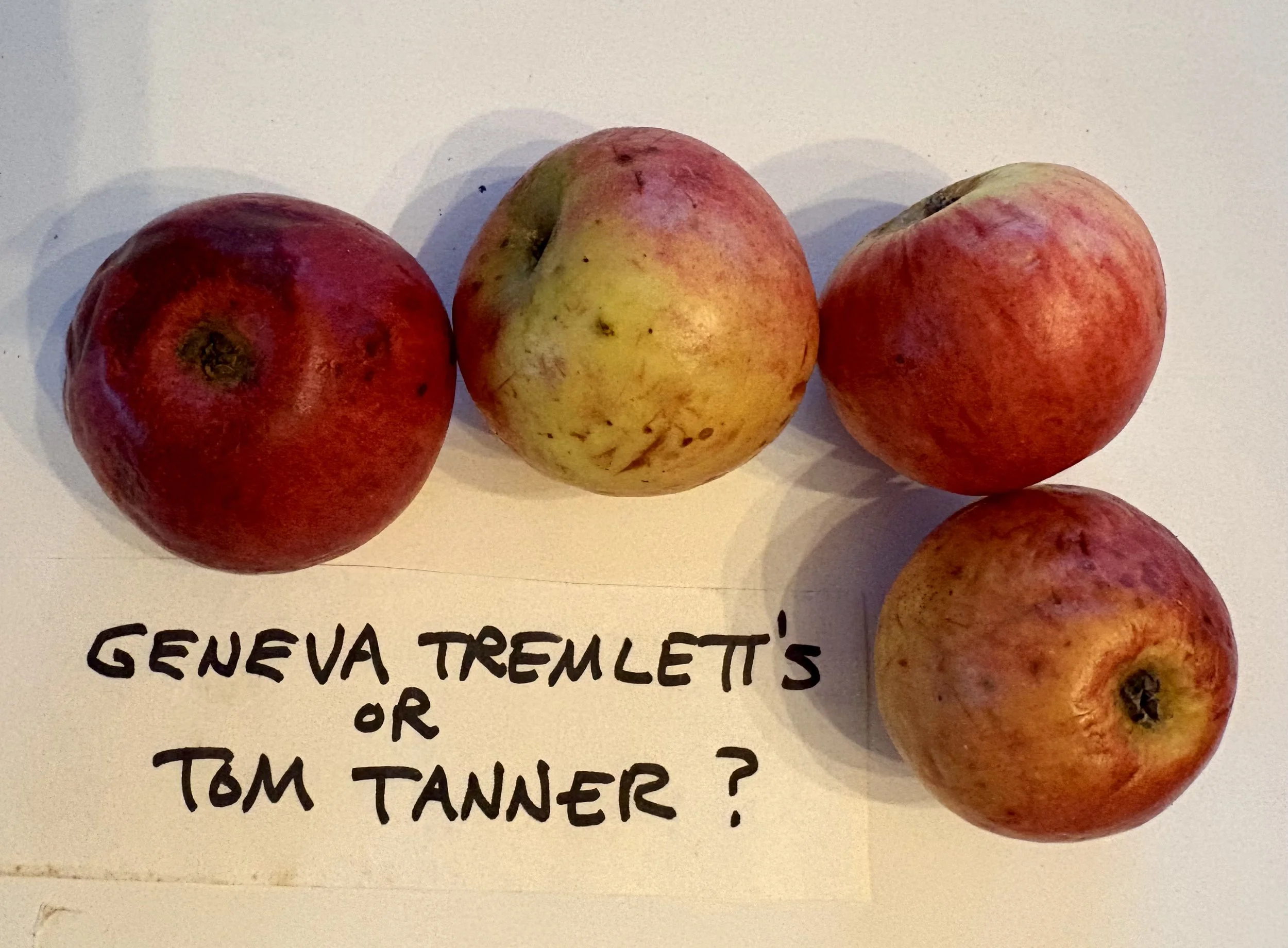
This is the story of Tom Tanners, an obscure, historic bittersharp cider apple from somewhere in the west of England. Though high in sugar and high in tannins, and coveted here and there, the apple was eschewed by the modern commercial cider powers-that-be and never made it to the big-time echelon of cider royalty, eventually slipping into obscurity, destined to be lost forever. Well, almost.

Like much about the apple, Tom Tanners’ beginnings remain a mystery. Its original name may have been Tanners Red, though we may never know that for sure. It was first recorded as Tom Tanners about a century ago at the famous Long Ashton Research Station near Bristol in the UK, having been submitted from the village of Butleigh, east of Street and south of Glastonbury. 

From the research of the modern pomologist Liz Copas, we know that after Tom Tanners was brought to Long Ashton, it was subsequently planted in various trial orchards and was included in the now extinct Whettons Museum orchard at Broxwood, Herefordshire. (Many of us in the cider world know the name Broxwood from the Broxwood Foxwhelp, a seedling of the famous “Old Foxwhelp,” itself one of the most important cider apples in the world. Maybe, the most. The mis-identification of Foxwhelp in the US is another story!) During the first half of the 20th century Tom Tanners was locally well-known in Rodney Stoke, near Wells, Somerset where it gained a reputation for its intense tannin and high sugar content. 

But as time went by and the demands of the commercial cider apple industry took precedence, Tom Tanners was pushed to back of the bus by other, more desirable cultivars such as “Michelin” (we’ll get to that), Yarlington Mill (another mix-up in the USA), Dabinett, Harry Master Masters Jersey and a few others, some correctly named and others, not so. And so, this very good cider apple was on the rusty track to oblivion—along with dozens of other worthy historic cultivars—were it not for one small error and a subsequent case of mistaken identity that appears to have saved Tom, with all his “fluttering odds and ends,” and insured his survival for generations to come.  

It all began in 1949, when the famous and beloved American pomologist Roger Darlington Way of the old New York State Fruit Testing Station in Geneva NY, in collaboration with another equally beloved pomologist, Professor B.T. P. Barker of Long Ashton, arranged to have a number of cider cultivars sent to the US to become part of Way’s test collection, a collection that was later to become the foundation of one of the most important apple collections in the world, that of the USDA ARS PGRU: The Agricultural Research Service/ Plant Genetics Resources Unit. What interested Dr. Way in cider apples, we’ll never know. The commercial cider industry in the USA had been dead for a hundred and fifty years. But, whatever the reason, we can all be thankful none the less. One of the cultivars Barker planned to send to his colleague and friend that spring was to be a highly-touted bittersweet cultivar called “Tremlett’s Bitter.” Tremlett’s Bitter— sometimes called Tremmies in parts of Devon—was a well-known and popular Devon bittersweet variety which was—and still is— commonly found throughout all the cider growing counties in both bush and standard orchards. In the cider world, it was “tricked out in the gaudy plumage of royalty.”

The fateful day came in the late winter of 1949 when it was time to cut the scionwood for the shipment to America. Clippers in hand, the trusted technician—perhaps it was B.T.P. himself—headed out into the orchard. Although no one knows for sure what happened next, someone was not paying attention. It wouldn’t have been a case of a distracting text message or cellphone call. No, the invention of the Smartphone was nearly a half-century away. And it probably wasn’t cannabis. The first pot in the UK wasn’t being rolled up in wheatstraw papers until Eric Clapton, Jeff Beck and John Lennon discovered it in 1965 (or maybe it was ’64). Was it too much cider sipping? We’ll never know. But, as it’s been done way too many time before, someone cut the wood from the wrong tree. 

The trees, as is often the case, were conveniently planted in alphabetical order, TR and TO being only a few feet apart. Alas, unbeknownst to all, Tom Tanners got cut that day instead. Oh, how easy it is to take one too many a sip from the costrel and then, oops, snip a beautiful long scion from the wrong branch! 

And so, in the late winter of 1949, lowly Tom Tanners was packaged up, signed, sealed, and delivered to Geneva NY where another technician—or perhaps it was the great Roger Way himself—innocently grafted it onto a rootstock and carefully wrote on the tag, “Tremlett’s Bitter.”

And when Tom T fruited a few years later, no one cared or even noticed that the fruit should be a true low-acid bittersweet and that this imposter was anything but. Not much of anyone was making cider anymore in the USA and who cared, anyway? Bittersweet?  Bittersharp? What’s the difference? (The last few cider-makers of the day were collecting their apples off the stone walls and down the ancient dirt roads of Maine, New Hampshire, Vermont and upstate New York.) So when Tom Tanners fruited, no one thought twice—or even once. At least, not yet. 

Fast forward fifty years. Tom lived on in disguise. All the guilty parties are to be forgiven. They weren’t cider-makers in the first place and none of them knew the English cultivars. Not only that, one stick of scionwood looks like another, especially if you aren’t out there pruning in the orchard all winter long. 

Then, as North Americans began to dabble in cider again, cidermakers began to show an interest in all the wonderful material available at the USDA ARS PGRU in Geneva, including the cider cultivars from the west country of England. And, with that interest came the ensuing revelations. 

First to get the axe was the mighty Foxwhelp. (We still haven’t figured out what the US “Fauxwhelp” really is. We may never know. But, at least it’s gone!) And then, as the dominoes tend to fall, someone asked the inevitable question about Tremlett’s Bitter. “Isn’t this supposed to be a bittersweet?”  

So the day had come when Tom was exposed for who he wasn’t. Meanwhile however, USA growers merrily continued to plant trees, press fruit and produce very acceptable cider, even a very decent single varietal. Tom Tanners was having his day though his true identity was still unknown. And, yes, it may never be.

Some suggest that the discrepancy in ripening dates rules out him being Tom Tanners, but as we know, ripening dates vary even within the states themselves. It’s true that the “Faux Tremletts” ripens earlier in the US than Tom Tanners does in Somerset, but the US fruit keeps quite well and we can still press it in mid-late October as they do in the UK. The phenotypes match quite well. The history also makes sense. Expert apple identifiers have stepped forward, thrown in their two cents (while the last cents are still around) and think they’ve made an ID. 

Yes, the guilty ones are presumably all up in orchard heaven by now, where they should be. After all, they did great things for us. And, Tom Tanners really is an excellent apple, whatever his name. Just ask the folks in Rodney Stokes, near Wells, Somerset. Or those in several old orchards along the north Dorset—south Somerset border. Or, for that matter, the US cider-makers scattered across North America.

And does the correct name matter anyway? What if it isn’t Tom Tanners? We could ask the “Michelin” growers in Herefordshire. Didn’t someone long ago say something about smelling roses by any other name? (And, by the way, who was Shakespeare, really?)

Meanwhile, we have a good bittersharp growing out in our orchard. We’ll graft a few more of them this coming spring. It’s also being grown and picked and pressed across the US. We now know it’s not Tremlett’s Bitter. It might not be the obscure historic apple called Tom Tanners. But then again, maybe it is.

“It may be history, it may be only a legend, a tradition. It may have happened, it may not have happened: but it could have happened.” Mark Twain, The Prince and the Pauper, 1881