August 16, 2026

As mentioned yesterday, farmers are looking for models to make farming work. Back when it was illegal, Cannabis was a good choice if you were willing to take the risk.
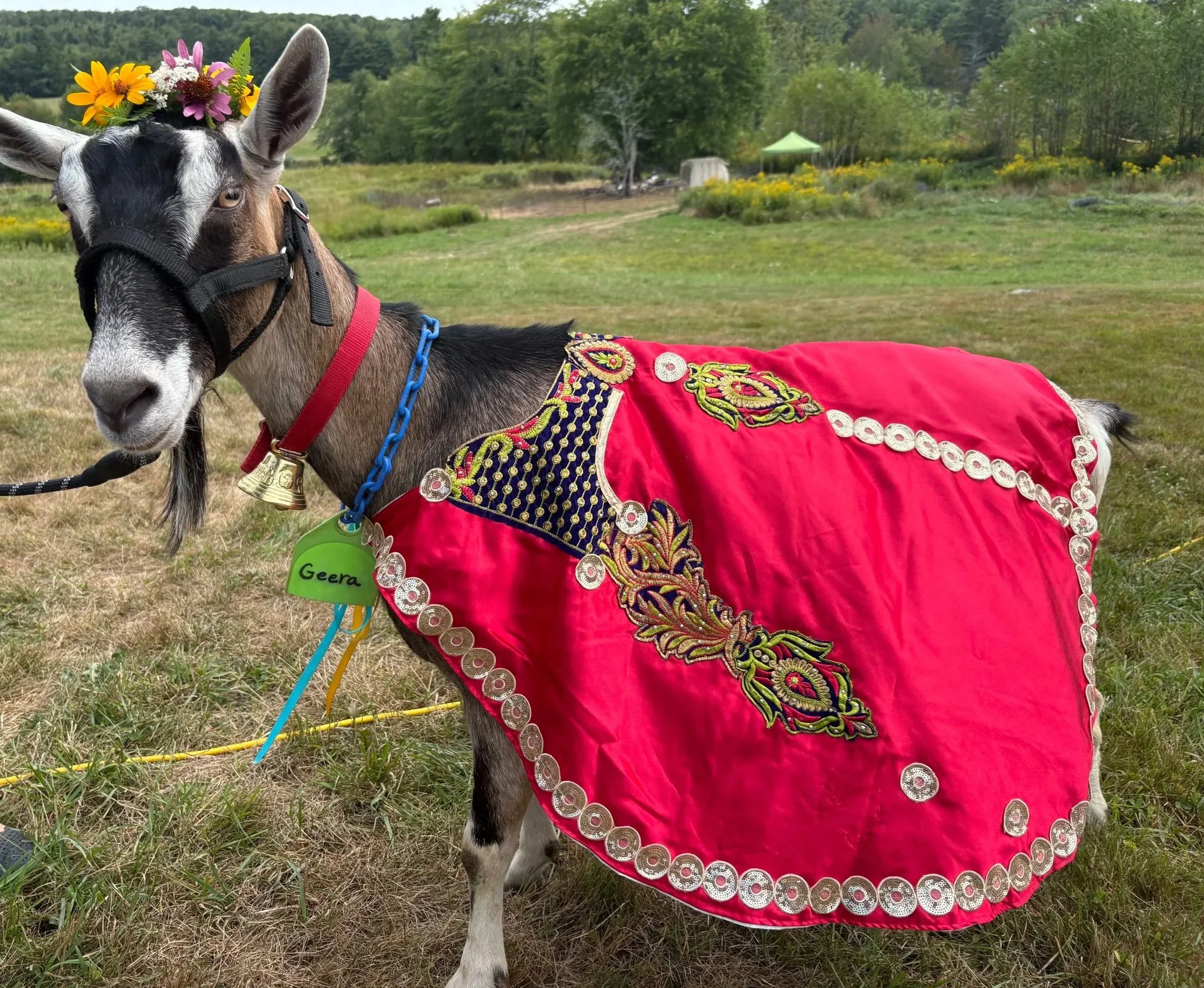
One of the winners, August 16, 2026

Pumpkin Vine Family Farm a few miles south of here in Somerville has tried a different route. They have built an impressive goat herd for milk and cheese and also (and perhaps more importantly) for community building. Today we attended their annual Goat Festival. I’m not sure who outnumbered whom, but there were goats and people everywhere. I bet there were over two hundred goats. A number of the goats were given awards and dressed up in elaborate garments and crowns. It was fun.

We had goats on the farm here a very long time ago. They are amazing creatures - lovable, loyal and delightful to the extreme. Filled with personality. They would go on walks through the woods with us and never run away. But they loved garden produce, especially fresh out of—or in—the garden. And they also loved to eat young trees, including apples.

Perhaps we’ll find a way to bring goats back to the farm. Animals are good for the farm, and the on-farm source of manure would be a big asset. They also love to eat poison ivy, and we have too much of that pesky plant in parts of the orchards.
August 15, 2026

Future farmer of America, August 15, 2026

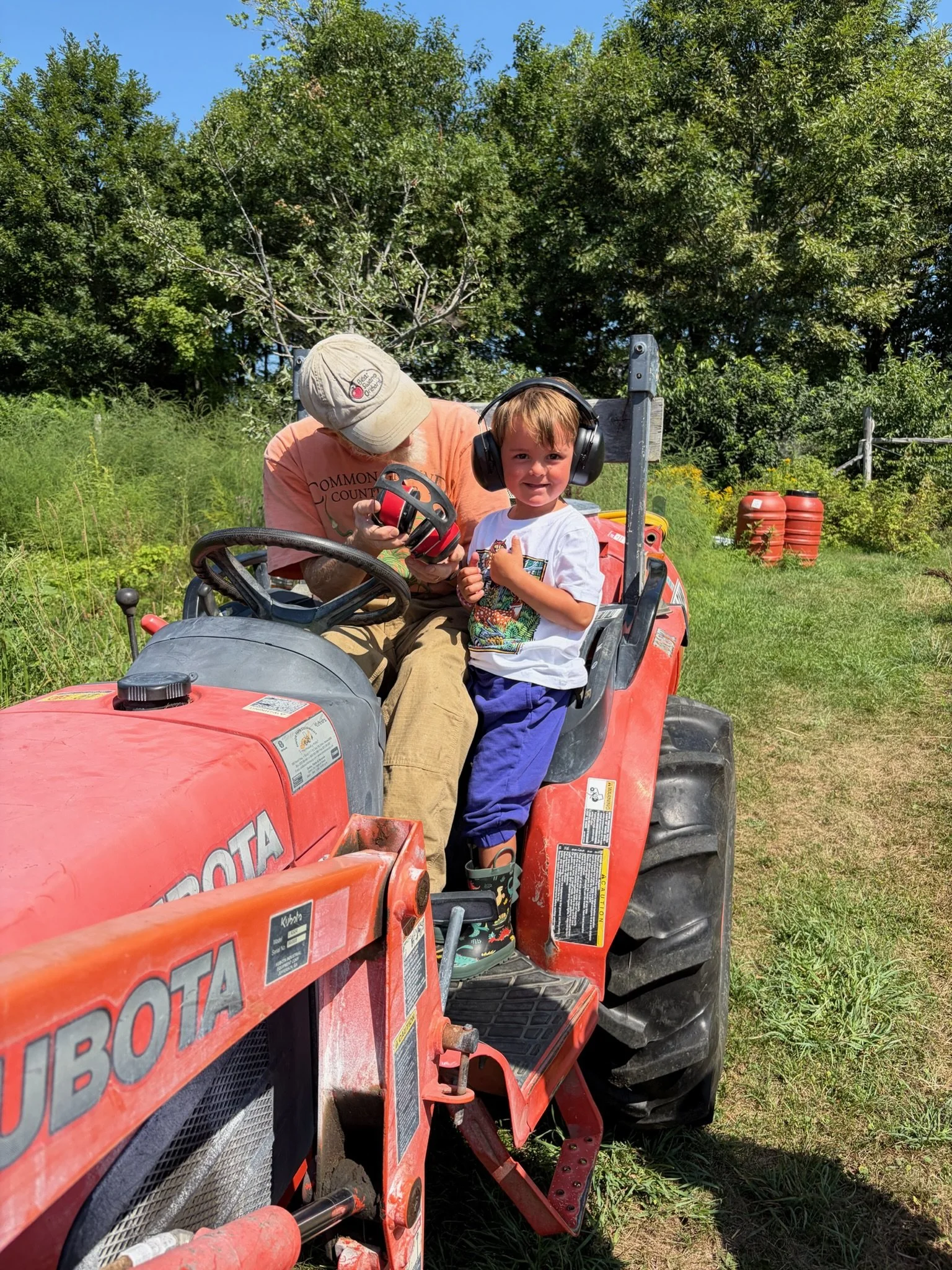
Today I toured the orchard on the tractor with two of our grandchildren. Both enjoyed the experience though Westy and I went twice around and then moved a load of manure to the compost heaps. I think he was ready to spend all day on the Kubota. In a few years when he can reach the pedals, we’ll offer him a summer job. We’ll pay him the big bucks.

Speaking of big bucks, small farms in Maine are forever exploring new ways to generate income streams. There may be legitimate reasons why small farms are not profitable, although I haven’t heard any that make sense to me. All the farmers I know work incredibly hard, and none are getting rich doing so. Is it government policy that keeps the small farmer down? Maybe. Not part of today’s report. But farmers tend to be resourceful folk and new models are getting invented all the time. Where there’s a will…

In 2006 Cammy and I met a couple from Vermont who worked farmers’ markets and offered customers Sunday dinner on their farm long before the Farm-to-Table pop-up dinners became trendy. They cooked the food they raised on their farm. There was no marketing, no website and no charge for the dinner; diners simply donated what they wanted. The couple made more money from those weekly summer dinners than from the cheese and meat they were producing. The on-farm, farm-to-table experience has since become a popular thing in Maine. Today we went to one near Belfast. The grandkids loved it, the food was good and we all had a really nice evening. They even have some old apple trees and want me to come back and identify them. Maybe we’ll trade a few ID’s for a couple of pizzas.

August 14, 2026

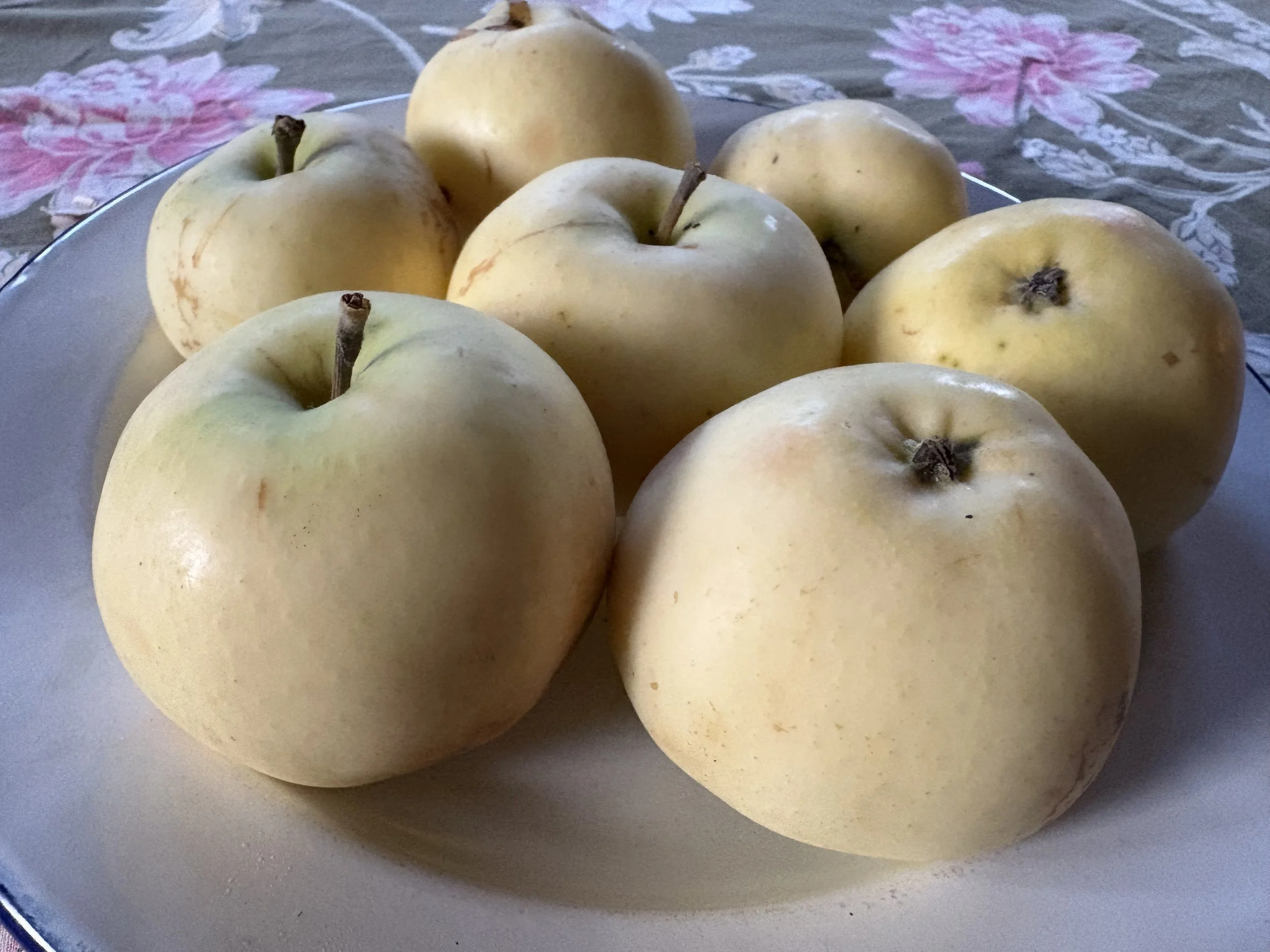
Yellow Transparent, August 14, 2026

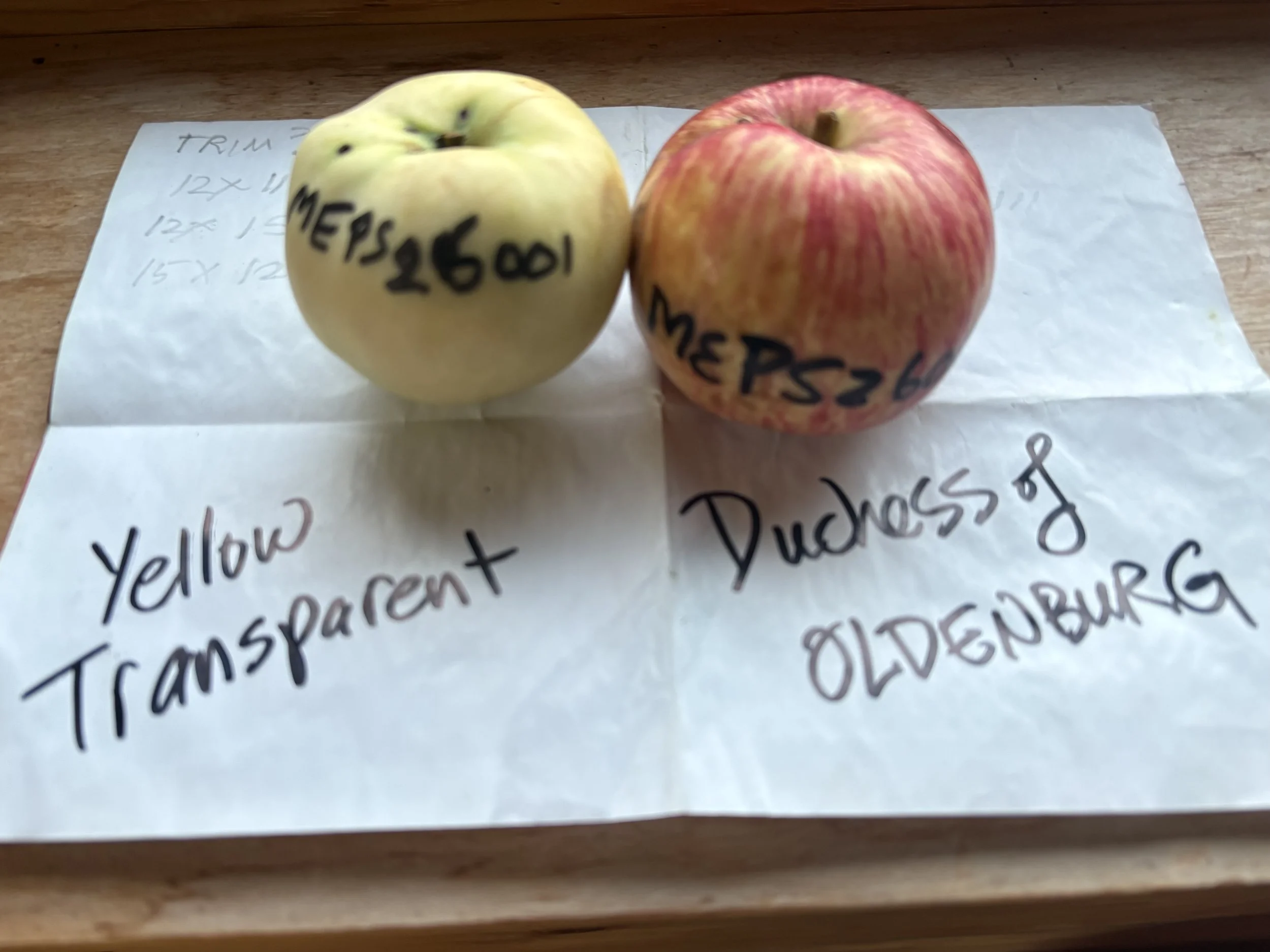
Today I picked the Yellow Transparents. The mono-chromatic faint-yellow apples are aptly named in English. The skin is practically translucent and has a porcelain shine. As far as anyone knows, Yellow Transparent originated in Russia. It was imported to the US in 1870 along with nearly 200 other hardy Russian culitvars. Bussey (Illustrated History of Apples in the US and Canada) lists two Russian synonyms: Skvosnoi Jeltui and Skwosnoi Schstoi.

The task of translating the names of the dozens of Russian cultivars proved to be nearly impossible. Charles Gibb and others did their best. In the end many of the English names were just made up. The Anglicized Russian words jeltui, jeltoe, scholti, schstoi, schaltui, are all variations on the color “yellow.” Skvosnoe, skvosnoi and skwosnoi are variations on “transparent.”

Yellow Trasparent is one of the first apples to ripen on the farm. They ripen, drop and rot all in about two or three days. We make sauce with ours. It’s tart, light yellow and… transparent. Use ‘em or lose ‘em!

August 13, 2026

I received an email from a friend today who is hoping to upgrade to a sprayer that can be attached to his tractor. No matter what you choose to spray in the orchard, it will be primarily water, and water is heavy. “Pint’s a pound…” For years I used a 5-gallon back-pack sprayer. It worked, but I spent as much time refilling the tank as I did doing the actual spraying. And all that weight didn’t do my back any good.

As I expanded the orchard, I graduated to a 50-gallon sprayer that hung on the back of the tractor. That worked well, but 50 gallons is also not a lot of spray. And the 50-gallon sprayer had no agitator. The agitator mixes up the spray as you drive which is really helpful, if not essential. You don’t want to have half the orchard sprayed with water and the other sprayed with sludge.

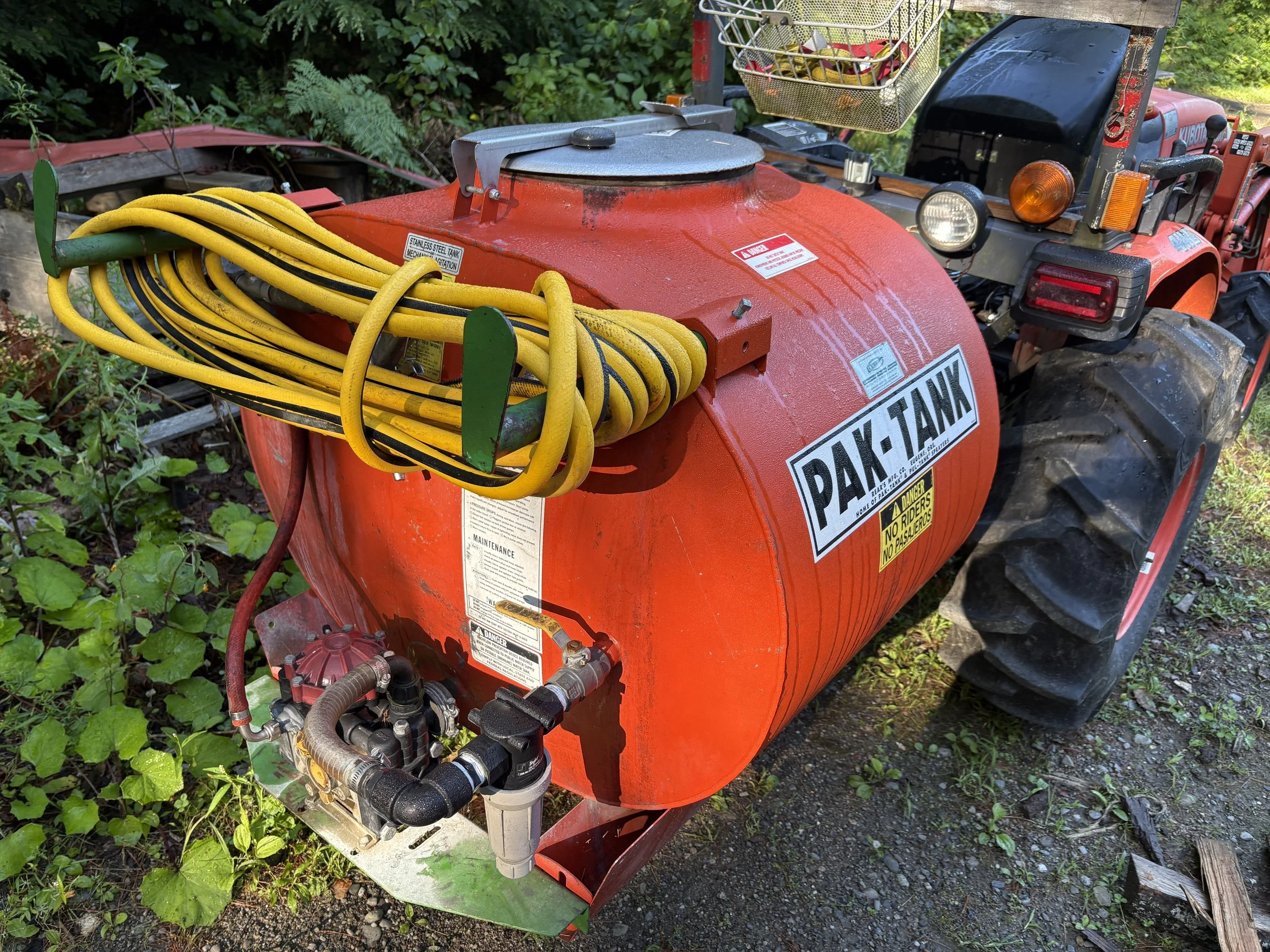
Our 100 gallon Pak-tank that hangs off the back of our Kubota B3300SU (33 HP).

So I eventually upgraded to a 100 gallon “Pak-tank” with an agitator and a hand-operated spray-gun on a long hose. I purchased it from OESCO in western MA. Although it took some getting used to as there was definitely a learning curve, the sprayer is excellent and has served us well for the past seven or eight years. The folks at OESCO are really helpful; they guided me through installation and have been always available if I panic or have questions.

August 12, 2026

Neem Oil and young apple tree

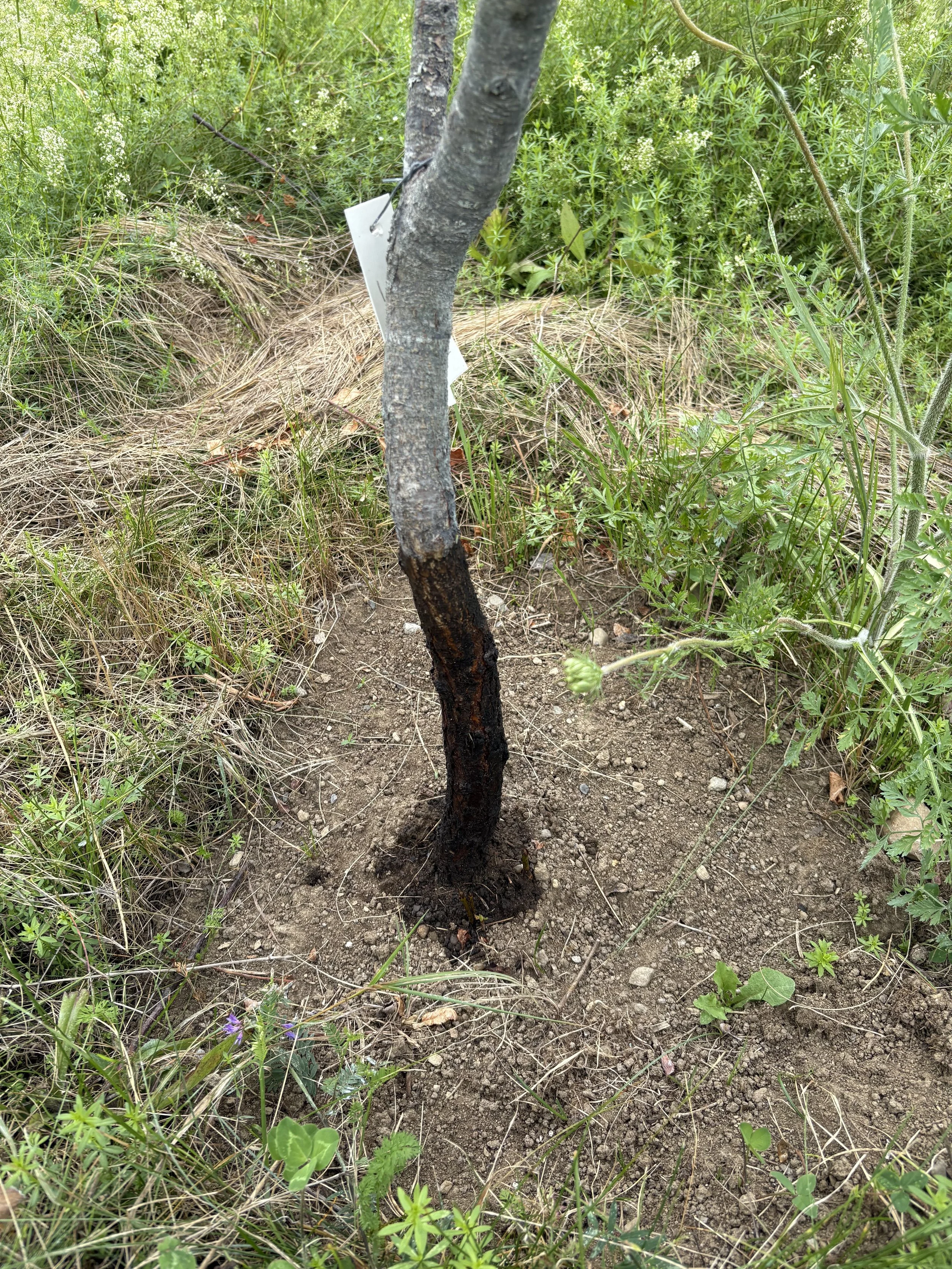
We continue to scythe around the apple trees, weed them and and paint the trunks to protect them from borers. I’ve been using Neem Oil on the trunks for several years with what seem to be good results. There has been little to no borer damage at all. But Neem turns the bark a dark, almost black, color, and I have noticed some bark damage. Could that be due to the Neem? I don’t know. But I decided it was time to experiment. So this year I’m painting different rows with one of three concoctions - a fresh manure/clay slurry mix, a manure/clay/Neem mix, and straight Neem.

I like the clay/manure option because both ingredients are available locally so I’m hoping that will provide good protection against the borers. Plus, a mix of clay and manure is said to have health-promoting and even bark-healing properties. I’ll be especially interested to see how the bark damaged trees do after being painted with manure and clay.

August 11, 2026

The rootcellar entrance

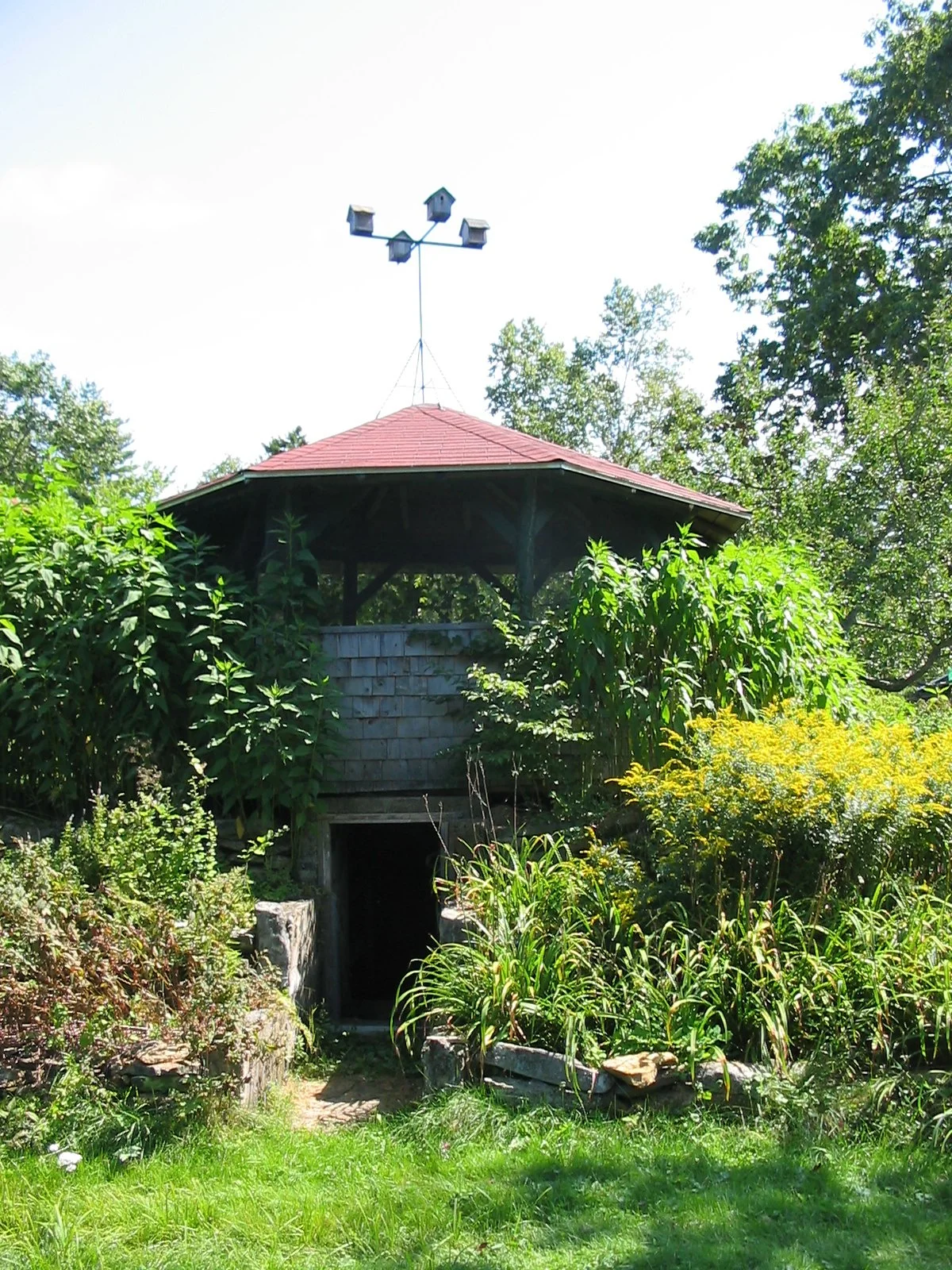
Of all the structures on the farm, which is the most important? The house? The barn? The work shop? The outhouse? The chicken coop? They’re all important for sure. But what about the rootcellar? My friends thought I’d gone nutty, when I decided to dig a pit into of the side of a small rise and build a rootcellar out of stone and cement. That was in 1978. I wanted to store as much food as possible without canning or drying or freezing. A rootcellar seemed like the perfect solution.

It was a big task. It took a lot of stone and a lot of cement and a lot of time. But despite being small (only about 8 ft x 10 ft and barely five feet high), by the following year I was convinced that the rootcellar is the most important structure on the farm. True, it would be hard to live without the other farm buildings, but the rootcellar is fantastic. We store apples, cabbage, potatoes, carrots, beets and much more down there for months. No processing. No electricity. Just earth surrounding what is essentially a rodent-proof box with high humidity and temperatures that hover just above 32F. It’s not good for squash, garlic and onions, but it’s great for a whole lot of what comes out of the garden and orchard. Fresh fruit and veggies all winter long.

We have two rootcellars on the farm. The original cellar has fallen into a state of neglect over the past five years. I’ve decided to remedy that. Today I had some time in the afternoon and decided to begin the process of cleaning it out and getting it ready for the first cold nights of Autumn. It’ll be great to see it back in action.

August 10, 2026

Throughout central Maine the porcupines are hungry. They are on the prowl now every night and sometimes during the day. They can do serious damage to a tree in one sitting. And what do they love to eat more than anything else? Their number one go-tos are the branches of apple trees that bear sweet (low-acid) apples. Not the fruit, but the branches themselves. They return to those trees in our orchards every year. They skip the trees with your typical acidic apples. Year after year after year.

How can they possibly know which trees bear sweet apples? It probably isn’t trial and error. If it was trial and error, we’d at least see some damage on assorted random trees. But we don’t. Somehow they know. This must mean that the elevated sugar content in sweet, low-acid apples must be in the branches as well. Who’d a thunk it? They also love pear trees so there’s something in the pear branches they covet too.

Sheet metal guard, August 10, 2026

Orchardists get out there and do battle with the porcys. It’s not something any of us relish. Often the death sentence is the only solution. But what a drag. After all, the porcupines have been here for a very long time. Don’t they deserve a place in the landscape? One orchardist friend told us he scoops them up into a trash can using the lid as the scooper and drives them off to some distance location. (Our orchard?)

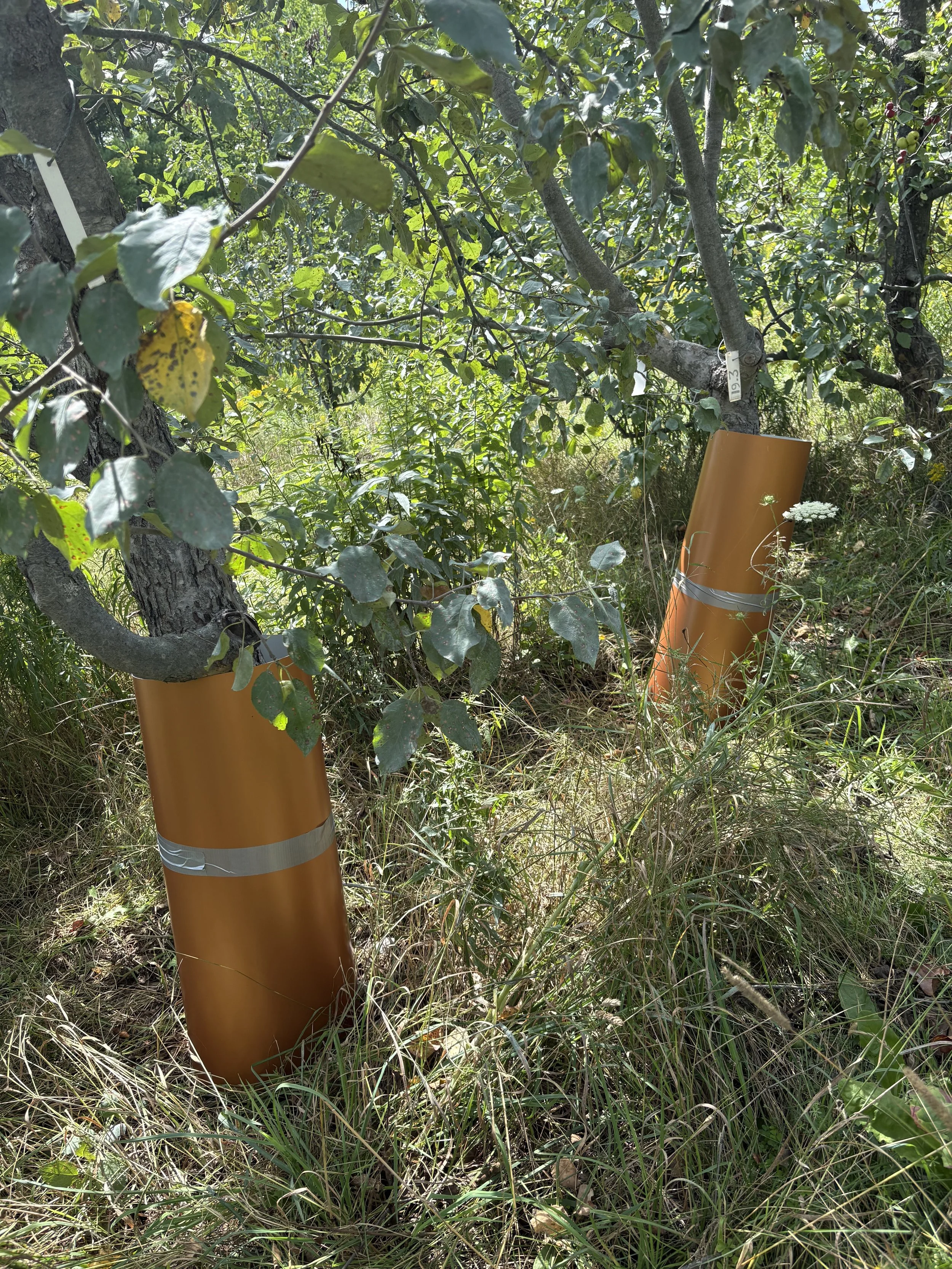
This year I’m trying sheet metal sleeves. A roofing company generously gave me a partial roll of dented sheet metal ends. Gold, no less! They even cut them up for me into random length pieces. Skylar and I wrapped the sheet metal around the trunks of our sweetest trees and secured it with duct tape. Try and get over that, you hungry porcipines.

August 9, 2026

I recently recalled a chat I had a few decades back with a homesteading friend of mine about how we organized our lives. It was long before cell phones. I don’t even think I owned a computer. We were both into making lists in little notebooks and on scraps of folded paper. “What about Sundays?” We both had special lists for Sundays. To make it to the Sunday list it had to be important, but not critical. The Sunday list was the stuff that would be really good to do but not till Sunday. The other Monday to Saturday stuff can’t wait. The Sunday stuff can wait till Sunday.

Now thirty or forty years later, I still have that Sunday list mentality. I still have those little notebooks and bits of paper. I still keep an assortment of pencils and pens scattered around the house and tucked into various pockets. My thinking is that, if I write Sunday stuff down, I can forget about it for now and do other things… on the other lists.

Eupatorium perfoliatum, August 9, 2026

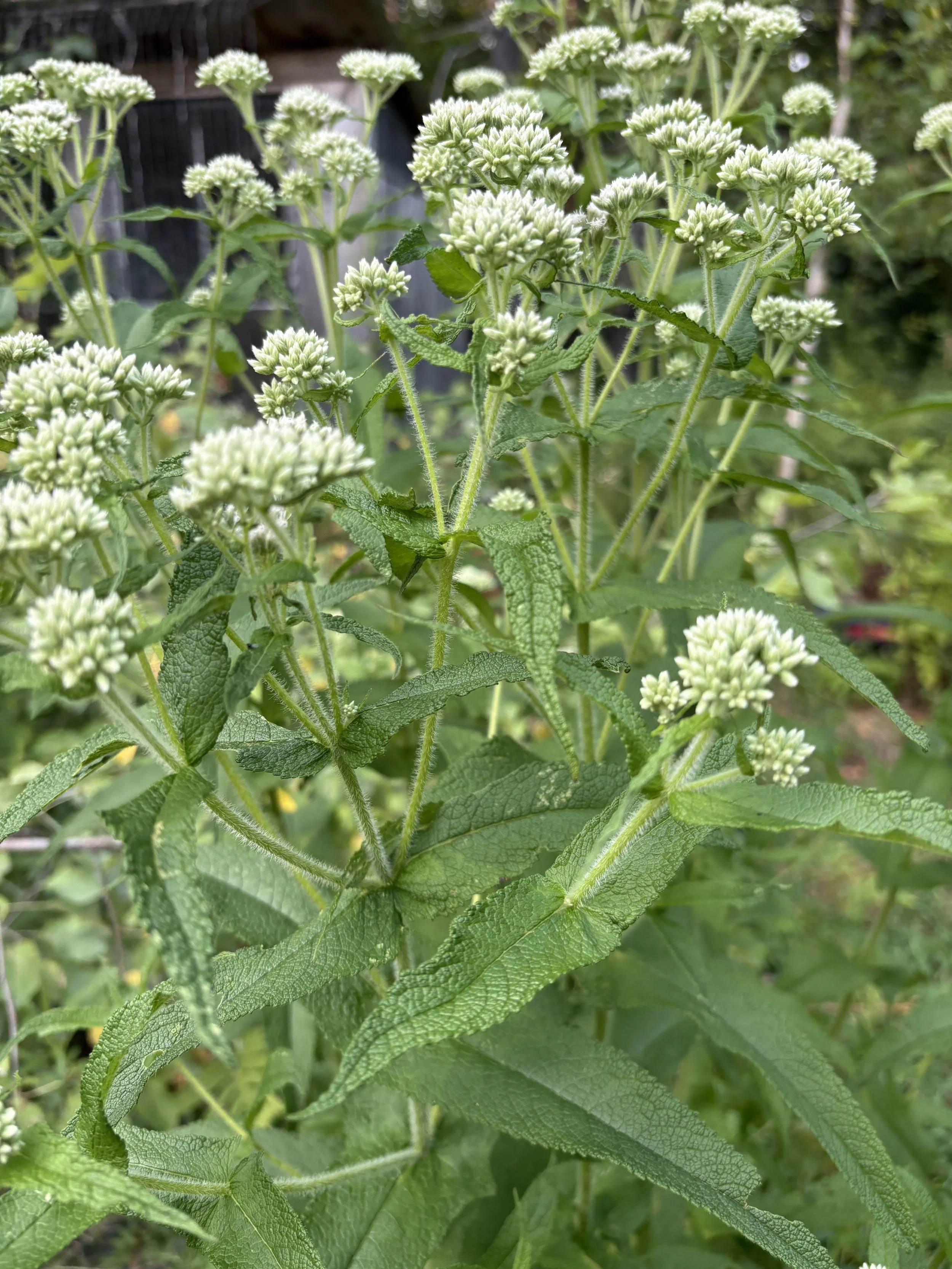
So this Sunday morning I roamed around the farm, checking out this, measuring that, cleaning up this, putting away that, and checking items off the Sunday list. So productive! In the afternoon I went out to the BRC with my trusty hand-pruners. I surveyed the blackberries and trimmed back some impressively towering canes along the paths. I cleared out around the rhubarb plants. I propped up some fruit-laden branches on the Gray Pearmain tree. I took note of what’s coming into bloom. The Boneset (Eupatorium perfoliatum) is now officially there. I did a little pruning. All of it important. None of it essential. It was Sunday. The hot afternoon floated by. And then it was 6:00. The dogs were barking. I could hear a car. Relatives had arrived. I put the Felcos back in the shop and headed for the house.

August 8, 2026

First ID’s of the season, August 8, 2026

More welcome rain today to the tune of 1.3”. That delayed the spraying of the last of the fermented teas of Nettles, Comfrey and Cannabis along with kelp and liquid Fish until mid-day. This has been the go-to spray for the past month. Overall the apples look surprisingly good despite the lack of insecticides and fungicides. Is it time for orchardists to go cold turkey?

During the rain delay, Skylar put together a template for a new apple identification system. We tried it out on our first apple ID submissions of the season. Both turned out to be classic, early-season, old favorites: Yellow Transparent and Duchess of Oldenburg.

I think the new system has great potential to streamline an enormously time-consuming process. Having the apples, addresses, tree-photos and other relevant information organized would be a huge help. The new system will be in place within the next week or so.

August 7, 2026

Hummingbird Clearwing, August 7, 2026

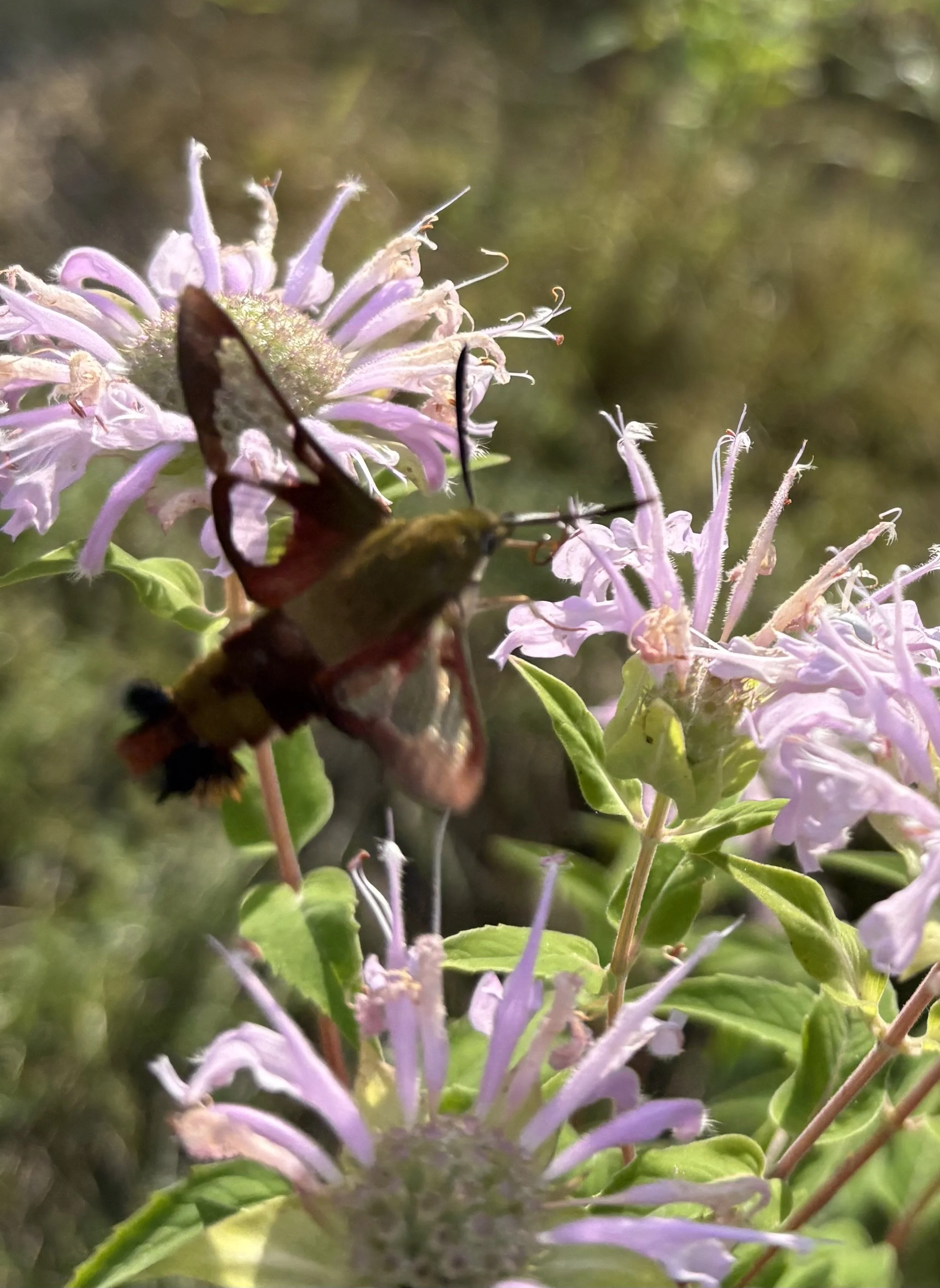
This morning the orchard was alive with hundreds of Bumble Bees and dozens of Hummingbird Clearwings (Hemaris thysbe). You may know them.They look like a really cool cross between Hummingbirds and Honey Bees. So much activity! They were feasting on the Monarda, the Golden Rod and the Queen Ann’s Lace. As I moved through the orchard, I was traveling through an ocean of flowers and bugs.

Unfortunately it is now prime feasting season for the porcupines. They love the bitter sweet apples and sweet-apple trees. One made a mess of the Fuel Service tree. They go after the branches as well as the fruit. In fact, they might like to eat branches even more than apples.

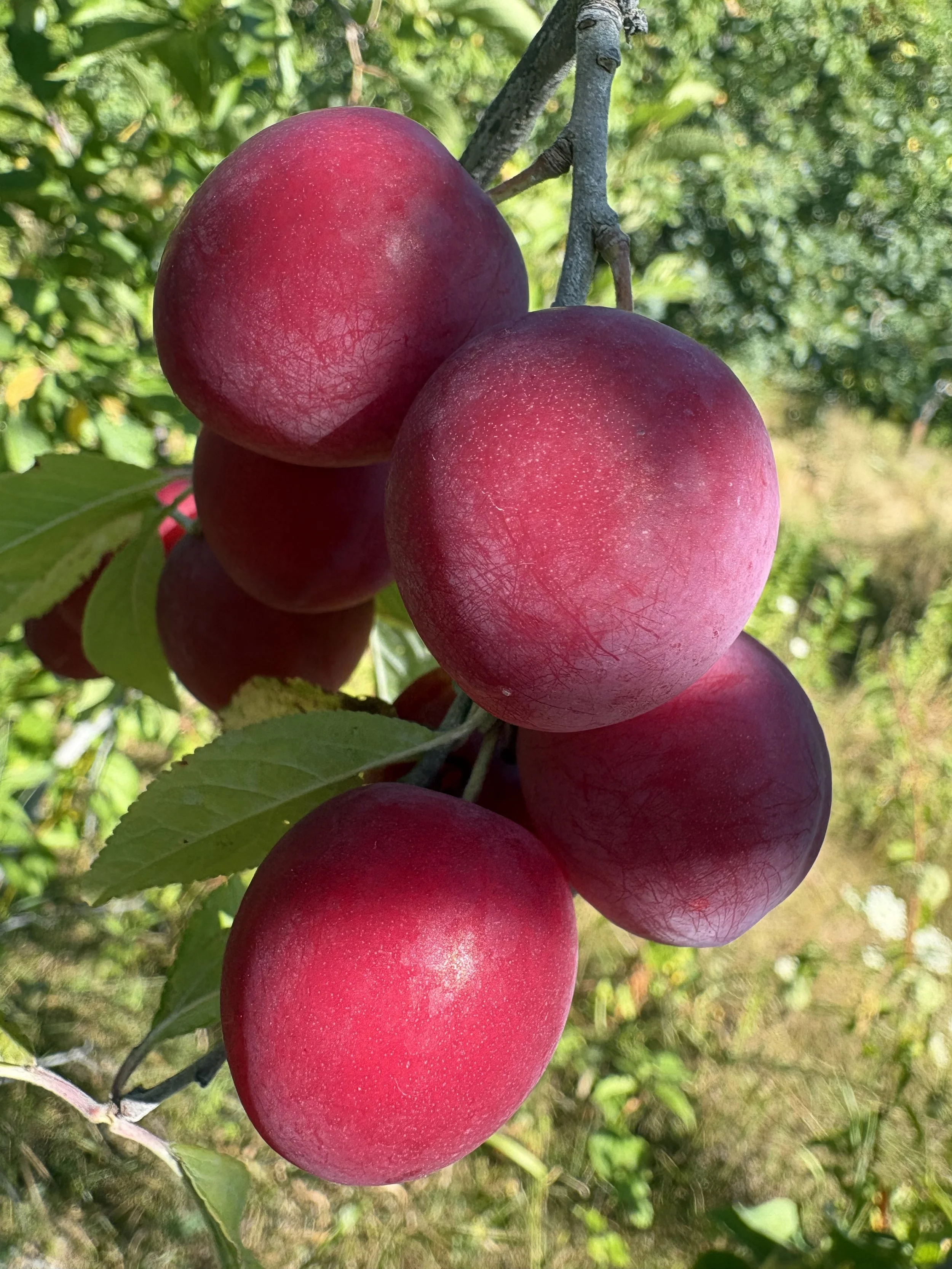
Plum season is upon us. We picked several crates of Tecumseh plums today. Better go check your plums. They may be ready.

August 5, 2026

Tecumseh Plums, August 5, 2026

With the recent rain everything has put on a growth spurt. Especially the vegetables. Today we ate our first corn of the season. Tomatoes are not too far behind.

In the orchard the plums will begin to ripen within the next few days. The Tecumseh’s are becoming slightly soft to the touch. If you have plums, go check them out ASAP. You don’t want to miss even one of them.

The Golden Rod is approaching full bloom. The milkweed pods are forming. Bee Balm is peaking. Today was nearly wind-less. The temperature was perfect and the conditions only improved as the afternoon turned into evening. Even for tor those who love every month of the year, August is hard to beat.

August 4, 2026

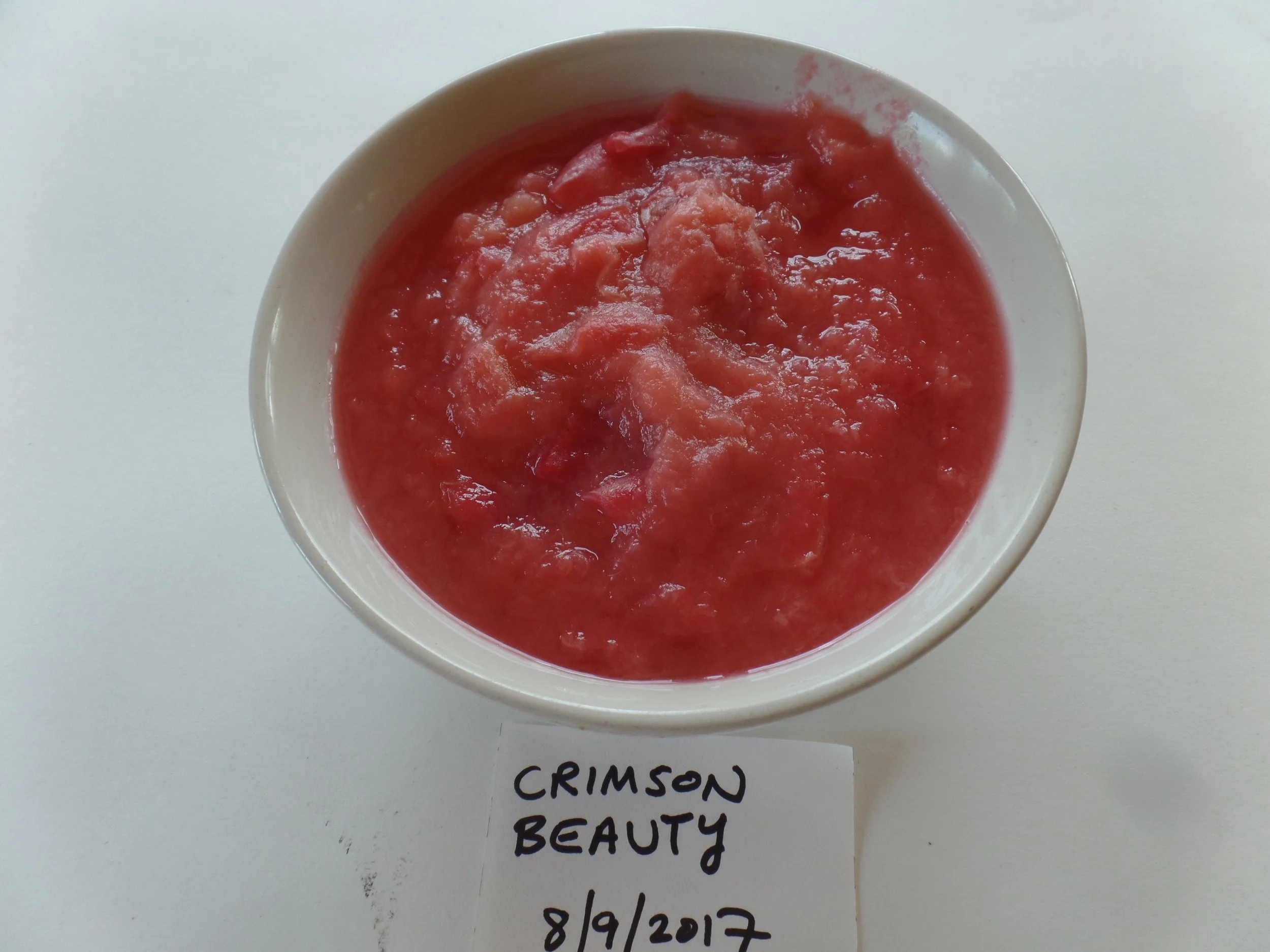
The first apple cultivars are ripening in Maine. Crimson Beauty is typically the first, usually on July 30. It’s tart, very good for cooking, and the skin is a… beautiful, crimson-red. (Surprise!) It cooks up into an orange-pink, thick, tart, creamy sauce in about 6 minutes. I grew Crimson Beauty for many years, but I only had it on one branch. Eventually it was overwhelmed by the other cultivars on the tree, and reluctantly I cut it off. I do have it saved over at the Maine Heritage Orchard.

Crimson Beauty was selected and introduced by Francis Peabody Sharp in about 1880. Sometimes it was distributed as “Early Red Bird.” It was thought to be a cross between Fameuse and New Brunswicker. Recent DNA profiling indicates that one parent is Duchess of Oldenburg and the other parent is unknown. F.P. Sharp was the New Brunswick breeder who introduced and popularized Russian cultivars—and his own introductions—to Maine and the rest of the US.

If you live up North and you’re looking for the earliest ripening apple, Crimson Beauty may be the one for you.

August 3, 2026

It finally rained. It began last night and rained off and on most of today. The final total was nearly 3/4”. Not the two inches we need, but it was the best rain we’ve had in weeks, and as much as we had in all of July put together.

This rainy day was the perfect time to complete a review of the apples still remaining in the root cellar. In case you’re wondering, most are long gone. Here are some of Skylar’s impressions:

“Apples are mostly all way past their prime, even if they are edible. Many of these apples have exceptional storage capacity although most of the fruit have a ‘root cellar must,’ which is mostly isolated to the skin of the apple. It isn’t something that can be tasted in the flesh of the apples . The apples have gotten more dry, mealy, or soft. Moisture has been lost, and sugars, starches, and other compounds have broken down. As a general rule, acidity has declined a lot, astringency too, bitterness lingers, as well as sweetness to some extent. Volatiles also seem to have broken apart and declined to a great extent. Some new aromas from fermentation, rot, and the storage environment have taken their place.”

Tozette Russet

This year’s storage-apple-winner might have to be Tozette Russet (aka GR2), the ancient Golden Russet-type we’ve found in multiple mid-coast locations but have still not identified: “quite sweet, major wrinkly, honey-ish”. It won’t be long before we’ll be eating the first of this summer’s apples!


August 1, 2026

Up at 5:30. Mixed the tank at 6:00, Sprayed the second half of the orchards with fish, kelp and fermented herbs. It takes almost exactly two 100-gallon tanks to do all the orchards. Sometimes (like today) we finish up the tank exactly on the last tree. How does that happen?

Later in the morning a massive cloud of bees swarmed at Finley. Marc and I rushed up and with Skylar’s help we were able to guide the thousands of bees into a cardboard box. Another colony for the orchard.

In the evening I took the big trek down to Portland to the beautiful Merrill Auditorium to attend a concert of the 86-year-old Herbie Hancock. I’m not all that familiar with his music, but our former apprentice, Nick Libby, invited me to join him. I was not disappointed. The five-member band did not hold back. They were cooking! It was sort of a cross between George Clinton and Sun Ra. Chaos with a great beat. Sometimes outright wild. Right up my alley.

“Double Dare” (drawing by Abbott Meader)

I was once again reminded of what Marion McPartland told our film-maker friend Huey about the four points of great jazz: play in any key, improvise, swing, and have a sense of humor. Hancock and his band were spot on all four. Herbie himself introduced a number of the tunes. He was thoughtful, charming, gentle and occasionally even silly. At one point he quoted Wayne Shorter’s definition of jazz: “I dare you.” Sounds like our definition of orcharding.

July 31, 2026

Another spray of my “patented blend” of fish, kelp and fermented herbs in the orchard. Boy, does it reek. For the time being I’ve resisted the pull to spray any manufactured pesticides or fungicides. The fruit quality is looking good so far (fingers crossed) ,and the Apple Maggot Fly traps are showing only a few catches. Maybe the population of “AMF” will remain below the spray threshold. Maybe spraying fermented herbs is helpful.

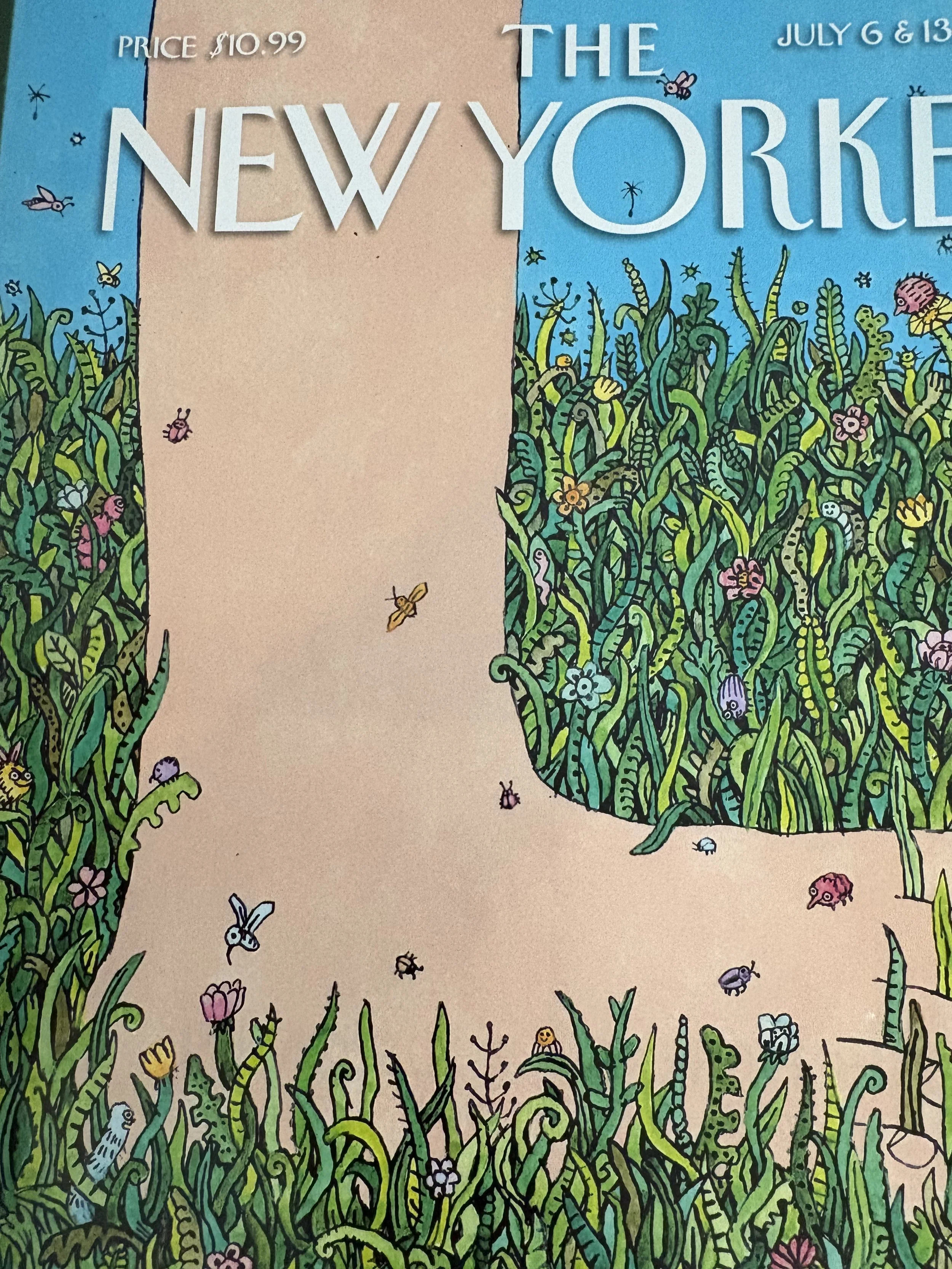
One of my goals is to maximize the insects, beetles, bugs and bees in the orchard. A recent “New Yorker” cover says it all. It’s a drawing of a foot in the grass covered with lots of small, happy, winged, multi-legged creatures. Let’s bring back the happy bugs.

Meanwhile the bee balm (Monarda) has nearly reached full bloom. There are thousands of plants flowering throughout the orchards. Amazing.

July 30, 2026

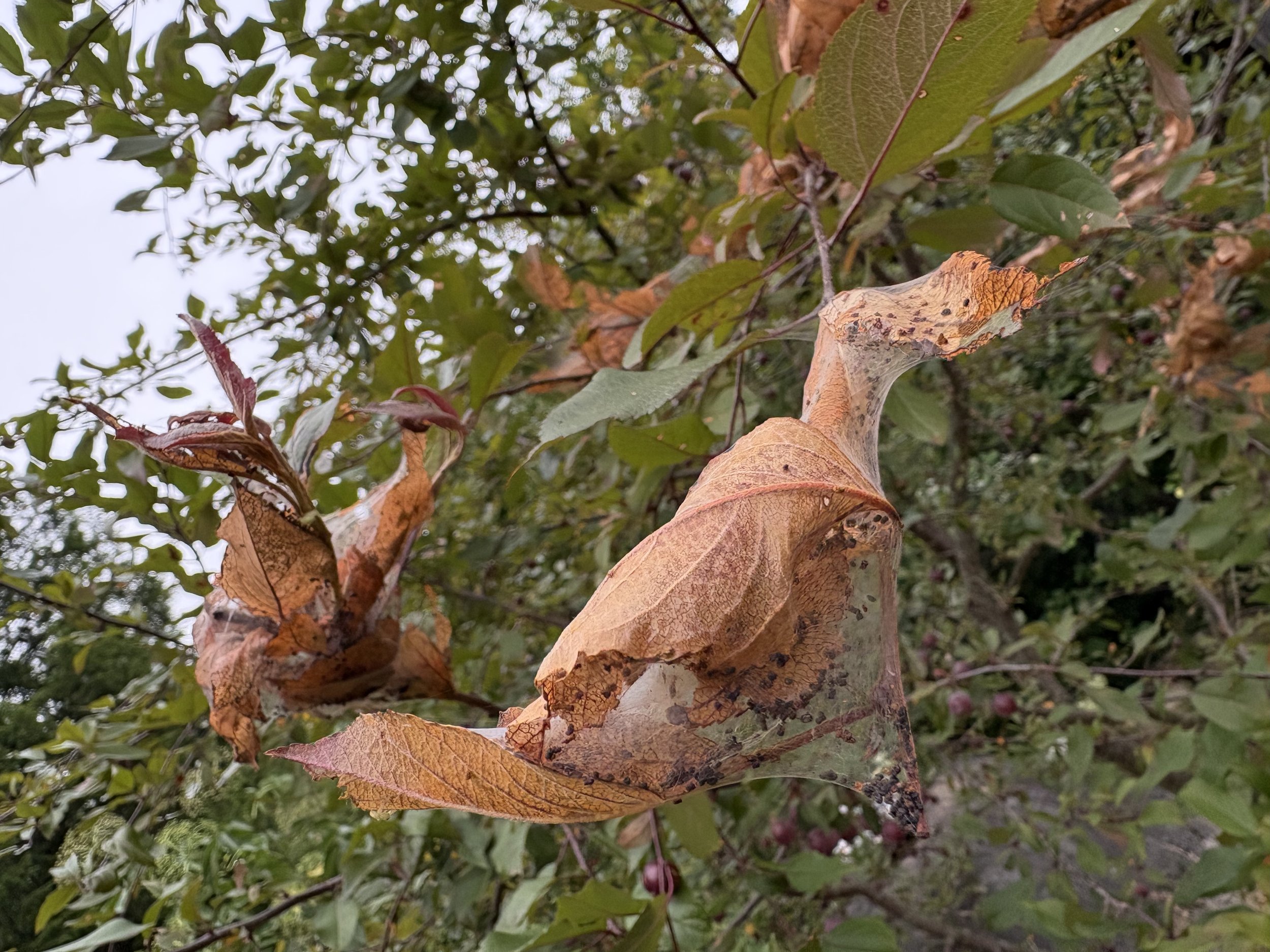
The fall webworm caterpillars (Hyphantria cunea) are back for their annual mid-summer sojourn in central Maine. We have a healthy crop this year. There’s a good chance you do too. Their webs are unsightly to some eyes, but they rarely do enough damage to put the life of an apple tree in danger.

Webworm, July 30, 2026

If you do want to be rid of the pesky creatures, you have an assortment of choices. You can pick them off. Tedious but it does work. You can do as my father-in-law used to do 60 years ago. According to Cammy, he would dip a rag in kerosine, attach it to a bamboo pole, light it up and burn them out. It worked, but it’s not the safest technique in a drought. You can spray Dipel (Bacillus thuringiensis), a relatively benign but effective organic spray that kills the caterpillars. You can also ignore them and allow them to eat the foliage off a few branches on your favorite trees. Meanwhile they provide food for various birds and insects. I mostly let them be, though this year I might spray Dipel to knock them back. Time will tell. 

July 29, 2026

We’re about a month into Summer. Shorts, bare feet, T-shirts. We’re eating almost entirely out of gardens. The berries and vegetables are piling up. With the exception of a few days earlier this month, we haven’t had the heat but that may come. I can remember summers when July was quite cool, but August more than made up for it, and we swam nearly every day. We can be thankful we’re not in France or Spain or Arizona where it was 109F today. We’ll take Maine.

For the past week Skylar’s dad, Wayne, has been visiting. It’s been a pleasure to have him here. He helped out wherever he could and never complained. He was here a year ago, and we hope it becomes an annual tradition. Thank you Wayne!

July 28, 2026

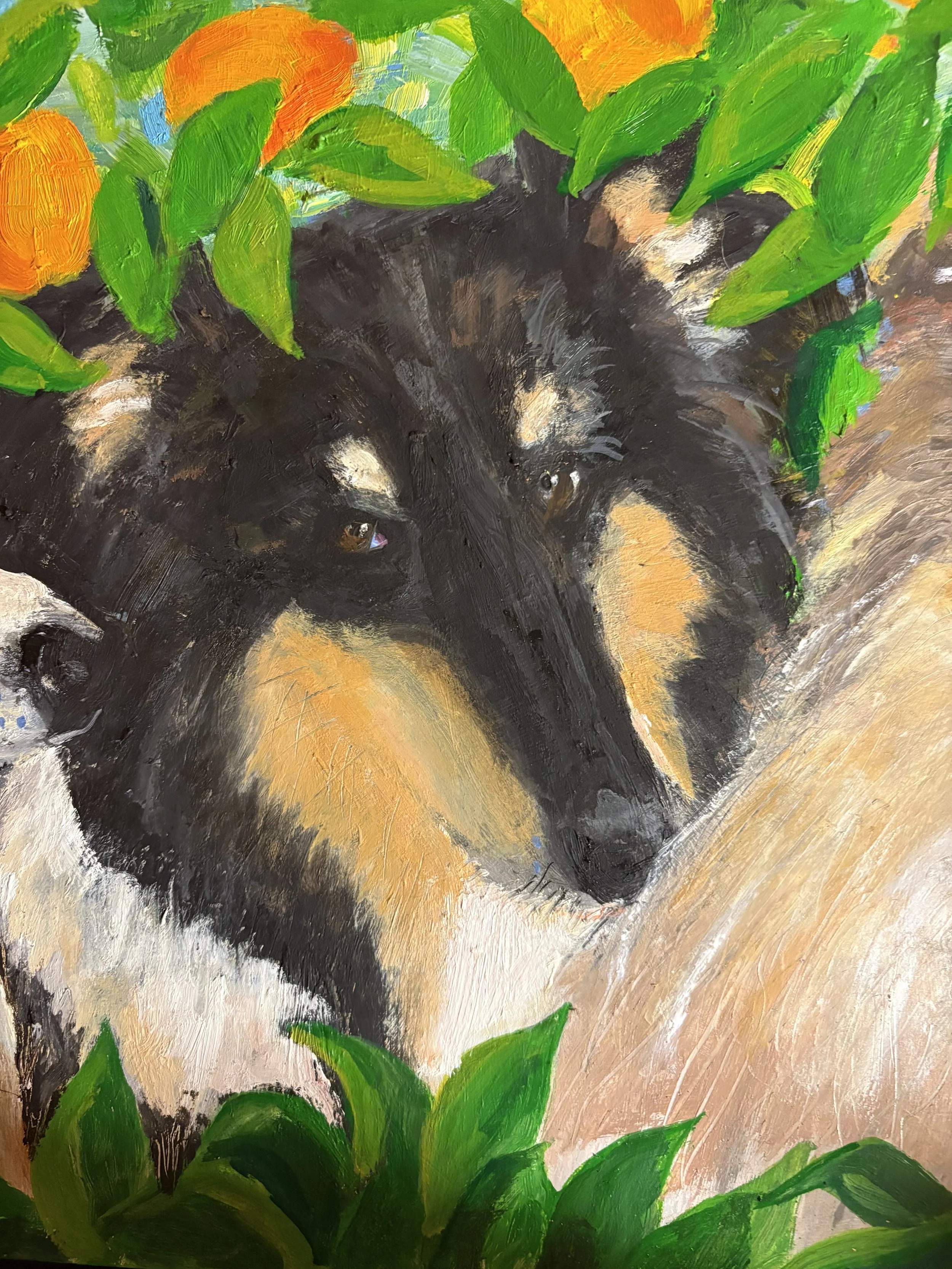
For the past thirty years we’ve have collies here on the farm. What fantastic dogs; they’re fun and friendly and wonderful. They’re a veritable canine fence around the orchard. They bark away the deer and the bear and the raccoons and whoever else might be contemplating a dinner of apples or apple trees. You can hear them out in the orchard at night barking, “Don’t even think about it!” They love to be outdoors 24-7-365 (although they rarely object to an open door policy, especially when it’s 20F and raining.) They’re the ultimate welcoming committee. They don’t bite your friends or neighbors orthe UPS guy.

On the delta-side, they may bark a lot. For us, that’s a good thing—it’s their job, but it can be an issue if you don’t have lots of space and the neighbors are close by. They shed. As the welcoming committee, they love to race out to meet incoming vehicles. That makes them potential car-chasers. They can get into porcupines (a bummer.)

The world’s greatest orchard dog

Why do I mention this? Friends just told us about a 5-year-old tricolored male collie looking for a home. His people died recently, and he’s in the market for a new orchard to look after. His name is Rex. We met him today, and he seems affectionate and bright. He’s from the same litter as the two collies we have living here. If you know someone (you?) who might be interested in adopting one of the world’s best dogs, please be in touch with us today. You probably need a collie in your orchard.


July 27, 2026

It ain’t gonna rain no more no more
It ain’t gonna rain no more
How in the heck can I wash my neck
If it ain’t gonna rain no more

It's dry in central Maine. We need rain. They say it’s coming later in the week. The plants will be happy. Us too. Our newly planted trees are starting to look droopy. Some worse than others, but all are suffering. After a full year in the orchard, they’ll typically do quite well on their own, but the first summer can be rough. They need a lot of rain or else regular gifts from a bucket or a hose.

One of the first plants to show the signs of drought are the blackberries. This could be because the vigorous first year “primocanes” put on so much growth they require a lot of water. The plants are so incredibly rugged, you’d think they could handle anything, but that’s not the case. They need water. Ours are now showing signs of thirst. They’re drooping.

So today I filled buckets and watered our new trees and companion plants out in the BRC. Tomorrow I’ll water the new row of trees up at Finley. If you planted apple trees this spring, go water them today. That’s an order. Your trees will thank you.

July 26, 2026

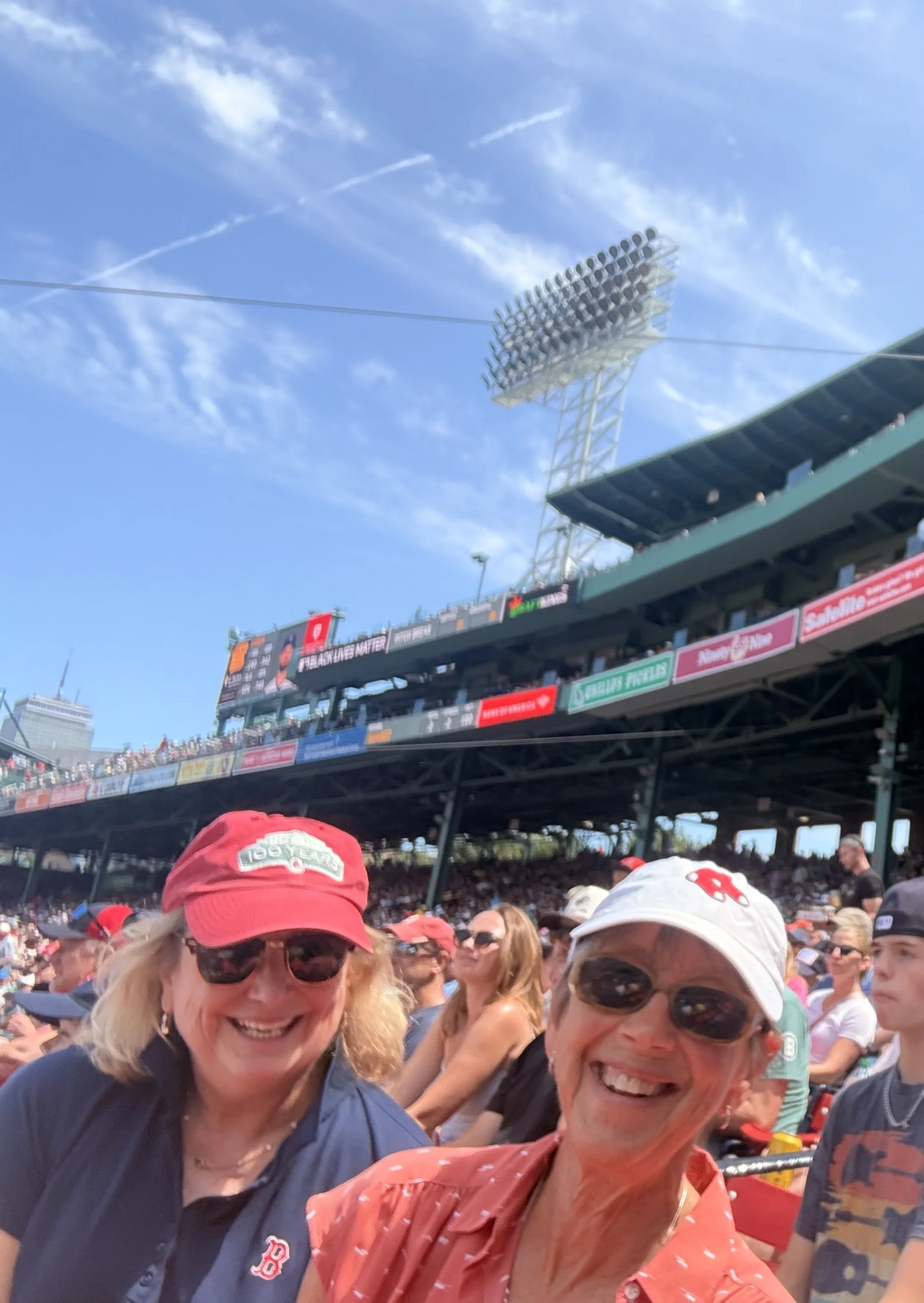
Before heading back to the farm we detoured to Boston and attended the Red Sox win over Toronto with Andy and Bill. In case your not a Sad Rox fan, they went from being worse than the worst team in baseball (is that possible?) to being better than the best (equally impossible). They were so bad, I almost stopped listening. (Well, not really.)

What does baseball—or Fenway Park for that matter—have anything to do with farming? First off, the only place in The Universe greener than the orchard up at Finley Lane is Fenway Park. The grass and The Wall are so green, a farmer could even feel right at home.

Secondly, watching baseball is like watching plants grow. You could swear that nothing’s happening. But don’t kid yourself, a lot is. You think there’s no apples on your Blake or Black Oxford or Sidrunkollane Talioun tree. But look again. You just might come back a few days later and—like magic—a whole bunch of apples have appeared. And then a week later and they’re the size of ping pong balls. Before long, you’re up on a ladder picking.

It’s like that with baseball too. You think nothing’s happening. You get bored and start gazing at the advertisement billboards or the Citgo Sign (which has been taken down for some reason) or the people in the next seats who are drinking too much beer and, oops, you just missed a three-run homer. Darn.

Whether you’re at Fenway Park or out in the orchard, pay attention. You just might miss the Goldfinch that flew by. Or the Monarch feeding on the milkweed. Or the Monarda flowers or the first apples on the Radar Love tree or that wall-ball double that just knocked in two runs. Sure, there’s instant reply on the Jumbotron. But nothing beats the real thing.