October 5, 2026

We had some version of rain this morning. It didn’t add up to much, but it was enough to keep me inside for the morning doing identifications. I was able to solve a few mysteries (always satisfying), but I’ve got many dozens ahead of us yet to go. At this point Skylar is keeping track of the requests, and I’m doing the actual staring at apples. That will change over time. Skylar can already ID many of the submissions, and as the data gets organized, we can both focus on the ID’s. It’s a huge undertaking, and one that will likely take us right through until spring.
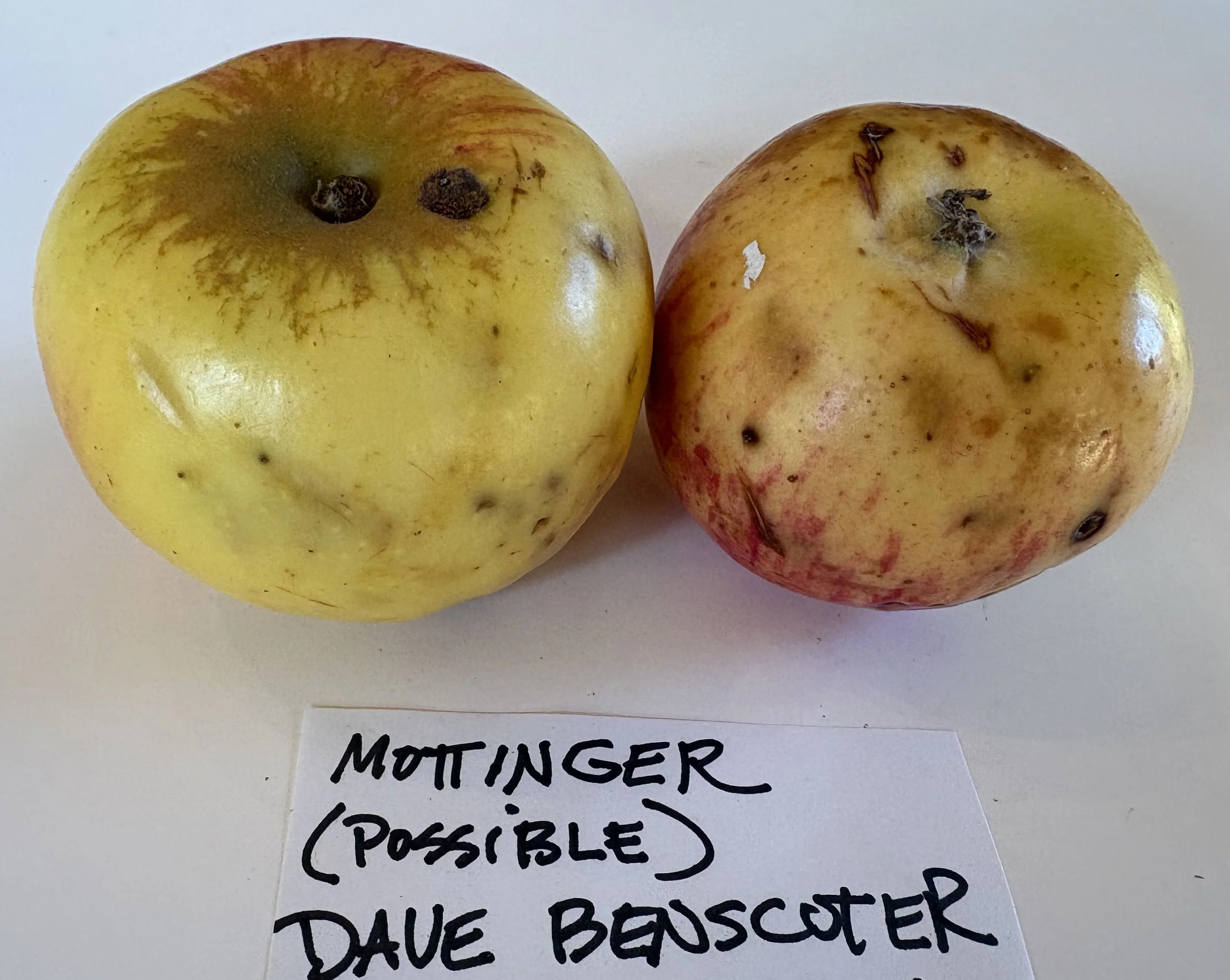
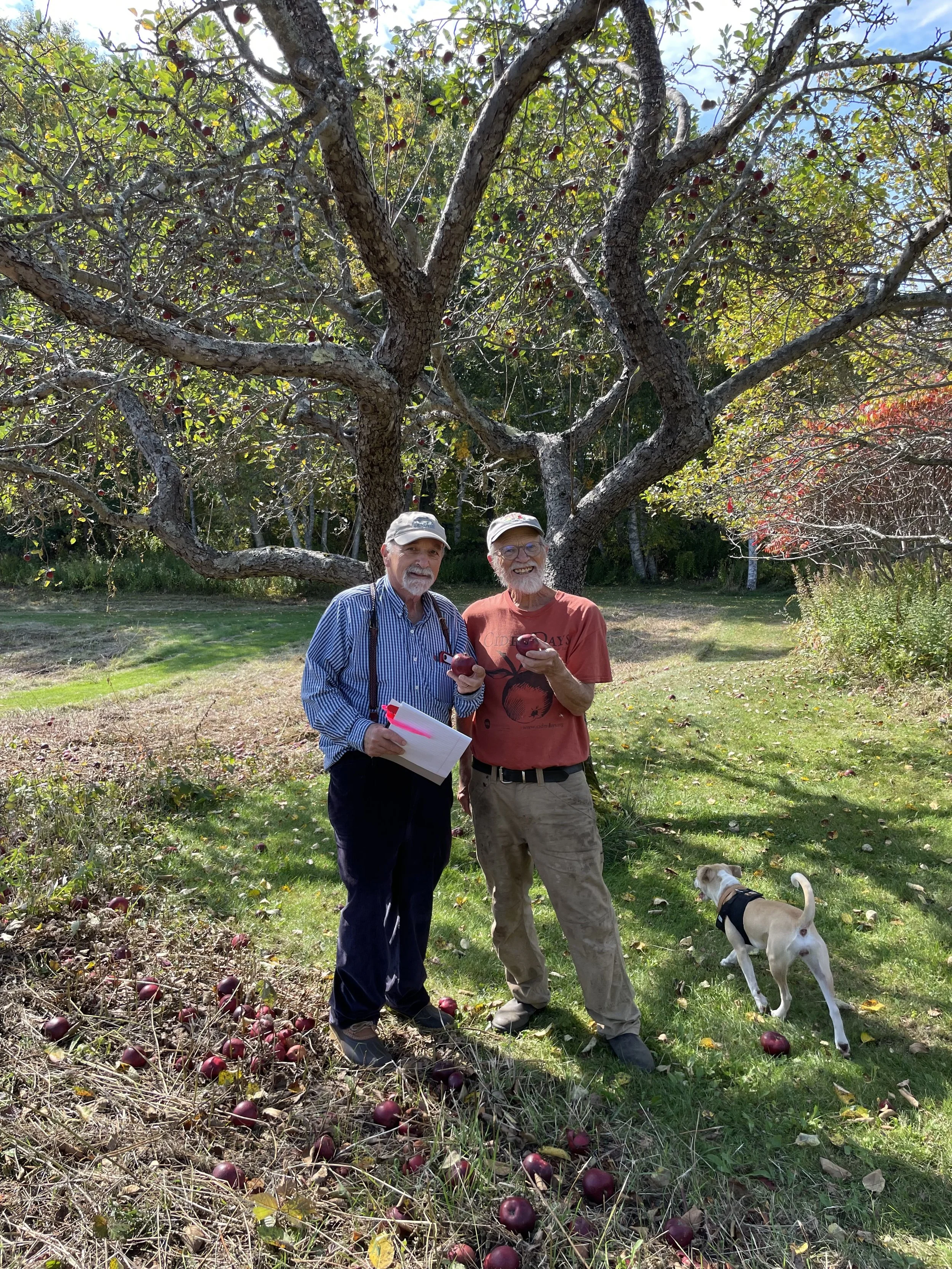
One apple we looked at this morning a possible Stevens Gilliflower from Sweden, ME. That would be an incredible find. It has been long presumed extinct. Another was from western Washington state, submitted by Dave Benscoter, the retired FBI agent who has become a good friend. (Always good to have those guys on your side.) Dave was told about a cultivar thought to be the “Mottinger” apple and wanted my thoughts. In July he had received a email from a friend, “She has specific memories about growing up with a Mottinger apple at the family home near Fredrickson, WA (near Lakewood).” That led him to the granddaughter who wrote, “The tree is essentially abandoned. My grandparents passed away about 30 years ago, the farm was sold, and the older gentleman who bought it had no interest in the orchard and let it completely overgrow. My brother has spoken with and visited the man a few times, and he is supportive of our efforts. The tree has not been cared for at all. Of interest, there are several other apple, pear and plum trees throughout the property, many are likely lost, but the Mottinger still stands and did produce some fruit last summer.” 

This is the type of ID that involves family lore, local history, descriptions from old regional nursery catalogs, ancient trees and the hope that no one cuts down the tree before we can save a few sticks of scionwood. The mystery. The story. The history. The pieces of the puzzle. Sometimes they all come together. Like this morning - I felt convinced that another old apple had been found.
October 4, 2026

Orange and Green, October 4, 2026

I love orange and green. 

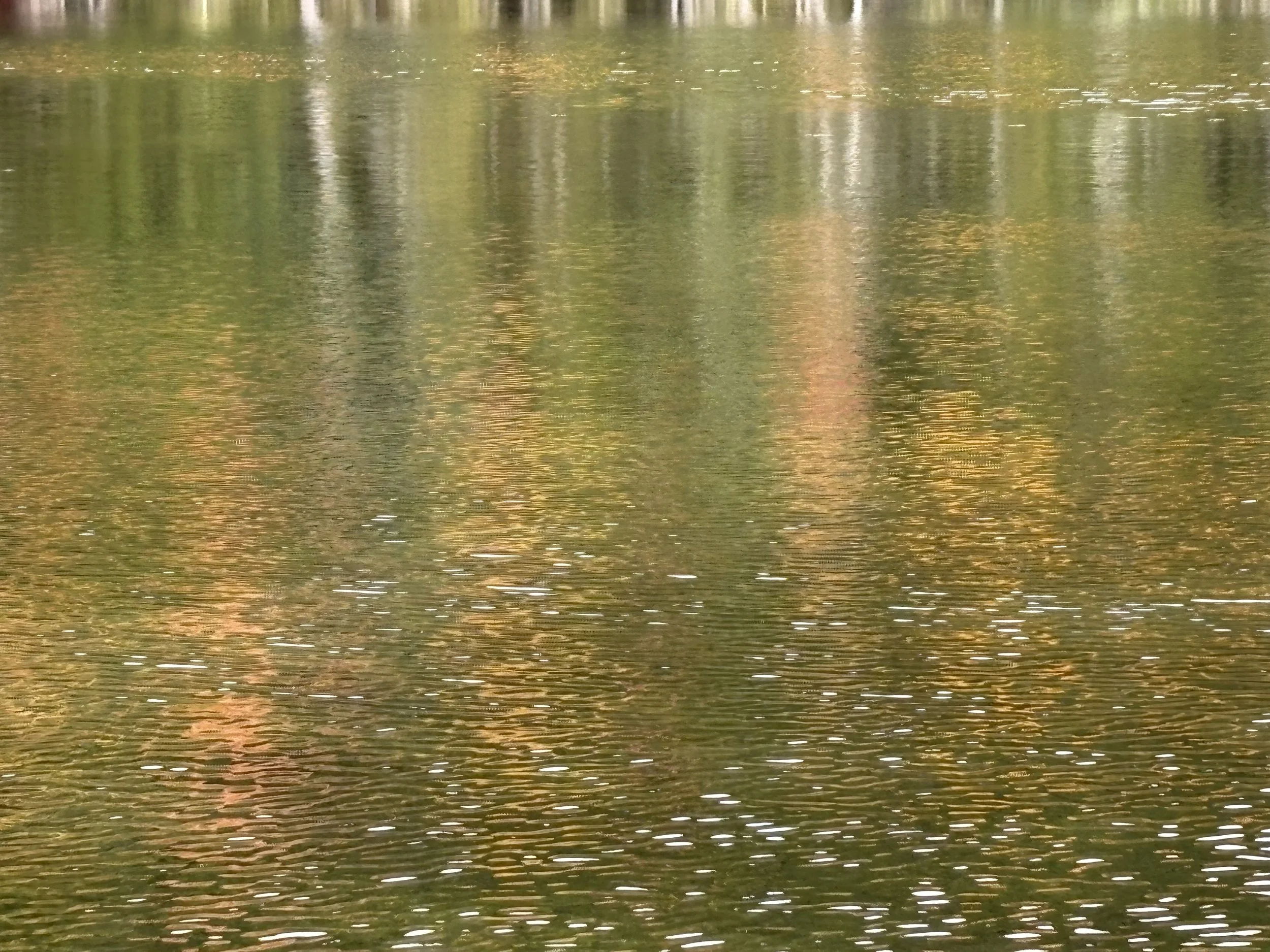
October is the month of orange and green. Open the door, step outside, and it’s orange and green. The orchard is orange and green. The Blenheim Orange are perfectly ripe. I’ll pick them in a day or two. The spruce and fir and white pine that dominate much of the landscape are all the more green thanks to the brilliant orange ribbons of maple treetops that punctuate the green hillsides. When the light is just right, even the water in the ponds is orange and green.

The leaves on the Ginkgo in our front yard will soon turn yellow and then drop on the same day. We guess the date each year. It’s like guessing which day the Yellow Transparent apples will drop in August. You better watch closely, or you’ll miss both. The orange maple leaves will fall, along with the oak and birch and beech and ash. Then the world will be defined by green and white. That too will be beautiful. For now, though, it’s orange and green.

I love orange and green.

October 3, 2026

Lots of Radar Love. October 3, 2026

We spent much of the day bringing firewood into the basement and stacking it for the winter. It’s an annual ritual and a rather important one. Best done on a clear blue fall day with a group of strong friends. Today was perfect.

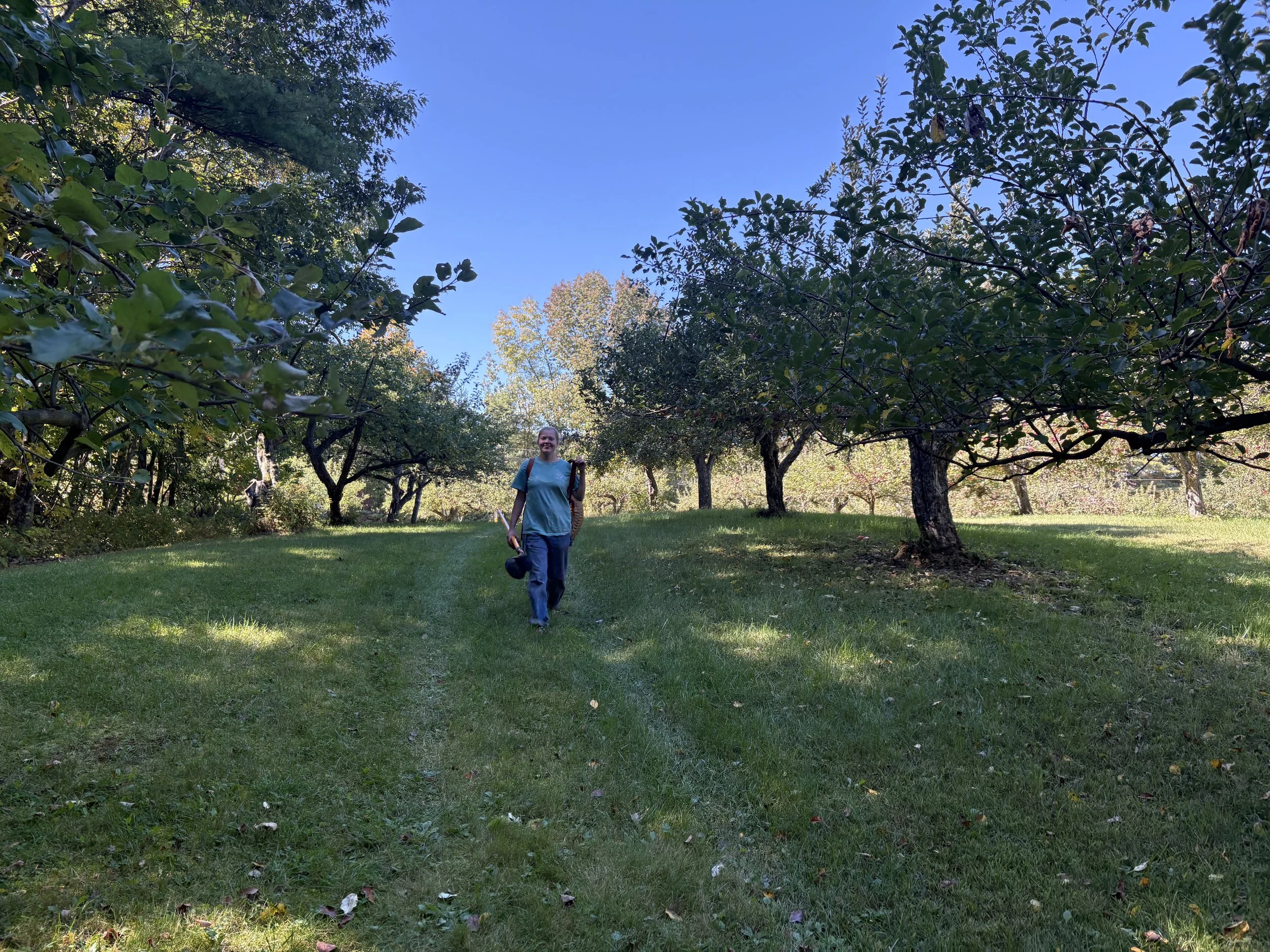
Later we toured the Finley Lane orchard looking for fruit. We picked a large basketful of odds and ends that are dropping,ncluding include Frostbite (MN 447), Marachal (the terrific French bittersweet) and another of the Niedwetzkyanas. We have several Niedzwetzkyana trees from different sources. They are all red-fleshed but do not all look the same. I suspect that some of them may be the true selection while others are seedlings. I plan to DNA profile them all.

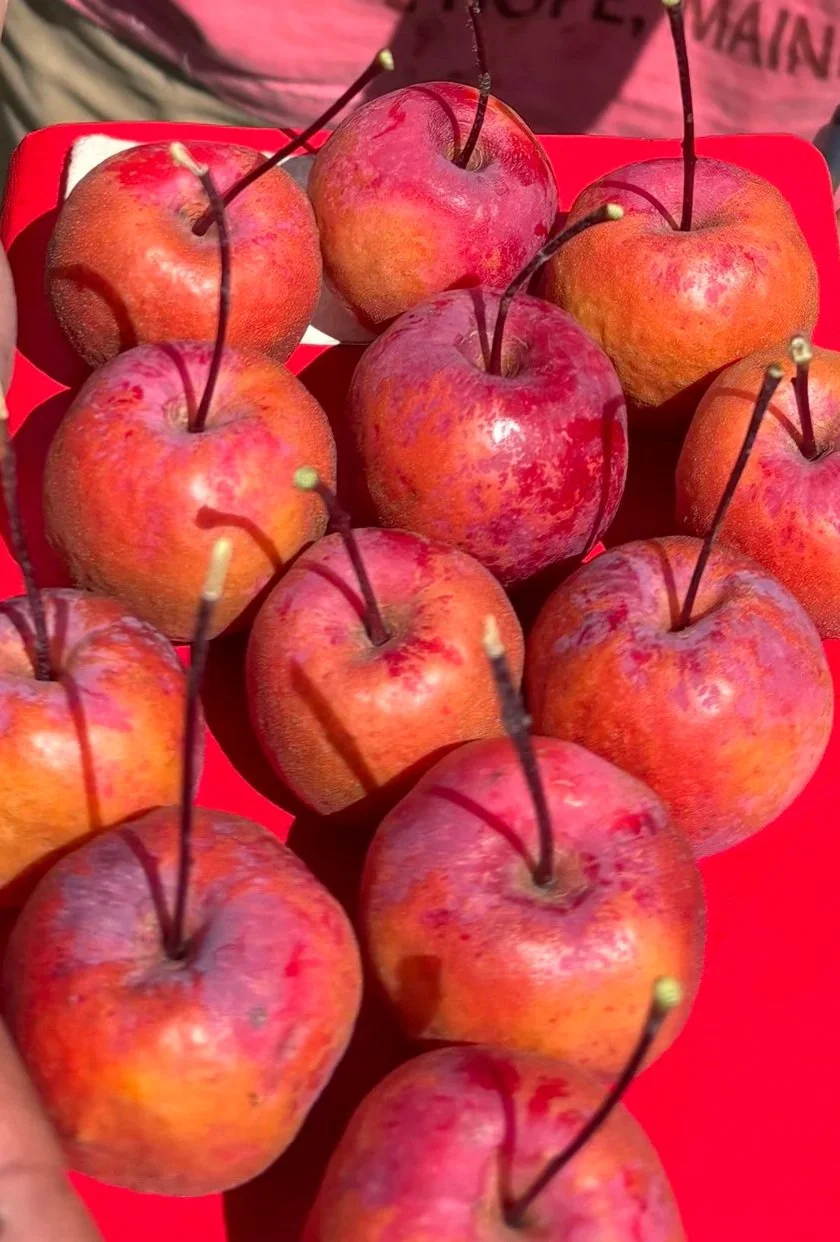
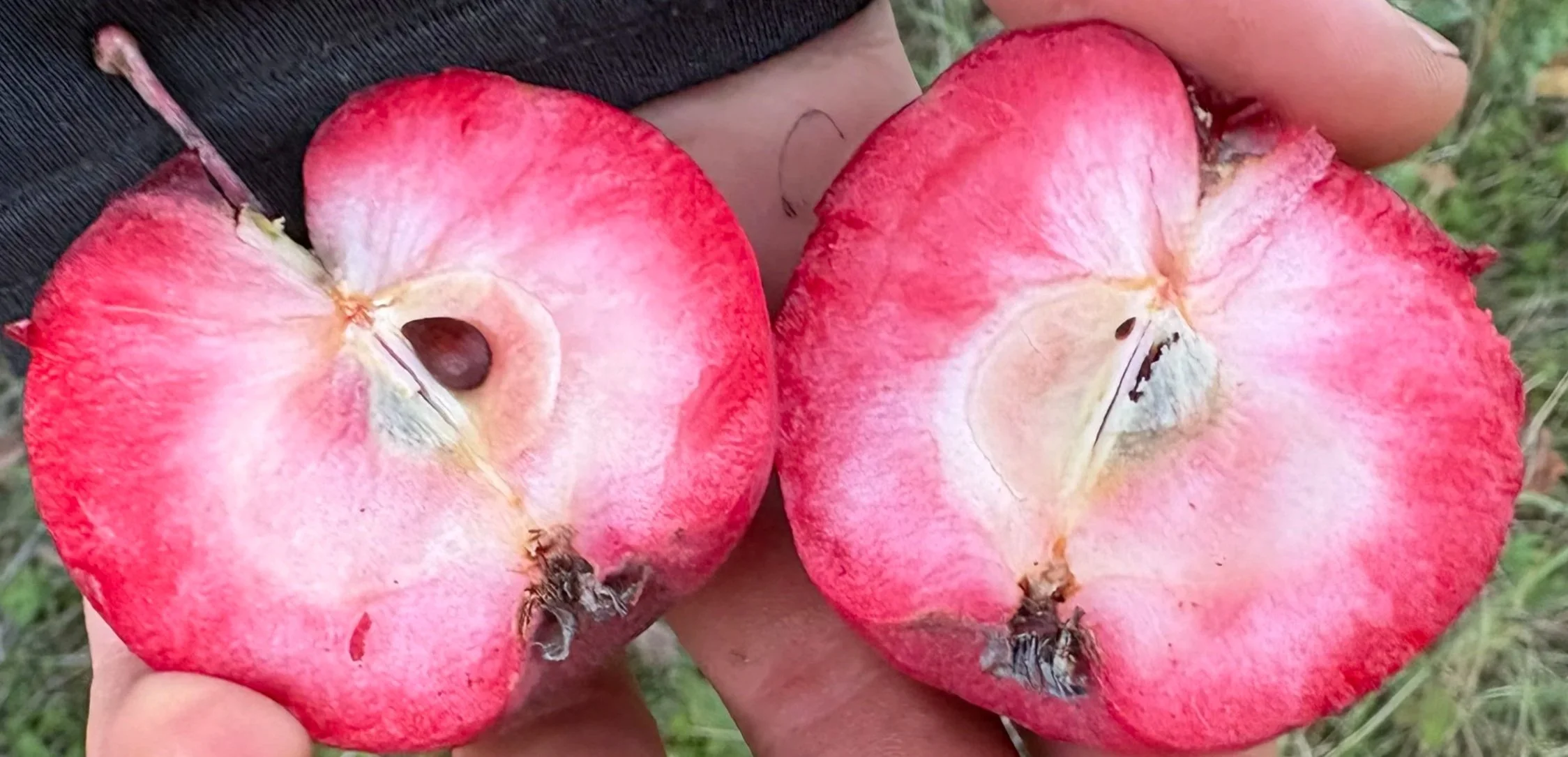
Speaking of red flesh, I was reminded by Cammy to pick the Radar Love, a red-fleshed seedling of Frostbite named after our sweet collie, Radar. The tree is small and took forever to bear, but we got our first crop a year ago and were immediately thrilled with its dessert potential. I think it’s the best red-fleshed dessert (fresh eating) apple I’ve ever tasted. The fruit size is the same as a typical Frostbite, small to almost medium. In fact, phenotypically it has an uncanny resemblance to Frostbite—what Cameron Peace calls “heritable traits”— but with two important caveats: the skin is cherry red (not the purple red of Frostbite) and the flesh is a splashy combination of red and white. We don’t know who the pollen parent is, though it has to have red flesh. It could be what I’ve been calling Winekist, a apple introduced to me many years ago by Earland Goodhue, one of my apple mentors. I’ll submit Radar Love leaves for DNA profiling this fall. 

Radar Love is crisp but not breaking, medium to very juicy, and delicious. It ripens in late September, which means it’s an excellent candidate for the annual Common Ground Fair apple tasting contest. Once we have a decent crop (2027?) I’ll bring it to The Fair and see how it competes with the other great September dessert apples.    

October 2, 2026

I graded apples and pears for sale first thing this morning and then headed off on an apple mission, first to drop off fruit at Tenderwild Farm in Rockport where it’ll be sold in their farm store, then to a small orchard just a few miles farther down the road, owned by the flutist Thomas Wolf and his family. 

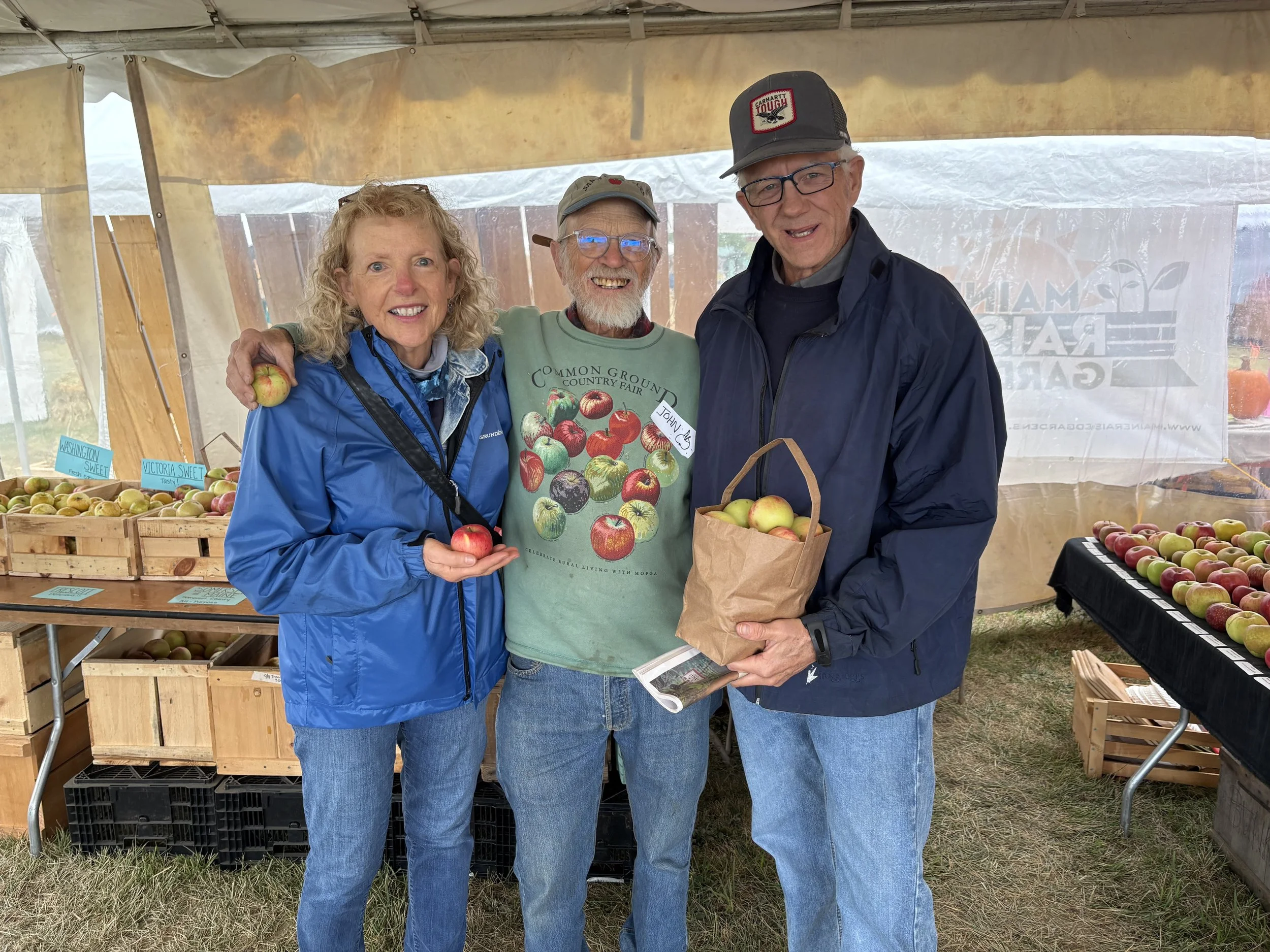
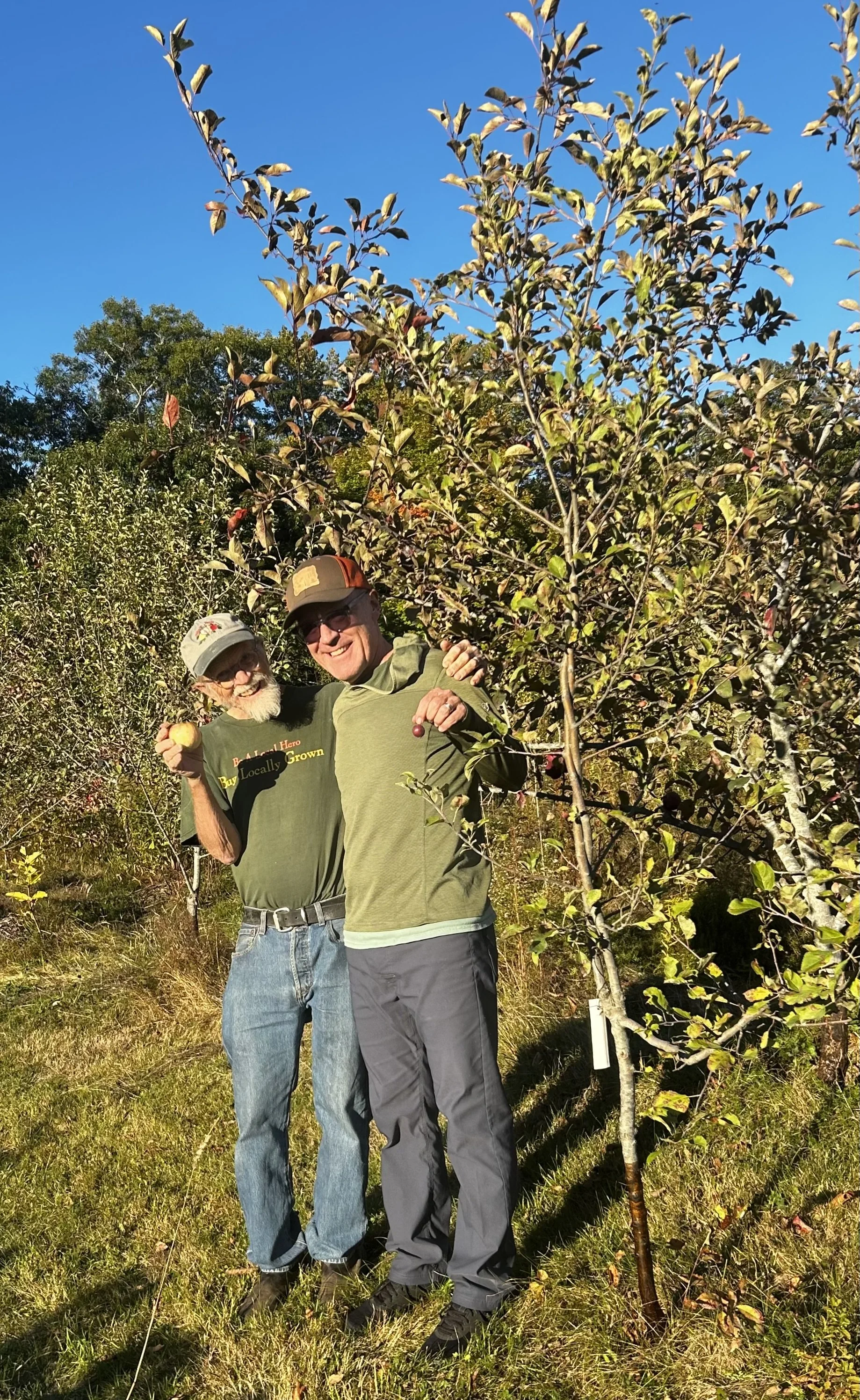
Tom Wolf and John, October 2, 2026

Tom lives in a most magical place that he has cared for lovingly. The farm is old; the house was built in 1790. On a terrace in back of the house that overlooks the orchard and the farm pond is a huge Weeping Beech tree (Fagus sylvatica ‘Pendula’) that’s been trained to lay over an arbor. Under the draping branches is a table and half a dozen chairs. What an amazing place to eat lunch on a hot summer day—or anytime!  

But that wasn’t our goal today. We were there to collect specimens from most of the twenty-five apple trees scattered about the back yard. The trees ranged in age from twenty or thirty years to well over a hundred. It was extremely helpful that Tom had numbered all the trees in advance. (Numbering your trees is always a good idea.) A few of the apples were easily recognizable—Wealthy, Twenty Ounce, Yellow Bellflower, Golden Delicious—but others were not so. A couple of the unfamiliar ones were extremely distinctive. Those can be really fun. I’ll study them all at home with my books and the apple key and hope to identify them in the coming weeks.

October 1, 2026

It’s October - the month of the apple. The height of apple season. The pinnacle. Grab your picking bucket. The ladder. It’s here. The time is right to go out on the limb.

And so we plunge into October, and it’s a beauty. The colors are just about perfect in central Maine right now. The sky is blue, really blue. The red maples (Acer rubrum) are electric orange and red. The leaves are dropping, but there are still plenty on the trees to enjoy. Looking up through the trees, the combination of red and blue does look… purple.

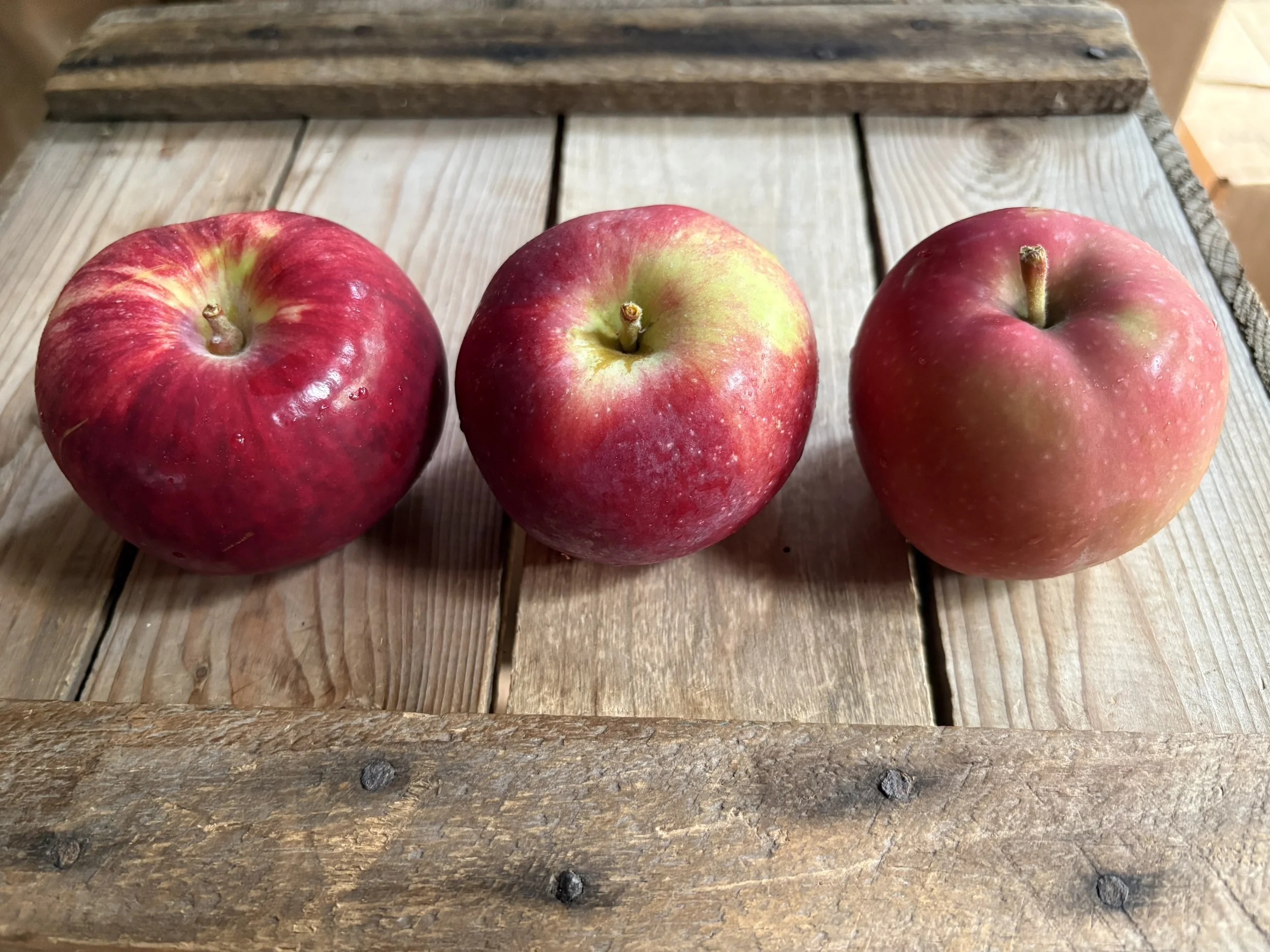
Cortland, Macoun and McIntosh. Can you tell them apart? Which is which?

Today the College of the Atlantic apple class returned to the farm. We played a game in which each of the eleven students created a written description of one of four apple cultivars, and then they tried to group themselves by cultivar according to which apple each was given. They could only use their written description to group themselves, not the apple itself. It wasn’t easy. Using the written word to describe an apple is challenging at best, especially when you have several roundish red apples. The apples they were describing were Cortland, Macoun, McIntosh and Red Gravenstein. To the inexperienced observer the four may seem indistinguishable even though they have obvious differences to the well-seasoned orchardist. 

I always ask myself, “what make this apple distinctive?“ I  look for the characteristic that sets this apple aside from any others I’ve ever seen. “When I see this cultivar again, how will I recognize it?” Each cultivar does have something that distinguishes it from all the others. The key is to observe each apple so deeply that the subtleties become obvious. The students did remarkably well. They’ll get better.

Is there a reason this matters? For those of us who are identifying apples, time is precious. We need to know the “Macs” and Cortlands and Macouns and Red Gravensteins as easily as we know red from green when we pull up to an intersection. That gives us more time to spend on the obscure, historic apple mysteries that have eluded identification for decades or even centuries.

Before the students headed home for the day, we put vole-deterring, spiral, plastic tree guards on some of the trees up at Finley Lane. We’ll be doing a lot more of that in the next three weeks. After they left, we graded apples for sale and picked more Grimes Golden and Pomme Grise. It’s October. It’s blue. It’s orange. It’s here.

September 30, 2026

After a week swallowed up by Common Ground Fair and then two days of (much needed) rain, we were finally able to do some picking again. We picked Canadian Strawberry, Pomme Grise, Belle de Boskoop, Rolfe and Grimes Golden apples as well as Seckel pears. All six of these cultivars are favorites here on the farm, and all six have perceived flaws that sadly eliminate them from ever being grown in a modern commercial orchard.

  • Canadian Strawberry has exceptionally good “dessert” (aka fresh eating) quality but has a relatively short window of ripeness. At least for the next few years, the name may actually be illegal. We’ll check on that with the tariff police.   

  • Pomme Grise has dessert quality fruit but small fruit size. (always a killer) The name also sounds suspiciously Quebecois.  

  • Belle de Boskoop is an acclaimed and beloved cooking apple in Europe but in America, as the wise old owl says, “who cooks for you?” Cooking apples are non-grata in the US grocery stores. We hope to change that.

  • Rolfe is an all-purpose, historic, Maine cultivar named for the Revolutionary War officer of that name, but the texture isn’t crisp. Could we change the name to something like, “Better Than Crisp”? 

  • Grimes Golden is good for everything, but it ripens over a three or four week period so, really, you should never pick them all at once. That’s a deal-breaker in the commercial orchard where you send in the crew to pick each tree clean.

  • Seckel, the famous, historic, delicious dessert pear, is just too darn small. 

Even for us with our small, barely-commercial orchard, these fruit present challenges in harvesting and marketing. But they are worth it. We’ll keep growing them. I can smell the Boskoop sauce on the cookstove as I write. Delectable!

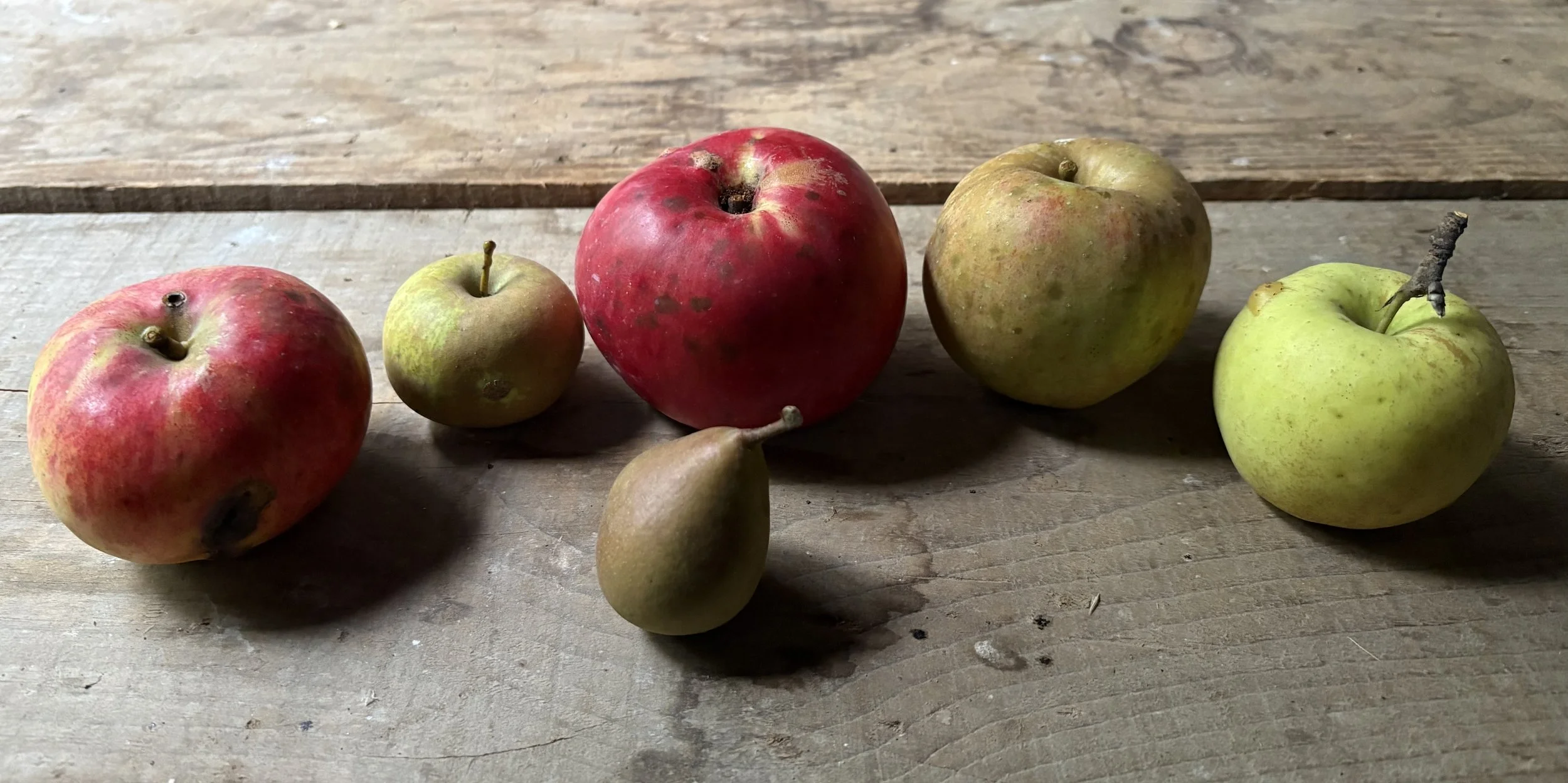
Canadian Strawberry, Pomme Grise, Rolfe, Belle de Boskoop, Grimes Golden and Seckel pear, September 30, 2026

September 29, 2026

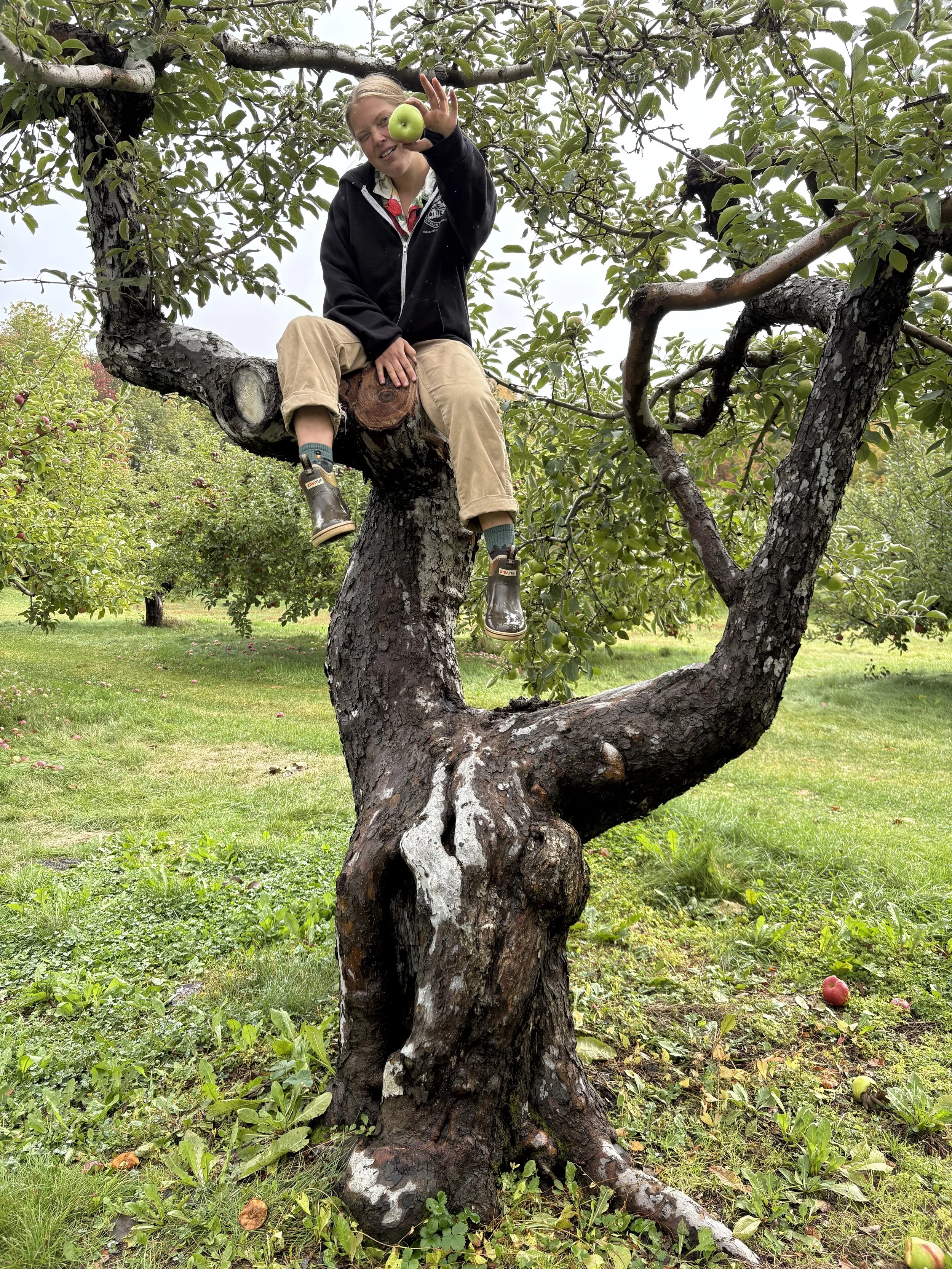
Old Greening tree, Bailey’s Orchard, September 29, 2026

The rain continued until about noon, and we spent much of the day indoors. Skylar and Cammy were fine-tuning our apple ID instructions and information forms. It promises to be a big ID season ahead.

Later in the morning when the rain began to letup, Skylar and I ventured out to Bailey’s Orchard in Whitefield, about a twenty minute drive from the farm. Rod and Kay Bailey have been running it for 51 years, now with both of their kids helping out. It’s not large for a commercial orchard, and there was no one else there this morning. It’s made up of old, free-standing trees, tucked back in off the road, well-kept and idyllic. It’s a magical spot. Rod walked out into the orchard with us to show us a couple trees I wanted to pick. I was collecting apples for the College of the Atlantic Apple Class that meets here on the farm once a week. Thursday is the next session and describing apples is on the agenda.

In the late afternoon I put airlocks on the cider we pressed a couple weeks ago. Trailman gets the award for most vigorous fermentation at this point.

September 28, 2026

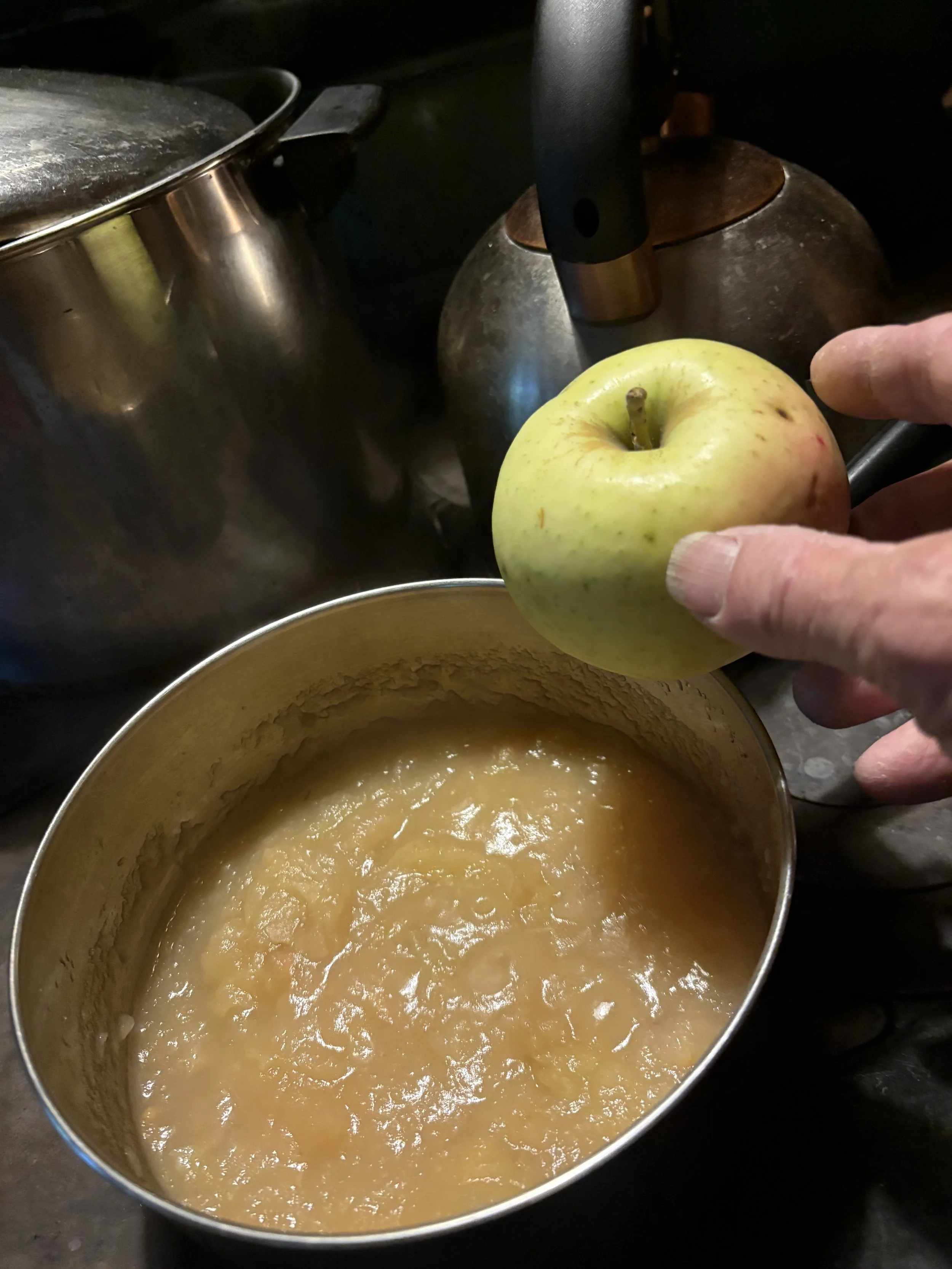
We’ve had our first two brushes with frost, and the time now feels right to be lighting up the cookstove in the morning. That means it’s applesauce and oatmeal season on the farm. It started a bit late this year. Not that we don’t have the apples and the oatmeal. We do. But the tomatoes have been excellent, and eggs poached in cooked tomatoes is hard to beat. But even though we still have tomatoes, the apples beckon.

Norton Greening

The apples for today’s sauce are Norton Greenings, one of my favorite midseason cooking apples. It’s a large, thin-skinned, light yellow, faintly blushed, roundish-conic fruit that quickly cooks into a smooth, tart, light-yellow, creamy sauce. The skins and core dissolve into nearly nothing. Where do they go? They vaporize. When you strain it through the Foley Food Mill, there’s nothing left but a few random seeds. Two or three Norton Greenings is plenty for one breakfast. Cut them up, put them in a small sauce pan with a bit of water and stick them on the stove. A second small sauce pan gets the oatmeal. Before long you’ve got your morning meal.

I first visited the tree we call Norton Greening with Robert McIntyre—aka Roberto—on what may have been our first Harpswell fruit exploring adventure together. The story I recalled was that Norton Greening was a seedling planted on the day of the birth of Helen Norton back in the 1930’s. I contacted Roberto’s widow Dorothy Rosenberg this morning to see what she knew. Dorothy wrote back to me that,

“Hannah Norton told us [Robert and Dorothy] about the apple, which she said was an excellent baking apple, that you and Robert took samples and later scions from and dubbed the Norton Greening. [That may mean I named it!] …

“According to Hannah (Helen Norton's sister-in-law), the tree grew from a wild sapling near the old Norton farm house when she was a child. We checked, but didn't find any graft mark. The original tree died several years ago…

“The Norton family has been in Harpswell since the 1740s, with a large farm and property on Harpswell Neck. Robert and I found a number of old trees on parts of the old farm that have been reclaimed by the forest. Helen and Walter Norton are well known philanthropists supporting conservation and environmental work in Maine. So it is nice to have their name preserved with the apple variety.”

Meanwhile it rained off and on all day today. A perfect day for applesauce and oatmeal. We need the rain.

September 27, 2026

Sunday, day-three of the Fair. The massive “Nor-easter” that’s been pounding southern New England skirted the Fair. It was rather incredible. The Fair could have been a total washout, but it barely got more than a bit damp.

John and Mary Freeman and Dudley apples, September 27, 2026

The steady stream of visitors to the apple tent continued all day. We had more requests for ID’s today than Friday and Saturday combined. Skylar and Evacilie have developed a stream-lined system for entering names and addresses and other useful information. Our goal is to see all your apples this fall and get back to you before the end of the year. If you have an old apple tree you’d like to identify, check this link for more information about how to proceed.

A highlight today was being visited by John and Mary Freeman. The Freemans own the property where Steve Miller and I rediscovered the Dudley Winter (aka Northstar) nearly thirty years ago. The short row of Dudley trees are still alive!    

September 26, 2026

Saturday crown voting for their favorite apple.

Day-two of “The Fair”. Another huge crowd and a steady stream of folks appearing at the Apple Tent to check out the display, ask fruit-related questions and cajole us into IDing their apples. We were busy all day.

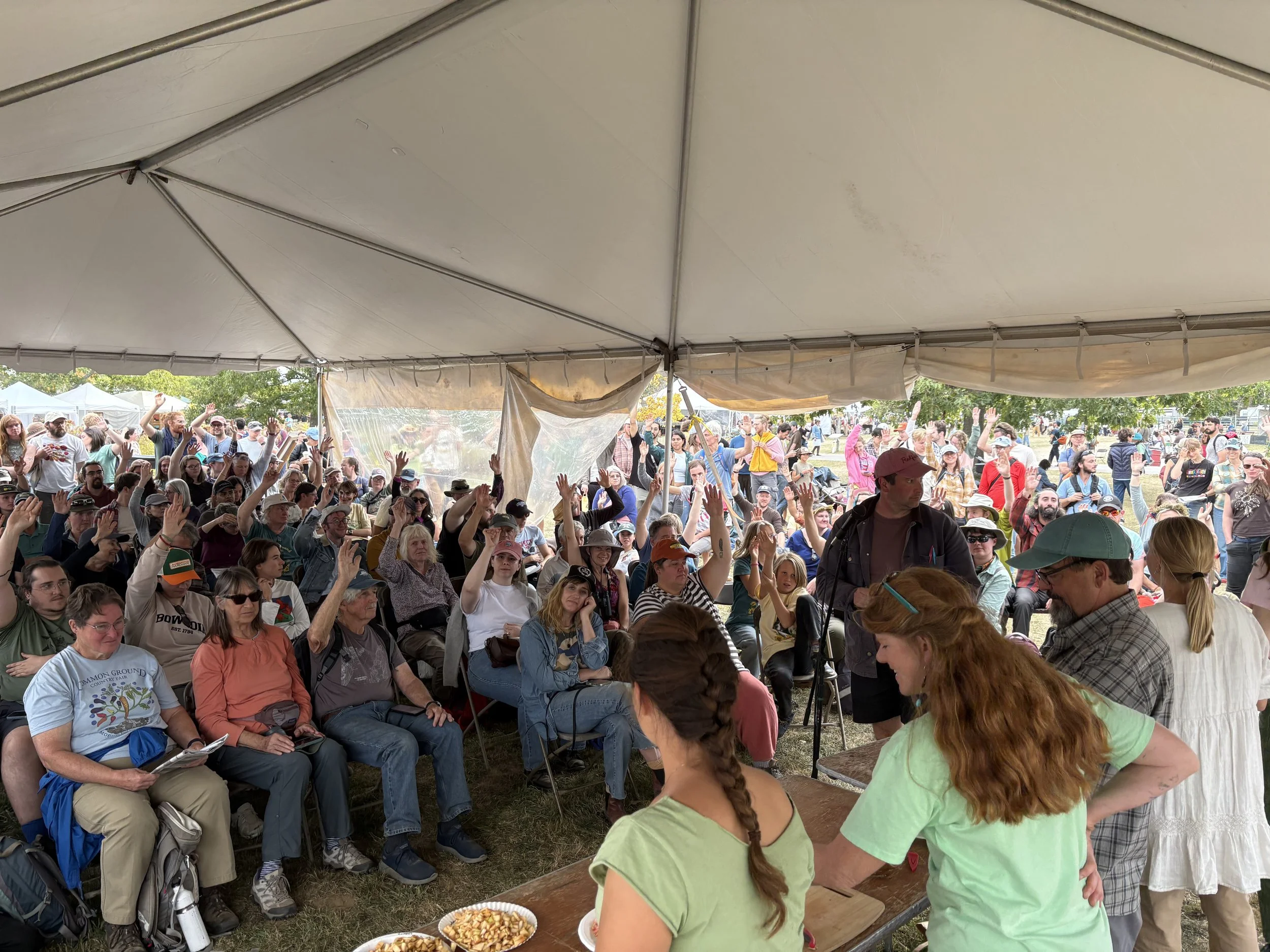
At 3 PM we held the second of our two apple tastings. It was an even bigger crowd than yesterday. In fact, it was likely the largest attendance we’ve ever had at a tasting. Again we cut and tasted twelve selections, some of them repeats from Friday as well as several new ones. We did not have enough apples to repeat Pipsqueak so we’ll never know if it would have gone two for two. The winner by a landslide was the pink-fleshed “Pink Pearl," a 1944 selection of the California breeder, Albert Etter. In second place was Chestnut Crab (no surprise there). Third was the famous Drap d’Or de Bretagne (aka Unknown Founder 13), and forth was Canadian Strawberry.

September 25, 2026

Today was Friday, the first day of the 50th Common Ground Country Fair. The weather was near-perfect, and the crowd was one of the largest ever. The apple display was a big hit, and our apple ID team was busy non-stop answering questions and identifying apples brought to us from throughout Maine and beyond.

And the winner is…PIPSQUEAK

At 3 PM we held the Friday-version of the annual apple tasting. The “Hayloft” speakers tent was packed with enthusiastic apple-tasters, and the crowd spilled over into the surrounding space. We had 12 especially curated apples to taste. Per usual, Sean Turley and I emceed. The winner of the tasting was our own Pipsqueak apple, a Frostbite x Chestnut Crab cross that originated here at Super Chilly Farm (As Joe Castiglione liked to say, “Can you believe it?”) Second place went to perennial favorite, Canadian Strawberry. Third went to Trescott, a seedling from eastern-most Maine discovered by Elizabeth Benjamin. Forth was another perennial favorite, St. Edmonds Russet.

Although the available pool of apples is always limited by what happens to be ripe at the moment, we were still able to include a wide assortment of selections with a diversity of flavor profiles and stories, including heirlooms, recent releases, cider apples, wild seedlings and more.

September 24, 2026

Apple display, September, 2026

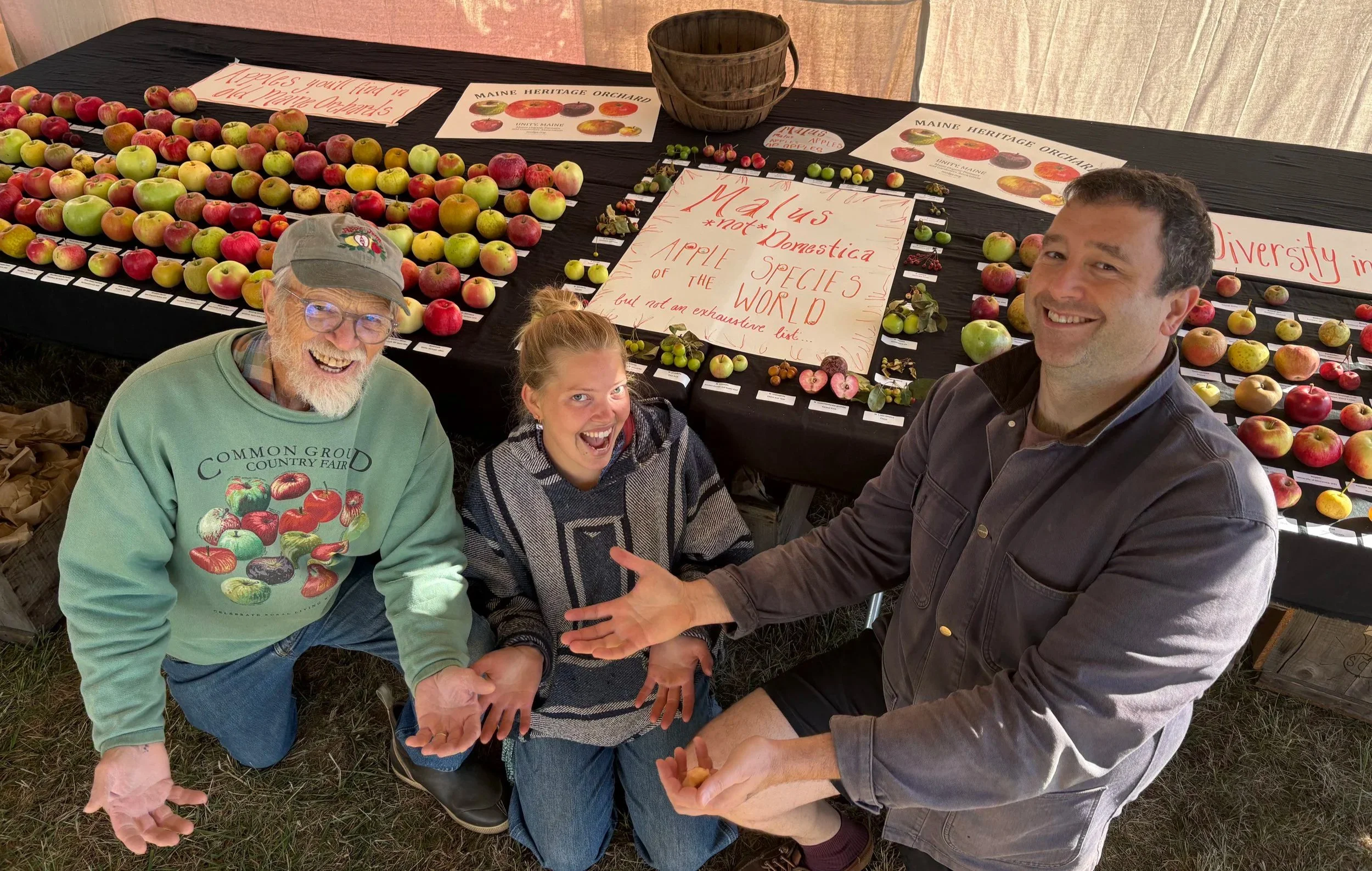
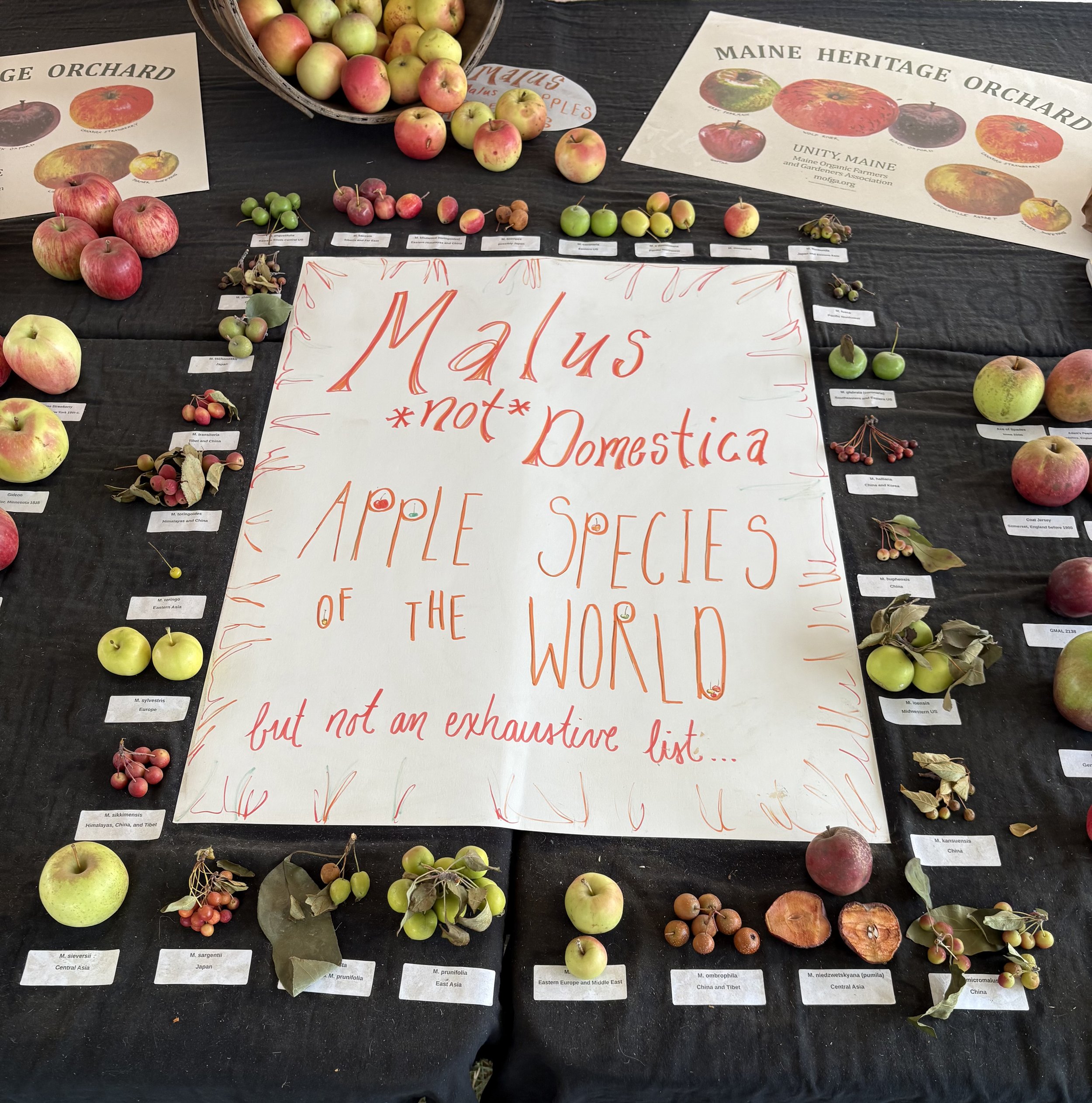
This morning was cold again though only a degree or two south of 32F. It was time set up the apple display at the Common Ground Fair apple tent. Tomorrow morning before the crowds arrive we’ll lay down the apples. The display will be in three parts: apples you’d be apt to find in old Maine orchards; Malus (apple) species of apples from around the world: and a huge assortment of apples showing the amazing diversity of the fruit. In all about 350 different specimens. It's been a long week getting the apples collected and organized, but we’ll be ready for the Fair!

September 23, 2026

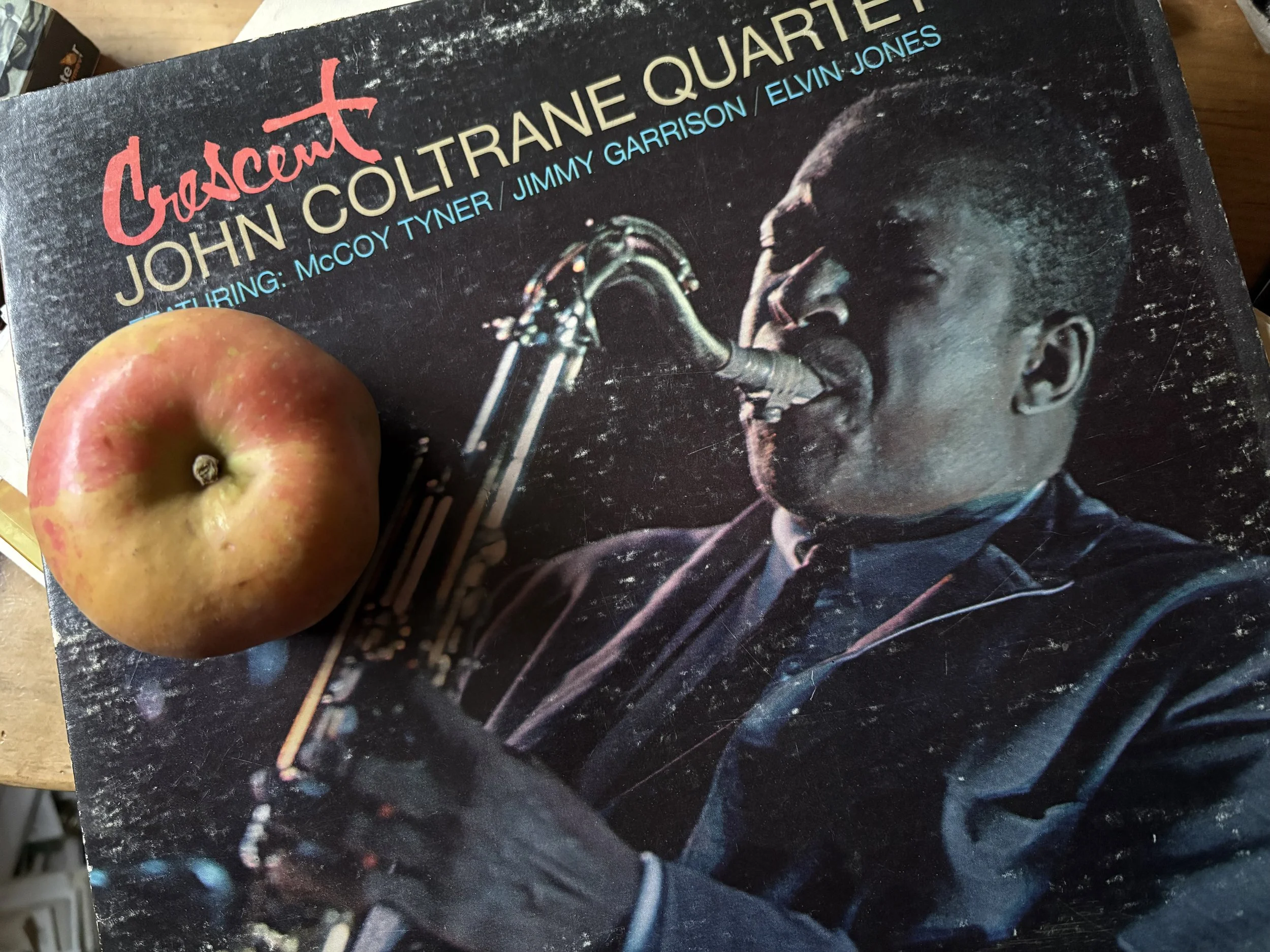
Today is the 100th birthday of John Coltrane. Coltrane is one of the most acclaimed of all jazz instrumentalists. His life and music have been honored all this year, and the celebrations will continue for months to come.

Happy 100th Birthday John! September 23, 2026

In a recorded interview on March 22, 1960 Coltrane was asked about his sometimes challenging, seemingly chaotic solos. The interviewer described his playing as “untenor-like, unbeautiful, unjust-about-everything-you-can-think-of.” (That was rough.) When the interviewer asked him if he felt angry, Coltrane replied in his soft but empathic voice, “No, I don’t [feel angry]…The reason I play so many things at one time, you see, [is that] I haven’t sorted them out. I have a bag of things I’m trying to work through and get the one essential. … There are some set things I know…that will take me out of the ordinary path, but I haven’t worked them through and I’m not familiar with them enough to take the one single line through, so I play all of them and acclimate my ears so I can hear and use them.”

I’ve thought about Coltrane’s words many times over the years. They remain an ever-present inspiration to me as I attempt to grow apples and plants in new and seemingly chaotic ways that I hope "will take me out of the ordinary path." Often I too “play” them all at once. (Multi-factorial synergy! ) One day maybe I’ll find that one essential. Or not.

This morning we tickled 32F for the first time since spring. No frost visible on the lawn, but this is a harbinger of things to come.

September 22, 2026

Another brisk morning and a glorious clear blue September day. More collecting for the Common Ground Fair display at Lane Road Orchard in New Sharon and Sandy River Orchard in Mercer. The two orchards are only a few miles apart, one in Franklin County and the other in Somerset County. Both have a wide selection of unusual varieties. They’re quiet, idyllic spots with interesting apples—both definitely worth the visit.

John and his nephew Cameron, September 22, 2026

In the afternoon I convinced my nephew Cameron who was visiting from NC to help collect apples at our Finley Lane Orchard. It was his first time up here in a number of years. He’s not an apple guy but was a very good sport. (He carried the pole picker which made him feel important.) He tasted bitter sweets and bitter sharps and even some pretty nasty-flavored apples that we generally only reserve for the true diehards. His favorite? Radar Love, another red-fleshed Frostbite seedling that originated here and was named after our beloved dog, Radar. I haven’t DNA profiled Radar Love yet, but it has promise as a good dessert cultivar.

It was a productive day and great to have Cameron along, although we spent as much time laughing as we did picking. No count yet, but we probably collected another 100+ varieties for the Common Ground Fair display.

September 21, 2026

Collecting apples for the Fair, September, 2026

Today it was a trip to the The Apple Farm in Fairfield to collect specimens for the Common Ground Fair apple display. The annual display is one of the most popular exhibits at The Fair. When the collecting is done it will include 300-400 cultivars, including species apples from around the world,  local roadside discoveries, old heirloom favorites and everything in between.   

The Apple Farm orchards slope to the east and the west and have multi-million dollar views in both directions. It was fun to be back there where we were greeted by the owners Marilyn and Steve Myerhans and our neighbor and former CSA crew member Lauren Cormier who now runs their packing line, as well as by the store crew and the Jamaican picking crew. We have spent many hours at the Apple Farm over the years topworking trees, picking apples for our CSA and hanging out with Steve and Marilyn that It felt like old home week.  

September 20, 2026

Geneva apples, September, 2026

The weather turned cold this morning, and all over Maine fires were lit, windows were closed and sweaters were dug out of the closet or the trunk or wherever it is we left them in April.

Skylar began the gargantuan task of sorting the many dozens of apples we collected in Geneva, NY at the USDA apple repository. We’ll be studying, photographing, describing, and displaying them for many weeks to come. Oh yes, we will also be eating them.

September 19, 2026

Contestants in the North Belgrade pie taste-off, September 19, 2026

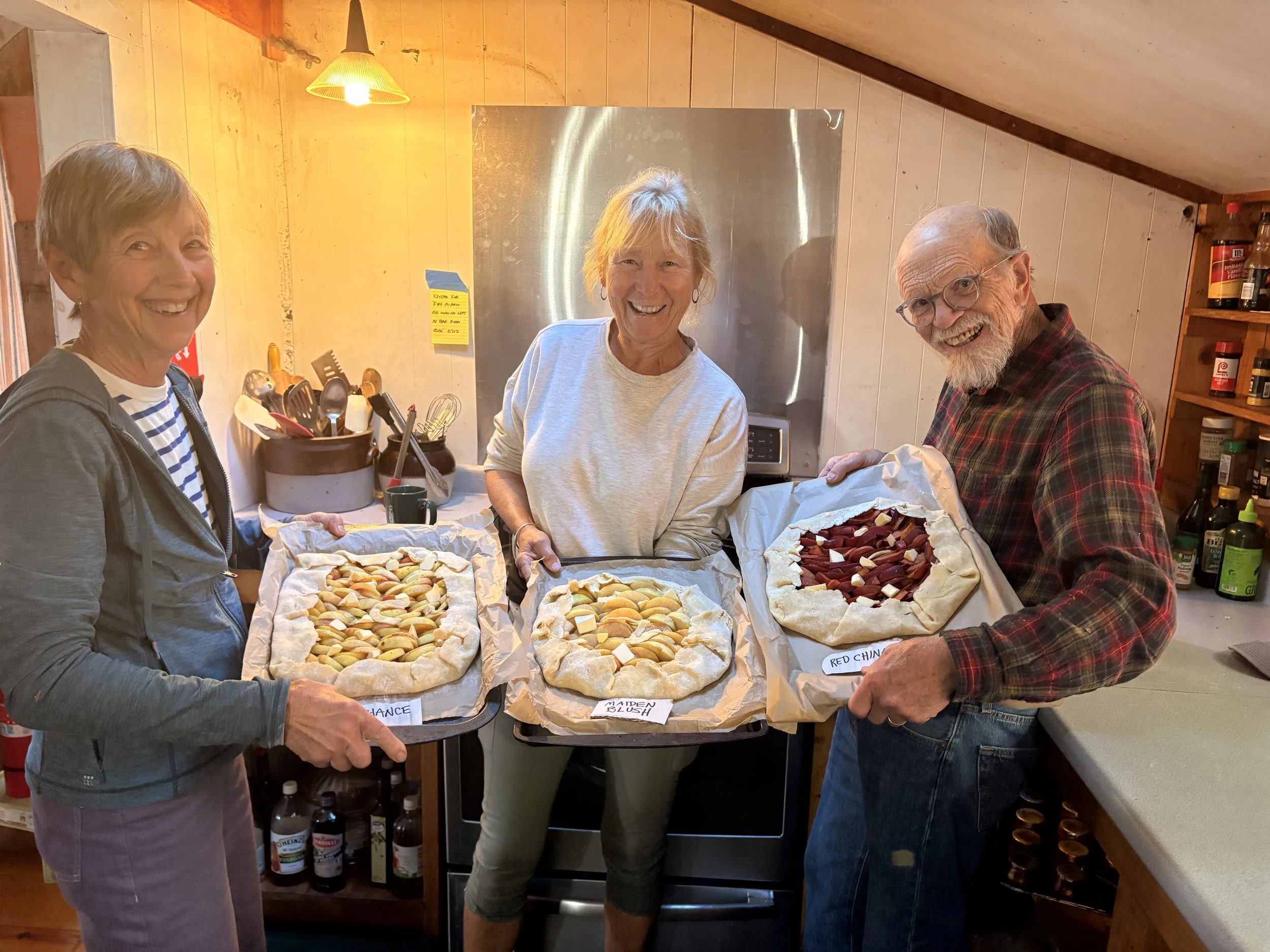
Tonight was the annual apple pie taste-off at Camp Merryweather in North Belgrade. We’ve been doing it for nearly thirty years. This year we shook things up a bit by baking galettes instead of two-crust pies because Cammy is convinced that you can taste the apples better without all that extra crust. Nonetheless, the contest was subject to the same strict rules as always: each “pie” is a single variety and the crust, spices (1/4 tsp cinnamon) and sugar (1/4 cup) are the same for each. Everyone (22 of us) got a small piece of all three galettes on paper plate divided into three sections. We tasted, discussed loudly and voted. It’s a wild and fun event. This year we featured last year’s winner, Red China, and two newcomers to the contest, Maiden’s Blush and Chance. Maiden’s Blush is an old beloved New England heirloom, and Chance is one of the seedlings discovered here on the farm, a cross between Duchess and Egremont Russet. It’s a firm and tasty dessert apple and, as it turns out, a star in a galette. It was the hands-down favorite. And if you remember from an earlier post, it was named after our oldest grandchild. Hooray for Chance.

September 18, 2026

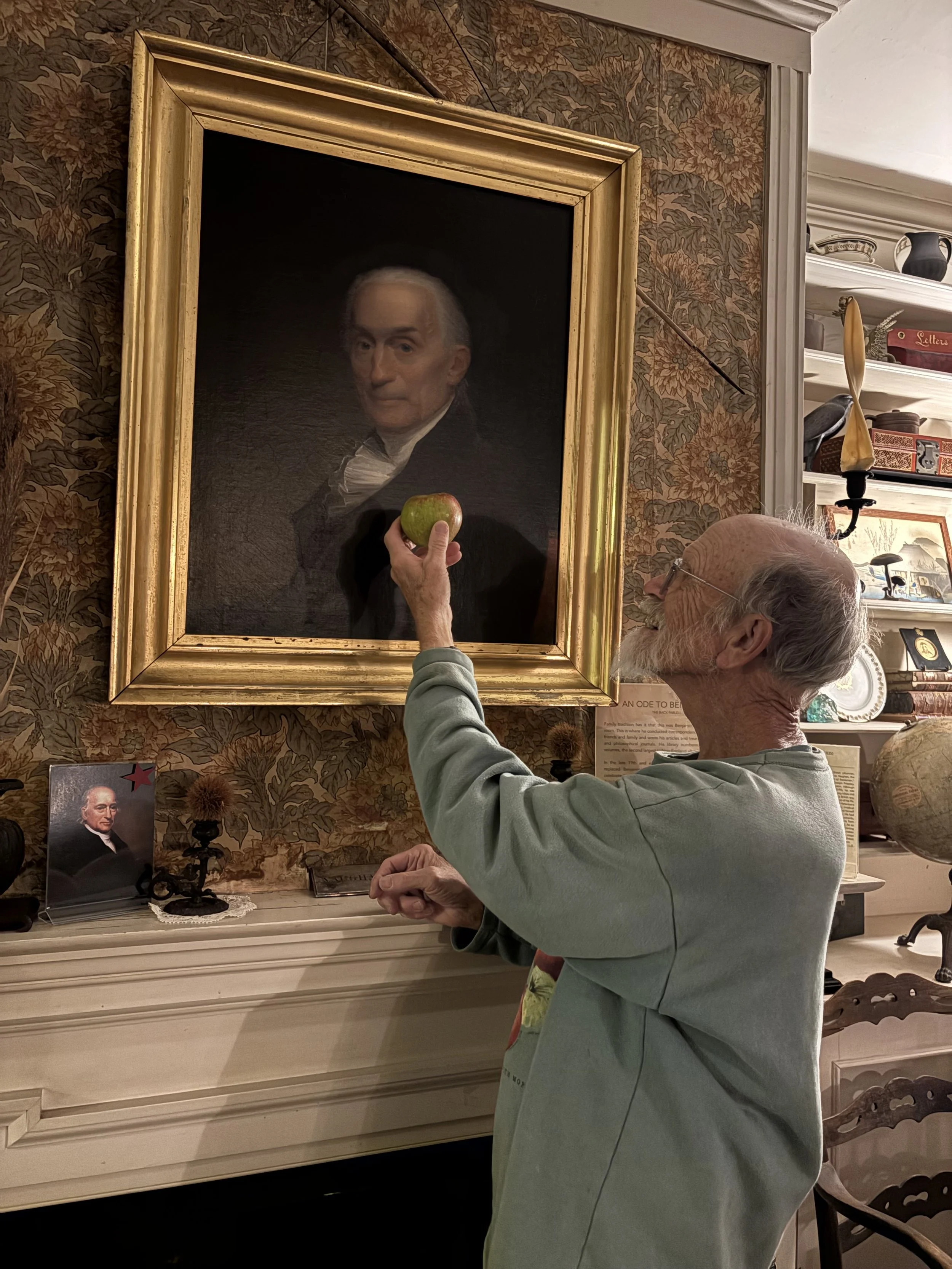
This evening I gave a talk in the parlor of the rambling old farmhouse at the Vaughan Homestead in Hallowell. This was the home of Benjamin Vaughan (1751-1835), one of the early important plant geeks of ME. The homestead was established in 1794, and the story goes that Benjamin Vaughan himself planted a tree of a brand new apple variety called Black Oxford. That tree is still producing apples in the front yard more than 225 years later!

Benjamin and Bunk, September 18, 2026

The topic of the talk was, “What can an old apple tree tell us about Maine’s past? Why saving an old apple means saving a piece of Maine’s History? And Why should we care? I did a deep dive into the MOFGA apple T-shirt with its 16 apples—one originating in each county of Maine. It was an evening of story telling. Afterwards, I did a photo op with Vaughan himself. I got to offer him a Black Oxford from his tree.

September 17, 2026

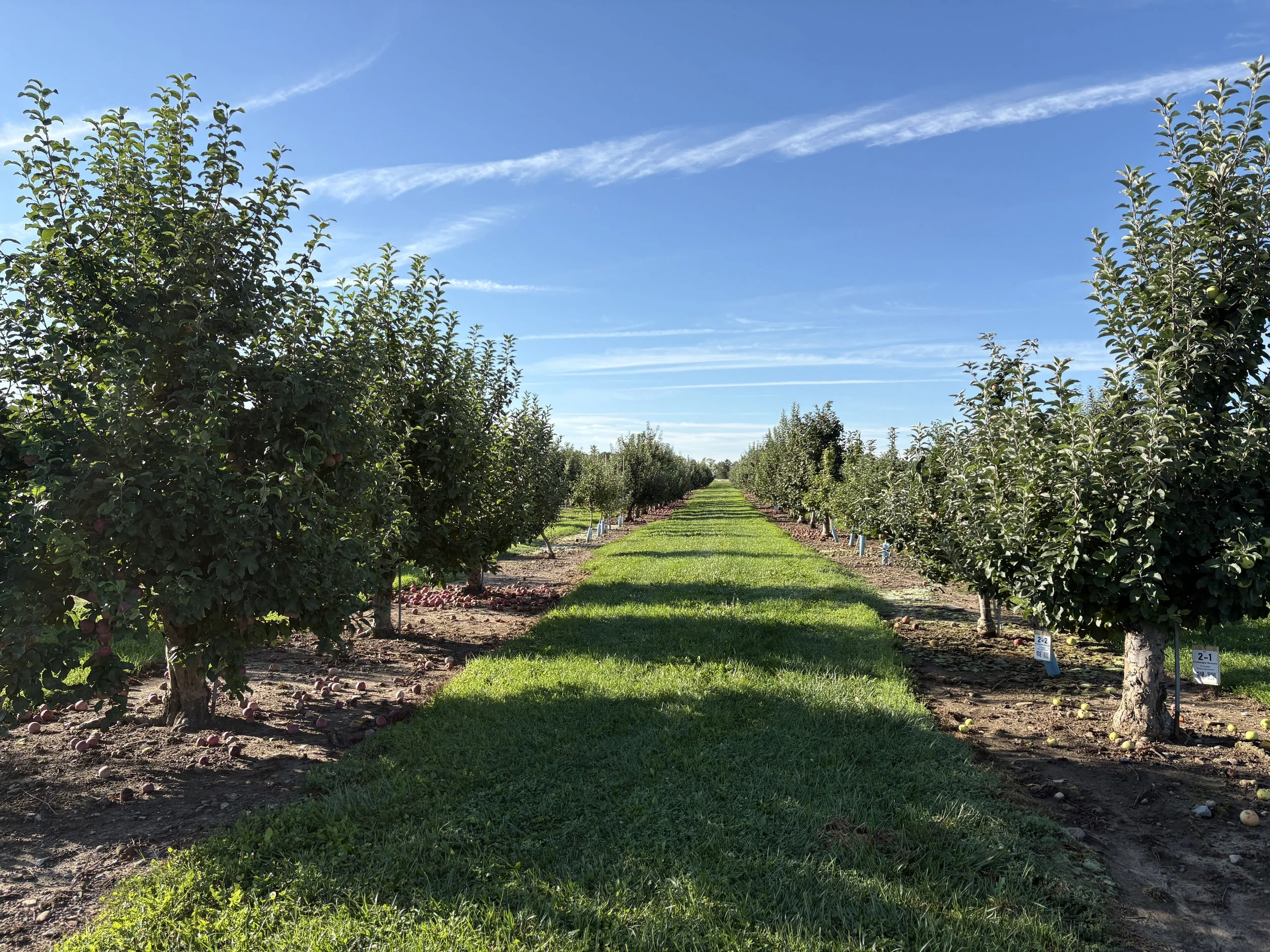
The Geneva Orchard, September 2026

Todd’s apple class from College of the Atlantic came to farm. We sat at the long wooden table under the grape arbor for the better part of the day and reviewed the Geneva trip. Skylar talked about tasting apples and apple flavors, and I talked about the phenotypic names of apple characteristics. It was delightful way to spend time on a late-summer day in Maine.   

September 16, 2026

Niedzwetzkyana rhymes with Obama, September 16, 2026

Today Cammy and I visited a tree in Peabody, MA thought to be Danvers Winter Sweet. A local historian had sent me the alert. The location was perfect: Peabody used to be part of Danvers long ago when Danvers Winter Sweet was a local (and regional) favorite. Finding the tree was a challenge. The area has become a jumble of highways and off-ramps and shopping center parking lots and even our cellphones were confused. (wow) Sadly, the tree turned out to be a seedling. But it was a fun adventure.

Meanwhile, back on the farm Skylar picked the Niedzwetzkyana, Golden Ball and Livii Sibiloun apples from Kazakhstan, Maine and Estonia, respectively. Who needs to go anywhere? The entire world is right here on the farm.